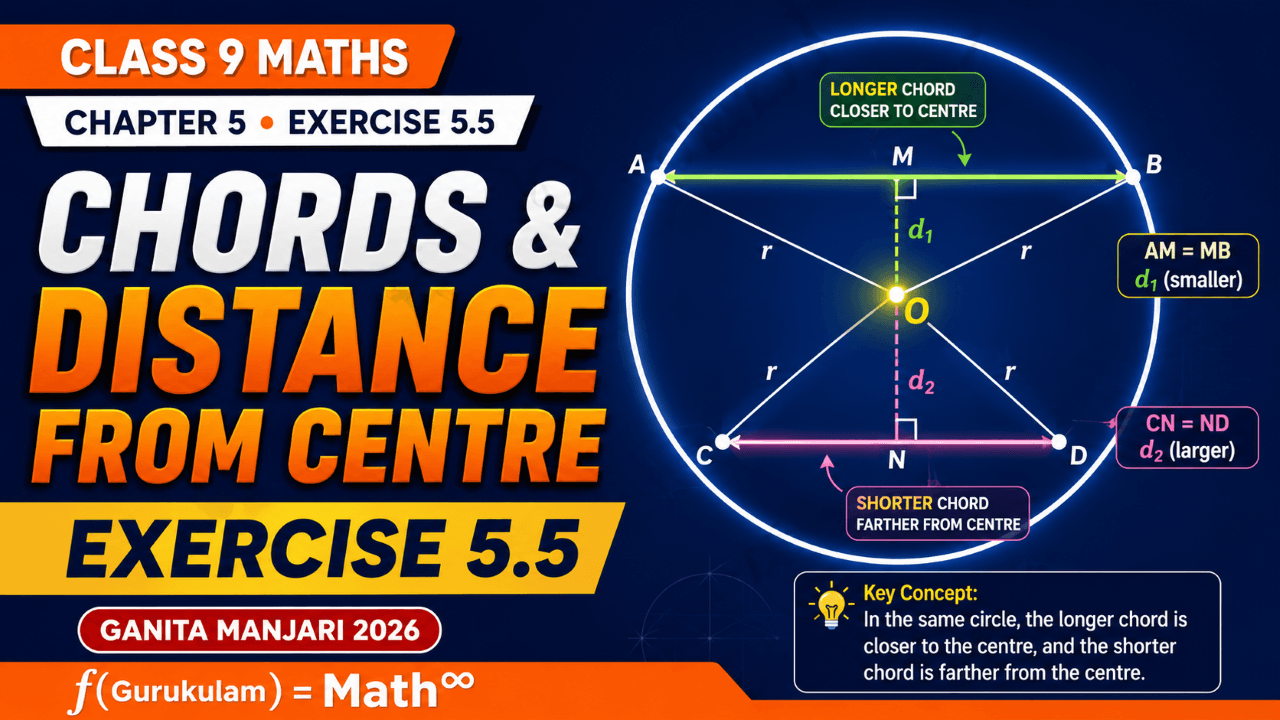
📖 About Class 9 Maths Chapter 5 Exercise 5.5
Class 9 Maths Chapter 5 Exercise 5.5 Solutions cover the fifth exercise of Chapter 5 – I’m Up and Down, and Round and Round from the latest NCERT Ganita Manjari (2026). This page is designed for students looking for complete and reliable NCERT Class 9 Maths solutions arranged according to the exercise questions.
The page presents Exercise 5.5 in a clear, student-friendly CBSE answer-writing format and is useful for classroom practice, homework, self-study, revision, and examination preparation. Each question is organised separately so students can quickly find the solution they need.
🎯 Exercise Snapshot
- Complete coverage of Exercise Set 5.5.
- NCERT-based solutions for all three questions.
- Clear, question-wise presentation for Class 9 students.
- Step-by-step NCERT solutions.
- Relevant Chapter 5 exercise coverage.
- Simple CBSE answer-writing approach.
- Students following Ganita Manjari (2026).
- Homework and classroom practice.
- Revision and CBSE examination preparation.
📚 Learn Before You Solve
Before solving
Class 9 Maths Chapter 5 Exercise 5.5 Solutions,
let’s quickly understand the important ideas about
unequal chords, their distances from the centre,
and chord length.
This
Learn Before You Solve
section follows the
NCERT / Ganita Manjari Class 9 Mathematics
sequence and focuses only on the concepts needed for
Exercise 5.5.
🎯 The main focus is on
unequal chords, Theorem 8, its consequences,
and finding the length of a chord.
Concepts already covered earlier are not unnecessarily repeated.
Unequal Chords ⇄ Distance from the Centre
Which of the two unequal chords is farther from the centre?
| Length of Chord | 16 cm | 12 cm | 8 cm |
|---|---|---|---|
| Distance from Centre | 6 cm | 8 cm | 9.17 cm |
Distance² = Radius² − (Half-chord)²
For 16 cm chord: √(10² − 8²) = 6 cm
For 12 cm chord: √(10² − 6²) = 8 cm
For 8 cm chord: √(10² − 4²) = √84 ≈ 9.17 cm
Method 1 — NCERT Book Method
Complete proof using Baudhāyana–Pythagoras theorem
Method 2 — Easy Method
Important: Direct inequality approach
Consequences of Theorem 8
Two important ideas to remember
Now let us see what happens at the two extreme positions.
1️⃣ Diameter — The Greatest Chord
Since the diameter passes through the centre, its distance from the centre is:
0
This is the smallest possible distance. Therefore, the corresponding chord has the greatest possible length.
Diameter = Greatest Chord
No. Therefore, the chord passing through the centre gives the maximum chord length.
2️⃣ Chord Becomes a Point
At the extreme position, the chord reduces to a single point on the circle.
Therefore:
Chord length = 0
The distance of this point from the centre is equal to the radius of the circle.
Distance from centre = Radius
Its length keeps decreasing.
Finding the Length of a Chord
From radius and distance from the centre to chord length
📐 Understanding the Relationship
AC = Radius
CM = Distance of chord from centre
AM = Half-chord
✏️ Try a Fresh Example
Distance from centre = 5 cm
Radius² = Distance² + (Half-chord)²
⚡ Quick Revision Dashboard
If AB > DE,
then the distance from C to AB is less than the distance from C to DE.
Longer chord → Smaller distance from centre
Compare the chord lengths with their perpendicular distances from the centre.
It is not the slant distance from the centre to an endpoint of the chord.
The diameter passes through the centre, so its distance from the centre is zero and it is the greatest chord.
Half-chord² = Radius² − Distance²
d = perpendicular distance of the chord from the centre, then:
Distance from centre = 0
Chord is the greatest possible chord.
2. Chord becomes a point
Chord length = 0
Distance from centre = radius.
CD = 2√(r² − d²)
- Do not confuse the perpendicular distance with the half-chord.
- Do not forget that the perpendicular from the centre bisects the chord.
- Do not use r² + d² when finding the half-chord.
- Do not stop after finding the half-chord when the question asks for the full chord.
- A chord being farther from the centre does not mean its length changes in the same ratio.
≈ 7.21 cm
AC = r (radius)
CM = d (distance from centre)
AM = half of the chord
Since OM ⟂ AB, OM bisects AB. Therefore, AM is half of AB.
Since ON ⟂ CD, ON bisects CD. Therefore, CN is half of CD.
AB < CD
Thus, the first chord is shorter, but this does not mean it is half the second chord.
Let r = 5 cm and d = 2 cm.
Therefore,
Distance of AB = 2d = 4 cm
Distance of CD = d = 2 cm.
½ CD ≈ 4.59 cm
but
AB = 6 cm
Hence,
AB ≠ ½ CD
AB = ½ CD.
In general, AB < CD, but AB is not necessarily half of CD.
📚 Continue Learning
Congratulations! You have completed the Class 9 Maths chapter 5 Exercise 5.5 Solutions. You have now worked through Exercise 5.5 of Chapter 5 – I’m Up and Down, and Round and Round. Continue your learning journey by moving to the previous or next exercise, or revisiting Exercise 5.5 whenever you need a quick revision.
📖 Explore More Class 9 Maths Chapters
❓ Frequently Asked Questions
Find quick answers to common questions about Class 9 Maths Chapter 5 Exercise 5.5 Solutions. These FAQs help students understand what is covered in the exercise, how the questions are approached, and how to use the solutions effectively for learning, revision, and examination preparation.
What is the main focus of Class 9 Maths Exercise 5.5?
Exercise 5.5 of Class 9 Maths Chapter 5 focuses on chords and their distance from the centre of a circle. The exercise includes Theorem 8 and three NCERT questions that help students apply the ideas developed in this part of the chapter.
How many questions are there in Exercise 5.5?
There are three questions in Exercise 5.5. The solutions on this page are arranged question-wise so that students can move directly to Question 1, Question 2, or Question 3 and follow the required steps clearly.
What is Theorem 8 in Class 9 Maths Chapter 5?
Theorem 8 states the relationship between the lengths of chords of a circle and their distances from the centre. In particular, a longer chord lies closer to the centre than a shorter chord. This theorem is important for understanding and solving the questions in Exercise 5.5.
What should I know before attempting Exercise 5.5?
Students should be comfortable with basic properties of circles and chords, perpendicular distance, right-angled triangles, and the Baudhāyana–Pythagoras theorem. The earlier exercises of Chapter 5 also provide useful preparation for Exercise 5.5.
How is the length of a chord found in Exercise 5.5?
The chord-length questions are approached by considering the right-angled triangle formed using the radius, the perpendicular distance from the centre to the chord, and half of the chord. The required steps are shown clearly in the step-by-step solutions for Exercise 5.5.
Why is the distance from the centre important when comparing chords?
The distance from the centre helps compare the positions of chords within the same circle. Exercise 5.5 uses this relationship to help students understand why chords of different lengths occur at different distances from the centre.
What are common mistakes students make in Exercise 5.5?
Common mistakes include confusing the chord with its distance from the centre, forgetting that the perpendicular distance is measured from the centre to the chord, and missing intermediate steps while applying Pythagoras. Writing each step clearly helps avoid these errors.
Are these Class 9 Maths Exercise 5.5 Solutions based on Ganita Manjari 2026?
Yes. These Class 9 Maths Chapter 5 Exercise 5.5 Solutions are prepared for the latest NCERT Ganita Manjari (2026) textbook and presented in a student-friendly, step-by-step format suitable for classroom practice, self-study, revision, and CBSE examination preparation.

Rakesh Kumar Singh
Founder, Maths Gurukulam & Newton Study Point
Teaching CBSE Mathematics Since 2006
These Class 9 Maths Chapter 5 Exercise 5.5 Solutions are carefully prepared according to the latest NCERT Ganita Manjari (2026) and the CBSE curriculum. The solutions follow a clear, step-by-step approach to help students understand the questions in Exercise 5.5 and build confidence in solving circle-based problems.