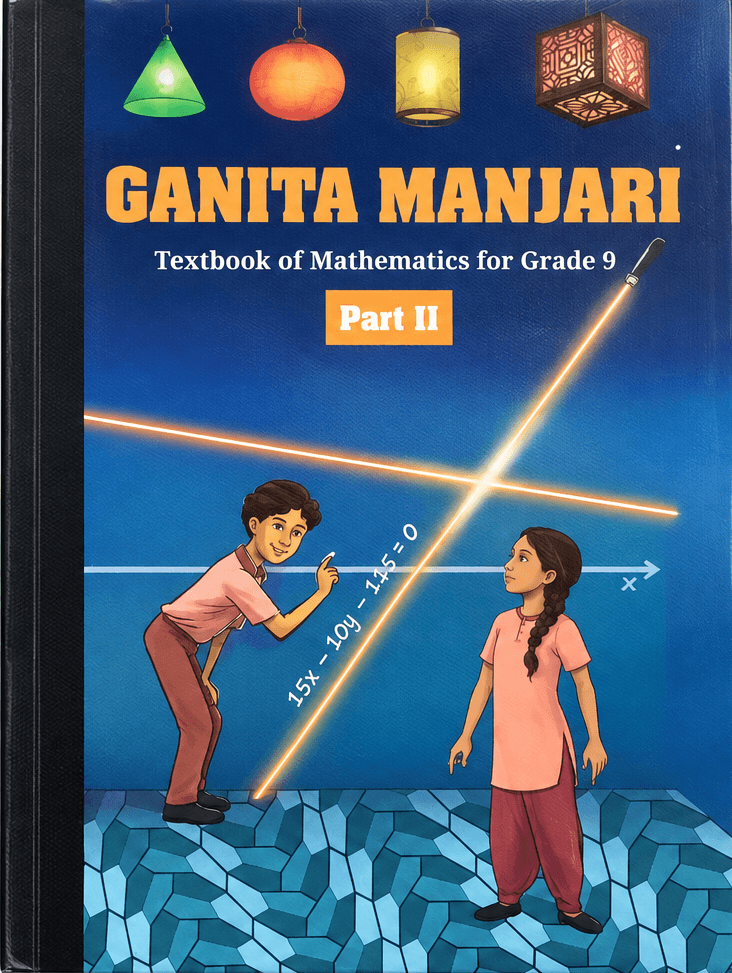
📘 CLASS 9 MATHEMATICS • GANITA MANJARI (NCERT 2026)

Class 9 Maths Chapter 3 Solutions

The World of Numbers
Class 9 Maths Chapter 3 Solutions
Explore Class 9 Maths Chapter 3 Solutions prepared according to the latest NCERT Ganita Manjari (2026). Learn every concept with easy explanations, exercise-wise solutions, visual learning cards, exam tips, and quick revision designed especially for CBSE Class 9 students.
Natural Numbers
Integers
Rational Numbers
Irrational Numbers
Real Numbers
Decimal Expansion
📚 STUDENT DASHBOARD

Your Learning Journey for Chapter 3

Everything you need to master The World of Numbers—organized in one place for quick learning, revision and CBSE exam preparation.

⏱️
Study Time 6–8 Hours
Difficulty Medium Level
🎯
Board Weightage High Importance
📘
Major Concepts 6 Core Topics
📝
Exercises 3 Available • 2 Coming Soon • End Exercise
📄
Practice Questions 40+ Questions & Examples
📚 CHAPTER NAVIGATION

Choose Your Exercise

Master Class 9 Maths Chapter 3 – The World of Numbers by solving each exercise in sequence. Every solution is prepared according to the latest NCERT Ganita Manjari (2026) and explained in a simple, step-by-step CBSE style.

🟢 Ready to Learn

Exercise 3.1

History of Numbers & Number Systems

Begin your journey into the fascinating world of numbers. Learn how different civilizations developed number systems and understand the evolution of modern mathematics.

📘 What You’ll Learn
  • History of Numbers
  • Ancient Number Systems
  • Hindu–Arabic Numerals
  • Introduction to Number Representation
⭐ Beginner
📝 12 Questions
⏱ 20–25 Min
🚀 Start Solving
🟢 Ready to Learn

Exercise 3.2

Integers & Their Operations

Strengthen your understanding of integers by learning their properties, operations, and applications on the number line through simple step-by-step NCERT solutions.

📘 What You’ll Learn
  • Addition & Subtraction of Integers
  • Multiplication & Division Rules
  • Properties of Integers
  • Applications on Number Line
⭐⭐ Intermediate
📝 10 Questions
⏱ 25 Minutes
🚀 Start Solving
🟢 Ready to Learn

Exercise 3.3

Rational Numbers & Their Properties

Explore the world of rational numbers through easy-to-understand examples. Learn their properties, compare rational numbers, and perform mathematical operations confidently for CBSE examinations.

📘 What You’ll Learn
  • Equivalent Rational Numbers
  • Comparison of Rational Numbers
  • Operations on Rational Numbers
  • Properties & Important NCERT Questions
⭐⭐ Intermediate
📝 11 Questions
⏱ 25–30 Minutes
📖 Start Solving
🟢 Ready to Learn

Exercise 3.4

Rational Numbers – Number Line & Applications

Practise representing rational numbers on the number line, finding rational numbers between two given numbers, simplifying expressions, and solving real-life application questions with step-by-step NCERT solutions.

📘 What You’ll Learn
  • Representing Rational Numbers on the Number Line
  • Finding Rational Numbers Between Two Numbers
  • Simplification of Rational Number Expressions
  • Word Problems & Decimal-Based Questions
⭐⭐ Intermediate
📝 6 Questions
⏱ 20–25 Minutes
📖 Start Solving
🟢 Ready to Learn

Exercise 3.5

Decimal Expansion of Rational Numbers

Master the decimal expansion of rational numbers by identifying terminating and recurring decimals, exploring repeating patterns, and classifying numbers as rational or irrational through detailed NCERT solutions.

📘 What You’ll Learn
  • Terminating & Recurring Decimals
  • Decimal Expansion of Rational Numbers
  • Rational vs Irrational Numbers
  • Repeating Decimal Patterns & Concept-Based Questions
⭐⭐⭐ Moderate
📝 5 Questions
⏱ 20–25 Minutes
📖 Start Solving
⭐ Complete Chapter Revision

End Exercise

Complete Chapter Assessment

Test your understanding of the entire chapter with mixed NCERT questions. This exercise is ideal for final revision before school exams and CBSE assessments.

🎯 Why Practice This?
  • Mixed NCERT Questions
  • Complete Chapter Revision
  • Board Exam Preparation
  • Confidence Booster
🏆 Must Practice
⭐ Board Focus
⏱ 35–40 Minutes
🏆 Start Final Revision
📖 STORY OF NUMBERS

The Journey of Numbers

Have you ever wondered how numbers evolved over thousands of years? This chapter takes you on an exciting journey—from the simple need to count everyday objects to the complete system of Real Numbers that we use today.

👨‍🌾

Need to Count

The Beginning of Mathematics

Long ago, people needed a simple way to count animals, food, tools, and other everyday objects. This basic human need gave birth to the idea of numbers and marked the beginning of mathematics.

🔢

Natural Numbers

1, 2, 3, 4, 5…

The first numbers used for counting are called Natural Numbers. They helped people count objects and perform basic calculations, forming the foundation of all future number systems.

0️⃣

Whole Numbers

0, 1, 2, 3, 4…

Mathematicians later realized the importance of 0 (Zero). By including zero with the natural numbers, we get the set of Whole Numbers. Zero represents “nothing” and plays a vital role in mathematics and modern science.

✨ Zero Introduced Foundation of Place Value

Integers

…, −3, −2, −1, 0, 1, 2…

People needed numbers to represent situations like loss, debt, and temperatures below zero. This led to the discovery of Integers, which include positive numbers, negative numbers, and zero.

➕ Positive Numbers ➖ Negative Numbers 0 Included
½

Rational Numbers

Fractions & Quotients

Whole numbers and integers were not enough to express quantities like half a pizza or three-fourths of a litre. Therefore, mathematicians introduced Rational Numbers, which can be written in the form p/q, where q ≠ 0.

Examples: ½, -3/5 Can be Written as p/q
√2

Irrational Numbers

Numbers That Cannot Be Written as p/q

While studying geometry, mathematicians discovered numbers like √2 and π that cannot be expressed as the ratio of two integers. Their decimal expansions are non-terminating and non-repeating. These are called Irrational Numbers.

√2 π (Pi) Non-Repeating Decimal
🌍

Real Numbers

The Complete Number System

Finally, mathematicians combined Rational Numbers and Irrational Numbers to form the set of Real Numbers. Every number used in daily life, science, engineering, and mathematics belongs to this number system.

✔ Real Numbers = Rational Numbers + Irrational Numbers
🎉

Congratulations!

You have successfully completed the fascinating journey from the simple need to count objects to understanding the complete Real Number System. This is the foundation for many advanced mathematical concepts you will study in higher classes.

🧠 Did You Know?

The evolution of number systems took thousands of years. Ancient civilizations first learned to count using natural numbers. Later, the invention of zero, the discovery of negative numbers, fractions, and finally irrational numbers helped build the modern Real Number System that we use today.

√2

Irrational Numbers

Numbers That Cannot Be Written as p/q

While studying geometry, mathematicians discovered numbers like √2 and π that cannot be expressed as the ratio of two integers. Their decimal expansions are non-terminating and non-repeating. These are called Irrational Numbers.

√2 π (Pi) Non-Repeating Decimal
🌍

Real Numbers

The Complete Number System

Finally, mathematicians combined Rational Numbers and Irrational Numbers to form the set of Real Numbers. Every number used in daily life, science, engineering, and mathematics belongs to this number system.

✔ Real Numbers = Rational Numbers + Irrational Numbers
🎉

Congratulations!

You have successfully completed the fascinating journey from the simple need to count objects to understanding the complete Real Number System. This is the foundation for many advanced mathematical concepts you will study in higher classes.

🧠 Did You Know?

The evolution of number systems took thousands of years. Ancient civilizations first learned to count using natural numbers. Later, the invention of zero, the discovery of negative numbers, fractions, and finally irrational numbers helped build the modern Real Number System that we use today.

🚀 QUICK REVISION

Journey of Numbers at a Glance

Revise the complete evolution of numbers in just a few seconds before solving the exercises.

👨‍🌾
Need to Count
🔢
Natural
0️⃣
Whole

Integers
½
Rational
√2
Irrational
🌍
Real Numbers
📝 Exam Memory Tip: Every new number system was introduced because the previous one could not solve all real-life problems. Remember the order: Natural → Whole → Integers → Rational → Irrational → Real Numbers.
📜 HISTORY OF MATHEMATICS

Journey Through the History of Numbers

Numbers were not invented in a single day. They developed over thousands of years as different civilizations discovered new ways to count, calculate, and solve everyday problems. Let’s explore this fascinating journey.

🦴

Ishango Bone

Around 20,000 Years Ago

One of the earliest known mathematical tools is the Ishango Bone, discovered in Central Africa. It contains groups of carved marks that many historians believe were used for counting and keeping records.

Did You Know?
The Ishango Bone is often called one of the world’s earliest evidence of mathematical thinking.
🏺

Ancient Civilizations

Egypt • Mesopotamia

As civilizations grew, people needed mathematics for farming, trade, construction, and astronomy. Ancient Egyptians and Mesopotamians developed early number systems to solve practical problems.

Interesting Fact:
Early mathematics helped people measure land, collect taxes, and build remarkable structures.
🇮🇳

Ancient India

Birthplace of the Decimal Number System

Ancient Indian mathematicians made revolutionary contributions by developing the decimal place-value system, which later spread across the world and became the foundation of modern mathematics.

Proud Moment:
The Hindu-Arabic numeral system used today has its roots in ancient India.
📜

Bakshali Manuscript

Ancient Indian Mathematical Manuscript

The Bakshali Manuscript is one of the oldest known mathematical texts from the Indian subcontinent. It contains arithmetic, algebra, geometry, and one of the earliest recorded uses of the symbol for zero (0) as a placeholder in calculations.

Historical Significance:
The manuscript shows that Indian mathematicians had already developed advanced calculation methods many centuries ago.
🧠

Brahmagupta

628 CE • Great Indian Mathematician

The famous Indian mathematician Brahmagupta was among the first scholars to write clear mathematical rules for using zero and negative numbers. His work laid the foundation for many modern mathematical operations.

Great Contribution:
Brahmagupta explained how to perform addition, subtraction, and multiplication involving zero and negative numbers, making mathematics more systematic.
√2

Discovery of Irrational Numbers

A New Mathematical Discovery

While studying geometry, mathematicians discovered numbers such as √2 that could not be written as the ratio of two integers. These numbers are called Irrational Numbers because their decimal expansions never end and never repeat.

Connection with Chapter 3:
The study of rational and irrational numbers finally leads us to the complete set of Real Numbers, which is the main focus of this chapter.
🌍

Modern Mathematics

Mathematics in Everyday Life

Today, mathematics is used in almost every field, including science, engineering, medicine, banking, computers, artificial intelligence, and space exploration. The number systems developed over thousands of years continue to shape our modern world.

Think About It:
Every time you use a mobile phone, GPS, digital payment, calculator, or computer, you are using mathematical ideas that evolved through centuries of human discovery.

📚 Connection with Your NCERT Chapter

In this chapter, you will study Real Numbers, which include both Rational Numbers and Irrational Numbers. Understanding the historical journey of numbers helps us appreciate why new number systems were developed and how they made mathematics more complete.

🇮🇳 India’s Remarkable Contribution

The development of the decimal place-value system and the widespread use of zero (0) are among India’s greatest contributions to mathematics. These discoveries transformed calculations and became the foundation of modern science and technology.

🏆

What We Learned

The story of numbers teaches us that mathematics has continuously evolved to solve new challenges. Every new discovery made mathematics more powerful, leading us to the complete system of Real Numbers that we study today.

🦴 Counting
0️⃣ Zero
➖ Integers
½ Rational Numbers
√2 Irrational Numbers
🌍 Real Numbers
🧠 THINK LIKE A MATHEMATICIAN

Don’t Just Solve — Think!

Great mathematicians don’t simply remember formulas—they ask questions, explore patterns, and understand the ideas behind every concept. Try thinking about these questions before opening the answers.

🧠 Why can’t the denominator be zero?
Answer:

A fraction represents division. For example, 8 ÷ 2 = 4 because 8 objects can be divided equally into 2 groups. But if we write 8 ÷ 0, there are zero groups, so it is impossible to divide the objects. Therefore, division by zero has no meaningful value, and a denominator can never be zero.
💡 Think More: Can any number divided by zero ever give a meaningful answer? Discuss your reasoning.
🧠 Why is √2 an irrational number?
Answer:

The decimal expansion of √2 never ends and never repeats. Every rational number has either a terminating or a repeating decimal expansion. Since √2 has neither of these properties, it cannot be written in the form p/q. Hence, √2 is an irrational number.
💡 Think More: Can you name two other irrational numbers that you know?
🧠 Why was zero one of the greatest discoveries in mathematics?
Answer:

Zero does much more than represent “nothing.” It acts as a placeholder in our decimal number system. Without zero, numbers like 105, 1008, or 50,000 could not be written correctly. Zero also plays an important role in algebra, arithmetic, computers, and modern technology.
💡 Think More: Imagine writing the number 1005 if the symbol 0 had never been invented. How would you do it?
🧠 Are there infinitely many rational numbers?
Answer:

Yes. Between any two rational numbers, there is always another rational number. For example, between 1 and 2, we can find (1 + 2) ÷ 2 = 3/2. Again, between 1 and 3/2, we can find another rational number. This process can continue forever. Therefore, there are infinitely many rational numbers between any two rational numbers.
💡 Think More: Can you find three different rational numbers between 5 and 6?
🧠 Is every integer a rational number?
Answer:

Yes. Every integer can be written as a fraction whose denominator is 1. Examples: 7 = 7/1 -9 = -9/1 0 = 0/1 Since every integer can be expressed in the form p/q (where q ≠ 0), every integer is a rational number.
💡 Think More: Can every rational number also be called an integer? Explain with an example.
🧠 Why do we need irrational numbers?
Answer:

Not every quantity in mathematics can be represented by a fraction. For example, the diagonal of a square with side length 1 unit is √2, which cannot be written as a ratio of two integers. Similarly, the number π is needed to measure circles. These numbers are called irrational numbers, and together with rational numbers they form the complete set of real numbers.
💡 Think More: Can you think of any real-life situation where an irrational number is used?
💡

The Habit of Every Great Mathematician

Mathematics is not about memorising answers—it is about asking good questions. Whenever you learn a new concept, ask “Why?”, “How?”, and “What happens if…?”. Curiosity is the first step towards becoming a confident problem solver.

🎯 CBSE LAST-MINUTE CHECKLIST

Important Exam Tips

Before solving the exercises or appearing in your CBSE examination, quickly revise these important tips and avoid the common mistakes that students often make.

✅ Score Better in Exams
  • Always write rational numbers in the form p/q, where q ≠ 0.
  • Remember the hierarchy: Natural ⊂ Whole ⊂ Integers ⊂ Rational ⊂ Real Numbers.
  • Learn important irrational numbers such as √2, √3 and π with their properties.
  • Practise questions on terminating and non-terminating repeating decimals carefully.
  • Write every mathematical step neatly instead of jumping directly to the final answer.
  • Revise important definitions and solve all NCERT examples before the examination.
❌ Common Mistakes to Avoid
  • Never write a fraction whose denominator is 0.
  • Do not think that every decimal number is irrational.
  • Avoid forgetting that every integer is also a rational number.
  • Do not confuse terminating decimals with non-terminating repeating decimals.
  • Remember that √4 = 2, so √4 is a rational number, not an irrational number.
  • Avoid skipping important mathematical steps and proper notation while writing your answers.
🌟

Final Revision Reminder

Success in mathematics comes from understanding concepts rather than memorising answers. Revise the number hierarchy, identify rational and irrational numbers correctly, and practise every NCERT exercise carefully. A few minutes of focused revision today can improve your confidence in the examination.

📘 Revise Concepts
✍️ Practice NCERT Questions
🎯 Avoid Common Mistakes
🏆 Score with Confidence
📚 QUICK REVISION SHEET

Chapter Quick Revision

Revise the complete chapter in just a few minutes using this comparison table. Read it before solving exercises or appearing in your CBSE examination.

Number System Example Can be Written as p/q? Important Point
🔢 Natural 5 Not Required Counting Numbers (1, 2, 3…)
0️⃣ Whole 0 Not Required Natural Numbers + 0
➖ Integer -8 Yes (−8/1) Includes negative numbers, 0 and positive numbers
½ Rational 3/5 ✅ Yes Terminating or repeating decimal
√2 Irrational √2 ❌ No Non-terminating, non-repeating decimal
🌍 Real π Includes Rational & Irrational Numbers All numbers on the number line

🧠 Remember This Order

Natural
Whole
Integers
Rational
+
Irrational
=
Real Numbers
Rakesh Kumar Singh - Maths Mentor

Rakesh Kumar Singh

Founder • Maths Gurukulam

Meet Your Maths Mentor

Hello! I’m Rakesh Kumar Singh, the founder of Maths Gurukulam and Newton Study Point. My goal is to make mathematics easy, logical, and enjoyable for every student. Every solution on this website is carefully prepared in a simple, step-by-step manner so that students can understand the concept, not just memorize the answer.

Whether you are preparing for school exams or strengthening your fundamentals, these notes and solutions are designed according to the latest CBSE pattern to help you learn with confidence.

🎓 18+ Years of Teaching Experience
📘 NCERT & CBSE Focused Learning
✍️ Step-by-Step Concept-Based Solutions
❤️ Helping Students Build Confidence in Maths

A Message for Every Student 💙

Mathematics is not difficult—it becomes easy when you understand the logic behind every step. Never be afraid of mistakes, because every mistake is an opportunity to learn something new. Stay curious, practise regularly, and believe in yourself. Success will surely follow.

🚀 KEEP LEARNING • KEEP GROWING

What’s Your Next Step?

Congratulations! You have completed this chapter. Continue learning with our free NCERT resources or get personalised guidance from experienced teachers at Newton Study Point.

📚 Continue Free Learning

  • Explore more NCERT chapter solutions.
  • Revise concepts with premium notes.
  • Practice chapter-wise questions.
  • Prepare confidently for CBSE examinations.
Explore More Chapters →

🎓 Join Newton Study Point

  • ✔ Small Batch Classes
  • ✔ Concept-Based Teaching
  • ✔ Weekly Tests & Practice
  • ✔ Regular Doubt Solving
  • ✔ Online & Offline Learning
  • ✔ CBSE Exam Preparation
Join on WhatsApp →
📍 Newton Study Point, Ankur Vihar, Ghaziabad
📞 Call: +91 84470 02272
🌐 Maths Gurukulam
❓ FREQUENTLY ASKED QUESTIONS

Chapter FAQs

Find quick answers to the most commonly asked questions about Class 9 Maths Chapter 3 – The World of Numbers (Ganita Manjari 2026).

1. What are real numbers?
Real numbers include all rational numbers and irrational numbers. Every number that can be represented on the number line is called a real number.
2. What is the difference between rational and irrational numbers?
A rational number can be written in the form p/q, where q ≠ 0. An irrational number cannot be written in this form and has a non-terminating, non-repeating decimal expansion.
3. Is √2 a rational number?
No. √2 is an irrational number because it cannot be expressed as the ratio of two integers, and its decimal expansion is non-terminating and non-repeating.
4. Are all integers rational numbers?
Yes. Every integer can be written in the form p/q. For example, −7 = −7/1 and 12 = 12/1. Therefore, all integers are rational numbers.
5. How can I score well in Chapter 3 of Class 9 Maths?
Understand the difference between various number systems, practise NCERT questions regularly, remember important definitions and examples, and revise decimal expansion concepts carefully before the examination.
6. Are these solutions based on the latest NCERT Ganita Manjari (2026) book?
Yes. All solutions on Maths Gurukulam are prepared according to the latest NCERT Ganita Manjari (2026) syllabus and follow the current CBSE guidelines with simple, step-by-step explanations.

📘 Official NCERT Resource

Want to read the original chapter? Download the latest NCERT Ganita Manjari (2026) textbook directly from the official NCERT website and practise along with our step-by-step solutions.

Visit NCERT →
📚 CONTINUE LEARNING

Explore More Class 9 Maths Chapters

Continue your learning journey with chapter-wise NCERT solutions prepared according to the latest Ganita Manjari (2026) syllabus. Every chapter includes exercise-wise solutions, concept explanations, revision tips, and CBSE exam guidance.

📍

Chapter 1

Coordinates

Complete NCERT solutions with exercise-wise explanations, important concepts, and CBSE-focused revision.

Explore Chapter →
📘

Chapter 2

Introduction to Linear Polynomials

Master linear polynomials through simple explanations, solved exercises, and exam-oriented practice.

Explore Chapter →

Chapter 3

The World of Numbers

You are currently exploring this chapter. Complete all exercises and revise the important concepts before moving ahead.

✔ You’re Here
🚀

Chapter 4

Coming Soon

Our expert team is preparing detailed NCERT solutions, revision notes, and exam tips for the next chapter.

Coming Soon