📘 NCERT GANITA MANJARI 2026–27 • CLASS 9 MATHEMATICS

Class 9 Maths Chapter 4 Solutions

Exploring Algebraic Identities

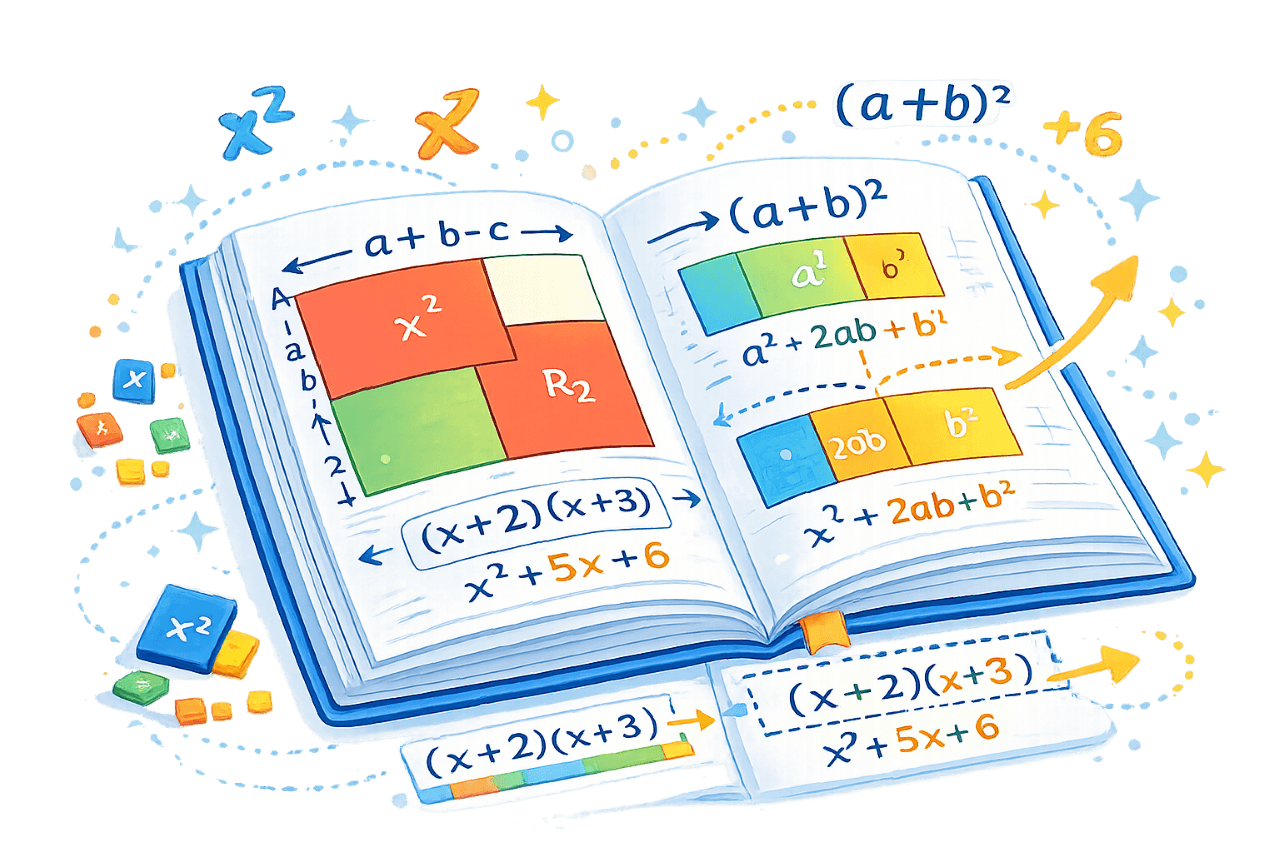
Find Class 9 Maths Chapter 4 Solutions with clear, step-by-step answers based on the latest NCERT Ganita Manjari (2026–27). Understand important algebraic identities, visual proofs, factorisation and rational expressions, and quickly move to the exercise-wise solutions you need.
✓ NCERT Aligned
✓ Step-by-Step Solutions
✓ Algebraic Identities
✓ Exercise-Wise Links
Class 9 Maths Chapter 4 Solutions – Exploring Algebraic Identities from NCERT Ganita Manjari 2026–27
🧭 CHAPTER 4 SOLUTION HUB

Find What You Need in Class 9 Maths Chapter 4 Solutions

Looking for Exploring Algebraic Identities Class 9 Solutions or a particular exercise answer? Start with the section you need and quickly reach the relevant solution, identity or revision resource.

🎯
Need a solution quickly? Choose an exercise below to reach the detailed Class 9 Maths Chapter 4 Solutions from NCERT Ganita Manjari 2026–27. Want to understand the concept first? Explore algebraic identities, visual proofs and factorisation when needed.
📖
Answers

Exercise-wise Solutions

Find clear, step-by-step Ganita Manjari Class 9 Chapter 4 Solutions for Exercise 4.1 to 4.5 and the End-of-Chapter Exercise.

View Exercise Solutions →
🧩
Learn

Algebraic Identities

Explore the important algebraic identities of Exploring Algebraic Identities and understand how they help in simplifying and solving algebraic expressions.

Explore Identities →
🎨
Visual

Visual Proofs

Understand algebraic identities through visual proofs and geometric reasoning designed to make the patterns easier to follow.

Explore Visual Proofs →
✂️
Learn

Factorisation

Review factorisation methods used in Chapter 4, including identities and algebraic techniques needed for solving expressions.

Explore Factorisation →
⚡
Revise

Quick Revision

Revise important identities, key algebraic ideas and essential results before solving questions or preparing for an exam.

Open Quick Revision →
🧠
Solutions

Think & Reflect Solutions

Explore the additional thinking questions from Chapter 4 and follow their clear, step-by-step solutions and reasoning.

View Think & Reflect →
💡 A simple way to use this page

Find your question → open the exercise solution → check the relevant identity or concept if needed → understand the reasoning → continue with the next question.

Solution → Concept → Practice → Revision
📚 Class 9 Maths Chapter 4 • Exercise Solutions

Class 9 Maths Chapter 4 Exercise Solutions

Jump directly to the exercise you want to practise. Explore clear, step-by-step Class 9 Maths Chapter 4 Solutions based on NCERT Ganita Manjari 2026–27, covering Exercises 4.1–4.5 followed by the End-of-Chapter Exercise from Exploring Algebraic Identities.

Smart Solution Path: Find your exercise → open the detailed solution → understand the method → practise the next question.
↑ Back to Chapter Top
🎯 Class 9 Maths Chapter 4 • Exploring Algebraic Identities

What You Will Learn in Class 9 Maths Chapter 4

Explore Exploring Algebraic Identities step by step — from recognising algebraic patterns and visualising identities to factorisation, algebra tiles, new identities and simplifying rational expressions. Use these concepts to better understand the Class 9 Maths Chapter 4 Solutions and solve the NCERT Ganita Manjari exercises with confidence.

4.1

Introduction

Begin with algebraic patterns and discover why certain expressions give the same result for all values of their variables. Understand the basic idea of an algebraic identity and how it differs from an equation.

4.2

Visualising Identities

Visualise important algebraic identities using squares, rectangles and geometrical models. Understand why identities such as (a + b)2 = a2 + 2ab + b2 remain true for different types of numbers.

4.3

Factorisation of Algebraic Expressions Using Identities

Learn how familiar identities can be used in reverse to factorise algebraic expressions. Recognise perfect-square patterns, take common factors when needed, and use identities to factor expressions efficiently.

4.4

More Identities

Extend the earlier identities to three variables and study the identity for (a + b + c)2. Use these identities for numerical calculations, algebraic manipulation and factorisation.

4.5

Factorisation Using Algebra Tiles

Use algebra tiles to visualise the product of linear expressions and understand how quadratic expressions can be factorised. Explore how the x-term can be split to form a rectangular arrangement.

4.6

Factorisation Without Using Algebra Tiles

Learn how to factorise quadratic expressions without algebra tiles by comparing coefficients and finding suitable numbers whose sum and product match the required terms.

4.7

Finding New Identities

Discover new identities by combining known results and using the distributive property. Explore cube identities, difference and sum of cubes, and the important three-variable identity involving x3 + y3 + z3 − 3xyz.

4.8

Simplifying Rational Expressions

Apply factorisation and algebraic identities to simplify rational algebraic expressions. Learn how common factors in the numerator and denominator can be cancelled, while respecting the condition that the denominator is not zero.

Your Chapter 4 Learning Journey
Algebraic Patterns → Visualise Identities → Factorise → Algebra Tiles → New Identities → Rational Expressions
⚡ QUICK FORMULA REFERENCE

Class 9 Maths Chapter 4 Important Algebraic Identities

Keep these important identities ready while solving Class 9 Maths Chapter 4. Select an identity to jump directly to the relevant Learn Before We Solve section or exercise solution.

💡 Quick Tip: Do not choose an identity by memorising its number. Look at the pattern of the expression first, then choose the identity that matches it.
IDENTITY 5 THREE VARIABLES

Square of Three Terms

(a + b + c)2 = a2 + b2 + c2 + 2ab + 2bc + 2ca
📖 Practise with: Exercise 4.3 Solutions →
📚 Continue with Chapter 4 Solutions
🎯 Use the identity → understand the pattern → open the relevant LBWS or exercise solution.
👀 SEE THE PROOF

Visual Proof Gallery

Discover how squares, rectangles, and cubes transform into algebraic identities. See the picture. Understand the formula.

🟧 Geometry  →  🟦 Area / Volume  →  🟩 Algebraic Identity
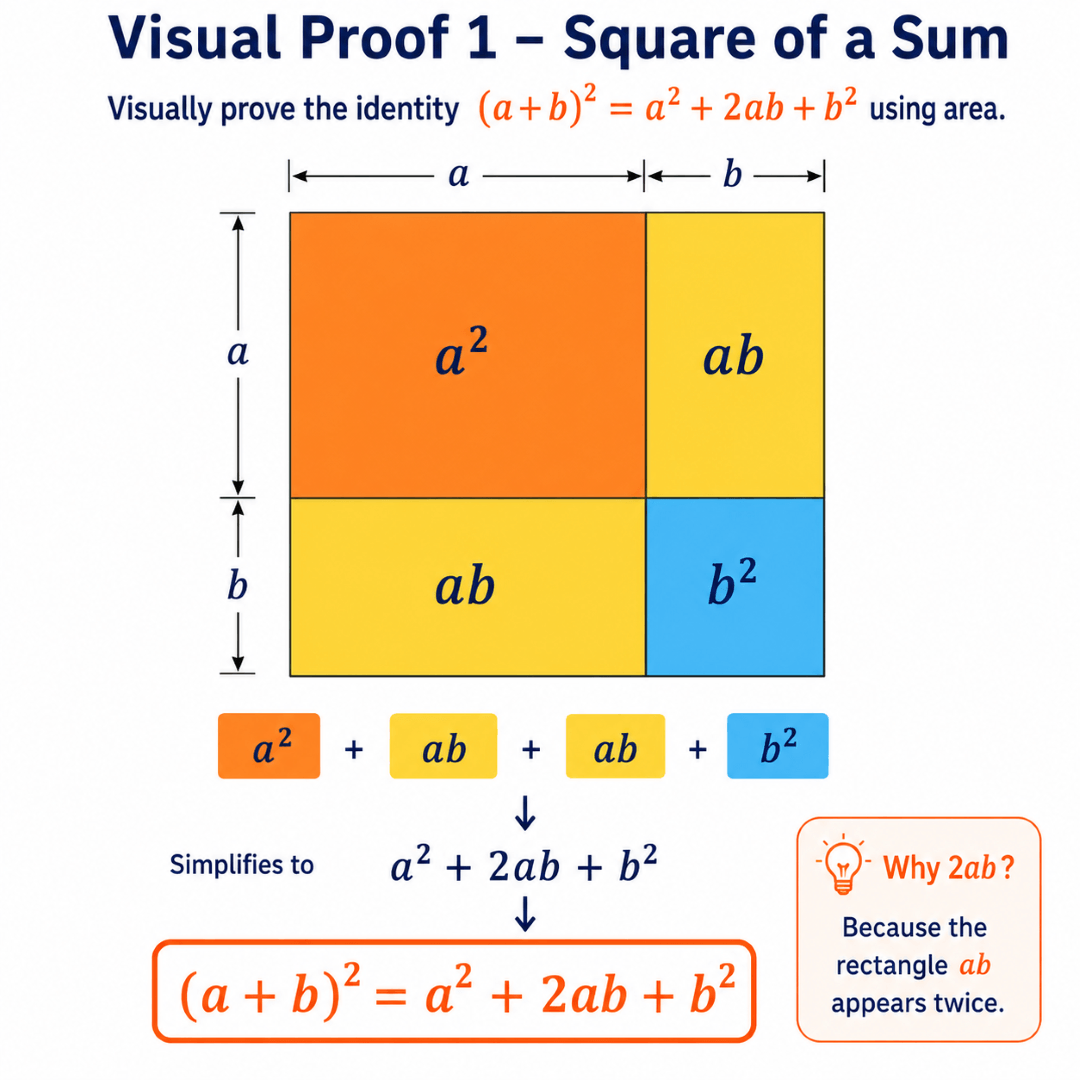
🟧 VISUAL PROOF 1

Square of a Sum

Watch how one square creates an entire algebraic identity.

Visual Proof of (a+b)²
💡 Why does 2ab appear?

The figure contains two identical yellow rectangles. Each rectangle has area ab. Therefore, ab + ab = 2ab

a² + ab + ab + b²
↓
(a+b)² = a² + 2ab + b²
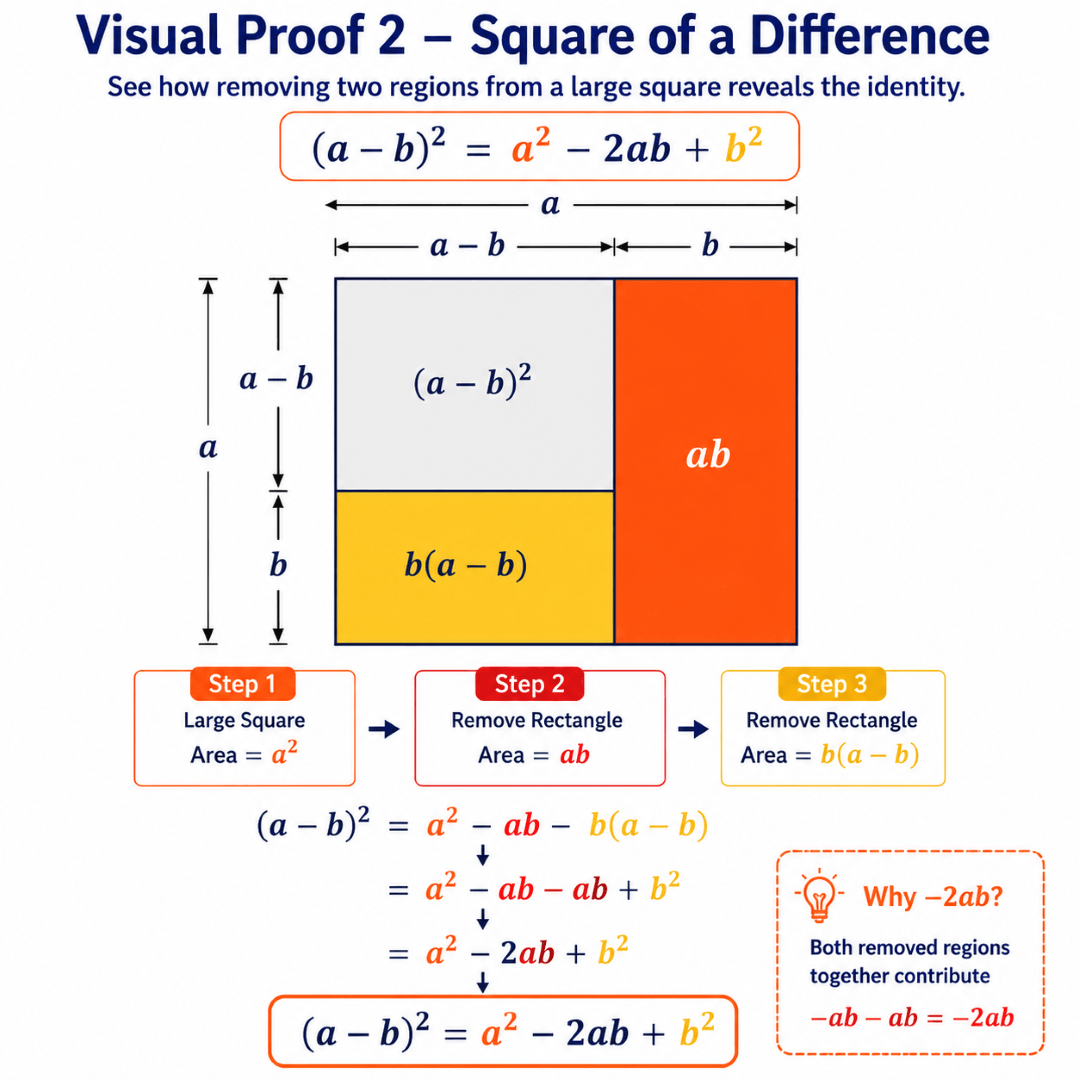
🟦 VISUAL PROOF 2

Square of a Difference

Start with one large square. Remove two regions. The remaining square reveals the identity.

Visual Proof of (a-b)²
Large Square
Area = a²
Rectangle Removed
Area = ab
Rectangle Removed
Area = b(a−b)
Remaining Square
Area = (a−b)²
💡 Why is the middle term −2ab ?

Two rectangular regions are removed from the large square. After simplifying, −ab − ab = −2ab

a² − ab − b(a−b)
↓
a² − ab − ab + b²
↓
(a−b)² = a² − 2ab + b²
🟩 VISUAL PROOF 3

Difference of Two Squares

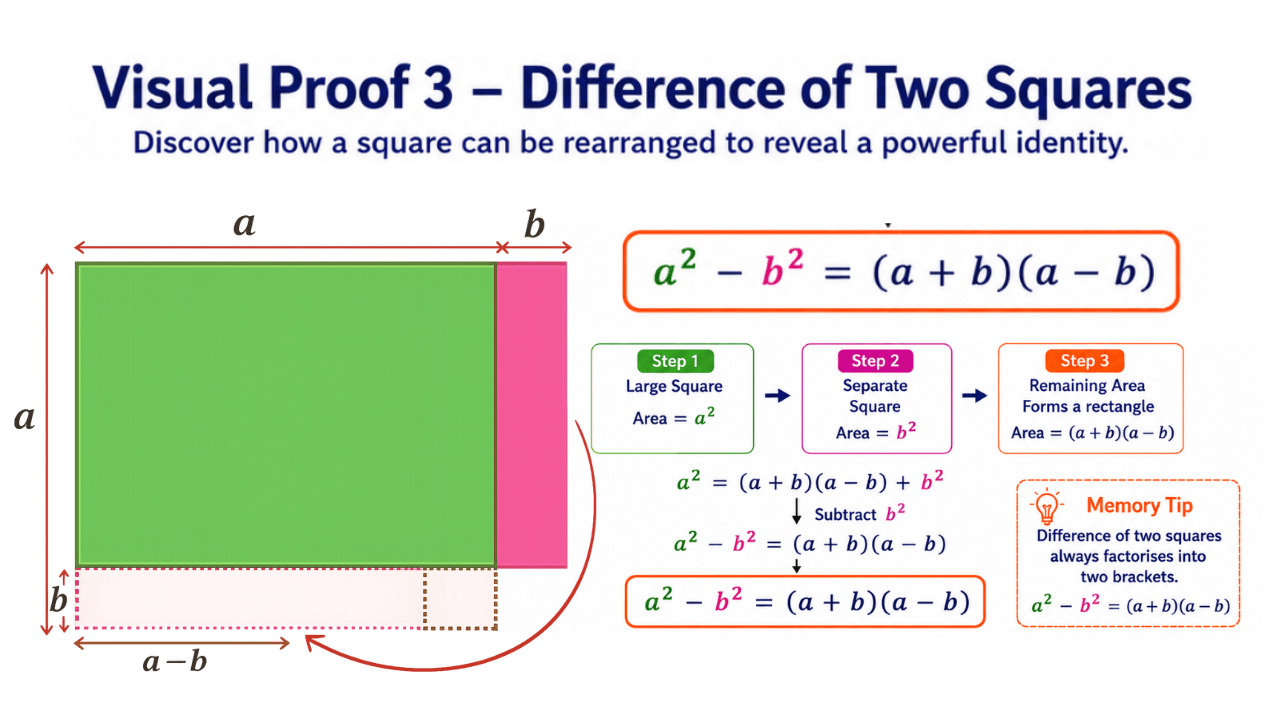
NCERT proves this identity by rearranging one square into a rectangle.

Difference of Two Squares Visual Proof
Large Square
Area = a²
Vertical Strip
Width = b
Small Square
Area = b²
↷
Rearrange
Rectangle (a+b)(a−b)
💡 What’s Happening?

The large square has area a². NCERT separates one small square of area b². The remaining coloured part is rearranged to form a rectangle whose dimensions are (a+b) × (a−b)

a²
↓
(a+b)(a−b)+b²
↓
a²−b²=(a+b)(a−b)
🧠 Memory Trick

Whenever you see a² − b², think of two brackets, not two squares.

🟪 VISUAL PROOF 4

Square of Three Terms

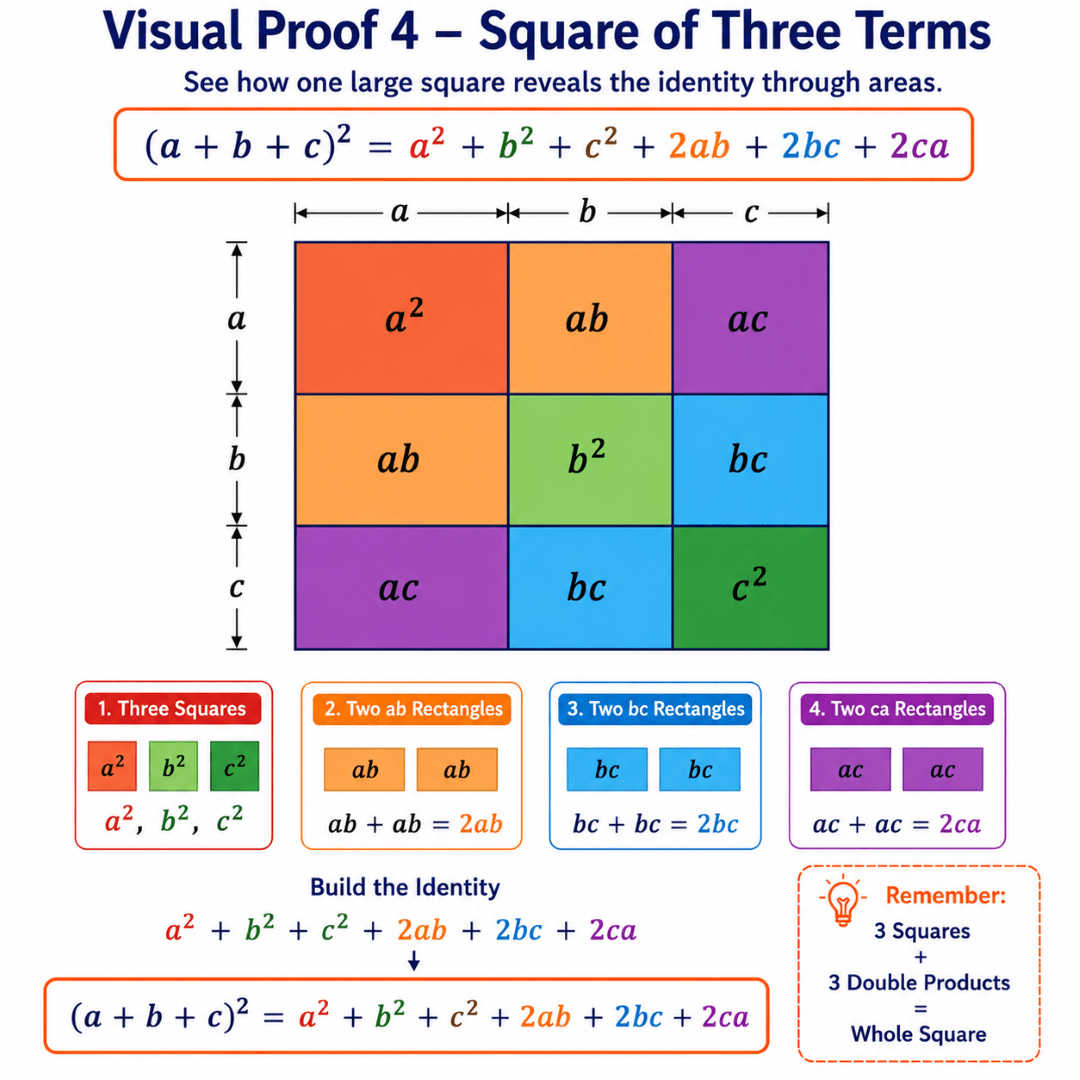
One large square is divided into smaller squares and rectangles. Their combined areas build the identity naturally.

Visual Proof of (a+b+c)²

👀 What Can You See?

🟥

3 Squares

a², b² and c²

🟧

2ab

Two identical rectangles.

🟨

2bc

Another pair of rectangles.

🟩

2ca

The final rectangle pair.

💡 The Secret

The figure contains three squares and three pairs of identical rectangles. Each pair becomes a doubled product.

a² + b² + c²
+
2ab + 2bc + 2ca
↓
(a+b+c)² = a²+b²+c² + 2ab+2bc+2ca
🧠 Memory Trick

Remember it as 3 Squares + 3 Double Products. That’s the entire identity.

🧩 ALGEBRA TILES

Algebra Tiles
Learning Lab

Build Shapes. Discover Algebra.

Explore how NCERT Class 9 Maths Chapter 4 – Exploring Algebraic Identities uses Algebra Tiles to make multiplication, factorisation and algebraic identities easy to understand. Instead of memorising formulas, you’ll build expressions with simple shapes and discover the answer yourself.

👀 Observe
→
🧩 Build
→
📐 Visualise
→
✂️ Factorise
→
✅ Solve
🧩 STEP 1 • MEET THE TILES

Every Algebraic Expression Starts With Three Simple Tiles

Instead of memorising symbols, NCERT helps you see algebra as shapes. Every expression in this chapter is built using just three tiles.

🟧 Square Tile

x²

Represents a square with side x.

x × x = x²

🟩 Rectangle Tile

x

Represents one variable tile.

x × 1 = x

🟨 Unit Tile

1

Represents one unit square.

1 × 1 = 1
💡 Amazing Fact

Every algebraic identity, multiplication, factorisation and quadratic expression in Class 9 Maths Chapter 4 is created using different combinations of these three simple tiles.

🧩 STEP 2 • BUILD AN EXPRESSION

Build an Expression

Collect the Algebra Tiles for the expression before arranging them into a rectangle.

Expression

x² + 5x + 6
↓

Convert each term into its matching Algebra Tile.

Collect the Tiles

1 Square Tile = x²
5 Rectangle Tiles = 5x
6 Unit Tiles = 6

🤔 Think Before Moving On

You have collected 1 Square Tile, 5 Rectangle Tiles and 6 Unit Tiles.

Can you arrange them into one perfect rectangle?

📐 STEP 3 • BUILD THE RECTANGLE

Arrange the Algebra Tiles

Don’t guess the factors. Arrange the tiles into one complete rectangle and let the rectangle reveal the answer.

Arrange Algebra Tiles into Rectangle
🟧

1 Square Tile

Forms the largest part of the rectangle.

🟩

5 Rectangle Tiles

Fill the sides of the square.

🟨

6 Unit Tiles

Complete the remaining empty spaces.

💡 The Secret

When every tile fits perfectly into a single rectangle, the rectangle is no longer just a picture. Its two side lengths become the two factors of the expression.

✨ Coming Next

Now read the two side lengths of the rectangle and discover (x + 2)(x + 3) without guessing.

📏 STEP 4 • READ THE FACTORS

The Rectangle Reveals the Factors

Once every tile fits perfectly, you don’t have to guess the answer. Simply read the two side lengths of the rectangle.

Rectangle showing factors x+2 and x+3
📏

Length

x + 3
📐

Width

x + 2

🎉 The Rectangle Has Solved It!

x² + 5x + 6
↓
(x + 2)(x + 3)

You didn’t memorise the factors. You discovered them by building a rectangle.

🧩 Tiles → 📐 Rectangle → 📏 Side Lengths → ✂️ Factors → ✅ Solution
🧠 CHOOSE THE RIGHT METHOD

How to Factorise Any Expression

Don’t Guess the Method. Ask the Right Question.

Every algebraic expression can be factorised, but the first step is choosing the correct method. This simple decision guide for Class 9 Maths Chapter 4 – Exploring Algebraic Identities helps you decide whether to use the Common Factor, Grouping, Split the Middle Term, or an Algebraic Identity.

🟧 Common Factor
→
🟩 Grouping
→
🟦 Split Middle Term
→
🟪 Identity
🚦 STEP 1 • FIND THE RIGHT METHOD

Ask This First Question

Before solving any factorisation question, don’t start multiplying or guessing. Simply follow this decision guide to choose the correct method.

START
↓
❓ Question 1
Is there a Common Factor?
✅

YES

Take the Common Factor first.

Go to Method 1
❌

NO

Move to the next question.

Continue ↓
➡️ Next Question

If there is no common factor, check whether the expression has 4 or more terms.

🟩 METHOD 1 • COMMON FACTOR

Always Check for a Common Factor First

This is the quickest method of factorisation. If every term has a common number or variable, take it outside first.

🔍 Ask Yourself

Can every term be divided by the same number or same variable?

Example
6x + 12
Factorisation
6x + 12
↓
6(x + 2)

🧠 Golden Rule

Never skip this step.

If a common factor exists, take it out before trying any other method.

🟩 METHOD 2 • GROUPING

Factorise by Grouping

If there is no common factor and the expression has four or more terms, group the terms in pairs and look for a common factor again.

🔍 Ask Yourself

Does the expression have 4 or more terms? Can I make two groups?

Example

ax + ay + bx + by

Factorise

a(x+y)
+
b(x+y)
↓
(a+b)(x+y)

🧠 Memory Trick

Group the terms. Take the common factor from each group. If the same bracket appears twice, take that bracket outside.

➡️ Next Method

If the expression has 3 terms and starts with x², learn Split the Middle Term.
🟦 METHOD 3 • SPLIT THE MIDDLE TERM

Split the Middle Term

Use this method when the expression has three terms, no common factor, and begins with a squared term.

🔍 Ask Yourself

Is it of the form ax² + bx + c with no common factor?

Example

x² + 5x + 6
Find two numbers whose Product = 6 and Sum = 5

Solution

x² + 2x + 3x + 6
↓
x(x+2)+3(x+2)
↓
(x+2)(x+3)

🧠 Memory Trick

Product → Sum → Split → Group → Factorise
➡️ Next Method

If the expression matches a known pattern like a² − b² or a² ± 2ab + b², use an Algebraic Identity.
🟪 METHOD 4 • IDENTITY BASED FACTORISATION

Factorise Using Algebraic Identities

Some expressions already match a well-known identity. Instead of splitting the middle term, apply the identity directly.

🔍 Ask Yourself

Does the expression look exactly like a known algebraic identity?

Example 1
a² − b²
↓
(a+b)(a−b)
Example 2
a²+2ab+b²
↓
(a+b)²
Example 3
a²−2ab+b²
↓
(a−b)²
Example 4
9x²−25
↓
(3x−5)(3x+5)
Example 5
4x²+12x+9
↓
(2x+3)²

🧠 Golden Rule

👀 Pattern Matches? → ✅ Apply Identity → ❌ Don’t Split Middle Term

Whenever an expression exactly matches a known identity, apply the identity directly. It is faster, simpler and avoids unnecessary calculations.

🎯 FACTORISATION MASTER CHECKLIST

Now You Know Which Method to Choose

Every factorisation question becomes easier when you ask the right question first instead of guessing the method.

🟧

Common Factor

Check this first for every expression.

🟩

Grouping

Use when the expression has 4 or more terms.

🟦

Split Middle Term

Use for quadratic trinomials.

🟪

Identity

Apply directly when the pattern matches.

⭐ Golden Order to Remember

🟧 Common Factor → 🟩 Grouping → 🟦 Split Middle Term → 🟪 Identity

🚀 You’re Ready!

Now that you know how to choose the correct factorisation method, you’re ready to solve the NCERT exercises with greater speed, accuracy and confidence.

📘 UNDERSTAND THE IDEA

What is a Rational Expression?

A Rational Expression is an algebraic fraction in which both the numerator and the denominator are algebraic expressions.

(x + 3)
──────────
(x − 2)

A simple example of a Rational Expression.

⬆️

Numerator

x + 3

The algebraic expression written above the fraction bar.

⬇️

Denominator

x − 2

The algebraic expression written below the fraction bar.

💡 Important Rule

A Rational Expression is defined only when the denominator is not equal to 0.

Always check the denominator before solving or simplifying.

✂️ FACTORISE • CANCEL • SIMPLIFY

How to Simplify a Rational Expression

Always factorise first, then cancel the common factors. Never cancel individual terms.

①

Factorise

Factorise the numerator and denominator.

②

Cancel

Cancel only the common factor.

③

Simplify

Write the remaining expression.

Worked Example

(x² + 5x + 6)
──────────────
(x + 2)
↓
((x + 2)(x + 3))
────────────────
(x + 2)
↓
x + 3

⚠️ Golden Rule

Never cancel terms.

Always factorise first, then cancel only the common factors.

⚡ 1-MINUTE REVISION

Chapter 4 Revision Hub

Before solving NCERT questions, spend one minute revising the five most important ideas from this chapter.

🟧

Algebraic Identities

Expand and factorise expressions using standard identities.

🟩

Factorisation

Use the correct method instead of guessing.

🟦

Algebra Tiles

Visualise expressions as shapes and read factors from rectangles.

🟪

Rational Expressions

Factorise first, then cancel only common factors.

🟨

Visual Proofs

Understand the picture before remembering the formula.

👀 Observe → 📐 Visualise → 🧮 Apply → ✂️ Factorise → ✅ Solve
🎯 FINAL SELF CHECK

Can You Answer These Questions?

If your answer is “Yes” to every question below, you’re ready to solve the NCERT exercises confidently.

✅ Can I identify the correct algebraic identity?
✅ Can I choose the correct factorisation method?
✅ Can I factorise an algebraic expression correctly?
✅ Can I simplify a rational expression?
✅ Can I explain an identity using a visual proof?
✅ Can I solve NCERT questions without memorising steps?

🚀 You’re Ready!

You have revised the complete chapter. Now it’s time to strengthen your understanding by solving the NCERT Exercise Questions step by step.

💡 NCERT GANITA MANJARI 2026–27 • THINK & REFLECT SOLUTIONS

Class 9 Maths Chapter 4 Think & Reflect Solutions

Understand the Concept Before You Solve Class 9 Maths Chapter 4 Questions.

Find clear, step-by-step Think & Reflect Solutions for Class 9 Maths Chapter 4, based on the latest NCERT Ganita Manjari (2026–27). These solutions help you understand Exploring Algebraic Identities, Algebra Tiles, Factorisation and Rational Expressions before solving the NCERT exercises with confidence.

Think → Understand → Solve → Master
📖 Chapter 4 • Page 65
Think and Reflect – 1 Solution

🔍 First Recall the Previous Pattern

On the previous page, we observed a surprising pattern for three consecutive square numbers.

1 + 9 − 2 × 4 = 2
25 + 49 − 2 × 36 = 2

In both examples, we added the smallest and largest square numbers and then subtracted twice the middle square(s). The result was always the same.

Now NCERT asks us to investigate whether a similar pattern exists for four consecutive square numbers.

❓ Question

Try and find other patterns like this one. For example, you could consider 4 consecutive squares and see if you can find a pattern.

✍️ Solution

Instead of guessing the answer directly, let us try one example and carefully observe what happens.

Take four consecutive square numbers:

1, 4, 9, 16

Now add the first and last square numbers.

1 + 16 = 17

Also add the two middle square numbers.

4 + 9 = 13

Now compare these two sums.

17 − 13 = 4

Try another set of four consecutive squares:

4, 9, 16, 25
(4 + 25) − (9 + 16)
29 − 25
= 4

Again, we get the same answer.

🎯 Observation

For these examples, we observe the pattern:

(First Square + Last Square)
−
(Two Middle Squares)
= 4

So, for four consecutive square numbers, the difference between the sum of the first and last squares and the sum of the two middle squares is always 4.

📖 Chapter 4 • Page 71
Think and Reflect – 2
❓ Question
  1. What can you say about a and b if
    (a + b)² < a² + b²
  2. What can you say about a and b if
    (a + b)² > a² + b²
  3. When will
    (a + b)² = a² + b²
  4. Did you observe that a + b and a² + b² are both positive? What term will decide which is larger? Use the expansion of
    (a + b)²
    to decide.

✍️ Solution

To answer all four questions, first recall the algebraic identity

(a + b)² = a² + 2ab + b²

Now compare this with

a² + b²

Notice that the only extra term is 2ab. Therefore, the comparison depends only on whether 2ab is positive, negative or zero.

① When will (a + b)² be less than a² + b²?

(a + b)² < a² + b²
a² + 2ab + b² < a² + b²
2ab < 0

This is possible only when a and b have opposite signs.

② When will (a + b)² be greater than a² + b²?

(a + b)² > a² + b²
a² + 2ab + b² > a² + b²
2ab > 0

This happens when a and b have the same sign (both positive or both negative).

③ When will they be equal?

(a + b)² = a² + b²
2ab = 0

This is possible only when a = 0 or b = 0.

④ Which term decides the comparison?

The deciding term is

2ab

If 2ab is positive, then (a + b)² is larger. If 2ab is negative, then a² + b² is larger. If 2ab = 0, both expressions are equal.

✅ Final Answer
Condition Conclusion
ab < 0 a and b have opposite signs, so (a+b)² < a² + b²
ab > 0 a and b have the same sign, so (a+b)² > a² + b²
ab = 0 Either a = 0 or b = 0, so (a+b)² = a² + b²
Deciding Term The comparison depends only on the term 2ab.
📖 Chapter 4 • Page 73
Think and Reflect – 3
❓ Question
What if we replace b by −b in the identity
(a + b)² = a² + 2ab + b²

Solution

We already know the identity

(a + b)² = a² + 2ab + b²

Now replace b by −b everywhere.

Step 1
(a + (−b))²
= a² + 2a(−b) + (−b)²
Step 2

Now simplify each term.

2a(−b) = −2ab
(−b)² = b²
Step 3
(a − b)² = a² − 2ab + b²
✅ Final Answer
(a − b)² = a² − 2ab + b²

Only the middle term changes its sign because replacing b by −b makes 2ab → −2ab, while (−b)² = b² remains positive.

📖 Chapter 4 • Page 76
Think and Reflect – 4 Solution
❓ Question

Label the squares and rectangles in Fig. 4.4 so that it represents the identity

(a + b + c)² = a² + b² + c² + 2ab + 2bc + 2ca

Solution

The large square has side (a + b + c), so its total area is (a + b + c)². Divide this square into smaller squares and rectangles as shown below.

a b c a b c a² ab ac ab b² bc ac bc c²

Observe the Figure

  • There are three squares: a², b² and c².
  • There are two rectangles of area ab, so together they give 2ab.
  • There are two rectangles of area bc, so together they give 2bc.
  • There are two rectangles of area ac, so together they give 2ac.
✅ Final Answer

The figure contains a², b², c², two rectangles of area ab, two rectangles of area bc, and two rectangles of area ac. Therefore, the total area of the large square is

(a + b + c)² = a² + b² + c² + 2ab + 2bc + 2ca
📖 Chapter 4 • Page 78
Think and Reflect – 5 Solution
❓ Question

Try to evaluate the following using a suitable identity:

(i) 35²     (ii) 65²     (iii) 85²     (iv) 105²

Do you observe any interesting pattern?

✍️ Solution

Notice that every number ends with 5. Therefore, we can use the identity

(a + b)² = a² + 2ab + b²

Here, take b = 5.

(i) Find 35²
35² = (30 + 5)²
= 30² + 2(30)(5) + 5²
= 900 + 300 + 25
= 1225
(ii) Find 65²
65² = (60 + 5)²
= 60² + 2(60)(5) + 5²
= 3600 + 600 + 25
= 4225
(iii) Find 85²
85² = (80 + 5)²
= 80² + 2(80)(5) + 5²
= 6400 + 800 + 25
= 7225
(iv) Find 105²
105² = (100 + 5)²
= 100² + 2(100)(5) + 5²
= 10000 + 1000 + 25
= 11025
What Pattern Do You Observe?
Number Square
35² 1225
65² 4225
85² 7225
105² 11025

We observe that all the given numbers end with 5, and their squares always end with 25.
This gives us a quick way to calculate the squares of numbers ending in 5 using the identity

(a + b)² = a² + 2ab + b²
✓ Final Answer
35² = 1225
65² = 4225
85² = 7225
105² = 11025

All these numbers end with 5, and their squares always end with 25.

Think and Reflect – 6
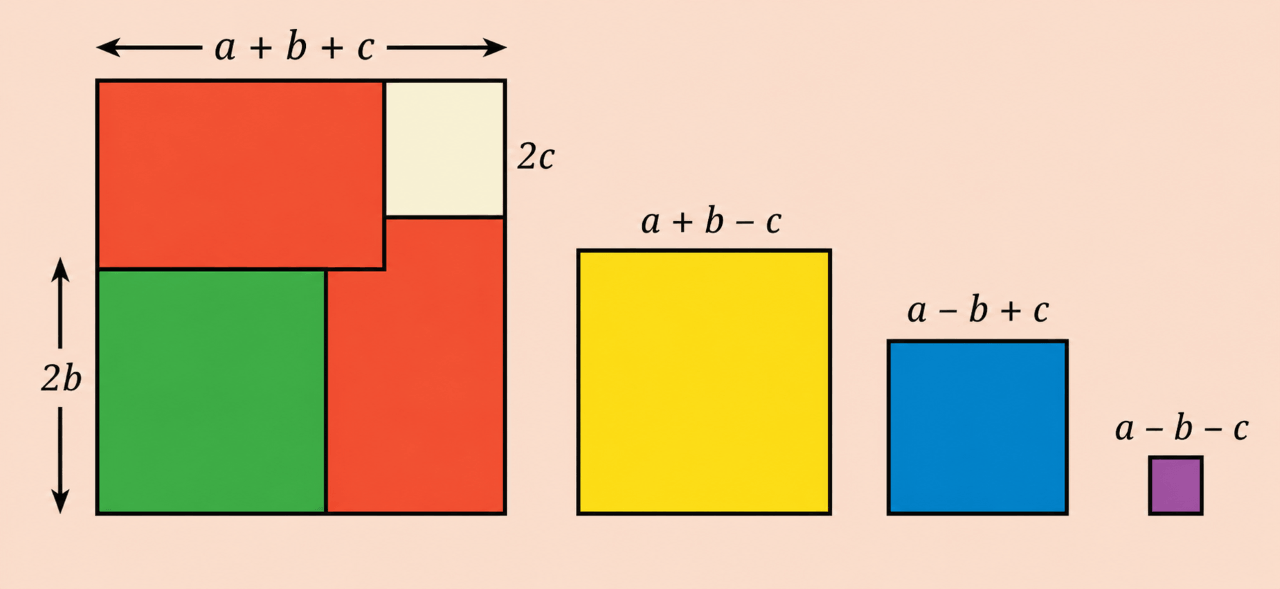
Observe the two rows of figures below. They represent an algebraic identity. Try to identify the identity.
Class 9 Maths Chapter 4 Think and Reflect 6 algebraic identity figure from NCERT Ganita Manjari page 78
✍️ Solution

We shall identify the algebraic identity by comparing the areas of the different parts of the given figure.

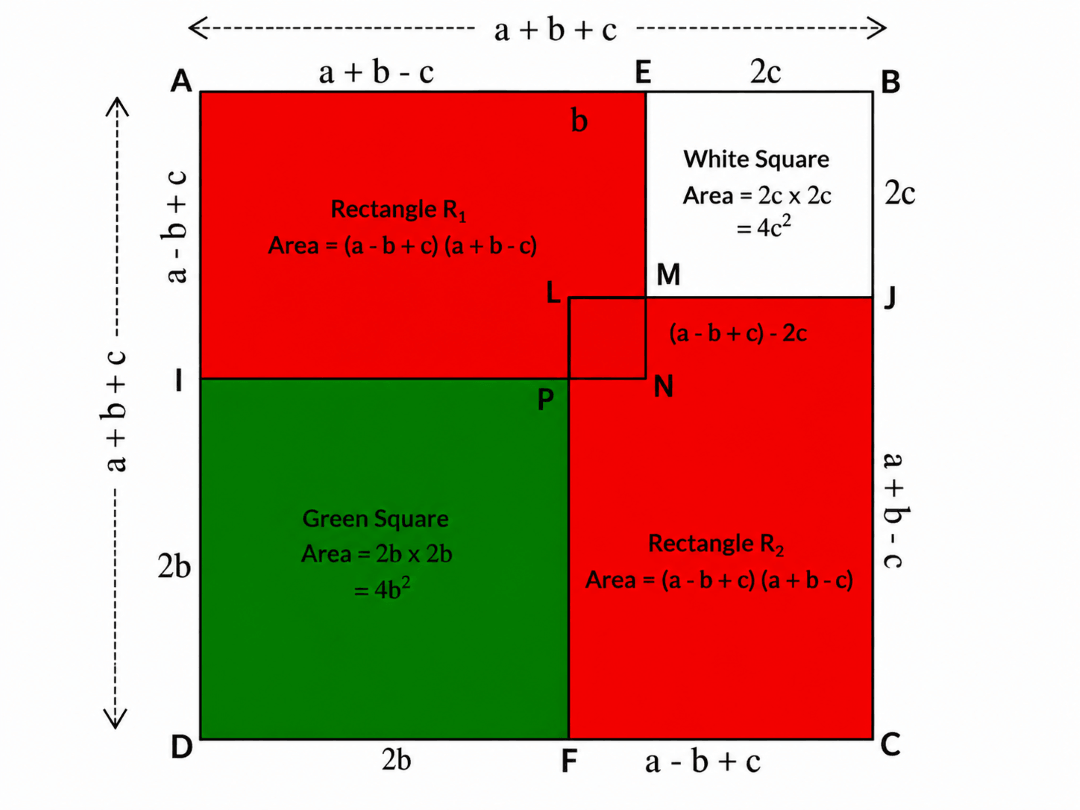
1. Dimensions and Area of Rectangle R1

The total side of the large square is

a + b + c

The white square occupies a length of 2c. Therefore, the width of Rectangle R1 is

Width of R1 = (a + b + c) − 2c = a + b − c

The green square occupies a height of 2b. Therefore, the height of Rectangle R1 is

Height of R1 = (a + b + c) − 2b = a − b + c

Hence,

Area of R1 = (a − b + c)(a + b − c)
2. Dimensions and Area of Rectangle R2

The green square occupies a length of 2b. Therefore, the horizontal side of Rectangle R2 is

Horizontal side of R2 = (a + b + c) − 2b = a − b + c

The white square occupies a height of 2c. Therefore, the vertical side of Rectangle R2 is

Vertical side of R2 = (a + b + c) − 2c = a + b − c

Hence,

Area of R2 = (a − b + c)(a + b − c)
3. Area of the Common Overlapping Region

The two rectangles R1 and R2 overlap each other. We first find the side of their common region.
Class 9 Maths Chapter 4 Think and Reflect 6 visual proof showing the complete square and overlapping region

The horizontal side of the common region is obtained by removing the side 2c of the white square from the horizontal side of R2.

Horizontal side = (a − b + c) − 2c = a − b − c

Similarly, the vertical side of the common region is obtained by removing the side 2b of the green square from the vertical side of R1.

Vertical side = (a + b − c) − 2b = a − b − c
Important Observation

Both sides of the common region are equal to

a − b − c

Therefore, the common overlapping region is a square.

Area of the Common Square
(a − b − c)²
4. Areas of the Green and White Squares

The side of the green square is 2b. Therefore,

Area of green square = (2b)² = 4b²

The side of the white square is 2c. Therefore,

Area of white square = (2c)² = 4c²
5. Area of the Complete Square

The side of the complete outer square is

a + b + c

Therefore,

Area of complete square = (a + b + c)²
6. Form the Area Equation

The complete square is obtained by combining the two rectangles, the green square and the white square. Since the common region has been counted twice in the two rectangles, its area is subtracted once.

Area of complete square
= Area of R1 + Area of R2 + Area of green square + Area of white square − Area of common square

Substituting the areas found above,

(a + b + c)²
= (a − b + c)(a + b − c) + (a − b + c)(a + b − c) + 4b² + 4c² − (a − b − c)²
7. Expand the Algebraic Expressions

First,

(a − b + c)(a + b − c) = a² − b² − c² + 2bc

Also,

(a − b − c)² = a² + b² + c² − 2ab − 2ac + 2bc

Therefore,

(a + b + c)²
= 2(a² − b² − c² + 2bc) + 4b² + 4c² − (a² + b² + c² − 2ab − 2ac + 2bc)
8. Simplify

Combining the like terms,

(a + b + c)² = a² + b² + c² + 2ab + 2bc + 2ac
✓ Final Answer
(a + b + c)² = a² + b² + c² + 2ab + 2bc + 2ac
📖 Chapter 4 • Page 79
Think and Reflect – 7
❓ Question

Suppose 7x is split as 2x + 5x. Can a similar rectangular arrangement be formed? Consider other possibilities and check.

📚 Recall the Previous Figure

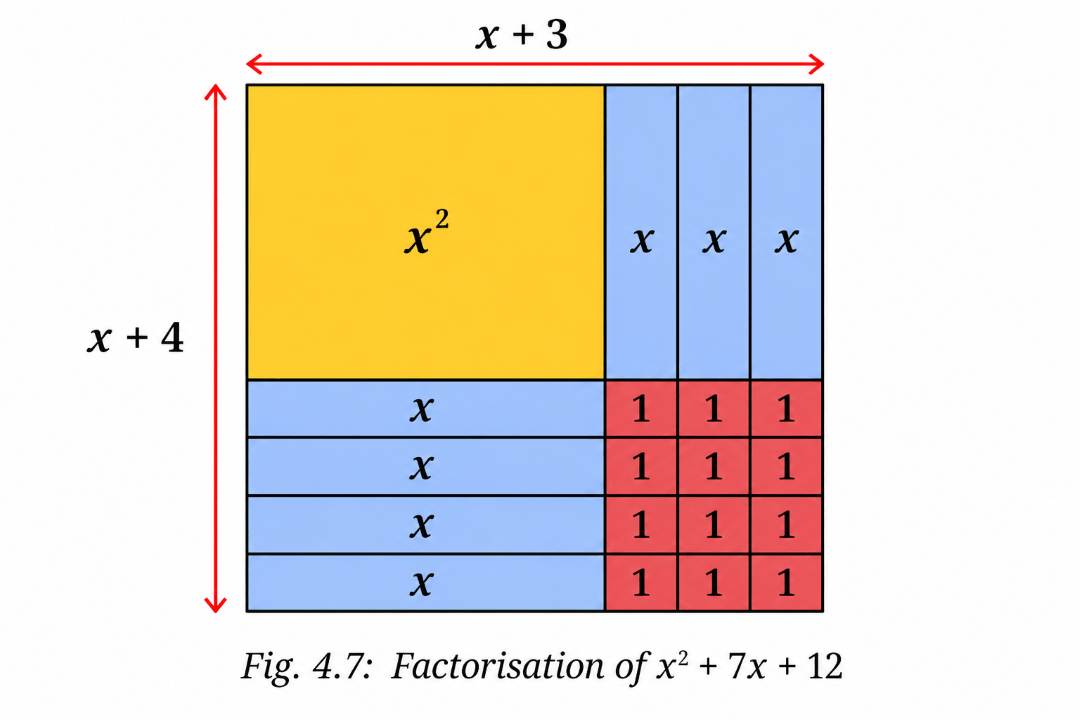
In the previous example, the algebra tiles were arranged by splitting 7x = 3x + 4x, which formed a rectangle of dimensions (x + 3) and (x + 4). Now, we shall investigate whether a similar rectangle can also be formed by splitting 7x = 2x + 5x.

Think and Reflect 7 algebra tiles arrangement for Class 9 Maths Chapter 4 Page 79

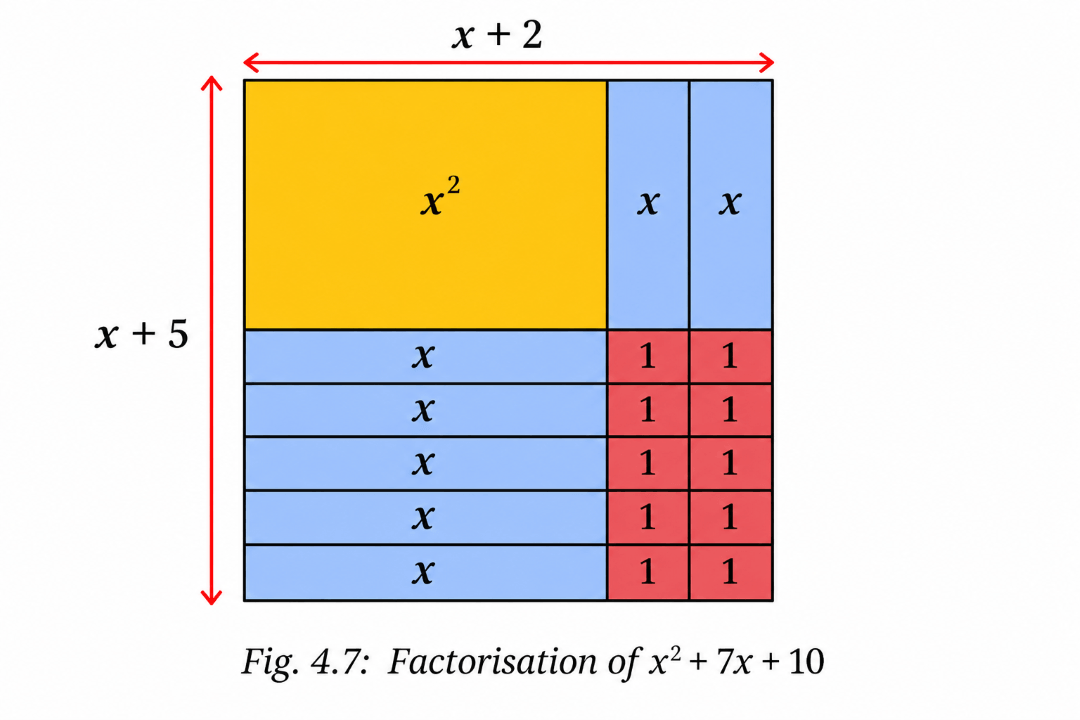
🧩 Step 1: Split 7x as 2x + 5x

In the previous arrangement, the 7x tiles were divided into 3x and 4x. Now, split them differently as

7x = 2x + 5x

Arrange the tiles again so that they form a complete rectangle without leaving any gaps.

Algebra tiles arranged as a rectangle after splitting 7x into 2x and 5x
Rectangular arrangement after splitting 7x into 2x and 5x

📏 Step 2: Find the Dimensions of the Rectangle

From the new arrangement of algebra tiles, observe the sides of the rectangle carefully.

Horizontal Side
= x + 2
Vertical Side
= x + 5

Since the figure is a rectangle, its area is equal to

Area
=
Length × Breadth
=
(x + 2)(x + 5)

🧮 Step 3: Find the Polynomial Represented by the Rectangle

The dimensions of the rectangle are (x + 2) and (x + 5). Therefore,

Area
= (x + 2)(x + 5)

= x(x + 5) + 2(x + 5)

= x² + 5x + 2x + 10

= x² + 7x + 10

Now compare this result with the previous arrangement.

Split of 7x Rectangle Polynomial
3x + 4x (x + 3)(x + 4) x² + 7x + 12
2x + 5x (x + 2)(x + 5) x² + 7x + 10

✅ Conclusion

Yes, a similar rectangular arrangement can be formed by splitting 7x = 2x + 5x. However, the rectangle now represents the polynomial x² + 7x + 10, which is different from the previous polynomial x² + 7x + 12. Hence, different ways of splitting the middle term can produce different rectangular arrangements and different polynomials.

📖 Chapter 4 • Page 79
Think and Reflect Question 8 Solution
❓ NCERT Question
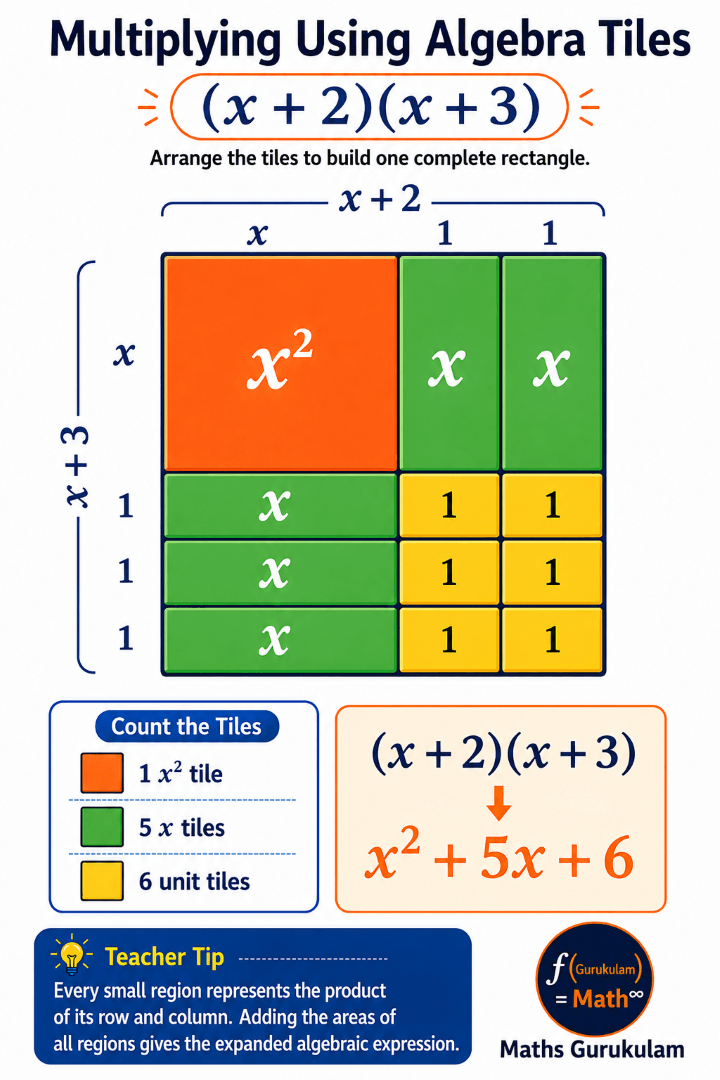
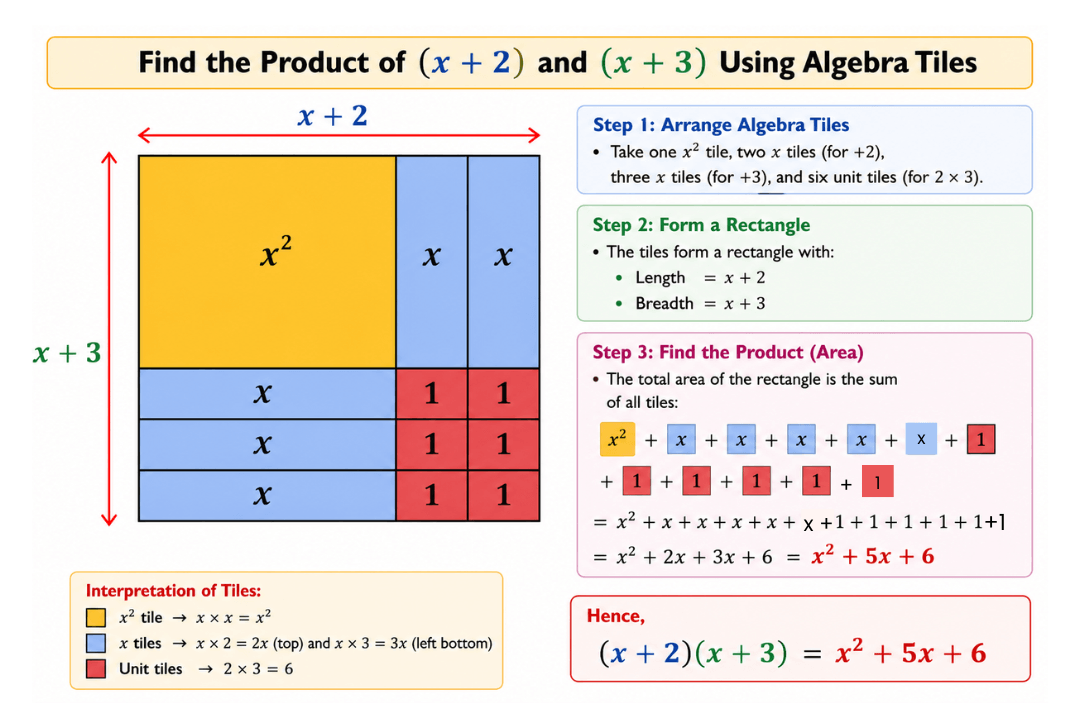
(i) Figure out the product of (x + 2) and (x + 3) using Algebra Tiles.

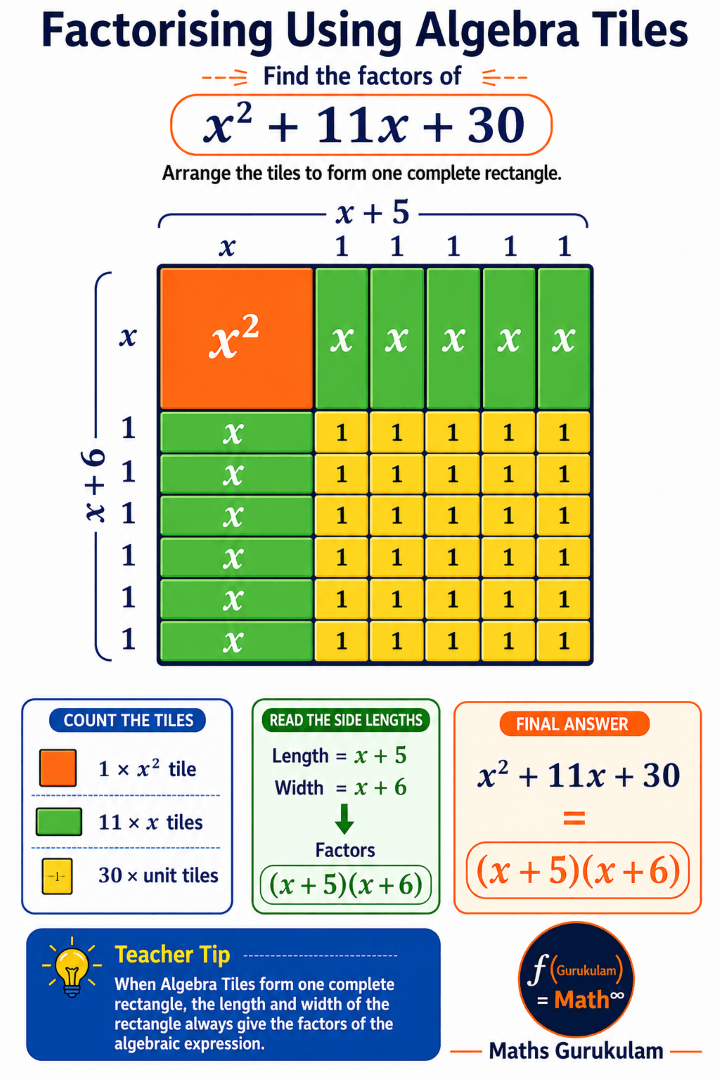
(ii) Lay out Algebra Tiles for x² + 11x + 30 in such a way that you will see its factors.
Solution (i)
We represent (x + 2) and (x + 3) using Algebra Tiles and arrange them to form a rectangle.
(x + 2) contains one x tile and two unit tiles, while (x + 3) contains one x tile and three unit tiles.
Algebra Tiles arrangement showing the product of (x + 2) and (x + 3)
From the rectangular arrangement:
🟨 1 square tile = x²
🟦 5 rectangular tiles = 5x
🟥 6 unit tiles = 6
Therefore,
(x + 2)(x + 3) = x² + 5x + 6
Solution (ii)
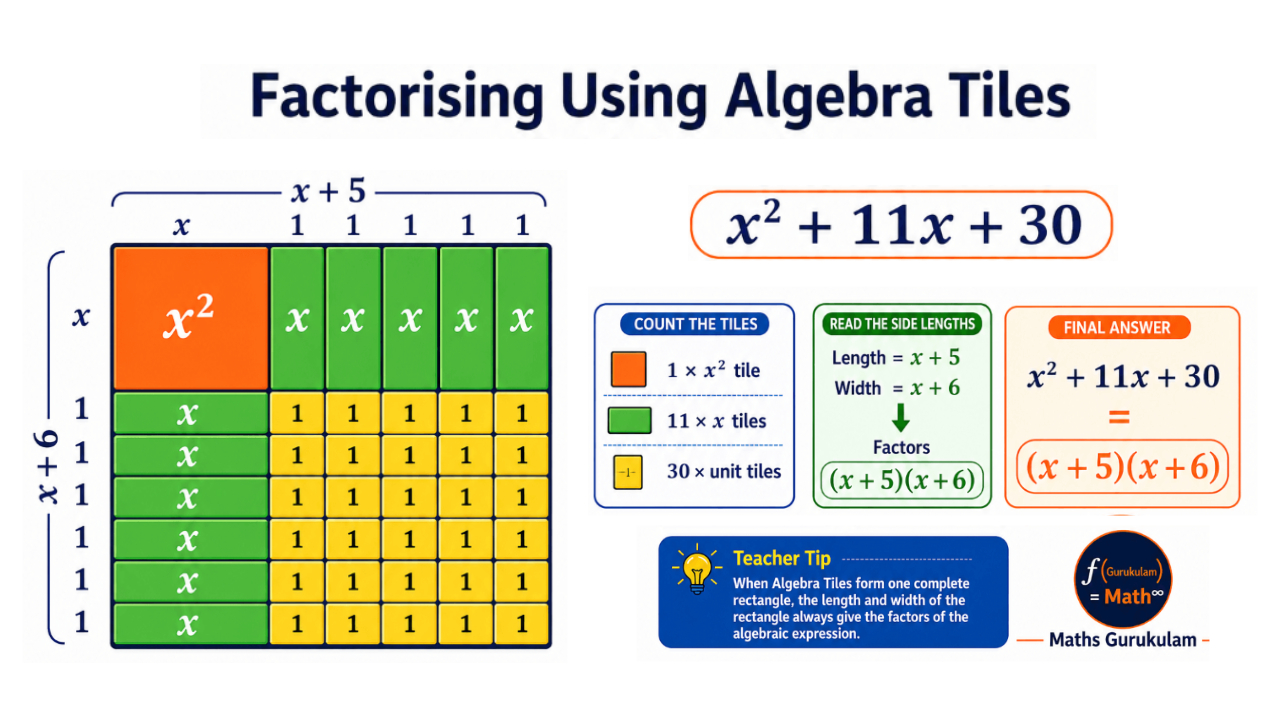
We have to arrange Algebra Tiles for x² + 11x + 30 so that they form a complete rectangle.
The tiles represent:
🟧 1 square tile = x²
🟩 11 rectangular tiles = 11x
🟨 30 unit tiles = 30
Algebra Tiles arranged to factorise x² + 11x + 30
The completed rectangle has:
Length = x + 5
Width = x + 6
Hence, the factors are
(x + 5) and (x + 6).
Verification
(x + 5)(x + 6)
= x² + 6x + 5x + 30
= x² + 11x + 30
Final Answers
(i) (x + 2)(x + 3) = x² + 5x + 6
(ii) x² + 11x + 30 = (x + 5)(x + 6)
📖 Chapter 4 • Page 80
Think and Reflect Question 9 Solution
❓ Question
We have seen that
(x + 3)(x + 4) = x² + 7x + 12
(x + 6)(x + 7) = x² + 13x + 42
Generalise the above pattern to obtain an expression for (x + a)(x + b).
✍ Solution
Observe the given examples:
Expression Expanded Form
(x + 3)(x + 4) x² + 7x + 12
(x + 6)(x + 7) x² + 13x + 42
From these examples:
• The coefficient of x is obtained by adding the two numbers.
• The constant term is obtained by multiplying the two numbers.
Replace the two numbers by the general numbers a and b.
(x + a)(x + b)
= x(x + b) + a(x + b)
= x² + bx + ax + ab
= x² + (a + b)x + ab
Hence, for every expression of the form (x + a)(x + b):
• Coefficient of x = a + b
• Constant term = ab
✅ General Rule
(x + a)(x + b)
= x² + (a + b)x + ab
📖 Chapter 4 • Page 80
Think and Reflect Question 10 Solution
❓ Question
James and Reshma are simplifying the algebraic expression
(a − b)²(a + b)
James first expands (a − b)², whereas Reshma first uses the identity (a − b)(a + b) = a² − b².

Determine whether both students are correct.
✍ Solution
Let us verify both methods one by one.
Method 1 — James
James first uses the identity
(a − b)² = a² − 2ab + b²
Substituting this into the given expression,
(a − b)²(a + b)
= (a² − 2ab + b²)(a + b)
= a³ + a²b − 2a²b − 2ab² + ab² + b³
= a³ − a²b − ab² + b³
Method 2 — Reshma
Reshma groups one factor of (a − b) and first applies the identity
(a − b)(a + b) = a² − b²
Therefore,
(a − b)²(a + b)
= (a − b)(a² − b²)
= a³ − ab² − a²b + b³
= a³ − a²b − ab² + b³
Both methods give exactly the same simplified expression. Therefore, both students have used valid algebraic identities correctly. The order of applying the identities is different, but the final result is the same.
✅ Final Answer
Both James and Reshma are correct. They used different algebraic identities, but both methods simplify the expression correctly.
(a − b)²(a + b)
= a³ − a²b − ab² + b³
📖 Chapter 4 • Page 85
Think and Reflect Question 11 Solution
❓ Question
We already know that
x² − y² = (x − y)(x + y)
We have also verified that
x³ − y³ = (x − y)(x² + xy + y²)
Observe that (x − y) is a common factor in both identities.

Do you think (x − y) is also a factor of x⁴ − y⁴?

Can you predict whether it is also a factor of x⁵ − y⁵?
✍️ Solution
From the given identities, we observe that (x − y) is a common factor.
Verify for x⁴ − y⁴
Since x⁴ and y⁴ are perfect squares,
x⁴ − y⁴
= (x²)² − (y²)²
= (x² − y²)(x² + y²)
Using x² − y² = (x − y)(x + y), we get
x⁴ − y⁴
= (x − y)(x + y)(x² + y²)
Therefore, (x − y) is also a factor of x⁴ − y⁴.
Predict for x⁵ − y⁵
The same pattern continues. We have
x⁵ − y⁵
= (x − y)(x⁴ + x³y + x²y² + xy³ + y⁴)
Hence, (x − y) is also a factor of x⁵ − y⁵.
Pattern Observed
x² − y² contains (x − y).
x³ − y³ contains (x − y).
x⁴ − y⁴ contains (x − y).
x⁵ − y⁵ contains (x − y).
✅ Final Answer
Yes. (x − y) is a factor of both x⁴ − y⁴ and x⁵ − y⁵.
x⁴ − y⁴ = (x − y)(x + y)(x² + y²)

x⁵ − y⁵ = (x − y)(x⁴ + x³y + x²y² + xy³ + y⁴)
📖 Chapter 4 • Page 87
Think and Reflect Question 12 Solution
❓ Question
Simplify the following rational expression.
36s² − 12st + t²
t² + 2ts − 48s²
Hint: Start by factorising the denominator t² + 2ts − 48s².
✍️ Solution
We first factorise the denominator and numerator.
Step 1 • Factorise the Denominator
We have
t² + 2ts − 48s²
Find two numbers whose product is −48 and whose sum is 2. The required numbers are 8 and −6.
t² + 2ts − 48s²
= (t + 8s)(t − 6s)
Step 2 • Factorise the Numerator
Rewrite the numerator in descending powers of t:
36s² − 12st + t²
= t² − 12st + 36s²
Compare this with the identity
a² − 2ab + b² = (a − b)²
Here, a = t and b = 6s. Therefore,
t² − 12st + 36s²
= (t − 6s)²
Step 3 • Substitute and Cancel the Common Factor
Therefore, the expression becomes
(t − 6s)²
(t + 8s)(t − 6s)
The common factor (t − 6s) appears in both the numerator and denominator. Cancel one common factor.
(t − 6s)
t + 8s
✅ Final Answer
(t − 6s)
t + 8s
❓ FREQUENTLY ASKED QUESTIONS

Class 9 Maths Chapter 4 FAQs

Find quick answers about Class 9 Maths Chapter 4 Solutions, Exploring Algebraic Identities, factorisation, Algebra Tiles and rational expressions based on NCERT Ganita Manjari 2026–27.

1. What are algebraic identities?

Algebraic identities are equations that remain true for all permissible values of the variables. They help simplify algebraic expressions, perform calculations efficiently and solve factorisation problems.

2. What is the difference between an algebraic expression and an algebraic identity?

An algebraic expression is a combination of numbers, variables and mathematical operations, whereas an algebraic identity is an equation that remains true for all permissible values of its variables.

3. Which algebraic identities are covered in Class 9 Maths Chapter 4?

Class 9 Maths Chapter 4 covers important identities involving squares, products and cubes. These include (a+b)², (a−b)², a²−b², (x+a)(x+b), cube identities and identities involving three variables. These identities are used for visualisation, simplification and factorisation.

4. What are Algebra Tiles?

Algebra Tiles are visual models used to represent algebraic expressions geometrically. They help students understand multiplication, algebraic identities and factorisation by connecting algebraic expressions with areas of geometric shapes.

5. How can algebraic identities be used for factorisation?

First, compare the given expression with a known algebraic identity. Then identify the corresponding terms and rewrite the expression in factorised form. For example, a²−b² can be factorised as (a+b)(a−b).

6. What is a rational expression?

A rational expression is an algebraic expression written as a fraction in which the numerator and denominator are algebraic expressions. While simplifying it, factorise the numerator and denominator first and cancel only common factors, subject to the denominator being non-zero.

7. Can I cancel terms directly in a rational expression?

No. Individual terms cannot be cancelled directly. Only common factors can be cancelled. Therefore, factorise the numerator and denominator first and then cancel the common factors, while keeping the restrictions on the denominator in mind.

8. Where can I find Class 9 Maths Chapter 4 exercise-wise solutions?

You can use the Class 9 Maths Chapter 4 Exercise Solutions section on Maths Gurukulam to jump directly to the required exercise. It provides exercise-wise solutions for the chapter, based on the latest NCERT Ganita Manjari 2026–27.

9. Where can I find the Class 9 Maths Chapter 4 End-of-Chapter Exercise Solutions?

The complete Class 9 Maths Chapter 4 End-of-Chapter Exercise Solutions are available in the dedicated End-of-Chapter solution section. The questions are solved step by step to help you revise the concepts and practise the complete chapter.

10. Are these Class 9 Maths Chapter 4 Solutions based on NCERT Ganita Manjari 2026–27?

Yes. The Class 9 Maths Chapter 4 Solutions on Maths Gurukulam are prepared according to the NCERT Ganita Manjari 2026–27 Class 9 Mathematics textbook. The solutions are presented in a clear, step-by-step format to support students in understanding and solving the chapter questions.

📚 Continue Learning Class 9 Maths

Continue your learning journey with Class 9 Maths Chapter 4 Solutions and explore complete chapter-wise Maths solutions based on the latest NCERT Ganita Manjari 2026–27, available on Maths Gurukulam.

📖 Explore All Class 9 Maths Chapters
🏫 OFFLINE CBSE MATHS COACHING

Master Maths with Newton Study Point

Looking for personal guidance after studying the Class 9 Maths Chapter 4 Solutions on Maths Gurukulam? Join Newton Study Point for concept-based offline Maths coaching where every student receives individual attention, regular practice, doubt-solving sessions and complete CBSE exam preparation for Classes 8, 9, 10, 11 & 12.

👨‍🏫 Expert Teaching

Simple concept-based explanations that make Mathematics easy to understand.

👥 Small Batches

Limited students for maximum personal attention and better learning.

📝 Regular Tests

Weekly practice, revision tests and complete CBSE exam preparation.

🎯 NCERT & CBSE Focus

Special guidance for school exams, NCERT and board examinations.

📍 Newton Study Point
Ankur Vihar, Ghaziabad (Delhi NCR)

📚 Useful Learning Resources

Strengthen your mathematical concepts with these carefully selected learning resources from Maths Gurukulam and trusted educational websites.

Rakesh Kumar Singh - Maths Mentor
👨‍🏫 Your Mathematics Mentor

Rakesh Kumar Singh

Founder of Maths Gurukulam & Newton Study Point
18+ Years of Teaching Experience • Teaching CBSE Mathematics Since 2006

These Class 9 Maths Chapter 4 Solutions for Exploring Algebraic Identities have been carefully prepared according to the latest NCERT Ganita Manjari (2026) and the current CBSE curriculum. Every solution is explained in a simple, step-by-step teaching style to help students understand Algebraic Identities, Factorisation, Algebra Tiles and Rational Expressions. The goal is to build strong concepts, improve problem-solving skills and help students perform confidently in school and CBSE examinations.

📘 NCERT Ganita Manjari 2026 🎯 CBSE Aligned 🧩 Algebra Tiles 📝 Step-by-Step Solutions 💡 Concept-Based Learning
Know More About Your Mentor →
🎒 Books • Study Tools • Brain Games