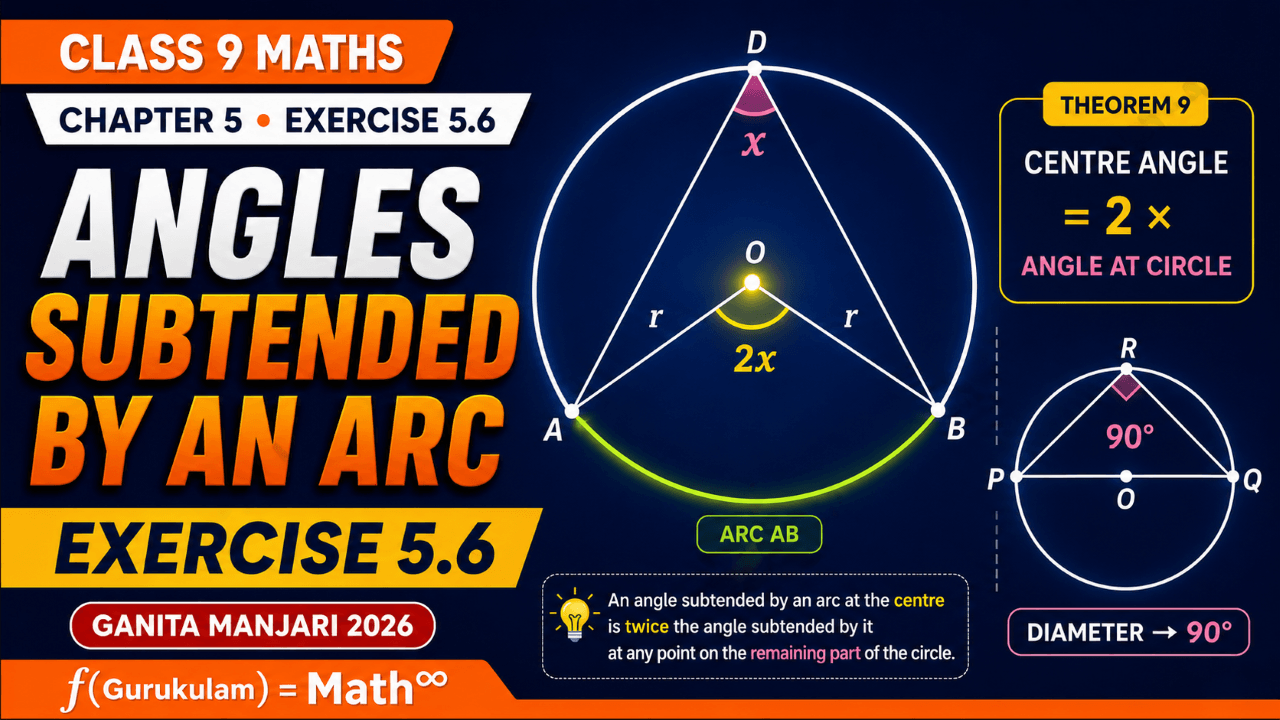
Class 9 Maths Chapter 5 Exercise 5.6 Solutions – Angles Subtended by an Arc

Class 9 Maths Chapter 5 Exercise 5.6 Solutions (Ganita Manjari 2026) – Angles Subtended by an Arc

šŸ“˜ NCERT Ganita Manjari (2026) šŸ“š CBSE 2026–27 šŸ† Step-by-Step Solutions

Class 9 Maths Chapter 5 Exercise 5.6 Solutions

Angles Subtended by an Arc

Prepare with complete Exercise 5.6 solutions from Chapter 5 – I’m Up and Down, and Round and Round based on the latest NCERT Ganita Manjari (2026). This exercise covers arcs, angles subtended by an arc, Theorem 9, angles in the same segment, and the important result for an angle subtended by a diameter. Questions 1, 2 and 3 are explained in a clear, step-by-step CBSE answer-writing style.

šŸ“–
Exercise
5.6
ā“
Questions
3 Questions
šŸ“
Main Concept
Angles &
Arcs
šŸ“
Key Result
Theorem 9
🧮
Centre Angle
= 2 Ɨ Circle Angle
⭐
Difficulty
Moderate
šŸŽÆ
Exam Importance
ā˜…ā˜…ā˜…ā˜…ā˜…
šŸŽÆ By the End of Exercise 5.6, You Will Be Able To…
āœ… Understand Major and Minor Arcs
āœ… Understand Angles Subtended by an Arc
āœ… Apply Theorem 9 Correctly
āœ… Understand Angles in the Same Segment
āœ… Use the Diameter–90° Result
āœ… Solve Questions 1, 2 and 3 Step by Step

šŸ“‘ Table of Contents

šŸ“– About Class 9 Maths Chapter 5 Exercise 5.6

Class 9 Maths Chapter 5 Exercise 5.6 Solutions cover the sixth exercise of Chapter 5 – I’m Up and Down, and Round and Round from the latest NCERT Ganita Manjari (2026). This page is designed for students looking for complete, reliable and easy-to-follow NCERT Class 9 Maths solutions arranged according to the exercise questions.

The page presents Exercise 5.6 in a clear, student-friendly CBSE answer-writing format and is useful for classroom practice, homework, self-study, revision and examination preparation. Each question is organised separately so students can quickly find the solution they need.

šŸŽÆ Exercise Snapshot

šŸ“˜ What You’ll Find
  • Complete coverage of Exercise Set 5.6.
  • NCERT-based solutions for all three questions.
  • Clear, question-wise presentation for Class 9 students.
šŸ“š Page Includes
  • Step-by-step NCERT solutions.
  • Complete Exercise 5.6 question coverage.
  • Simple CBSE answer-writing approach.
šŸ† Best For
  • Students following Ganita Manjari (2026).
  • Homework and classroom practice.
  • Revision and CBSE examination preparation.

šŸ“š Learn Before You Solve

✨ Solve ą¤•ą¤°ą¤Øą„‡ ą¤øą„‡ ą¤Ŗą¤¹ą¤²ą„‡ ą¤•ą„ą¤› ą¤øą„€ą¤–ą„‡ą¤‚

Exercise Set 5.6 ą¤•ą„‹ ą¤†ą¤øą¤¾ą¤Øą„€ ą¤øą„‡ हल ą¤•ą¤°ą¤Øą„‡ ą¤øą„‡ ą¤Ŗą¤¹ą¤²ą„‡, ą¤†ą¤‡ą¤ arcs और angles subtended by an arc ą¤•ą„‡ ą¤®ą„‚ą¤² concepts ą¤•ą„‹ ą¤øą¤®ą¤ą„‡ą¤‚ą„¤ यह section NCERT / Ganita Manjari Class 9 Mathematics ą¤•ą„‡ ą¤…ą¤Øą„ą¤øą¤¾ą¤° ą¤¹ą„ˆ, ą¤²ą„‡ą¤•ą¤æą¤Ø concepts ą¤•ą„‹ सरल और student-friendly ą¤¤ą¤°ą„€ą¤•ą„‡ ą¤øą„‡ ą¤øą¤®ą¤ą¤¾ą¤Æą¤¾ गया ą¤¹ą„ˆą„¤

यहाँ हम minor और major arcs, angle at the centre, angle at a point on the circle, Theorem 9 और angle in a semicircle ą¤•ą„‹ step-by-step ą¤øą¤®ą¤ą„‡ą¤‚ą¤—ą„‡ą„¤

Arc Basics

Understand arcs, their endpoints, and the difference between minor and major arcs.

Before learning how an arc subtends an angle, we first need to understand what an arc is and how two points on a circle can determine two different arcs.
šŸ“ Minor Arc and Major Arc
Minor arc and major arc of a circle between points A and B Class 9 Mathematics diagram showing a circle with centre O and two endpoints A and B on the circumference. The shorter arc AXB is the minor arc and the longer arc AYB is the major arc. The points X and Y lie on their respective arcs. A B O X Y Minor arc AXB Major arc AYB
Two arcs are formed between the same endpoints A and B.
What is an Arc?
An arc is a connected portion of a circle.

It is identified by its two points on the circle, called the endpoints, together with the curved part of the circle joining them.
šŸ“ Endpoints of an Arc
The two points on the circle that mark the ends of an arc are called its endpoints.
In the figure, A and B are the endpoints.
Minor Arc
The smaller of the two arcs between the same endpoints is called the minor arc.
Here: AXB
Major Arc
The larger of the two arcs between the same endpoints is called the major arc.
Here: AYB
šŸ’” Key Observation
The same two endpoints A and B can determine two arcs:
one minor arc and one major arc.

So, whenever a question refers to an arc, first identify which route between the two endpoints is being considered.
🧠 Remember
Same endpoints → Two arcs
Smaller arc → Minor arc    |    Larger arc → Major arc

Angle Subtended by an Arc at the Centre

Understand how a chosen arc of a circle determines an angle at its centre.

Once we understand an arc, the next step is to see how that arc subtends an angle at the centre of the circle. The angle depends on the particular arc chosen between the two endpoints.
šŸ“ Arc and Central Angle
Angle subtended by a minor arc at the centre of a circle Class 9 Mathematics diagram showing a circle with centre O, endpoints A and B, minor arc AXB, radii OA and OB, and the central angle AOB subtended by the minor arc AXB. A B O X ∠AOB Minor arc AXB OA OB
The minor arc AXB subtends ∠AOB at the centre O.
What Does ā€œAngle Subtended by an Arcā€ Mean?
Consider an arc AXB of a circle with centre O.

The endpoints of the arc are A and B. Join the centre O to A and B.

The angle formed at the centre is:
Angle Subtended at the Centre
∠AOB
The arc AXB subtends ∠AOB at the centre O.
šŸ”„ Think of It as an Angle Being Swept
Imagine moving from OA to OB along the chosen arc. The angle swept during this movement is the angle subtended by that arc at the centre.
Minor Arc
The smaller arc gives the smaller central angle.
Major Arc
The larger arc gives the larger central angle.
šŸ“Œ How to Identify the Arc
Central angle < 180° Minor arc
Central angle > 180° Major arc
🧠 Remember
An arc subtends an angle at the centre.
Minor arc → smaller central angle    |    Major arc → larger central angle

Angle Subtended at a Point on the Circle

See how the same fixed arc can subtend the same angle at suitable points on the circle.

We have seen how an arc subtends an angle at the centre. Now let us move the vertex from the centre to a point on the circumference. If A and B are the endpoints of a fixed arc and P, Q or R is a suitable point on the circle, the arc subtends angles such as ∠APB, ∠AQB and ∠ARB.
šŸ“ Fixed Arc and Angles at P, Q and R
Same arc AKB subtends equal angles APB, AQB and ARB Class 9 Mathematics Chapter 5 Circles, Exercise 5.6. A fixed minor arc AKB of a circle subtends the angles APB, AQB and ARB at suitable points P, Q and R on the circle outside the selected arc. The diagram illustrates the same arc subtending equal angles at suitable points on the circle. A B K P Q R ∠APB ∠AQB ∠ARB Fixed arc AKB
P, Q and R are suitable points on the circle outside the fixed arc AKB.
What Happens When the Point Moves?
Keep the arc AKB fixed. Now choose different points P, Q and R on the circle, outside the chosen arc.

Join each point to the endpoints A and B. We then obtain:
šŸ“ Angles Formed
∠APB    ∠AQB    ∠ARB
Each of these angles is subtended by the same fixed arc AKB.
šŸ”¬ Observe the Activity
Follow the idea of the NCERT activity:
  1. Fix the arc AKB.
  2. Choose suitable points P, Q and R on the circle outside the chosen arc.
  3. Join each point to A and B.
  4. Measure ∠APB, ∠AQB and ∠ARB.
  5. Compare the three measured angles.
šŸ”Ž Main Observation
Although the point of observation changes from P to Q to R, the fixed arc remains the same.

The angles subtended by this same arc at these suitable points are equal.
∠APB = ∠AQB = ∠ARB
āš ļø Important Condition — Do Not Miss This
It is not enough to remember the statement as:
āŒ ā€œSame chord → always equal angles.ā€
The point where the angle is formed must be a point on the circle and must lie in the required position outside the chosen arc.
āœ… Same fixed arc + suitable points on the circle → equal angles subtended by that arc
🧠 Remember
Same fixed arc → Same angle at suitable points on the circle

šŸ”µ Theorem 9

Angle subtended by an arc at the centre and at a point on the circle

Theorem 9
The angle subtended by an arc at the centre of the circle is double the angle subtended by the arc at any point on the circle outside the arc.
⭐ Core Relationship
Angle at centre = 2 Ɨ Angle at circle
Angle at circle = ½ Ɨ Angle at centre

Case 1 — Complete Proof

Given,
AFB is an arc of a circle.
∠ACB is the angle subtended by arc AFB at the centre C.
D is a point on the circle outside arc AFB.
The extension of DC meets the circle at E on arc AFB.
To show,
∠BCA = 2∠BDA
šŸ“ Figure — Case 1
Theorem 9 Case 1 proof diagram Class 9 Mathematics Chapter 5 Circles diagram for Theorem 9 Case 1. A and B are endpoints of arc AFB. C is the centre. D is a point on the circle outside the arc. DC is extended through C to meet the circle again at E. Lines CA, CB, DA and DB are drawn for the proof. A B F E C D ∠BCA ∠BDA
Case 1: D lies outside the chosen arc AFB and D, C, E are collinear.
āœļø Proof
Since CB and CD are radii of the same circle,
CB = CD
[Radii of the same circle]
Therefore, ā–³DCB is an isosceles triangle.
∠CBD = ∠CDB
[Angles opposite equal sides of an isosceles triangle]
Since CE is an extension of CD, ∠BCE is an exterior angle of ā–³BCD.
∠BCE = ∠CBD + ∠CDB
[Exterior angle theorem]
∠BCE = 2∠BDC
[Since ∠CBD = ∠CDB]
Similarly, CA and CD are radii of the same circle.
CA = CD
[Radii of the same circle]
Therefore, ā–³ADC is an isosceles triangle.
∠CAD = ∠CDA
[Angles opposite equal sides of an isosceles triangle]
Since CE is an extension of CD, ∠ACE is an exterior angle of ā–³ACD.
∠ACE = ∠CAD + ∠CDA
[Exterior angle theorem]
∠ACE = 2∠CDA
[Since ∠CAD = ∠CDA]
Now, CE lies inside ∠BCA. Therefore,
∠BCA = ∠BCE + ∠ECA
Substituting the two results obtained above,
∠BCE = 2∠BDC
∠ECA = 2∠CDA
Hence,
∠BCA = 2∠BDC + 2∠CDA
∠BCA = 2(∠BDC + ∠CDA)
But,
∠BDA = ∠BDC + ∠CDA
[DC lies inside ∠BDA]
Therefore,
∠BCA = 2∠BDA
āœ… Hence Proved
∠BCA = 2∠BDA
🧠 Theorem 9 — Key Idea
Angle subtended by an arc at the centre = 2 Ɨ angle subtended by the same arc at a suitable point on the circle.
∠BCA = 2∠BDA

Case 2 — Extension of DC Meets the Circle at E

Given,
AFB is an arc. ∠ACB is the angle subtended by arc AFB at centre C. D is a point on the circle outside arc AFB such that when we extend DC it cuts the circle at some point E outside the arc AFB, as shown in Fig. 5.22.
To show,
∠ACB = 2∠ADB
šŸ“ Figure
Fig. 5.22 — Theorem 9 Case 2, angle subtended by arc AFB Class 9 Mathematics geometry diagram for Theorem 9. A, B, D and E are points on the circumference of a circle with centre C. AFB is the arc from A to B. D is on the circle outside arc AFB. DC is extended to E on the circumference. CA, CB, DA and DB are drawn. A F B D C E
Fig. 5.22: Angle subtended by arc AFB
āœļø Proof
Since CA = CD, triangle ā–³ADC is an isosceles triangle.
∠ADC = ∠CAD
[Angles opposite equal sides of an isosceles triangle]
∠ACE is the exterior angle of ā–³ADC.
∠ACE = ∠ADC + ∠CAD
[Exterior angle theorem]
∠ACE = 2∠ADC
[Since ∠ADC = ∠CAD]
Similarly, ā–³BCD is an isosceles triangle because
CB = CD
[Radii of the same circle]
∠BDC = ∠CBD
[Angles opposite equal sides of an isosceles triangle]
∠BCE is the exterior angle of ā–³BCD.
∠BCE = ∠BDC + ∠CBD
[Exterior angle theorem]
∠BCE = 2∠BDC
[Since ∠BDC = ∠CBD]
šŸ”Ž Now combine the two angle relations
Since E lies outside arc AFB, the central angle is obtained by subtracting the two exterior angles.
Also,
∠ACB = ∠ACE āˆ’ ∠BCE
= 2∠ADC āˆ’ 2∠BDC
= 2(∠ADC āˆ’ ∠BDC)
Also,
∠ADB = ∠ADC āˆ’ ∠BDC
Therefore,
∠ACB = 2(∠ADB)
Hence,
∠ACB = 2∠ADB
āœ… Hence Proved
∠ACB = 2∠ADB

Same Arc → Equal Angles

A useful consequence of Theorem 9
Once we know Theorem 9, we can understand an important pattern in a circle: the same arc subtends equal angles at suitable points on the circle.
In the figure, the fixed arc is AXB. Points D, E and F lie on the circle outside this arc.
šŸ“ Same Arc Subtends Equal Angles
Same arc AXB subtends equal angles at D, E and F Class 9 Mathematics diagram showing a fixed arc AXB of a circle. C is the centre. D, E and F are suitable points on the circle outside arc AXB. The angles ADB, AEB and AFB are equal and represented by theta. The central angle ACB is represented by 2 theta. The angle markings are positioned inside their respective angles. Īø Īø Īø 2Īø A X B D E F C
Same arc AXB subtends equal angles at D, E and F.

šŸ”Ž Why are the three angles equal?

The arc AXB is fixed. Therefore, the central angle subtended by this arc, ∠ACB, is the same for every point chosen on the circle outside the arc.
∠ACB = 100°
∠ADB = ∠AEB = ∠AFB = ½ Ɨ 100° = 50°
This follows directly from Theorem 9:

Angle at the centre = 2 Ɨ angle at the circle

So, for the same arc, every suitable point on the circle gives the same angle.
Same arc AXB
↓
Same central angle ∠ACB
↓
∠ADB = ∠AEB = ∠AFB = 50°
āš ļø Important Condition
The points D, E and F must be on the circle and in the appropriate position outside the chosen arc AXB.

So do not remember this as simply: ā€œSame chord → always equal angles.ā€

The correct idea is: Same arc + suitable points on the circle → equal angles.
🧠 Student Memory
Same arc + suitable points on the circle → Equal angles
∠ADB = ∠AEB = ∠AFB

šŸ”µ Corollary — Angle in a Semicircle

A 90° angle follows directly from Theorem 9
The angle subtended by a diameter at any point on the circle is 90°.
This result is called the angle in a semicircle.
šŸ“ Angle in a Semicircle
Angle in a semicircle is 90 degrees Class 9 Mathematics diagram showing a circle with centre C and diameter AB. Point D lies on the circumference. Triangle ADB is formed by joining D to A and B. The angle ADB is marked as a right angle, showing that the angle subtended by a diameter at a point on the circle is 90 degrees. 90° A B D C
AB is a diameter, so the angle ADB is a right angle.

šŸ”Ž Why is the angle 90°?

Let AB be a diameter of the circle and C be its centre.
Since AB is a diameter, the radii CA and CB form a straight angle at the centre.
∠ACB = 180°
By Theorem 9, the angle subtended by an arc at the centre is twice the angle subtended by the same arc at a point on the circle.
Therefore,
∠ADB = ½ Ɨ ∠ACB
∠ADB = ½ Ɨ 180°
= 90°
Therefore, ∠ADB = 90° .

Hence, the angle subtended by a diameter at any point on the circle is a right angle.
šŸ’” What is a Corollary?
A corollary is a fact that follows immediately from an already proved result.

Here, the 90° result follows directly from Theorem 9.
🧠 Quick Memory
Diameter → Central angle = 180°
Theorem 9 → Angle at circle = ½ Ɨ 180°
Therefore → Angle in a semicircle = 90°

🟠 Same Arc Segment: What Changes and What Does Not?

Same arc does not mean ā€œsame chord → always equal anglesā€
The important question is not only which chord is used. We must also look at which arc is being considered and where the vertex of the angle lies.
Let us compare the correct situation with other positions.
āœ… Suitable Points — Same Arc, Equal Angles
Same arc AXB subtends equal angles at D, E and F Class 9 Mathematics circle diagram showing a fixed arc AXB with endpoints A and B. D, E and F are suitable points on the circle outside the selected arc. Lines AD, BD, AE, BE, AF and BF are drawn, and the angles ADB, AEB and AFB are marked equally with theta. The diagram illustrates that angles subtended by the same arc at appropriate points on the circle are equal. Īø Īø Īø A X B D E F
D, E and F lie on the circle in the required position relative to the selected arc AXB.
The arc AXB is fixed.

When suitable points D, E and F are taken on the circle outside this selected arc, the same arc subtends equal angles:

∠ADB = ∠AEB = ∠AFB

This is the situation described by Theorem 9: the angle subtended by the same arc at suitable points on the circle remains the same.
āš ļø Other Positions — Do Not Apply Automatically
Why position of the angle vertex matters for angles subtended by a chord Comparison diagram showing a circle with chord AB. A point P is inside the circle and a point Q is outside the circle. Lines from A and B to the different points show that the familiar equal-angle result cannot be applied blindly when the required position of the vertex is not satisfied. A B P Q inside the circle outside the circle
The position of the vertex matters; do not apply the equal-angle rule without checking the conditions.
The statement ā€œsame chord → always equal anglesā€ is too broad.

The theorem concerns the angle subtended by a specified arc at a point on the circle in the appropriate position relative to that arc.

Therefore, simply seeing the same endpoints A and B is not enough to apply the result.
šŸ” Before You Use ā€œSame Arc → Equal Anglesā€
  1. Which arc is being considered?
  2. Where is the vertex of the angle?
  3. Is the vertex on the circle?
  4. Is it in the required position outside the selected arc?
🚫 Important: Do Not Memorise the Wrong Rule
āŒ Wrong shortcut: ā€œSame chord always gives equal angles.ā€

āœ… Correct understanding: ā€œAngles subtended by the same arc at appropriate points on the circle are equal.ā€
🧠 Student Memory Rule
Same arc + Suitable points on the circle → Equal angles
Always check the arc and the position of the vertex first.

šŸ”— Concept Connection

अब तक ą¤øą„€ą¤–ą„‡ ą¤—ą¤ ą¤øą¤­ą„€ concepts ą¤ą¤•-ą¤¦ą„‚ą¤øą¤°ą„‡ ą¤øą„‡ ą¤œą„ą¤”ą¤¼ą„‡ ą¤¹ą„ą¤ ą¤¹ą„ˆą¤‚ą„¤ इस connection ą¤•ą„‹ ą¤øą¤®ą¤ ą¤²ą„‡ą¤Øą„‡ पर Exercise 5.6 ą¤•ą„‡ questions ą¤•ą„‹ solve करना ą¤¬ą¤¹ą„ą¤¤ आसान ą¤¹ą„‹ जाता ą¤¹ą„ˆą„¤

Step 1 Arc
Step 2 Minor Arc / Major Arc
Step 3 Central Angle
Step 4 Angle at a Point on the Circle
⭐ Theorem 9 Centre angle = 2 Ɨ angle at the circle
Consequence Same arc → Equal angles
šŸ”µ Corollary Diameter → 90°
Remember: Arc → Central Angle → Angle on Circle → Theorem 9 → Equal Angles → Diameter gives 90°.

⚔ Quick Revision Dashboard

Exercise 5.6 — Angles Subtended by an Arc
šŸŽÆ CORE IDEA
Central Angle = 2 Ɨ Angle at the Circle
šŸ”µ 1. Arc
An arc is a connected portion of a circle between two points on the circle.

The smaller arc is the minor arc and the larger arc is the major arc.
Smaller → Minor Arc
Larger → Major Arc
šŸ“ 2. Angle Subtended at Centre
If an arc has endpoints A and B, the angle subtended by the arc at centre O is the central angle ∠AOB.

The angle depends on the arc being swept from OA to OB.
Minor arc → smaller central angle
Major arc → larger central angle
🟠 3. Angle at a Point on the Circle
If A and B are the endpoints of an arc and D is a suitable point on the circle outside the selected arc, then the arc subtends ∠ADB at D.

The angle does not depend on which suitable point on the circle is selected.
Same arc + suitable point on circle → same subtended angle
⭐ Theorem 9
The angle subtended by an arc at the centre of the circle is double the angle subtended by the arc at any point on the circle outside the arc.
∠Centre = 2 Ɨ ∠Circle
∠Circle = ½ Ɨ ∠Centre
🧠 Theorem 9 — Quick Use
Whenever a question gives the angle at the centre and asks for the angle at a suitable point on the circle:
Angle at circle = ½ Ɨ central angle
If the angle at the circle is given, then:
Central angle = 2 Ɨ angle at circle
šŸ”— Same Arc → Equal Angles
For a fixed arc AB, if D, E, F are suitable points on the circle outside that arc, then:
∠ADB = ∠AEB = ∠AFB
Each angle is half of the same central angle.
āš ļø Important Condition
Do not memorise the wrong rule!
  • āŒ Same chord always gives equal angles.
  • āœ… Check which arc is being considered.
  • āœ… The vertex must be on the circle.
  • āœ… The point must be in the required position outside the selected arc.
šŸ”µ Corollary — Angle in a Semicircle
A diameter subtends a straight angle of 180° at the centre.

By Theorem 9:
∠ at circle = ½ Ɨ 180° = 90°
Diameter → 90°
The angle in a semicircle is a right angle.
šŸ”— Concept Connection
Arc
→
Minor / Major Arc
→
Central Angle
→
Angle on Circle
→
Theorem 9
→
Same Arc → Equal Angles
→
Diameter → 90°
šŸ“ Exercise Set 5.6 — Questions at a Glance
1
A circle has centre O, central angle ∠AOB = 60° and radius 12 cm. Find the length of chord AB.
2
For points A and B on a circle, analyse whether points X and Y can produce different/equal subtended angles and whether equal angles imply the required cyclic position.
3
In Fig. 5.26, the angle at D is 100°. Find x.
🧩 Q3 — Key Idea
In the cyclic quadrilateral of Fig. 5.26, the opposite angles are supplementary.
x + 100° = 180°

x = 80°
Final Answer: x = 80°
āœ… Exam Checklist
āœ“ Identify the arc first.
āœ“ Identify the central angle.
āœ“ Check the position of the point on the circle.
āœ“ Use Theorem 9 carefully.
āœ“ Same arc → equal angles only under the required condition.
āœ“ Diameter → 90°.
⭐ Arc → Central Angle → Angle on Circle   |   Centre Angle = 2 Ɨ Circle Angle   |   Diameter → 90°

šŸ“ Class 9 Maths Chapter 5 Exercise 5.6 Solutions

Solve all three questions of Class 9 Maths Chapter 5 Exercise 5.6 with clear, step-by-step NCERT Ganita Manjari (2026) solutions. This exercise focuses on angles subtended by an arc, Theorem 9, angles in the same arc segment and the important result for an angle subtended by a diameter.

šŸ“ Step-by-Step Solutions šŸŽÆ NCERT & CBSE Aligned ⭐ Complete Exercise 5.6
Question 1
In a circle with centre O, the central angle AOB is 60°. If the radius of the circle is 12 cm, what is the length of the chord AB?
āœļø Solution
Given,
Radius of the circle = 12 cm
∠AOB = 60°
To find,
Length of chord AB
šŸ“ Figure
Class 9 Maths Exercise 5.6 Question 1 — Chord AB with central angle AOB equal to 60 degrees A circle with centre O and radius 12 cm. A and B are points on the circumference and AB is a chord. Radii OA and OB form a central angle AOB of 60 degrees. Triangle AOB is shown to determine the length of chord AB. 60° A B O 12 cm 12 cm AB = ?
OA = OB = 12 cm and ∠AOB = 60°.
āœļø Solution
Since OA and OB are radii of the same circle,
OA = OB
Therefore, ā–³AOB is an isosceles triangle.
Given,
∠AOB = 60°
Since OA = OB, the angles opposite to these equal sides are equal.
∠OAB = ∠OBA
In ā–³AOB, the sum of the three angles is 180°.
∠OAB + ∠OBA + ∠AOB = 180°
∠OAB + ∠OBA + 60° = 180°
∠OAB + ∠OBA = 120°
But,
∠OAB = ∠OBA
∠OAB = ∠OBA = 60°
Thus all three angles of ā–³AOB are 60°.
∠OAB = ∠OBA = ∠AOB = 60°
Therefore, ā–³AOB is an equilateral triangle.
Key idea: In an equilateral triangle, all three sides are equal.
Hence,
AB = OA = OB
Since the radius is 12 cm,
AB = 12 cm
āœ… Final Answer
Length of chord AB = 12 cm
Question 2
Let A and B be two points on a circle with centre O.
  1. Are there points X, Y on the circle, on the same side of AB, such that ∠AXB is different from ∠AYB?
  2. Is it true that if ∠AXB = ∠AYB, then X and Y lie on the same side of AB?
  3. If ∠AXB = ∠AYB, and X and Y do not lie on the circle, does the circle through A, B and X also pass through Y?
Question 2 (i)
Are there points X, Y on the circle, on the same side of AB, such that ∠AXB is different from ∠AYB?
āœļø Solution
Given,
A and B are two points on a circle.
X and Y are points on the circle on the same side of chord AB.
šŸ“ Figure
Same chord AB subtends equal angles at X and Y in the same segment of a circle Class 9 Mathematics geometry diagram showing a circle with chord AB. Points X and Y lie exactly on the circumference on the same side of chord AB. Lines AX, BX, AY and BY are drawn. The angles AXB and AYB are marked theta with angle arcs placed correctly between their respective arms. Īø Īø A B X Y
X and Y lie on the same segment of the circle.
Solution
Since X and Y lie on the same side of chord AB, the angles ∠AXB and ∠AYB are subtended by the same chord AB in the same segment of the circle.
Angles subtended by the same chord in the same segment of a circle are equal.
∠AXB = ∠AYB
Therefore, ∠AXB cannot be different from ∠AYB.
∓ No, there are no such points X and Y on the same side of AB for which ∠AXB is different from ∠AYB.
Question 2 (ii)
Is it true that if ∠AXB = ∠AYB, then X and Y lie on the same side of AB?
āœļø Solution
Given,
A and B are two fixed points on a circle.
∠AXB = ∠AYB.
We have to determine whether X and Y must lie on the same side of AB.
šŸ“ Figure
Points X and Y on opposite sides of chord AB Class 9 Mathematics circle diagram showing chord AB and points X and Y on opposite sides of AB. Lines AX, BX, AY and BY form equal angles at X and Y. The figure illustrates the special case when AB is a diameter, so both angles are right angles. O 90° 90° A B X Y
X and Y lie on opposite sides of diameter AB, yet both subtend a right angle at AB.
Solution
No, it is not necessarily true.
Consider the special case in which AB is a diameter of the circle.
By the theorem on the angle in a semicircle, the angle subtended by diameter AB at any point on the circle is a right angle.
∠AXB = 90°
∠AYB = 90°
Therefore,
∠AXB = ∠AYB
But X and Y are on opposite sides of AB. Hence, equality of ∠AXB and ∠AYB does not imply that X and Y must lie on the same side of AB.
∓ No, X and Y need not lie on the same side of AB.
Question 2 (iii)
If ∠AXB = ∠AYB, and X and Y do not lie on the circle, does the circle through A, B and X also pass through Y?
āœļø Solution
Given,
A and B are two fixed points.
X and Y are points not lying on the circle.
∠AXB = ∠AYB.
šŸ“ Figure
Same chord AB subtends equal angles at X and Y in the same segment of a circle Class 9 Mathematics geometry diagram showing a circle with chord AB. Points X and Y lie exactly on the circumference on the same side of chord AB. Lines AX, BX, AY and BY are drawn. The angles AXB and AYB are marked theta with angle arcs placed correctly between their respective arms. Īø Īø A B X Y
The circle through A, B and X also passes through Y.
Solution
Let the circle passing through A, B and X be drawn. We are given that
∠AXB = ∠AYB
The angle ∠AXB is the angle subtended by chord AB at X. Since ∠AYB is equal to ∠AXB, the point Y lies on the same circle through A, B and X.
Therefore, the four points A, B, X and Y lie on one circle.
Key idea: Equal angles standing on the same chord AB identify points lying on the same circle.
∓ Yes, the circle through A, B and X also passes through Y.
Question 3
Find x in Fig. 5.26.
āœļø Solution
Given,
A, B, C and D are points on the same circle.
∠ADC = 100°.
∠ABC = x.
šŸ“ Figure 5.26
Fig. 5.26 — Cyclic quadrilateral ABCD with angles 100 degrees and x Class 9 Mathematics diagram showing cyclic quadrilateral ABCD. A, D, C and B lie on the circumference of a circle. Angle ADC is 100 degrees and angle ABC is x. The angle arcs are accurately positioned between the two arms of each angle. 100° x A D C B
Fig. 5.26 — A, B, C and D lie on the same circle.
Solution
Since A, B, C and D lie on the same circle, ABCD is a cyclic quadrilateral.
Property used: Opposite angles of a cyclic quadrilateral are supplementary.
Therefore,
∠ADC + ∠ABC = 180°
100° + x = 180°
x = 180° āˆ’ 100°
x = 80°
∓ x = 80°

šŸ“š Continue Learning

Congratulations! You have completed the Class 9 Maths Chapter 5 Exercise 5.6 Solutions. You have now worked through Exercise 5.6 of Chapter 5 – I’m Up and Down, and Round and Round. Continue your learning journey by moving to the previous or next exercise, or revisiting Exercise 5.6 whenever you need a quick revision.


šŸ“– Explore More Class 9 Maths Chapters

ā“ Frequently Asked Questions

Find quick answers to common questions about Class 9 Maths Chapter 5 Exercise 5.6 Solutions. These FAQs help students understand what is covered in the exercise, how the questions are approached, and how to use the solutions effectively for learning, revision, and examination preparation.

What is the main focus of Class 9 Maths Exercise 5.6?

Exercise 5.6 of Class 9 Maths Chapter 5 focuses on angles subtended by an arc. The exercise applies the ideas developed in this part of the chapter, including Theorem 9, angles in the same arc segment, and the special result for an angle subtended by a diameter.

How many questions are there in Exercise 5.6?

There are three questions in Exercise 5.6. Question 2 also contains three parts, so the page presents Question 1, Question 2(i), Question 2(ii), Question 2(iii), and Question 3 separately for easier learning and revision.

What is Theorem 9 in Class 9 Maths Chapter 5?

Theorem 9 states that the angle subtended by an arc at the centre of a circle is double the angle subtended by the same arc at any point on the circle outside the arc. Thus, if the angle at the centre is known, the corresponding angle at the circle is half of it.

What should I know before attempting Exercise 5.6?

Students should be familiar with the basic meaning of an arc, major arc, minor arc, and an angle subtended by an arc at the centre or at a point on the circle. The preceding pages of Chapter 5 also introduce the ideas needed to understand Theorem 9 and its applications.

What is the relationship between the angle at the centre and the angle at the circle?

According to Theorem 9, the angle subtended by an arc at the centre is twice the angle subtended by the same arc at a point on the circle outside the arc. Therefore, angle at the circle = half the angle at the centre.

Why is the angle subtended by a diameter 90°?

A diameter subtends a straight angle of 180° at the centre. By Theorem 9, the angle subtended by the same diameter at any point on the circle is half of this angle: 180° ÷ 2 = 90°. Thus, the angle subtended by a diameter at any point on the circle is 90°.

What does it mean that angles in the same arc segment are equal?

For the same arc, the angles subtended at different suitable points on the circle in the same arc segment are equal. The textbook illustrates this using points on the circle and shows that the corresponding subtended angles have the same measure.

Are these Class 9 Maths Exercise 5.6 Solutions based on Ganita Manjari 2026?

Yes. These Class 9 Maths Chapter 5 Exercise 5.6 Solutions are prepared for the latest NCERT Ganita Manjari (2026) textbook and follow the concepts, terminology, theorem and questions covered in Exercise Set 5.6. The solutions are presented in a student-friendly, step-by-step format for classroom practice, self-study, revision and CBSE examination preparation.

šŸ“š Useful Learning Resources

Continue your preparation with more Class 9 Maths resources from Maths Gurukulam, or visit the official NCERT and CBSE websites for the latest textbooks, syllabus, and academic updates.

Need Personal Guidance in Maths?

Find Class 9 Maths Chapter 5 Exercise 5.6 Solutions helpful? For students who need personal support beyond self-study, join Newton Study Point for concept-based Maths coaching by an experienced teacher. Small batches, individual attention, regular tests, and complete CBSE exam preparation are available for Classes 8, 9, 10, 11 & 12.

šŸ“ž Call Now: 8447002272 šŸ’¬ WhatsApp šŸ« Explore Newton Study Point

šŸ“ Newton Study Point • Ankur Vihar, Ghaziabad

Rakesh Kumar Singh - M.Sc. Mathematics - Maths Educator
šŸ‘Øā€šŸ« Reviewed & Prepared By

Rakesh Kumar Singh

M.Sc. Mathematics • Founder & Mathematics Educator, Maths Gurukulam & Newton Study Point
18+ Years of Mathematics Teaching Experience • Teaching Since 2006

These Class 9 Maths Chapter 5 Exercise 5.6 Solutions are carefully prepared according to the latest NCERT Ganita Manjari (2026) and the CBSE curriculum. The solutions follow a clear, step-by-step approach to help students understand the questions in Exercise 5.6 and build confidence in solving circle and angle-based problems.

šŸ“˜ NCERT Ganita Manjari (2026) šŸŽÆ CBSE Aligned šŸ“ Step-by-Step Solutions šŸ’” Concept-Based Learning
Know More About the Author →

Leave A Reply

Your email address will not be published. Required fields are marked *

You May Also Like