📖 About Class 9 Maths Chapter 1 End of Chapter Exercise
Class 9 Maths Chapter 1 End of Chapter Exercise Solutions provide complete, easy-to-follow solutions to the End-of-Chapter Exercises from Chapter 1, Orienting Yourself: The Use of Coordinates, in the latest NCERT Ganita Manjari (2026). This page is designed for students looking for reliable NCERT Class 9 Maths solutions for coordinate geometry questions in a clear and student-friendly format.
The exercise covers questions based on the Cartesian coordinate system, coordinates of points, quadrants, distance between points, midpoint, collinearity, geometrical figures, and real-life applications of coordinates. The solutions are arranged question-wise to make homework, classroom practice, revision and CBSE examination preparation simple and convenient.
🎯 Exercise Snapshot
- Complete coverage of the End-of-Chapter Exercises.
- NCERT-based solutions for all 16 questions.
- Clear, question-wise presentation for Class 9 students.
- Step-by-step NCERT solutions.
- Coordinate geometry and graphical questions.
- Simple CBSE answer-writing approach.
- Students following Ganita Manjari (2026).
- Homework and classroom practice.
- Revision and CBSE examination preparation.
📍 Topics Covered in This Exercise
🎯 What You Will Learn
After completing these Class 9 Maths Chapter 1 End Exercise Solutions, you will be able to confidently solve coordinate geometry questions asked in CBSE examinations.
📑 Chapter 1 End Exercise
Quick Navigation to All Questions
Learn Before You Solve
Before solving the Class 9 Maths Chapter 1 End Exercise, quickly revise these important concepts and formulas. Spending one minute here will help you solve the questions faster and avoid common mistakes.
📍 Origin
The origin is the point where the x-axis and
y-axis intersect.
Origin = (0, 0)
↔ Parallel Lines
Parallel to x-axis → y = constant
Parallel to y-axis → x = constant
📏 Distance Formula
√[(x₂ − x₁)² + (y₂ − y₁)²]
📌 Midpoint Formula
((x₁ + x₂)/2 , (y₁ + y₂)/2)
🎯 Collinear Points
Three or more points are collinear if they lie on the same straight line.
🪞 Reflection Rules
Across x-axis → (x, −y)
Across y-axis → (−x, y)
💡 Quick Exam Tip
Revise these concepts before attempting the exercise. Most mistakes in coordinate geometry occur because students forget the formulas for distance, midpoint, or the rules for parallel lines.
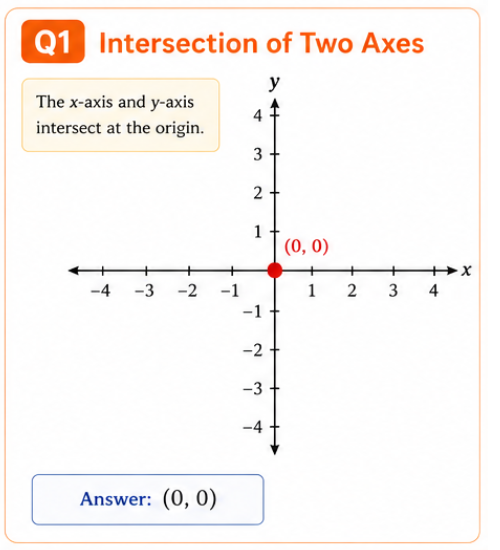
Q1 Intersection of Two Axes
Given: x-axis and y-axis
To Find: Coordinates of their point of intersection
Solution:
All points on x-axis have y = 0
All points on y-axis have x = 0
At intersection, both conditions are satisfied:
x = 0, y = 0
Q2 Point on Line Parallel to y-axis
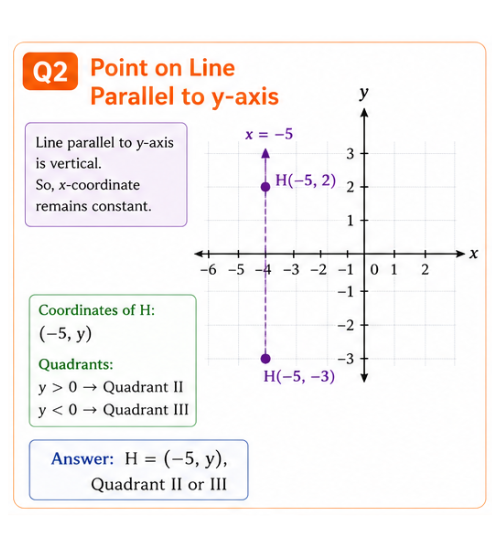
Given: Point W has x-coordinate = −5
To Find: Coordinates of point H and possible quadrants
Solution:
A line parallel to the y-axis is vertical, so x-coordinate remains constant.
Therefore, coordinates of H will be:
H = (−5, y)
If y > 0 → Quadrant II
If y < 0 → Quadrant III
Q3 Quadrilateral RAMP
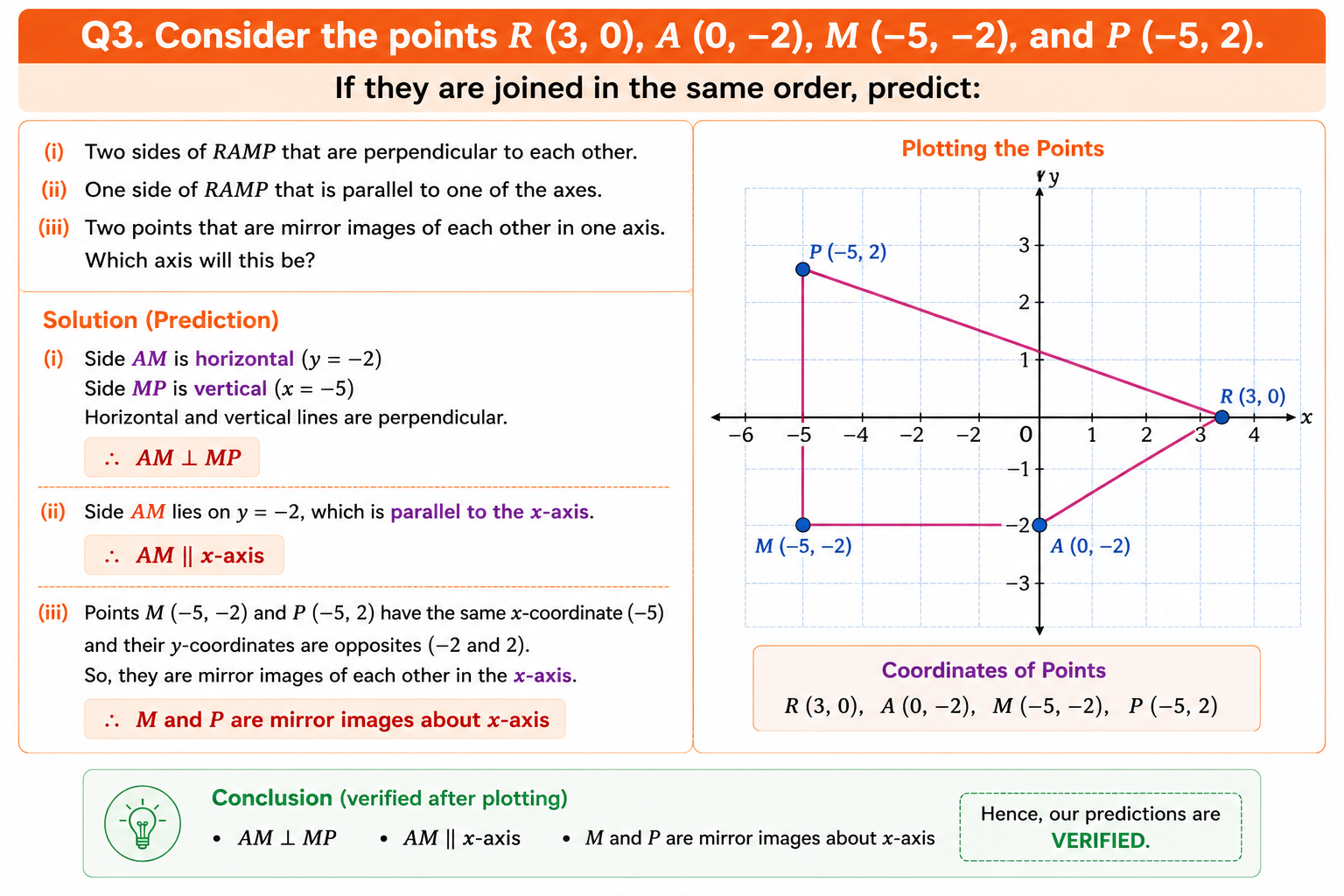
Given: R(3,0), A(0,−2), M(−5,−2), P(−5,2)
To Find:
(i) Perpendicular sides
(ii) Side parallel to axis
(iii) Mirror image points
Solution:
(i) AM has same y-coordinate → horizontal
MP has same x-coordinate → vertical
Therefore, AM ⟂ MP
(ii) AM is parallel to x-axis
(iii) M(−5,−2) and P(−5,2) have same x but opposite y
Hence, they are mirror images about x-axis
(i) AM ⟂ MP
(ii) AM ∥ x-axis
(iii) M and P are mirror images about x-axis
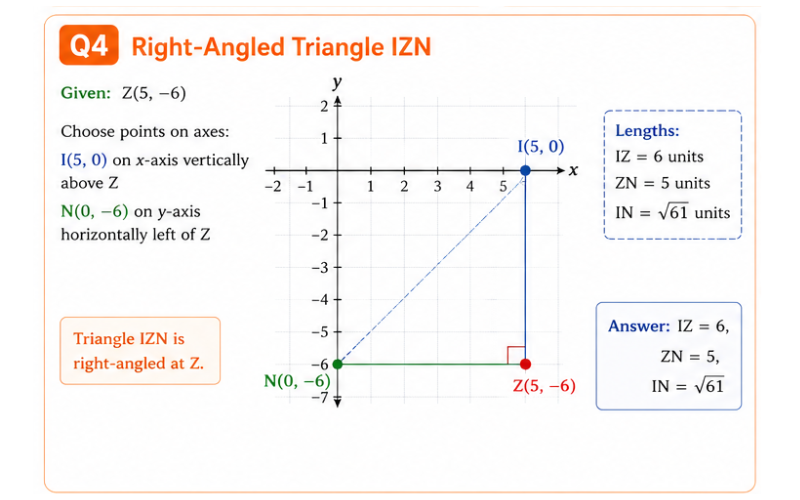
Q4 Right-Angled Triangle IZN
Given: Z(5, −6)
To Find: Lengths of sides of triangle IZN
Solution:
Choose points on axes:
I(5,0) and N(0,−6)
Using distance formula:
IZ = √[(5−5)² + (−6−0)²] = √36 = 6
ZN = √[(5−0)² + (−6+6)²] = √25 = 5
IN = √[(5−0)² + (0+6)²] = √61
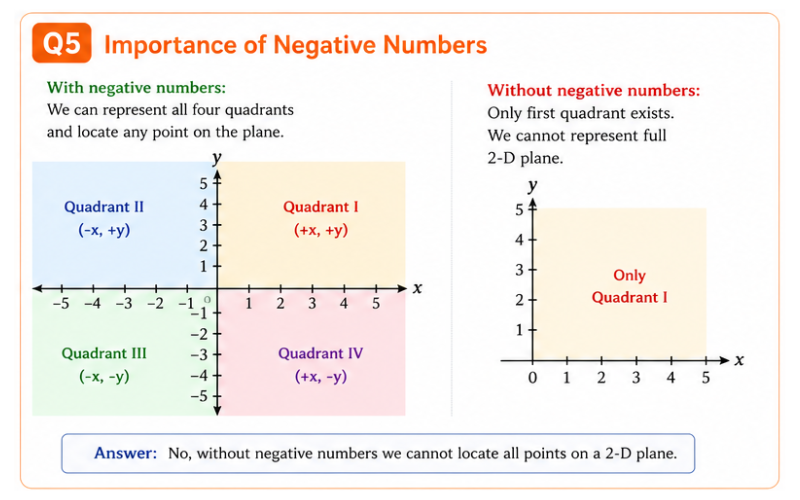
Q5 Importance of Negative Numbers
Given: Coordinate system without negative numbers
To Find: Whether all points can be located
Solution:
Without negative numbers, only positive values of x and y exist.
This represents only the first quadrant.
Other quadrants cannot be represented.
🎯 Need help in Maths? Join Class 9 Maths Coaching in Ankur Vihar for step-by-step guidance and test practice.
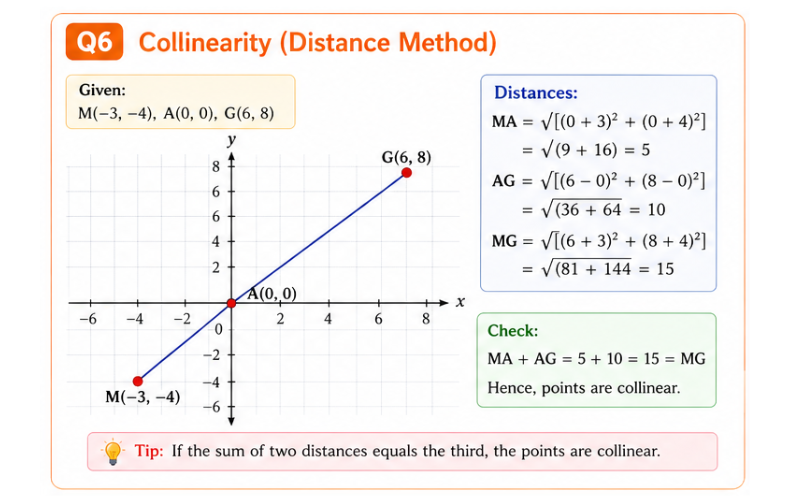
Q6 Collinearity (Distance Method)
Given: M(−3,−4), A(0,0), G(6,8)
To Find: Whether points are collinear
Solution:
Distance MA:
√[(0 + 3)² + (0 + 4)²] = √(9 + 16) = 5
Distance AG:
√[(6 − 0)² + (8 − 0)²] = √(36 + 64) = 10
Distance MG:
√[(6 + 3)² + (8 + 4)²] = √(81 + 144) = 15
MA + AG = 5 + 10 = 15 = MG
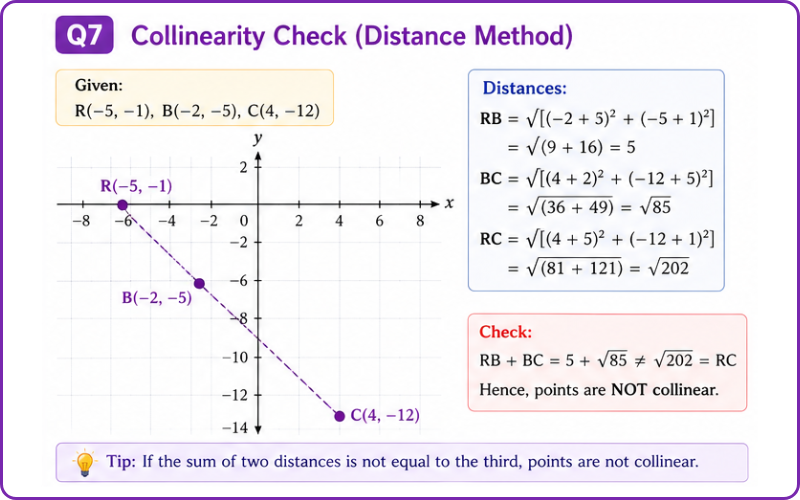
Q7 Collinearity Check (Distance Method)
Given: R(−5,−1), B(−2,−5), C(4,−12)
To Find: Whether points are collinear
Solution:
RB:
√[(−2 + 5)² + (−5 + 1)²] = √(9 + 16) = 5
BC:
√[(4 + 2)² + (−12 + 5)²] = √(36 + 49) = √85
RC:
√[(4 + 5)² + (−12 + 1)²] = √(81 + 121) = √202
RB + BC ≠ RC
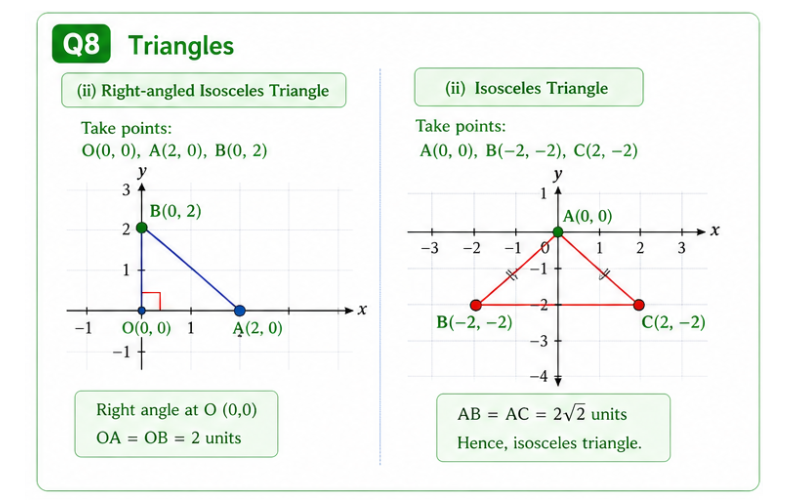
Q8 Triangles
To Find: Coordinates of required triangles
Solution:
(i) Right-angled isosceles triangle:
O(0,0), A(2,0), B(0,2)
(ii) Isosceles triangle:
A(0,0), B(−2,−2), C(2,−2)
Q9 Midpoint Verification
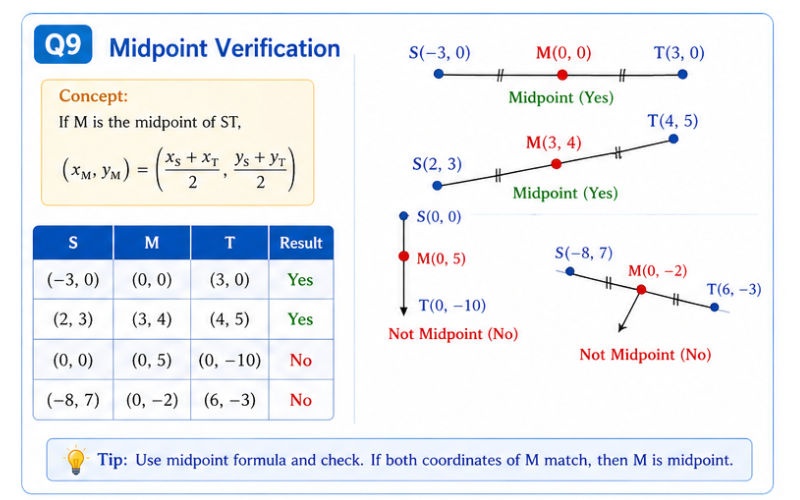
To Find: Whether M is midpoint of ST
Solution:
| S | M | T | Result |
|---|---|---|---|
| (−3,0) | (0,0) | (3,0) | Yes |
| (2,3) | (3,4) | (4,5) | Yes |
| (0,0) | (0,5) | (0,−10) | No |
| (−8,7) | (0,−2) | (6,−3) | No |
Q10 Find Coordinates of B (Using Midpoint Formula)
Given: M(−7,1), A(3,−4), B(x,y)
Step 1: Use midpoint formula
M = ( (x₁ + x₂)/2 , (y₁ + y₂)/2 )
Step 2: Substitute values
−7 = (3 + x)/2
1 = (−4 + y)/2
Step 3: Solve
Multiply both sides by 2:
−14 = 3 + x → x = −17
2 = −4 + y → y = 6
Q11 Trisection of Line Segment
Given: A(4,7), B(16,−2)
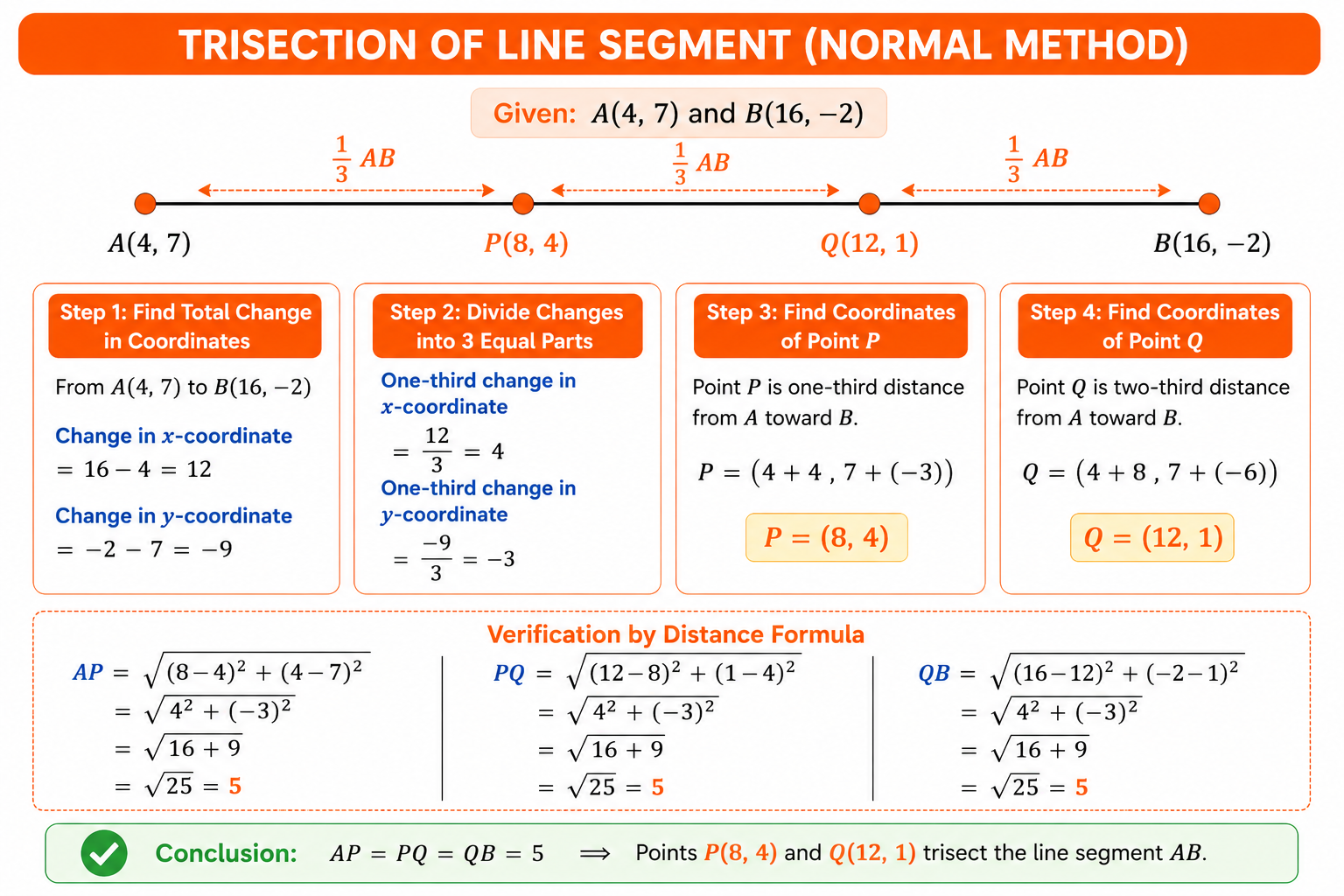
Diagram: Points P and Q divide AB into 3 equal parts
Step 1: Find Total Change in Coordinates
Change in x-coordinate = 16 − 4 = 12
Change in y-coordinate = −2 − 7 = −9
Step 2: Divide Changes into 3 Equal Parts
One-third change in x-coordinate = 12/3 = 4
One-third change in y-coordinate = −9/3 = −3
Step 3: Find Coordinates of Point P
Point P is one-third distance from A toward B.
P = (4 + 4 , 7 + (−3))
P = (8 , 4)
Step 4: Find Coordinates of Point Q
Point Q is two-third distance from A toward B.
Q = (4 + 8 , 7 + (−6))
Q = (12 , 1)
Verification by Distance Formula
AP = √[(8−4)2 + (4−7)2]
= √[42 + (−3)2]
= √(16 + 9)
= √25 = 5
PQ = √[(12−8)2 + (1−4)2]
= √[42 + (−3)2]
= √25 = 5
QB = √[(16−12)2 + (−2−1)2]
= √[42 + (−3)2]
= √25 = 5
P = (8, 4)
Q = (12, 1)
Q11 Trisection of Line Segment Using Section Formula
Given: A(4,7), B(16,−2)
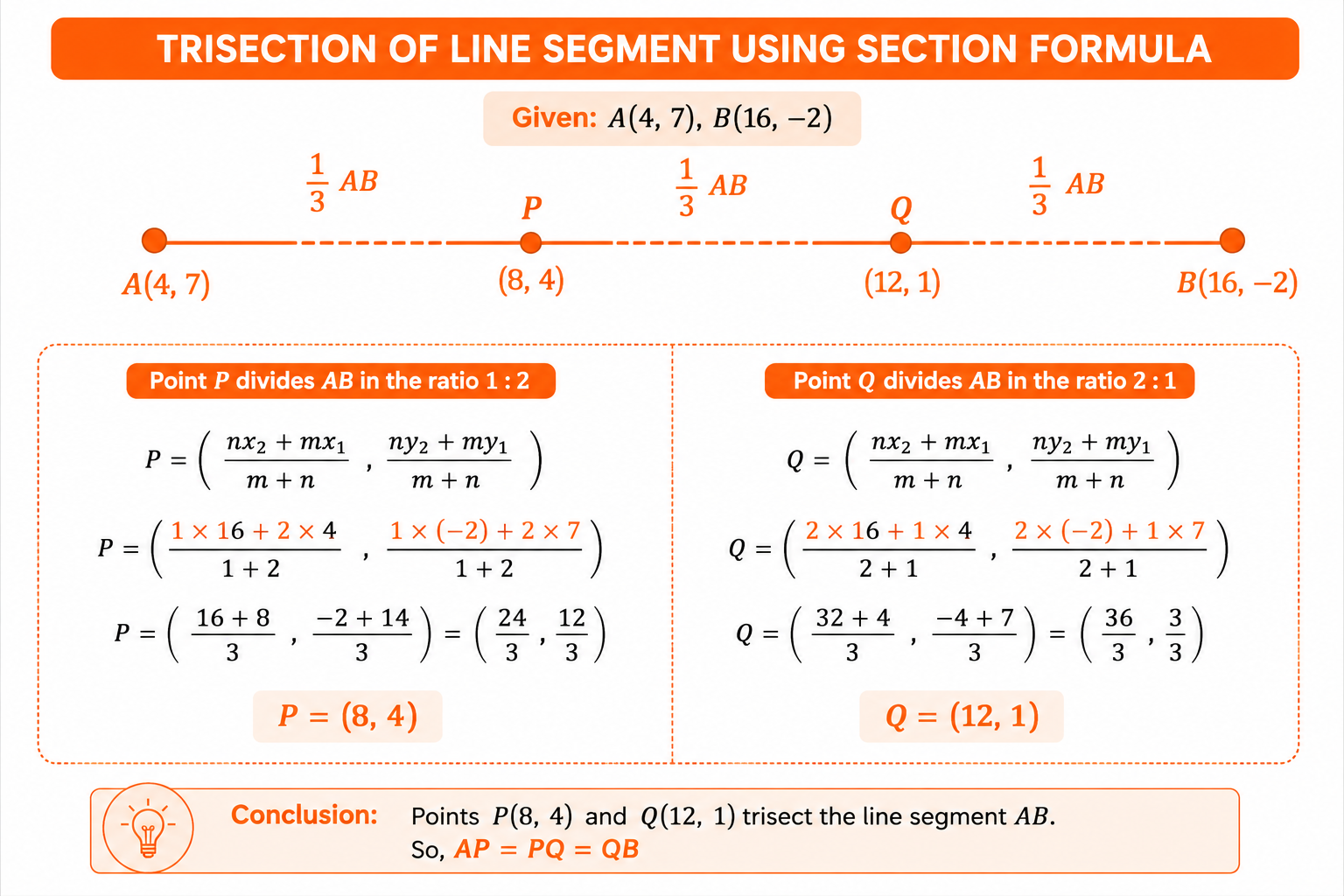
Diagram: Points P and Q trisect the line segment AB
Concept Used:
Point P divides AB internally in the ratio 1 : 2
Point Q divides AB internally in the ratio 2 : 1
Section Formula:
(x , y) = ( mx2 + nx1 m + n , my2 + ny1 m + n )
Step 1: Find Coordinates of Point P
Point P divides AB internally in the ratio 1 : 2
P = ( (1 × 16) + (2 × 4) 1 + 2 , (1 × (−2)) + (2 × 7) 1 + 2 )
P = ( 16 + 8 3 , −2 + 14 3 )
P = ( 24 3 , 12 3 )
P = (8 , 4)
Step 2: Find Coordinates of Point Q
Point Q divides AB internally in the ratio 2 : 1
Q = ( (2 × 16) + (1 × 4) 2 + 1 , (2 × (−2)) + (1 × 7) 2 + 1 )
Q = ( 32 + 4 3 , −4 + 7 3 )
Q = ( 36 3 , 3 3 )
Q = (12 , 1)
P = (8, 4)
Q = (12, 1)
Q12 Circle Verification Using Distance Formula
Given: A(1,−8), B(−4,7), C(−7,−4), Centre O(0,0)
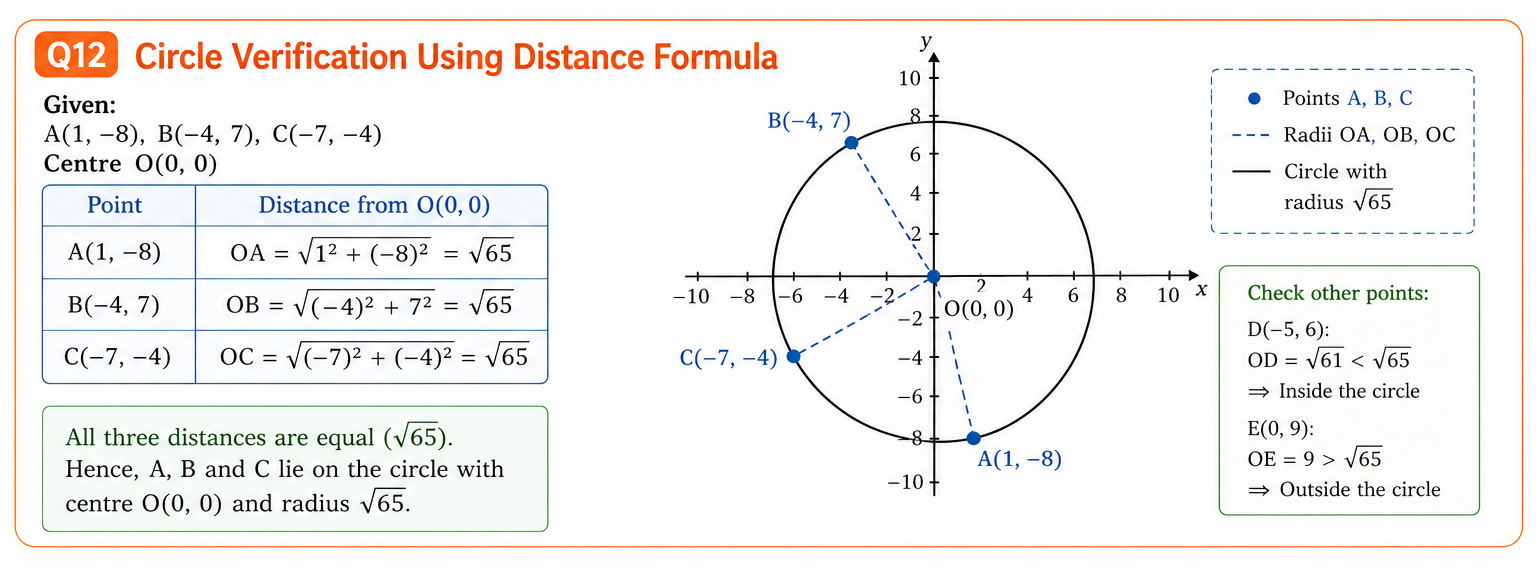
Diagram: Points A, B, C lie on circle with centre O
Step 1: Distance from origin
OA = √(1² + (−8)²) = √65
OB = √((−4)² + 7²) = √65
OC = √((−7)² + (−4)²) = √65
👉 All distances equal → points lie on same circle
Radius = √65
(ii) Check D and E
OD = √61 < √65 → Inside
OE = 9 > √65 → Outside
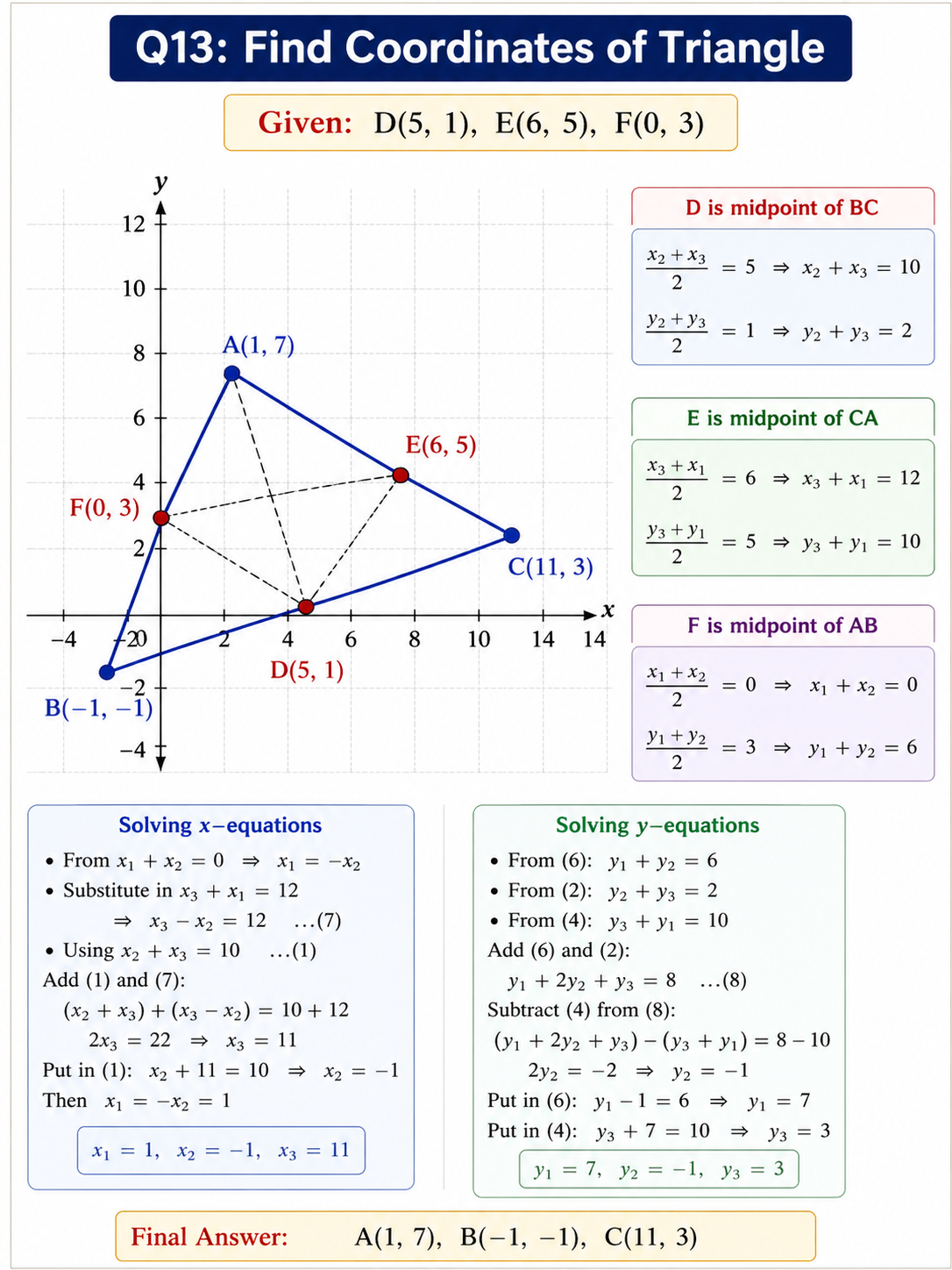
Q13 Find Coordinates of Triangle (Step-by-Step)
Given: D(5,1), E(6,5), F(0,3)
To Find: Coordinates of triangle ABC
Step 1: Let
A(x₁, y₁), B(x₂, y₂), C(x₃, y₃)
Using midpoint formula:
D = midpoint of BC
(x₂ + x₃)/2 = 5 → x₂ + x₃ = 10 …(1)
(y₂ + y₃)/2 = 1 → y₂ + y₃ = 2 …(2)
E = midpoint of CA
(x₃ + x₁)/2 = 6 → x₃ + x₁ = 12 …(3)
(y₃ + y₁)/2 = 5 → y₃ + y₁ = 10 …(4)
F = midpoint of AB
(x₁ + x₂)/2 = 0 → x₁ + x₂ = 0 …(5)
(y₁ + y₂)/2 = 3 → y₁ + y₂ = 6 …(6)
Step 2: Solve x-equations
From (5): x₁ + x₂ = 0 → x₁ = −x₂
Substitute in (3):
x₃ + (−x₂) = 12 → x₃ − x₂ = 12 …(7)
Now from (1): x₂ + x₃ = 10 …(1)
Add (1) and (7):
(x₂ + x₃) + (x₃ − x₂) = 10 + 12
2x₃ = 22 → x₃ = 11
Put x₃ = 11 in (1):
x₂ + 11 = 10 → x₂ = −1
Then x₁ = −x₂ = 1
Step 3: Solve y-equations
From (6): y₁ + y₂ = 6 …(6)
From (2): y₂ + y₃ = 2 …(2)
From (4): y₃ + y₁ = 10 …(4)
Add (6) and (2):
(y₁ + y₂) + (y₂ + y₃) = 6 + 2
y₁ + 2y₂ + y₃ = 8 …(8)
Now subtract (4) from (8):
(y₁ + 2y₂ + y₃) − (y₃ + y₁) = 8 − 10
2y₂ = −2 → y₂ = −1
Put y₂ = −1 in (6):
y₁ − 1 = 6 → y₁ = 7
Put y₁ = 7 in (4):
y₃ + 7 = 10 → y₃ = 3
A(1,7), B(−1,−1), C(11,3)
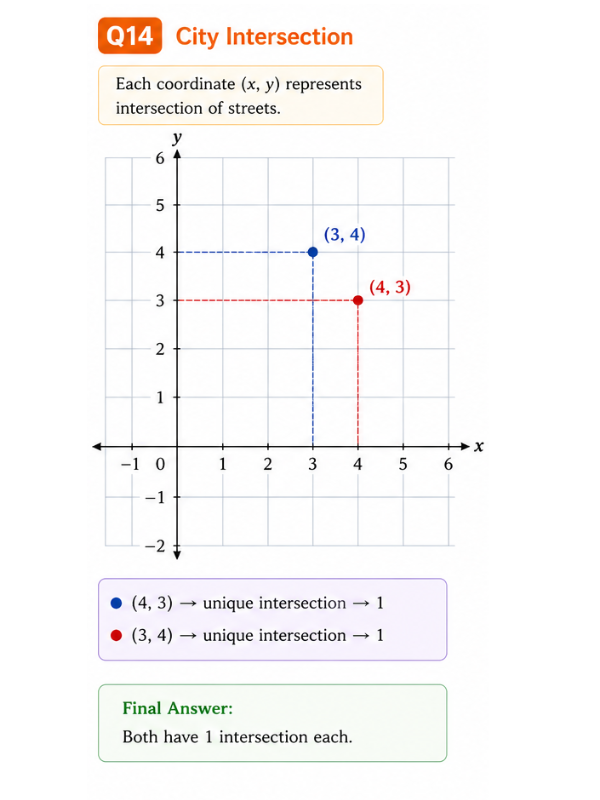
Q14 City Intersection
Each coordinate (x,y) represents intersection of streets
(4,3) → unique intersection → 1
(3,4) → unique intersection → 1
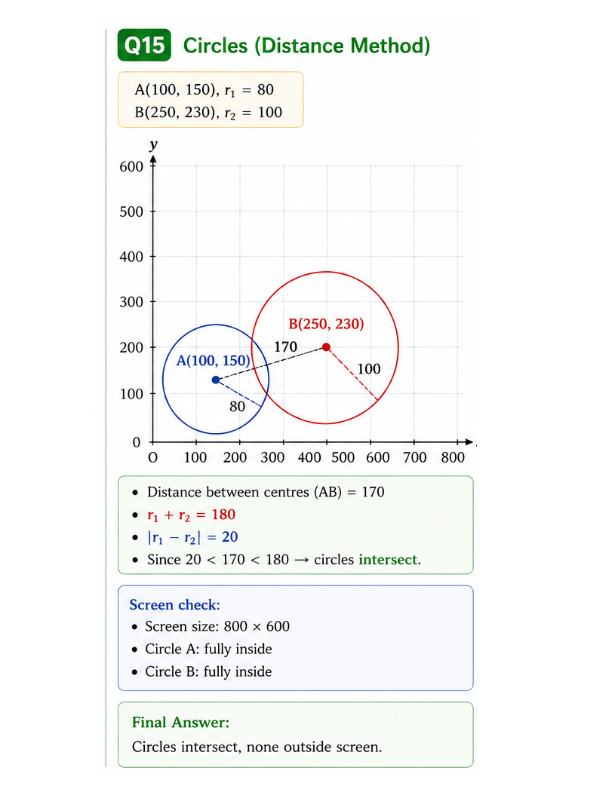
Q15 Circles (Distance Method)
Given:
A(100,150), r₁=80
B(250,230), r₂=100
Step 1: Distance between centres
d = √[(250−100)² + (230−150)²]
= √(150² + 80²)
= √(22500 + 6400)
= √28900 = 170
Step 2: Compare radii
- r₁ + r₂ = 180
- |r₁ − r₂| = 20
👉 Since 20 < 170 < 180 → circles intersect
Screen check:
- Screen size: 800×600
- Circle A: fully inside
- Circle B: fully inside
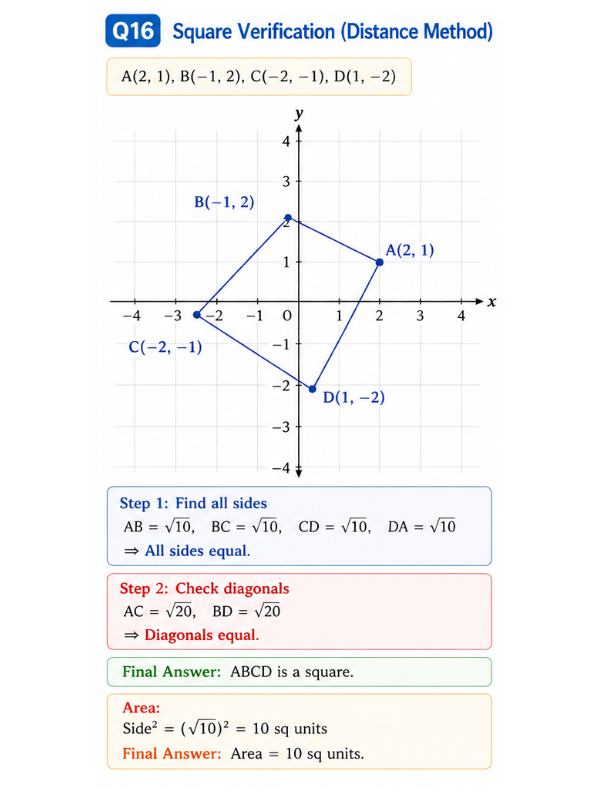
Q16 Square Verification (Distance Method)
Given: A(2,1), B(−1,2), C(−2,−1), D(1,−2)
Step 1: Find all sides
AB = √[(−1−2)² + (2−1)²] = √(9 + 1) = √10
BC = √[(−2+1)² + (−1−2)²] = √(1 + 9) = √10
CD = √[(1+2)² + (−2+1)²] = √(9 + 1) = √10
DA = √[(2−1)² + (1+2)²] = √(1 + 9) = √10
👉 All sides equal
Step 2: Check diagonals
AC = √[(−2−2)² + (−1−1)²] = √(16 + 4) = √20
BD = √[(1+1)² + (−2−2)²] = √(4 + 16) = √20
👉 Diagonals equal
Area:
Side² = (√10)² = 10 sq units
📚 Class 9 Maths Chapter 1 End-of-Chapter Exercise Quick Revision Sheet
Before revising the Class 9 Maths Chapter 1 End of Chapter Exercise Solutions, quickly review these important concepts from Coordinate Geometry. This revision sheet is based on the latest NCERT Ganita Manjari (2026) and covers the key ideas needed to solve the chapter-end exercise questions accurately.
📍 Coordinates & Origin
The origin is the point (0, 0), where the x-axis and y-axis intersect. A point in the coordinate plane is represented by (x, y), where x is the x-coordinate and y is the y-coordinate.
📊 Axes & Quadrants
The x-axis and y-axis divide the Cartesian plane into four quadrants. Remember the signs: (+, +) → Quadrant I, (−, +) → Quadrant II, (−, −) → Quadrant III, (+, −) → Quadrant IV.
📏 Distance Between Two Points
For points
(x₁, y₁) and (x₂, y₂),
the distance is
√[(x₂ − x₁)² + (y₂ − y₁)²]
Use the Baudhāyana–Pythagoras Theorem
to understand the distance between two points in the coordinate plane.
📌 Midpoint of a Segment
If M is the midpoint of a segment joining
S(x₁, y₁) and T(x₂, y₂),
its coordinates are obtained by taking the average of the
corresponding coordinates:
M = ((x₁ + x₂)/2, (y₁ + y₂)/2)
🎯 Collinear Points
To check whether three points lie on the same straight line, use a suitable coordinate method and verify the required distance or coordinate relationship. For the End-of-Chapter Exercise, remember to justify your answer clearly.
↔ Parallel & Perpendicular Lines
A line parallel to the x-axis has the same y-coordinate, while a line parallel to the y-axis has the same x-coordinate. Also identify perpendicular sides by observing their directions on the coordinate plane.
🪞 Reflection & Symmetry
When points are reflected in an axis, their coordinates change according to the axis of reflection. Remember to carefully check the signs of the coordinates before plotting the reflected point.
📐 Plotting & Graphical Questions
For graphical questions, first draw the x-axis, y-axis and origin, choose a suitable scale, plot each point carefully and then join or analyse the points as required by the question.
🧠 Quick Memory Checklist
Before solving any question, check:
1. Identify the coordinates correctly.
2. Check the signs and quadrant.
3. Decide whether the question needs plotting, distance, midpoint or another coordinate method.
4. Write the formula or method before calculation.
5. Show all important steps clearly.
6. For graphical questions, label the axes, scale and points correctly.
7. Always write the final conclusion clearly.
📝 CBSE Exam Tip
In coordinate geometry questions, marks are often earned through correct plotting, correct signs, formula, calculation and conclusion. Do not skip mathematical steps even when the answer looks obvious.
✅ Use this revision sheet before solving the Class 9 Maths Chapter 1 End of Chapter Exercise to refresh the key concepts of Coordinate Geometry and improve accuracy.
❓ Frequently Asked Questions
Find quick answers to common questions about Class 9 Maths Chapter 1 End of Chapter Exercise Solutions, Coordinate Geometry, and the concepts covered in the NCERT Ganita Manjari (2026) chapter. These FAQs are useful for learning, revision and examination preparation.
What is covered in the Class 9 Maths Chapter 1 End of Chapter Exercise?
The Class 9 Maths Chapter 1 End of Chapter Exercise covers important applications of Coordinate Geometry. The questions involve locating and identifying points, coordinates, axes and quadrants, plotting points, geometric relationships on the coordinate plane, and other applications developed in the chapter.
How many questions are there in the Class 9 Maths Chapter 1 End Exercise?
The Chapter 1 End Exercise contains a set of questions based on the concepts of Coordinate Geometry. The complete page presents the questions and their solutions separately so that students can easily find the required Class 9 Maths Chapter 1 End Exercise Solution.
What are the important concepts to revise before the Chapter 1 End Exercise?
Before attempting the Class 9 Maths Chapter 1 End of Chapter Exercise, revise the Cartesian plane, coordinates of a point, origin, x-axis, y-axis, quadrants, plotting of points, distance between points, midpoint, collinearity, and other coordinate-based relationships covered in the chapter.
How should I solve Class 9 Maths Chapter 1 End Exercise questions?
Start by identifying what the question is asking and write down the given coordinates or information carefully. Choose the appropriate coordinate geometry method, show the required mathematical steps, and write the final answer or conclusion clearly. For graphical questions, draw the axes, use a suitable scale, and plot the points accurately.
What is the distance formula used in Class 9 Coordinate Geometry?
For two points
(x₁, y₁) and (x₂, y₂),
the distance between them can be found using
√[(x₂ − x₁)² + (y₂ − y₁)²]
When using the formula, substitute the coordinates carefully and
show the calculation step by step.
How can I check whether three points are collinear?
Three points are collinear if they lie on the same straight line. In coordinate geometry, a suitable method such as comparing distances can be used to verify this. If the sum of the two smaller distances equals the third distance, the three points lie on the same straight line.
Why are graphical questions important in the Chapter 1 End Exercise?
Graphical questions help students understand how coordinates represent points and geometric relationships on the Cartesian plane. While solving such questions, students should carefully draw the axes, choose the scale, plot the coordinates, and label the required points correctly.
Are these Class 9 Maths Chapter 1 End of Chapter Exercise Solutions based on Ganita Manjari 2026?
Yes. These Class 9 Maths Chapter 1 End of Chapter Exercise Solutions are prepared according to the latest NCERT Ganita Manjari (2026) textbook. The questions are presented with clear, step-by-step explanations in a student-friendly notebook-style format to support classroom practice, self-study, revision and examination preparation.
🔗 Useful Resources
📚 Continue Learning
Congratulations! You have completed the Class 9 Maths Chapter 1 End of Chapter Exercise Solutions. You have now completed the final exercise of Chapter 1 – Coordinate Geometry. Continue your preparation by revisiting the previous exercise, reviewing the complete Chapter 1, or moving ahead to Chapter 2.
📖 Explore More Class 9 Maths Chapters
📘 Download Class 9 Maths NCERT Book (Ganita Manjari 2026)
For better understanding of concepts, students should always refer to the original NCERT textbook. You can download the official Class 9 Maths book directly from the NCERT website.
This will help you practice questions exactly as per CBSE exam pattern and improve conceptual clarity.
📥 Download NCERT Class 9 Maths BookSource: Official NCERT Website

Rakesh Kumar Singh
Founder,
Maths Gurukulam
&
Newton Study Point
📚 Teaching Mathematics Since 2006
The Class 9 Maths Chapter 1 End of Chapter Exercise Solutions on this page are prepared with reference to the latest NCERT Ganita Manjari (2026). The solutions are presented in a clear, step-by-step, student-friendly notebook style to help Class 9 students understand the questions, follow the mathematical steps, and write answers confidently.
🎓 Need Personal Guidance in Mathematics?
If these Class 9 Maths Chapter 1 End Exercise Solutions helped you understand the concepts, take your learning to the next level with expert classroom coaching at Newton Study Point. Learn Mathematics through concept-based teaching, regular practice, chapter-wise tests, and complete CBSE exam preparation.
📍 Newton Study Point
Ankur Vihar, Ghaziabad (U.P.)
Helping students build strong concepts in Mathematics since 2006.