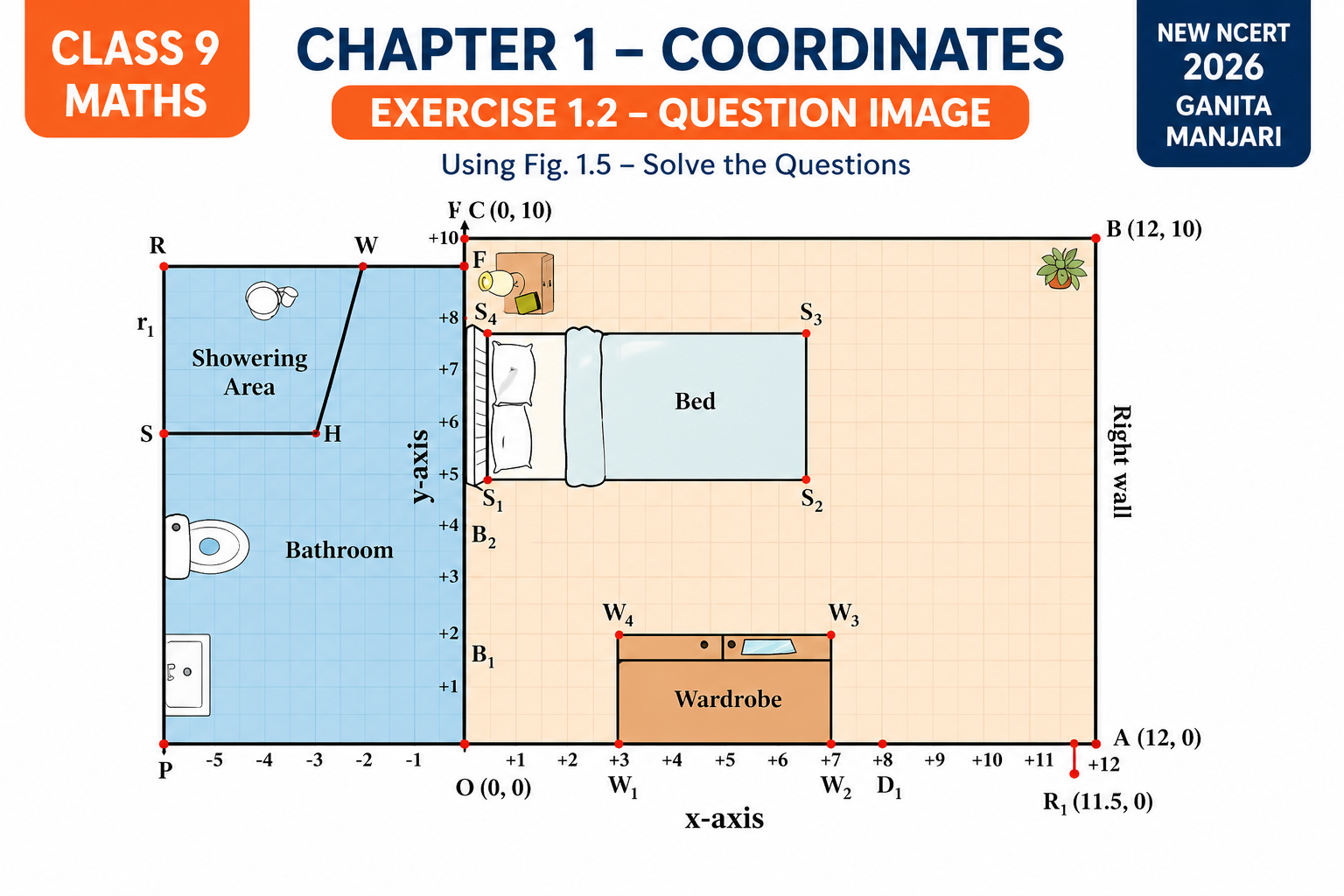
📚 Table of Contents
📍 About Class 9 Maths Chapter 1 Exercise 1.2
Class 9 Maths Chapter 1 Exercise 1.2 Solutions help you apply coordinate geometry to practical situations. Instead of simply reading coordinates, you will use them to identify locations, complete rectangles, and answer questions based on a real-life house layout. This exercise develops observation skills, logical thinking, and confidence in solving coordinate-based problems.
🌟 What You Will Do in This Exercise
Identify Locations
Read the coordinates of different points shown in the house layout and identify their exact locations.
Complete Rectangles
Use the given vertices to determine the missing corner of a rectangle accurately.
Observe Carefully
Compare horizontal and vertical positions to answer questions correctly from the given figure.
Connect Maths with Daily Life
Understand how coordinate geometry is used to represent room layouts, furniture placement, and floor plans.
💡 Student Tip
Before solving the questions, spend a minute observing the complete house layout. Understanding the figure first will help you identify the correct locations and solve every question more confidently.
🧠 Learn Before You Solve
Exercise 1.2 is based on applying coordinate geometry to practical situations. Before solving the questions, revise the important concepts used in this exercise. These ideas will help you identify coordinates correctly, complete rectangles, and answer the questions confidently.
🎯 Concepts Used in Exercise 1.2
Unlike Exercise 1.1, this exercise focuses on applying coordinates to solve practical problems. You will identify coordinates of points, complete rectangles, calculate horizontal and vertical measurements, and plot new points accurately on the coordinate plane.
Coordinates of a Point
Every point is written as an ordered pair (x, y). Always read the x-coordinate first and then the y-coordinate. Changing their order changes the position of the point.
Rectangle on the Coordinate Plane
If three vertices of a rectangle are known, the fourth vertex can be found by matching the corresponding x-coordinates and y-coordinates.
Horizontal & Vertical Measurement
Horizontal length depends only on the difference between the x-coordinates, while vertical length depends only on the difference between the y-coordinates.
Plotting New Points
Some questions ask you to plot new objects or shapes. Locate every point carefully before joining or drawing the required figure.
💡 Remember Before Solving
Read every coordinate exactly as given before writing your answer.
Understand whether the figure forms a rectangle before solving the question.
Many answers can be obtained simply by observing the coordinate pattern instead of lengthy calculations.
📖 Concepts & Formula Sheet
Exercise 1.2 mainly uses rectangle properties and simple coordinate geometry concepts. Revise these ideas before solving the questions.
📏 Horizontal Distance
Use this concept when both points lie on the same horizontal line. Only the x-coordinates are different.
📐 Vertical Distance
Use this concept when both points lie on the same vertical line. Only the y-coordinates are different.
⬛ Rectangle Properties
- Opposite sides are equal.
- Opposite sides are parallel.
- Adjacent sides meet at right angles.
- Horizontal side = Length, Vertical side = Width.
These properties help identify the missing corner and verify your answer.
🎯 Fourth Vertex Rule
⬇
(x2, y2)
Match the missing x-coordinate with the missing y-coordinate to obtain the fourth vertex.
🧮 Which Concept Should You Use?
Need the Length?
Same y-coordinate → Use Horizontal Distance.
Need the Width?
Same x-coordinate → Use Vertical Distance.
Need the Fourth Vertex?
Combine the matching x-coordinate with the matching y-coordinate.
📝 Class 9 Maths Chapter 1 Exercise 1.2 Solutions
Solve every question of Class 9 Maths Chapter 1 Exercise 1.2 with easy, step-by-step NCERT Ganita Manjari (2026) solutions. Every answer is prepared according to the latest CBSE answer-writing format to help students understand concepts clearly and score better in exams.
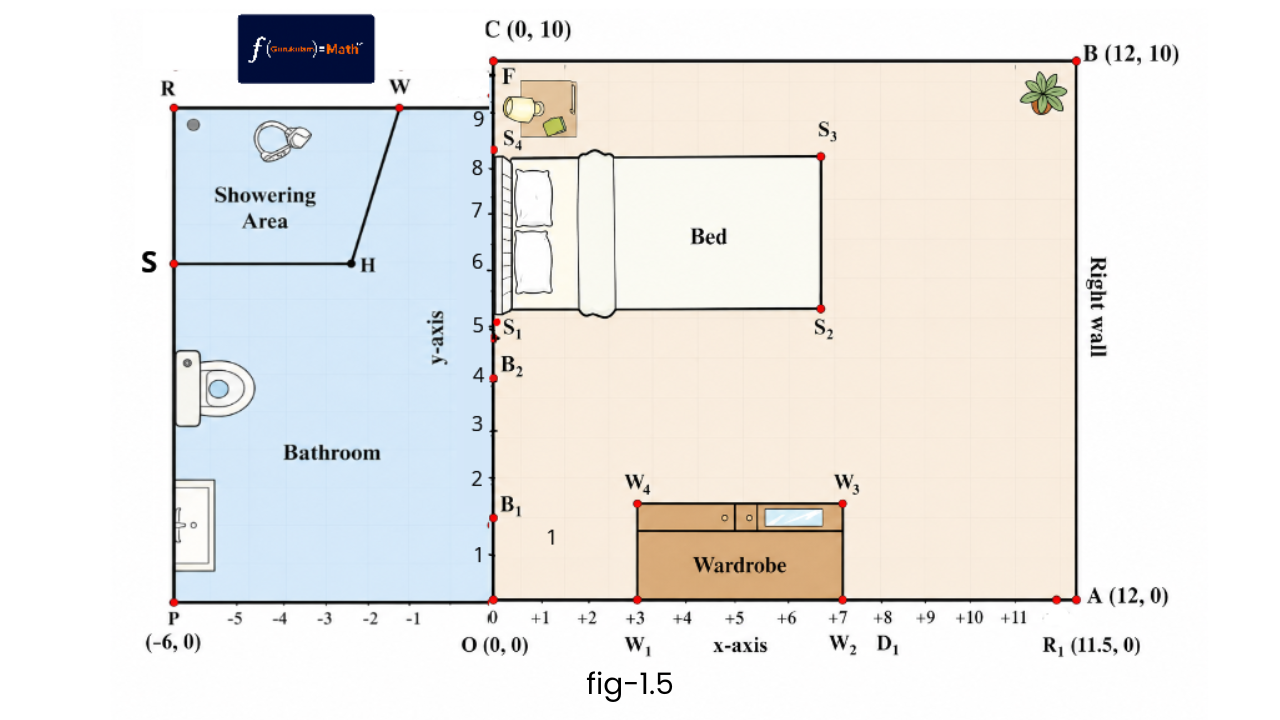
📌 Refer to Fig. 1.5 and answer the following questions:
- Place Reiaan’s rectangular study table with three of its feet at the points (8, 9), (11, 9) and (11, 7).
- Where will the fourth foot of the table be?
- Is this a good spot for the table?
- What is the width of the table? The length? Can you make out the shape of the table?
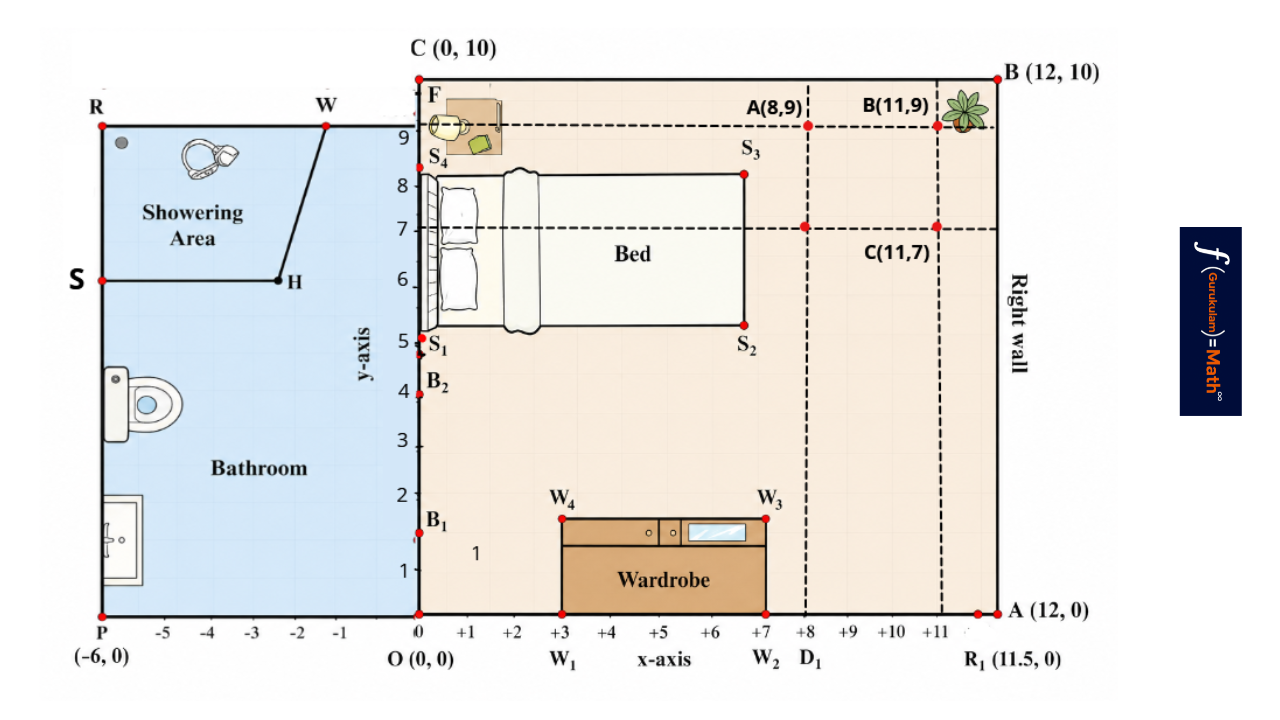
In a rectangle,
- Opposite sides are parallel.
- Opposite sides are equal.
Since point C is directly below B, the fourth vertex must be directly below A.
Therefore,
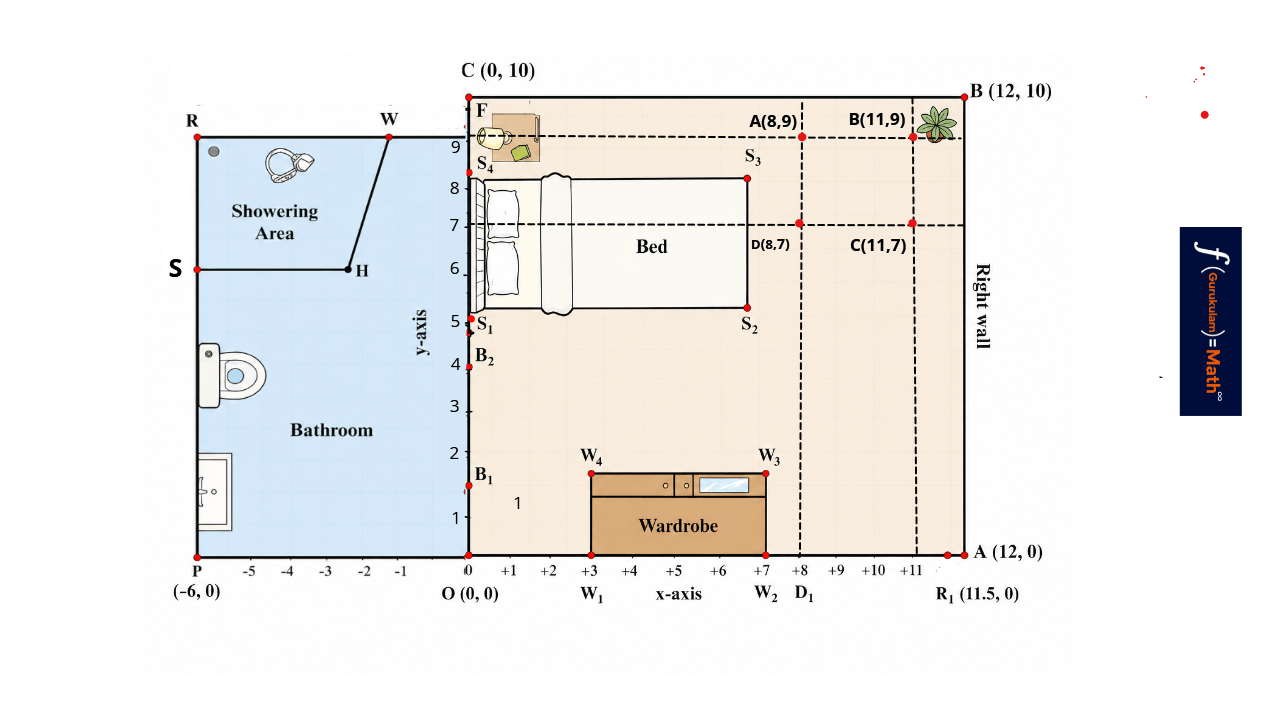
There is enough space around the table for easy movement.
Therefore, this is a suitable place to keep the study table.
The vertical side of the rectangle gives the width. Here, the x-coordinate remains the same and only the y-coordinate changes.
Width = 9 − 7 = 2 units
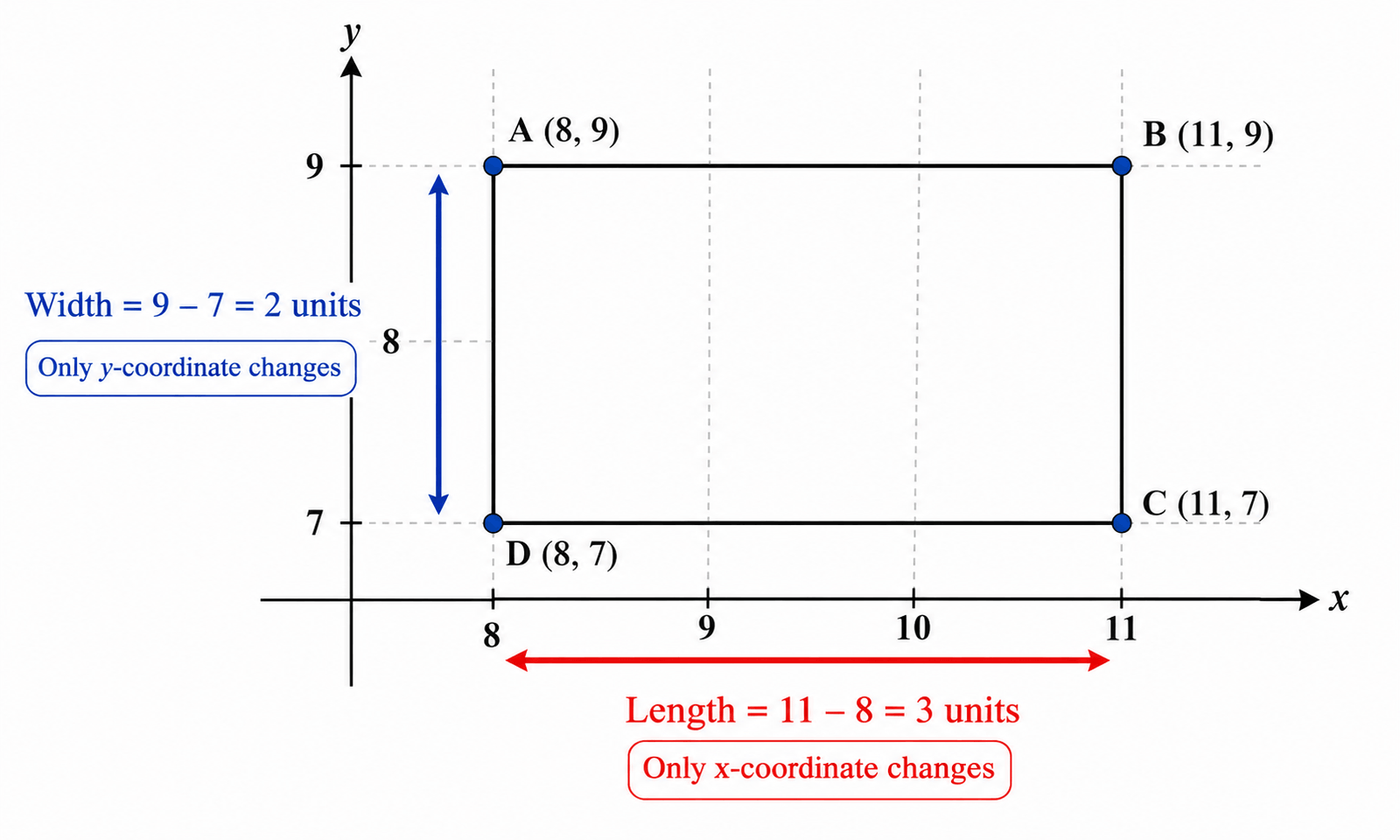
Length = 11 − 8 = 3 units
The height of the table cannot be determined because all the given points lie on the coordinate plane. No information about the vertical height of the table is given.
✔ Length = 3 units
✔ Height cannot be determined from the given information.
From Fig. 1.5,
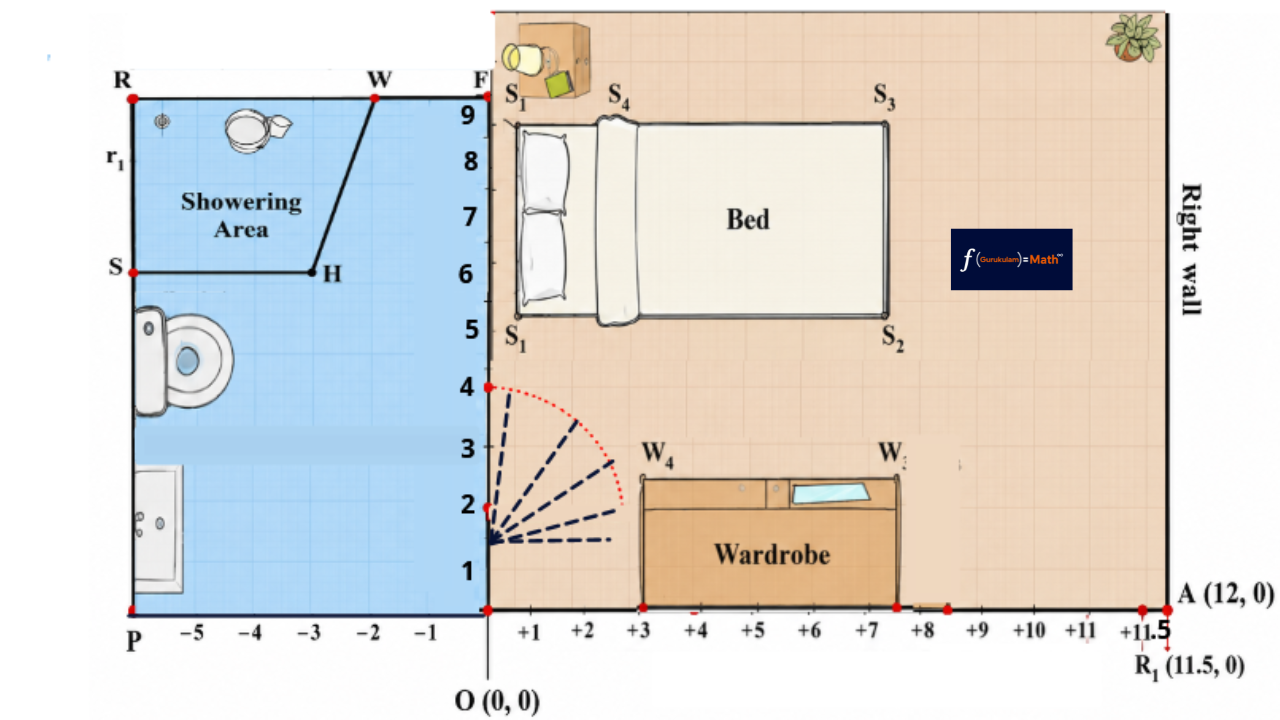
Hinge of the bathroom door = B1(0, 1.5)
Top edge of the bathroom door = B2(0, 4)
Therefore, the width of the bathroom door is
The wardrobe starts at W1(3, 0). Hence, the nearest edge of the wardrobe is 3 units from the y-axis.
Since the door rotates about the hinge at B1, its maximum reach is equal to its width, i.e., 2.5 units.
Since
Therefore, the bathroom door will not hit the wardrobe while opening.
If the door is made wider than 3 units, it may hit the wardrobe. Therefore, the wardrobe should be shifted farther away or the width of the door should be reduced.
- What are the coordinates of the four corners O, F, R, and P of the bathroom?
- What is the shape of the showering area SHWR in Reiaan’s bathroom? Write the coordinates of the four corners.
- Mark off a 3 ft × 2 ft space for the washbasin and a 2 ft × 3 ft space for the toilet. Write the coordinates of the corners of these spaces.
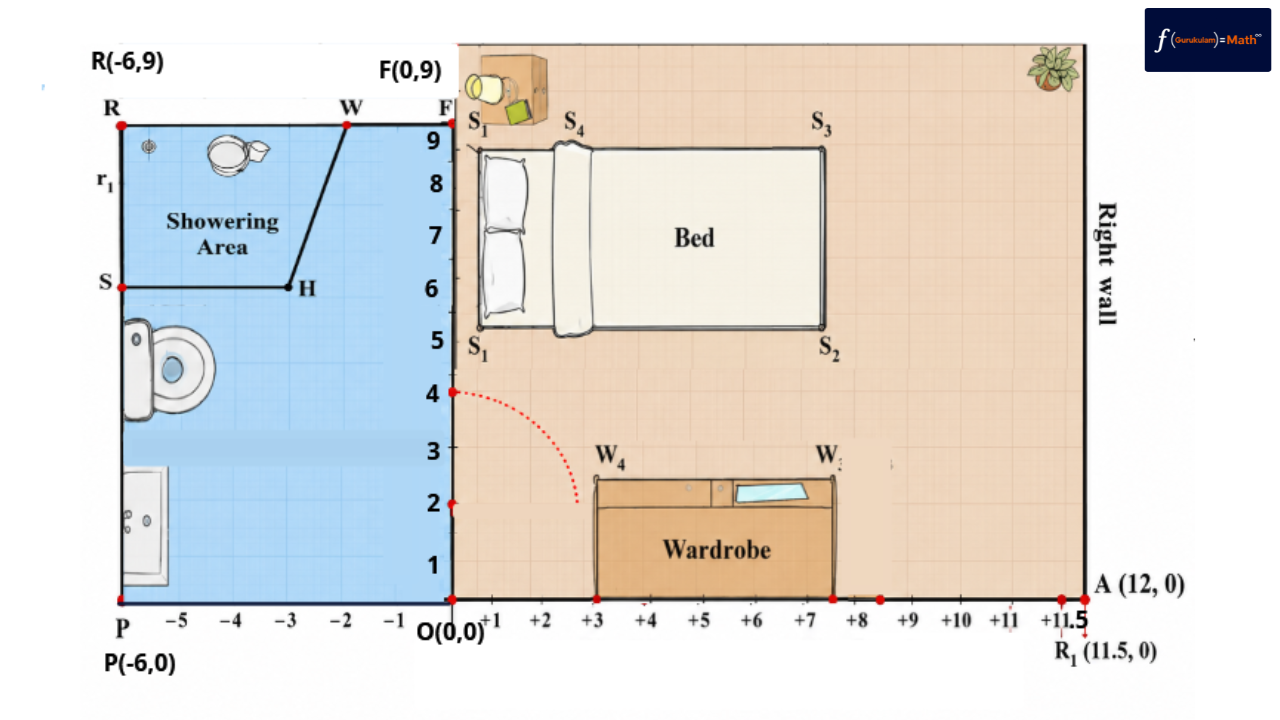
- O = (0, 0)
- P = (−6, 0)
- F = (0, 9)
- R = (−6, 9)
✔ P = (−6, 0)
✔ F = (0, 9)
✔ R = (−6, 9)
Therefore, the shape of SHWR is a trapezium.
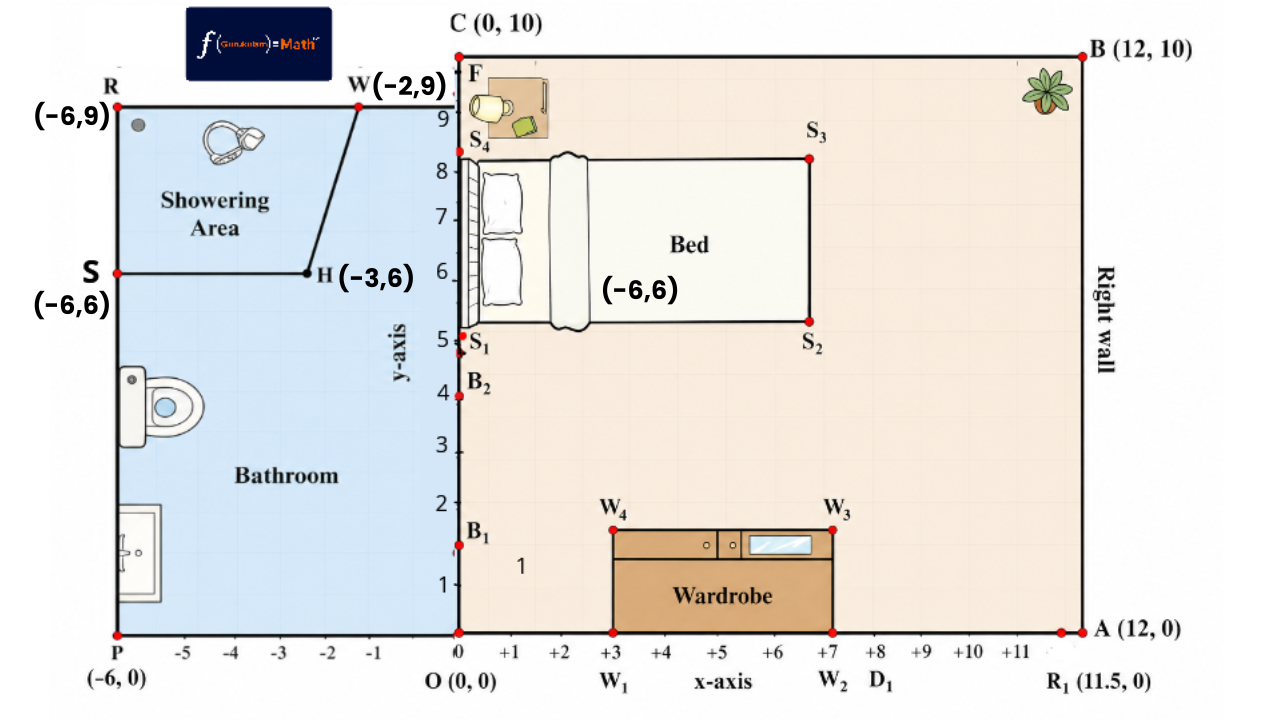
- S = (−6, 6)
- H = (−3, 6)
- W = (−2, 9)
- R = (−6, 9)
✔ S = (−6, 6)
✔ H = (−3, 6)
✔ W = (−2, 9)
✔ R = (−6, 9)
Washbasin (Rectangle MNPV)
- M = (−6, 0)
- N = (−3, 2)
- P = (−6, 0)
- V = (−3, 0)
Toilet (Rectangle SXYZ)
- S = (−6, 6)
- X = (−6, 3)
- Y = (−4, 3)
- Z = (−4, 6)
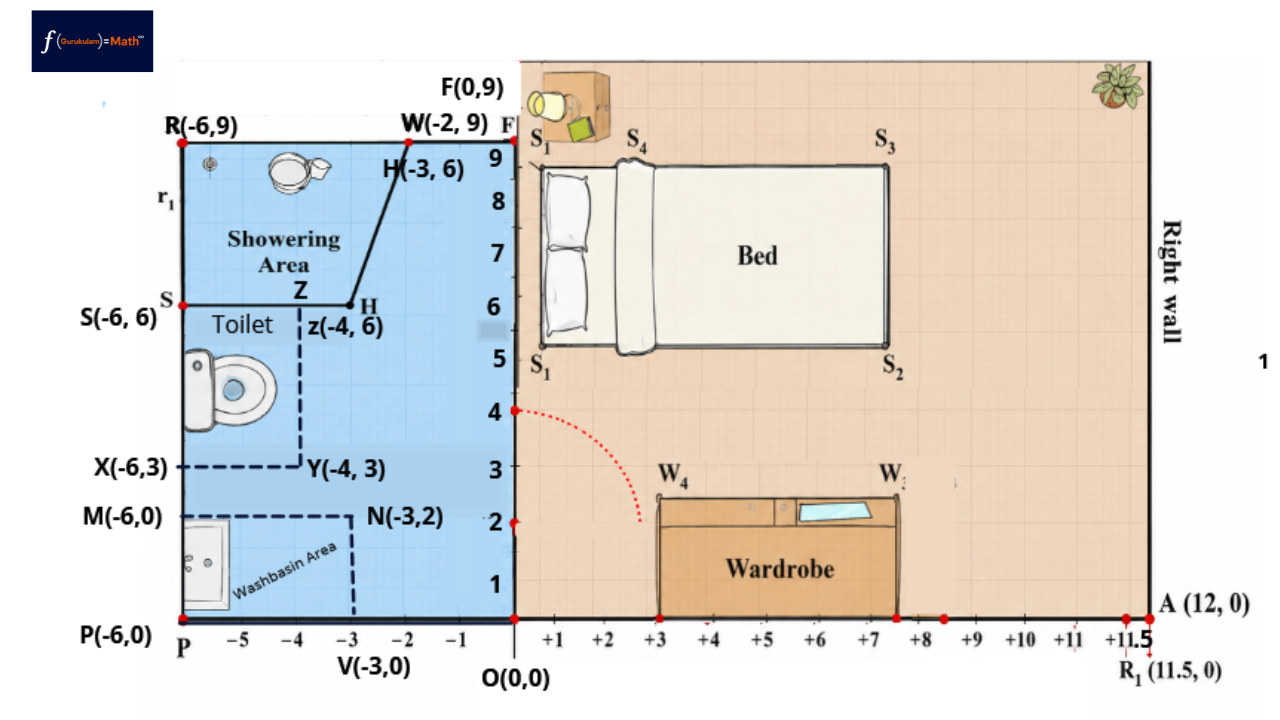
P(−6, 0), M(−6, 2), N(−3, 2), V(−3, 0)
Toilet (Rectangle SXYZ):
S(−6, 6), X(−6, 3), Y(−4, 3), Z(−4, 6)
- Reiaan’s room door leads from the dining room which has the length 18 ft and width 15 ft. The length of the dining room extends from point P to point A. Sketch the dining room and mark the coordinates of its corners.
- Place a rectangular 5 ft × 3 ft dining table precisely in the centre of the dining room. Write down the coordinates of the feet of the table.
Since the dining room is below the x-axis and its width is 15 ft, the remaining two corners are 15 units below the x-axis.
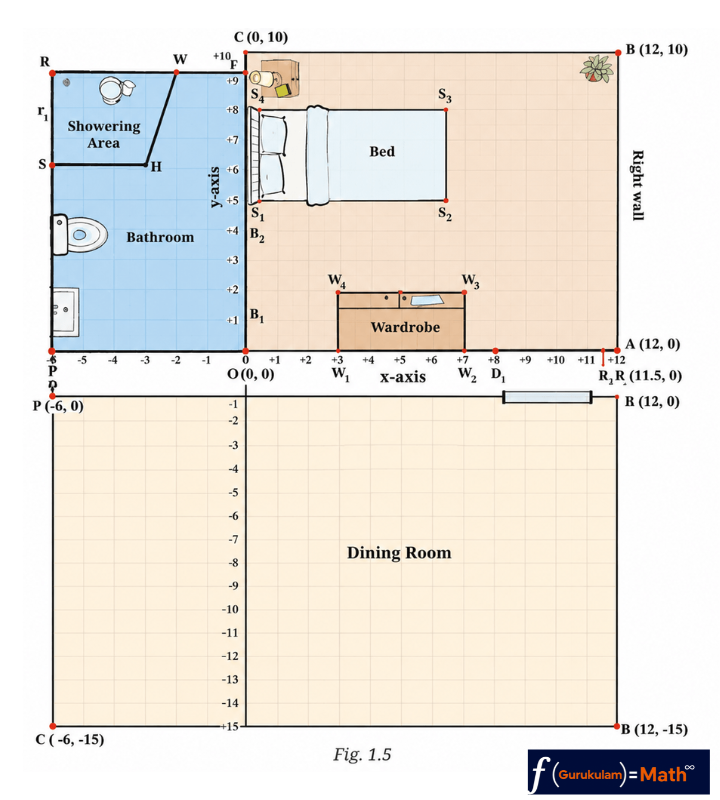
- P = (−6, 0)
- A = (12, 0)
- B = (12, −15)
- C = (−6, −15)
✔ A = (12, 0)
✔ B = (12, −15)
✔ C = (−6, −15)
Step 1: Find the centre of the dining room.
Half of 18 ft = 9 ft
Half of 15 ft = 7.5 ft
Starting from P(−6, 0), move 9 units to the right and 7.5 units downward.
Therefore, the centre of the dining room is (3, −7.5).
Step 2: Find the distance from the centre to each side of the table.
Half of 5 ft = 2.5 ft
Half of 3 ft = 1.5 ft
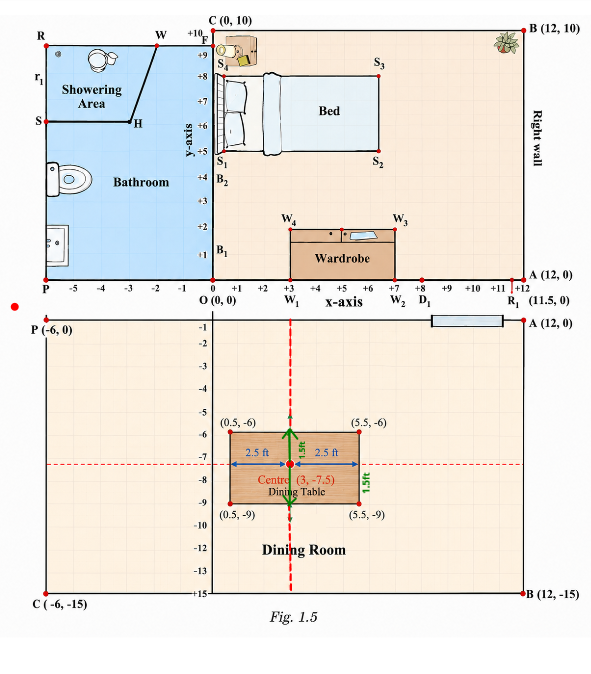
From the centre (3, −7.5),
- Move 2.5 units left and 1.5 units up = (0.5, −6)
- Move 2.5 units right and 1.5 units up = (5.5, −6)
- Move 2.5 units right and 1.5 units down = (5.5, −9)
- Move 2.5 units left and 1.5 units down = (0.5, −9)
(0.5, −6), (5.5, −6), (5.5, −9), (0.5, −9)
📚 Continue Learning
Continue your Class 9 Maths Chapter 1 learning with the End Exercise or explore other NCERT chapters.
🔗 Useful Learning Resources
Explore these trusted resources to strengthen your understanding of Class 9 Maths Chapter 4 Exercise 4.3.
🏛 Official Resources
📚 Maths Gurukulam Resources
❓ Frequently Asked Questions
Find answers to the most common questions about Class 9 Maths Chapter 1 Exercise 1.2 Solutions, rectangles on the coordinate plane, and coordinate geometry concepts.
1. How do you find the fourth vertex of a rectangle on the coordinate plane?
Compare the given coordinates and match the missing x-coordinate with the missing y-coordinate. The fourth vertex is obtained by combining these two values.
2. How do you calculate the horizontal distance between two points?
Subtract the x-coordinates of the two points and take the absolute value. The horizontal distance is |x₂ − x₁|.
3. How do you calculate the vertical distance between two points?
Subtract the y-coordinates of the two points and take the absolute value. The vertical distance is |y₂ − y₁|.
4. Which rectangle properties are used in Exercise 1.2?
Exercise 1.2 uses the facts that opposite sides of a rectangle are equal and parallel, while adjacent sides meet at right angles. These properties help identify missing corners and measurements.
5. Which chapter does Exercise 1.2 belong to?
Exercise 1.2 belongs to Chapter 1 – Coordinates of the latest NCERT Class 9 Mathematics (Ganita Manjari 2026) textbook prescribed by CBSE.
6. Are these Class 9 Maths Chapter 1 Exercise 1.2 solutions based on the latest NCERT book?
Yes. These solutions follow the latest NCERT Ganita Manjari (2026) textbook and are fully aligned with the current CBSE Class 9 syllabus.
7. Are these solutions useful for CBSE exams?
Yes. Every solution is explained step by step in a simple CBSE answer-writing format, making it useful for homework, classroom learning, revision, periodic tests, and annual examinations.
8. What are the common mistakes students make in Exercise 1.2?
Students often interchange the x-coordinate and y-coordinate, identify the wrong fourth vertex of a rectangle, calculate horizontal and vertical distances incorrectly, or fail to observe the given figure carefully before answering.
Need Personal Guidance in Maths?
Join Newton Study Point for concept-based Maths coaching by an experienced teacher. Small batches, individual attention, regular tests, and complete CBSE exam preparation for Classes 8, 9, 10, 11 & 12.
📞 Call Now: 8447002272 💬 WhatsApp📍 Newton Study Point • Ankur Vihar, Ghaziabad

Rakesh Kumar Singh
Founder, Maths Gurukulam & Newton Study Point
Teaching CBSE Mathematics Since 2006
These Class 9 Maths Chapter 1 Exercise 1.2 Solutions are carefully prepared according to the latest NCERT Ganita Manjari (2026) and the CBSE curriculum. Every solution follows a clear, step-by-step approach designed to strengthen conceptual understanding, improve problem-solving skills, and help students perform confidently in school and board examinations.