📚 Class 9 Maths → Chapter 3 → The World of Numbers → Exercise 3.1
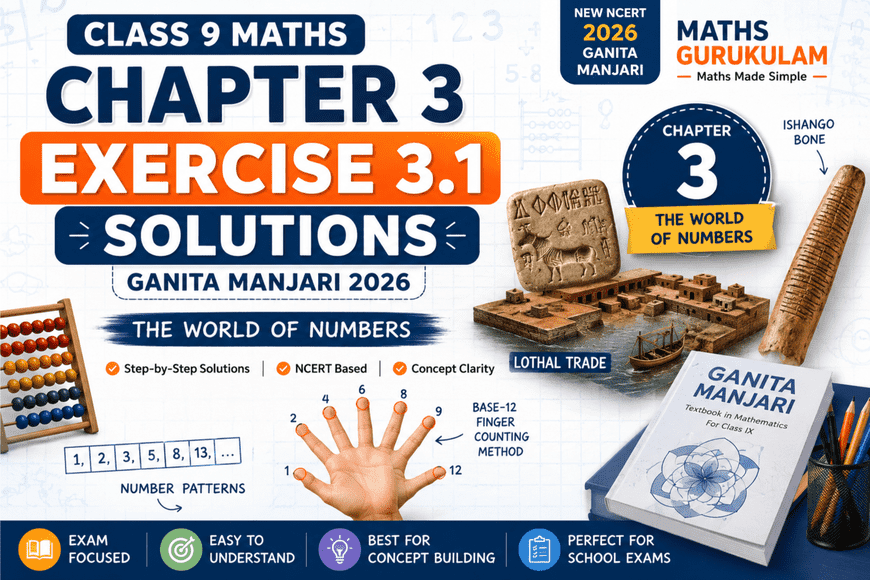
Class 9 Maths Chapter 3 Exercise 3.1 Solutions
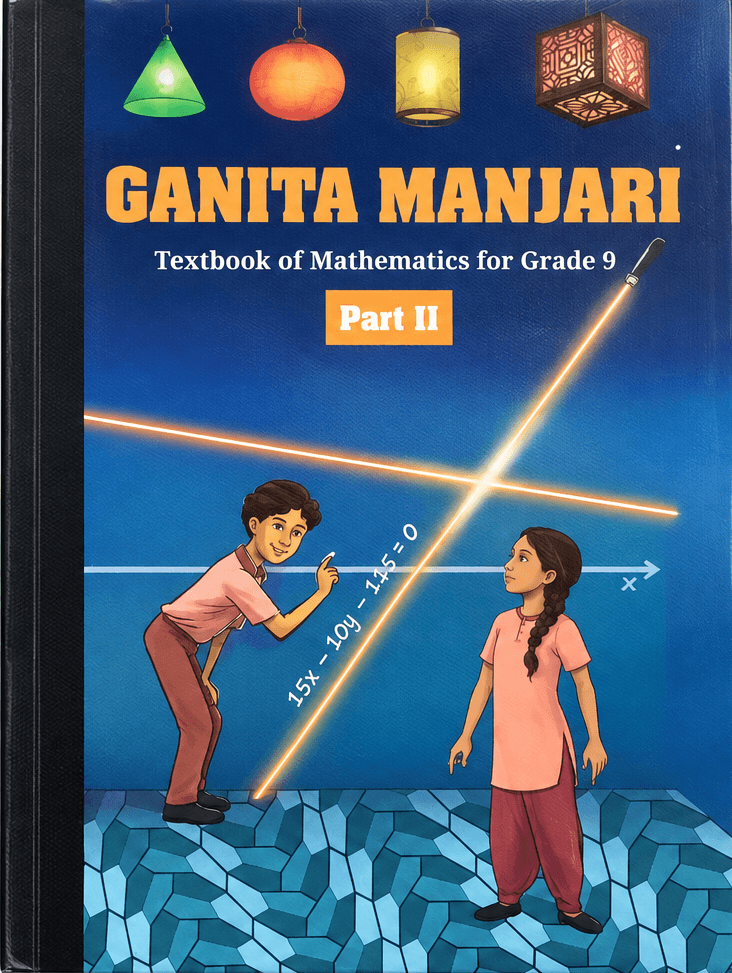
Ganita Manjari (NCERT 2026) – The World of Numbers
Master Exercise 3.1 with easy-to-understand, step-by-step NCERT solutions, visual concept cards, historical mathematics insights, and colourful illustrations specially designed for CBSE Class 9 students.
🌍 What You’ll Learn in Exercise 3.1
- Ratio through the ancient Lothal trade example.
- Recognise number patterns using the Ishango Bone sequence.
- Understand the closure property of natural numbers.
- Explore the ancient Indian base-12 finger counting system.
- Build logical reasoning through activity-based questions.
📖 Exercise 3.1 Overview
Exercise 3.1 introduces students to the fascinating world of numbers through real-life situations, historical discoveries and logical reasoning. Instead of lengthy calculations, this exercise encourages students to explore how numbers were used in ancient civilizations, recognise number patterns and understand important mathematical properties through engaging activities.
🏺 Historical Mathematics
Learn how ancient civilizations such as Lothal used mathematics in trade and daily life.
🔢 Number Patterns
Identify interesting number sequences using the famous Ishango Bone activity.
➕ Mathematical Reasoning
Understand why some mathematical operations satisfy the closure property while others do not.
✋ Ancient Counting
Discover the traditional base-12 finger counting system used in ancient India.
🎯 By the End of This Exercise, You Will Be Able To
- Apply mathematical ideas to real-life situations.
- Recognise simple number patterns and sequences.
- Explain the closure property of natural numbers using examples.
- Understand the importance of ancient counting methods.
- Develop logical thinking and mathematical reasoning skills.
💡 Learn Before You Solve Exercise 3.1
Before solving the questions, let’s quickly understand the important ideas used throughout Exercise 3.1. These concepts will help you answer every question more confidently.
Natural Numbers
Natural numbers are counting numbers such as 1, 2, 3, 4, 5… They are used in everyday counting and form the foundation of mathematics.
Closure Property
Natural numbers remain natural numbers after addition but not always after subtraction.
Mathematics in History
This exercise shows how ancient civilizations used mathematics in trade, measurement and counting long before modern calculators.
Pattern Recognition
Observe carefully. Many questions ask you to identify the hidden rule instead of performing lengthy calculations.
⚡ Quick Revision Before Solving
- ✔ Read every question carefully before calculating.
- ✔ Look for patterns instead of guessing.
- ✔ Write complete mathematical statements.
- ✔ Use logical reasoning wherever possible.
- ✔ Check whether the question is asking for explanation or calculation.
📝 Exercise 3.1 Questions at a Glance
Before starting the Class 9 Maths Chapter 3 Exercise 3.1 Solutions, take a quick look at what each question is asking. This helps you understand the purpose of the exercise and makes revision much faster.
① Question 1
Exchange of spice bags and copper ingots using ratio.
Real-Life Mathematics② Question 2
Recognise the hidden pattern in the Ishango Bone number sequence.
Number Pattern③ Question 3
Verify whether natural numbers are closed under subtraction.
Reasoning④ Question 4
Understand the ancient Indian finger counting system and Base-12 concept.
Historical Maths🎯 Study Strategy
Start with Question 1 to understand ratio through a real-life example. Then move to Question 2 to develop pattern recognition. Question 3 strengthens your understanding of mathematical properties, while Question 4 connects mathematics with ancient Indian counting methods.
🚀 Jump to Any Question
Click on any question below to jump directly to its detailed NCERT solution.
📚 Before You Start Solving
Take one minute to understand these important ideas. They will help you solve all the questions correctly and improve your conceptual understanding.
🔢 Read Carefully
Identify whether the question requires a calculation, finding a pattern, or giving a mathematical explanation.
💡 Think Logically
Observe the relationship between the given numbers before performing any calculations.
✔ Show Complete Steps
Write every important mathematical step clearly instead of writing only the final answer.
🎯 NCERT Tip
Many questions test your reasoning ability, so always justify your answers whenever required.
⭐ Success Strategy
Read the question carefully → Understand the concept → Solve step by step → Verify your answer before moving to the next question.
Let’s Solve Exercise 3.1
Now that you’ve understood the important concepts, let’s solve every question of Exercise 3.1 step by step using the NCERT method with clear explanations.
Question 1
📝 Question
A merchant in the port city of Lothal is exchanging bags of spices for copper ingots. He receives 15 copper ingots for every 2 bags of spices. If he brings 12 bags of spices to the market, how many copper ingots will he leave with?
📌 Given
- 2 bags of spices = 15 copper ingots
- Bags brought by the merchant = 12
🎯 To Find
Find the number of copper ingots received for 12 bags of spices.
🟧 Step-by-Step Solution (Quick Method)
2 bags of spices → 15 copper ingots
12 bags are
12 ÷ 2 = 6
Therefore,
Copper ingots
= 15 × 6
= 90
✅ Final Answer
The merchant will receive 90 copper ingots.
💡 Alternative Method (Using Unitary Method)
We can also solve the question using the Unitary Method.
2 bags → 15 copper ingots
Copper ingots for 1 bag
= 15 ÷ 2 = 7.5
Copper ingots for 12 bags
= 7.5 × 12 = 90
Thus, the merchant receives 90 copper ingots.
📘 Key Concept Used
When one quantity increases by a certain factor, the corresponding quantity also increases by the same factor. This relationship is known as direct proportion.
⚠ Common Mistake
Some students multiply 15 × 12 directly without considering that 15 copper ingots correspond to only 2 bags, not 1 bag.
🎯 Exam Tip
Whenever two quantities increase together in the same ratio, first find the multiplication factor or use the unitary method. Both methods give the same answer.
🧠 Memory Trick
Find the factor 🔢
or
Find the unit 1️⃣
Both methods lead to the same answer ✔
Question 2
📝 Question
Look at the sequence of numbers on one column of the Ishango Bone: 11, 13, 17, 19. What do these numbers have in common? List the next three numbers that fit this pattern.
📌 Given
Sequence: 11, 13, 17, 19
🎯 To Find
- Identify the common property of the given numbers.
- Write the next three numbers in the same pattern.
🟧 Method 1 (Pattern Observation) ⭐ Recommended
Observe the given numbers carefully.
11, 13, 17, 19
Each number has exactly two factors: 1 and the number itself. Therefore, all the given numbers are prime numbers.
The next prime numbers after 19 are
23, 29, 31
✅ Final Answer
The given numbers are prime numbers.
The next three numbers in the pattern are
23, 29 and 31.
💡 Extra Understanding (Verify the Prime Numbers)
A prime number has only two factors: 1 and the number itself. Let’s verify one number.
| Number | Factors | Prime? |
|---|---|---|
| 23 | 1, 23 | ✔ Yes |
| 29 | 1, 29 | ✔ Yes |
| 31 | 1, 31 | ✔ Yes |
Hence, 23, 29 and 31 are the next prime numbers in the sequence.
📘 Key Concept Used
A prime number is a natural number greater than 1 that has exactly two factors: 1 and the number itself.
⚠ Common Mistake
Some students continue the sequence by adding a fixed number. However, the pattern is based on prime numbers, not equal differences.
🎯 Exam Tip
Whenever you see a sequence, first identify its pattern. Check whether it is based on prime numbers, even and odd numbers, multiples, or a constant difference.
🧠 Memory Trick
Prime Number =
Only Two Factors
1 and
Itself
✔
Question 3
📝 Question
We know that Natural Numbers are closed under addition (the sum of any two natural numbers is always a natural number). Are they closed under subtraction? Give suitable examples to justify your answer.
📌 Given
- Natural numbers are closed under addition.
- We have to check whether they are closed under subtraction.
🎯 To Find
Determine whether natural numbers are closed under subtraction and justify your answer with examples.
🟧 Method 1 (Using Counter Examples) ⭐ Recommended
A set is said to be closed under an operation if performing that operation on any two elements of the set always gives another element of the same set.
Let us consider the following examples.
| Subtraction | Result | Natural Number? |
|---|---|---|
| 8 − 5 | 3 | ✔ Yes |
| 5 − 8 | −3 | ✘ No |
| 7 − 7 | 0 | ✘ No |
Since subtraction does not always give a natural number, natural numbers are not closed under subtraction.
✅ Final Answer
Natural numbers are not closed under subtraction. This is because the difference of two natural numbers may be a negative number or zero, which are not natural numbers.
💡 Alternative Understanding (Closure Property)
To prove that a set is closed, every possible subtraction must give a natural number.
However,
5 − 8 = −3
7 − 7 = 0
Since −3 and 0 are not natural numbers, even one such example is enough to conclude that natural numbers are not closed under subtraction.
📘 Key Concept Used
A set is said to be closed under an operation if performing that operation on any two elements of the set always produces another element of the same set.
⚠ Common Mistake
Many students check only one example such as 8 − 5 = 3 and conclude that subtraction is closed. Remember that the property must be true for all natural numbers.
🎯 Exam Tip
To prove that a set is not closed under an operation, one counter-example is sufficient.
🧠 Memory Trick
One Wrong Example = Not Closed
✔ Addition → Always Natural
✘ Subtraction → Not Always Natural
Question 4
📝 Question
Ancient Indians used the joints of their fingers to count, a practice still seen today. Each finger has 3 joints, and the thumb is used to count them. How many can you count on one hand? How does this relate to the ancient base-12 counting system?
📌 Given
- One hand has 4 fingers (excluding the thumb).
- Each finger has 3 joints.
- The thumb is used to count the joints.
🎯 To Find
- Find the total number of finger joints counted on one hand.
- Explain how this relates to the ancient base-12 counting system.
🟧 Method 1 (Direct Counting Method) ⭐ Recommended
One hand has 4 fingers (excluding the thumb).
Each finger has 3 joints.
Total joints
= 4 × 3
= 12
The thumb acts as a pointer to count these 12 joints. Therefore, one complete cycle of counting reaches 12, which explains the ancient base-12 counting system.
✅ Final Answer
- The number of finger joints counted on one hand is 12.
- This method explains the ancient base-12 counting system, where the 12 finger joints formed one complete counting cycle.
💡 Alternative Understanding (Visual Counting)
Imagine your thumb touching each finger joint one by one.
Finger 1 → 3 joints
Finger 2 → 3 joints
Finger 3 → 3 joints
Finger 4 → 3 joints
3 + 3 + 3 + 3 = 12
After counting all 12 joints, the counting cycle starts again. This is why many ancient civilizations used a base-12 counting system.
📘 Key Concept Used
The thumb is used as a pointer to count the 3 joints on each of the 4 fingers, giving a total of 12 joints. This is believed to be one of the reasons behind the development of the ancient base-12 counting system.
⚠ Common Mistake
Many students count the thumb as one of the fingers. In this method, the thumb is not counted; it is used only as a pointer to count the joints of the other four fingers.
🎯 Exam Tip
Remember the formula: 4 fingers × 3 joints = 12. This is the easiest way to explain the origin of the ancient base-12 counting system in exams.
🧠 Memory Trick
4 Fingers × 3 Joints = 12
👍 Thumb = Pointer
➡ Base-12 Counting
🌍 Mathematics Around Us
Mathematics is much more than numbers written in a textbook. Every day, we use mathematical ideas while shopping, travelling, measuring distances, telling time, sharing objects equally and recognising patterns. Exercise 3.1 helps us understand how numbers developed through real-life needs and how ancient civilizations used mathematics long before modern calculators existed.
Trade & Business
Merchants in ancient cities like Lothal used numbers to exchange goods fairly and calculate quantities.
Finding Patterns
Ancient people observed number patterns to solve practical problems and record information.
Counting Methods
Different civilizations developed unique ways of counting using fingers, stones and symbols.
Logical Thinking
Mathematics helps us analyse situations, recognise patterns and make correct decisions in everyday life.
💡 Did You Know?
The decimal number system and the use of zero, which are now used throughout the world, have deep historical roots in the Indian mathematical tradition. Understanding the development of numbers helps us appreciate how mathematics evolved into the subject we study today.
📘 Important Concepts Covered in Exercise 3.1
Before solving Class 9 Maths Chapter 3 Exercise 3.1, it is helpful to revise the important concepts used throughout the exercise. These ideas form the foundation of the Number System chapter in Ganita Manjari (NCERT 2026) and will also help in future exercises.
🔢 Number System
The number system helps us represent, compare and use numbers in daily life. This chapter begins with the historical development of numbers and counting methods.
➕ Closure Property
Natural numbers are closed under addition but are not always closed under subtraction. Understanding this property is essential for solving Question 3.
🦴 Number Patterns
Observing patterns helps us identify mathematical relationships. The Ishango Bone activity introduces students to one of the earliest known number patterns.
🏺 Ancient Mathematics
Ancient civilizations used mathematics for trade, measurement and counting. Exercise 3.1 connects these historical ideas with modern mathematical thinking.
🎯 Why These Concepts Matter
Understanding these concepts will make it easier to solve every question in Exercise 3.1 and build a strong foundation for the remaining topics in Chapter 3 – The World of Numbers. These ideas also appear frequently in classroom discussions, school examinations and future mathematics chapters.
📖 Exercise 3.1 Vocabulary Box
Understanding these important mathematical and historical terms will help you solve the questions of Class 9 Maths Chapter 3 Exercise 3.1 more confidently.
🏺 Lothal
An ancient city of the Indus Valley Civilization, known for its well-planned dockyard and active trade.
🦴 Ishango Bone
An ancient bone tool with markings that is believed to represent one of the earliest examples of counting and number patterns.
➕ Closure Property
A property that tells whether performing an operation on numbers always gives a number from the same set.
✋ Base-12 Counting
A counting method that uses the twelve finger joints of one hand to count numbers from 1 to 12.
🌟 Why is Exercise 3.1 Important?
Exercise 3.1 is the first step in understanding the Number System. Instead of introducing formulas, this exercise develops your mathematical thinking through stories, historical discoveries, number patterns and logical reasoning. The concepts learned here will help you throughout Chapter 3 and many higher mathematics topics.
📘 Builds Strong Fundamentals
Understanding numbers is the foundation for algebra, geometry, mensuration, statistics and many other chapters in mathematics.
🧠 Develops Logical Thinking
Instead of memorising answers, this exercise encourages observation, reasoning and problem-solving skills.
🌍 Connects Maths with Real Life
The questions show how mathematics was used in ancient trade, counting methods and everyday life.
🎯 Helps in Exams
Many school examinations include reasoning-based questions similar to those found in Exercise 3.1.
🎯 Learning Outcomes of Exercise 3.1
After completing Class 9 Maths Chapter 3 Exercise 3.1 Solutions, you should be able to confidently perform the following tasks.
✔ Understand
Explain how numbers were used in ancient civilizations for counting, trading and measurement.
✔ Identify
Recognise mathematical patterns and identify simple numerical relationships.
✔ Apply
Apply the closure property of natural numbers using suitable examples.
✔ Connect
Relate historical counting methods with modern mathematical concepts.
⭐ By the End of This Exercise…
You will not only solve the NCERT questions correctly but also understand why numbers were developed, how mathematical reasoning works and how ancient civilizations contributed to the evolution of the modern number system.
❓ Frequently Asked Questions (FAQs)
Here are some frequently asked questions related to Class 9 Maths Chapter 3 Exercise 3.1 – The World of Numbers. These answers will help you strengthen your understanding of the concepts covered in this exercise.
1. What is the main objective of Exercise 3.1?
Exercise 3.1 introduces students to the historical development of numbers, mathematical reasoning, number patterns and the closure property of natural numbers through interesting real-life and activity-based questions.
2. What is the closure property of natural numbers?
Natural numbers are closed under addition because the sum of two natural numbers is always a natural number. However, they are not closed under subtraction since the difference of two natural numbers may not be a natural number.
3. Why is the Lothal trade example included in this exercise?
The Lothal trade example shows how mathematics was used in ancient times for exchanging goods fairly. It helps students understand that mathematical ideas developed from practical needs in everyday life.
4. What is the Ishango Bone?
The Ishango Bone is an ancient artefact with carved markings. Many historians believe these markings represent one of the earliest known examples of counting and number patterns.
5. Why is pattern recognition important in mathematics?
Pattern recognition helps students observe relationships between numbers, predict future values and develop logical thinking. It is an important skill used throughout mathematics.
6. What is the base-12 finger counting method?
The base-12 counting method uses the twelve finger joints of one hand to count from 1 to 12. It is an ancient counting technique used in several cultures.
7. Is Exercise 3.1 important for school examinations?
Yes. Exercise 3.1 helps students understand important concepts such as number patterns, mathematical reasoning and the closure property, which are frequently tested in school examinations.
8. How should I prepare for Exercise 3.1?
Begin by understanding the basic concepts discussed in the chapter. Then solve each question step by step, observe the mathematical ideas behind the answers and revise the key concepts after completing the exercise.
📚 Official Learning Resources
Students can refer to the following official educational resources for the latest NCERT Ganita Manjari textbook, CBSE curriculum, syllabus, sample papers and other academic updates related to Class 9 Mathematics.
📖 NCERT
Download the latest NCERT Ganita Manjari textbooks, supplementary learning resources and official educational materials.
Visit NCERT →🏫 CBSE Academic
Access the latest CBSE syllabus, curriculum, academic circulars, competency-based resources and sample question papers.
Visit CBSE →Note: Maths Gurukulam provides independently prepared educational explanations and step-by-step solutions based on the NCERT Ganita Manjari curriculum. Students are encouraged to verify the latest syllabus, textbooks and official notifications through the NCERT and CBSE websites.
📚 Continue Your Learning Journey
Explore more NCERT Ganita Manjari Class 9 Maths Solutions to strengthen your concepts and prepare confidently for school exams.
🎓 Master Maths with Newton Study Point
Learning from NCERT solutions is a great start, but regular guidance, concept clarity and practice are the keys to scoring excellent marks in Mathematics. Join Newton Study Point for expert classroom coaching or interactive online classes designed to build strong mathematical foundations.
Offline Classes
CBSE Class 8, 9 & 10 Mathematics
Online Classes
Live interactive sessions from anywhere in India.
Complete Support
NCERT Solutions • Practice Sheets • Tests • Doubt Support
📍 Visit Newton Study Point
Address:
A-15, SLF Ved Vihar,
DLF Ankur Vihar, Ghaziabad (U.P.)
📞 Call / WhatsApp: 8447002272
📞 Call Now 💬 WhatsApp Now✨ Join hundreds of students learning Mathematics with confidence through Newton Study Point and Maths Gurukulam.

Mathematics Educator
👨🏫 Reviewed & Prepared By
Rakesh Kumar Singh
Founder, Newton Study Point & Maths Gurukulam | Mathematics Educator Since 2006
Rakesh Kumar Singh has been teaching CBSE Mathematics since 2006 and has helped students of Classes 8 to 12 develop strong mathematical concepts through step-by-step learning, logical reasoning and regular practice.
These Class 9 Maths Chapter 3 Exercise 3.1 Solutions are independently prepared and carefully reviewed according to the latest NCERT Ganita Manjari (2026) textbook. Every solution follows the current CBSE curriculum and is designed to improve conceptual understanding through easy explanations, visual learning and exam-oriented problem solving.