📚 Table of Contents
Quickly navigate to any question of Class 9 Maths Chapter 2 End Exercise Solutions.
- Question 1: Polynomial of Degree 3
- Question 2: Finding Value of Polynomials
- Question 3: Linear Equation with Fractions
- Question 4: Positive Numbers Problem
- Question 5: Savings Pattern and Linear Expression
- Question 6: Two-Digit Number Problem
- Question 7: Graphs of Linear Equations
- Question 8: Temperature Conversion Formula
- Question 9: Work Done and Force Graph
- Question 10: Finding a Linear Polynomial
- Question 11: Finding p(x) and q(x)
- Question 12: Hexagon Matchstick Pattern
- Question 13: Parallel Linear Polynomials
- Question 14: Common Property of Linear Functions
📘 About Class 9 Maths Chapter 2
The chapter Introduction to Linear Polynomials is one of the most important chapters in the Class 9 Maths New NCERT 2026 syllabus. It introduces students to polynomials, linear equations, graphs, algebraic patterns, and real-life mathematical modelling. By studying this chapter, students learn how mathematical relationships can be represented using linear expressions and understood through graphical representation.
🎯 What You’ll Learn
Understand linear polynomials, evaluate polynomial expressions, draw graphs, identify patterns, solve word problems, and connect algebra with everyday situations.
📝 Why This Chapter Matters
The concepts learned here build a strong foundation for coordinate geometry, linear equations, functions, graph interpretation, and higher mathematics in future classes.
📚 Important Topics Covered
📝 Class 9 Maths Chapter 2 End Exercise Solutions
Question 1
Write a polynomial of degree 3 in the variable x, in which the coefficient of the x² term is −7.
Given:
A polynomial in x of degree 3 with coefficient of x² equal to −7.
To Find:
A suitable polynomial.
Solution:
A polynomial of degree 3 must have the highest power of x equal to 3.
Also, the coefficient of x² must be −7.
One such polynomial is:
x³ − 7x² + 2x + 5
x³ − 7x² + 2x + 5
Key Concept Used: Degree of a polynomial.
Common Mistake: Writing a polynomial whose highest power is not 3.
Exam Tip: Many answers are possible. Just check that the degree is 3 and coefficient of x² is −7.
Question 2 (i)
Find the value of the polynomial 5x² − 3x + 7 if x = 1.
Given:
p(x)=5x²−3x+7
x=1
To Find:
The value of the polynomial.
Solution:
Substituting x=1,
p(1)=5(1)²−3(1)+7
=5−3+7
=9
p(1)=9
Key Concept Used: Evaluation of a polynomial.
Common Mistake: Forgetting to square the value of x.
Exam Tip: Substitute the value carefully and simplify step-by-step.
Question 2 (ii)
Find the value of the polynomial 4t³ − t² + 6 if t = a.
Given:
p(t)=4t³−t²+6
t=a
To Find:
The value of the polynomial.
Solution:
Substituting t=a,
p(a)=4a³−a²+6
4a³ − a² + 6
Key Concept Used: Evaluation of a polynomial.
Common Mistake: Replacing only some of the variables.
Exam Tip: Replace every occurrence of the variable.
Question 3
If we multiply a number by 5 2 and add 2 3 to the product, we get −7 12 . Find the number.
Given:
Let the number be x.
To Find:
The value of x.
Solution:
According to the question,
5 2 x + 2 3 = −7 12
Subtracting 2 3 from both sides,
5 2 x = −7 12 − 2 3
= −7−8 12
= −15 12 = −5 4
Multiplying both sides by 2 5 ,
x= −5 4 × 2 5
= −10 20
= −1 2
The required number is −1 2 .
Key Concept Used: Linear equation in one variable.
Common Mistake: Error in addition/subtraction of fractions.
Exam Tip: Convert fractions to like denominators before simplifying.
Question 4
A positive number is 5 times another number. If 21 is added to both the numbers, then one of the new numbers becomes twice the other new number. What are the numbers?
Given:
One number is 5 times the other.
To Find:
The two numbers.
Solution:
Let the smaller number be x.
Then the larger number is 5x.
After adding 21 to both numbers,
5x+21=2(x+21)
5x+21=2x+42
3x=21
x=7
Therefore,
5x=35
The two numbers are 7 and 35.
Key Concept Used: Formation of linear equation.
Common Mistake: Writing 5x+21=2(5x+21).
Exam Tip: First assume the smaller number and then form the equation carefully.
Question 5
If you have ₹800 and you save ₹250 every month, find the amount you have after (i) 6 months (ii) 2 years. Express this as a linear pattern.
Given:
- Initial amount = ₹800
- Monthly saving = ₹250
To Find:
- Amount after 6 months
- Amount after 2 years
- The linear pattern
Solution:
Let the number of months be n.
Observe the pattern:
| Months (n) | 0 | 1 | 2 | 3 | 4 | n |
| Amount (₹) | 800 |
800+250
=1050 |
800+2×250
=1300 |
800+3×250
=1550 |
800+4×250
=1800 |
800+250n |
Hence, the amount after n months is given by the linear pattern:
A = 800 + 250n
(i) Amount after 6 months
A = 800 + 250(6)
= 800 + 1500
= ₹2300
(ii) Amount after 2 years
Since 2 years = 24 months,
A = 800 + 250(24)
= 800 + 6000
= ₹6800
- Amount after 6 months = ₹2300
- Amount after 2 years = ₹6800
- Linear pattern: A = 800 + 250n
Key Concept Used: Linear pattern and algebraic expression.
Common Mistake: Students often take 2 years as 12 months instead of 24 months.
Exam Tip: When a quantity increases by a fixed amount every time, first make a table and then identify the pattern.
Question 6
The digits of a two-digit number differ by 3. If the digits are interchanged, and the resulting number is added to the original number, we get 143. Find both the numbers.
Given:
- The digits of a two-digit number differ by 3.
- The sum of the number and the number obtained by interchanging its digits is 143.
To Find:
The original number and the number obtained after interchanging the digits.
Solution:
Let the digit in the units place be x.
Then, the digit in the tens place is x + 3.
Therefore, the original number is:
10(x + 3) + x
= 10x + 30 + x
= 11x + 30
After interchanging the digits, the new number becomes:
10x + (x + 3)
= 11x + 3
According to the question,
(11x + 30) + (11x + 3) = 143
22x + 33 = 143
22x = 110
x = 5
Therefore,
Units digit = 5
Tens digit = 5 + 3 = 8
Hence, the original number is:
85
After interchanging the digits, we get:
58
Verification:
85 + 58 = 143 ✓
- Original number = 85
- Interchanged number = 58
Key Concept Used: Formation of a two-digit number using its digits and solving a linear equation.
Common Mistake: Students often write the number as x + (x + 3) instead of 10(x + 3) + x.
Exam Tip: Remember that a two-digit number with tens digit a and units digit b is written as 10a + b.
Question 7 : Graphs of Linear Equations
In Question 7, we learn how to convert a linear equation into slope-intercept form, prepare a table of values and draw its graph. We also identify the slope and y-intercept of the line.
Question 7 (i)
Draw the graph of y = −3x + 4 and identify its slope and y-intercept. Also, find the coordinates of the point where it cuts the y-axis.
Given:
y = −3x + 4
To Find:
- The graph of the equation
- The slope
- The y-intercept
- The coordinates of the point where the graph cuts the y-axis
Step 1: Compare with the standard form
y = mx + c
Comparing,
m = −3
c = 4
Step 2: Prepare a table of values
| x | 0 | 1 | 2 |
| y = −3x + 4 | 4 | 1 | −2 |
Step 3: Draw the graph
Plot the points:
- (0, 4)
- (1, 1)
- (2, −2)
Join these points using a ruler to obtain the graph of the line.
Observe that the graph intersects the y-axis at the point (0, 4).
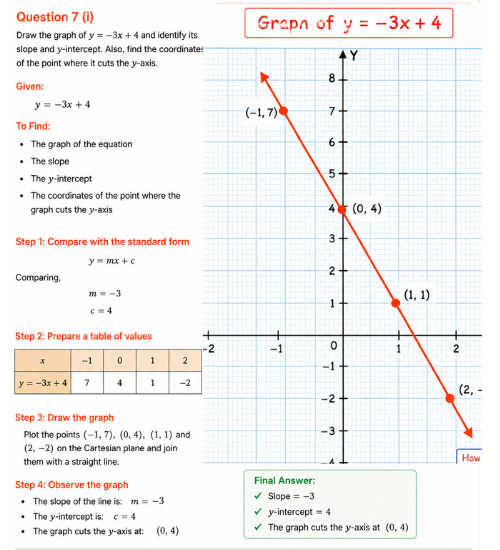
Graph of y = −3x + 4
Step 4: Observe the graph
The slope of the line is:
m = −3
The y-intercept is:
c = 4
The graph cuts the y-axis at:
(0, 4)
- Slope = −3
- y-intercept = 4
- The graph cuts the y-axis at (0, 4)
Key Concept Used: Slope-intercept form of a linear equation: y = mx + c
Common Mistake: Students often ignore the negative sign of the slope.
Exam Tip: In the equation y = mx + c, the value of c always gives the point where the graph cuts the y-axis.
Question 7 (ii)
Draw the graph of the equation 2y = 4x + 7 and identify its slope and y-intercept. Also, find the coordinates of the point where the graph cuts the y-axis.
Given:
2y = 4x + 7
To Find:
- The graph of the equation.
- The slope of the line.
- The y-intercept.
- The coordinates of the point where the graph cuts the y-axis.
Step 1: Convert the equation into slope-intercept form
2y = 4x + 7
Dividing both sides by 2,
y = 2x + 7 2
Comparing with the standard form
y = mx + c
we get,
m = 2
c = 7 2
Step 2: Prepare a table of values
| x | −2 | −1 | 0 | 1 | 2 |
| y = 2x + 7 2 | − 1 2 | 3 2 | 7 2 | 11 2 | 15 2 |
| Decimal Form | −0.5 | 1.5 | 3.5 | 5.5 | 7.5 |
Step 3: Draw the graph
Plot the following points on the Cartesian plane:
- (−2, −0.5)
- (−1, 1.5)
- (0, 3.5)
- (1, 5.5)
- (2, 7.5)
Join the plotted points by a straight line.
Observe that the line cuts the y-axis at ( 0, 7 2 ) .
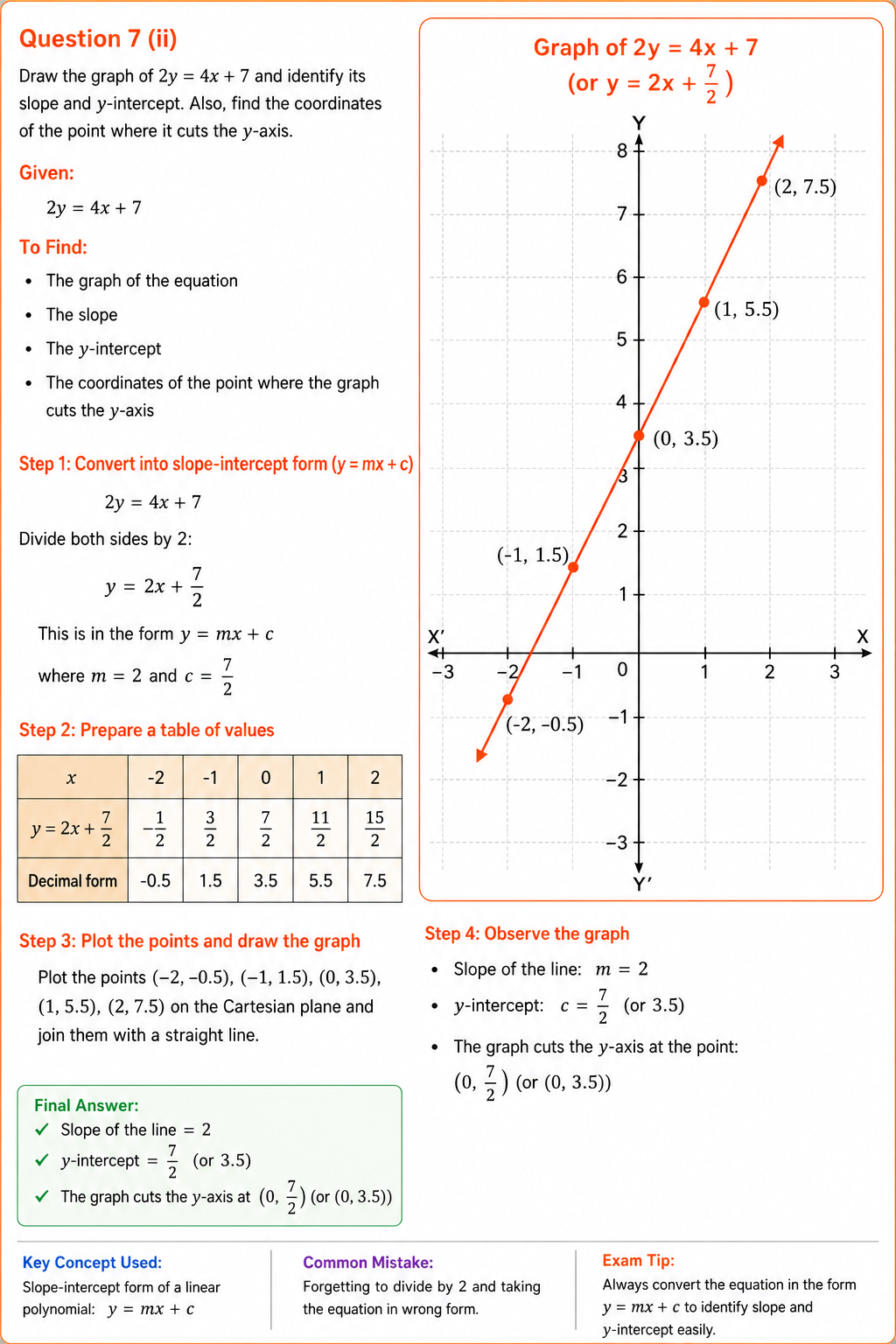
Graph of 2y = 4x + 7
Step 4: Observe the graph
- The slope of the line is: m = 2
- The y-intercept is: 7 2
- The graph cuts the y-axis at: ( 0, 7 2 )
- Slope = 2
- y-intercept = 7 2
- The graph cuts the y-axis at ( 0, 7 2 )
Key Concept Used: Slope-intercept form of a linear equation: y = mx + c
Common Mistake: Students often forget to divide the entire equation by 2 and incorrectly identify the slope and y-intercept.
Exam Tip: Always convert the equation into the form y = mx + c before finding the slope and y-intercept.
Question 7 (iii)
Draw the graph of the equation 5y = 6x − 10 and identify its slope and y-intercept. Also, find the coordinates of the point where the graph cuts the y-axis.
Given:
5y = 6x − 10
To Find:
- The graph of the equation.
- The slope of the line.
- The y-intercept.
- The coordinates of the point where the graph cuts the y-axis.
Step 1: Convert the equation into slope-intercept form
5y = 6x − 10
Dividing both sides by 5,
y = 6 5 x − 10 5
y = 6 5 x − 2
Comparing with the standard form
y = mx + c
we get,
m = 6 5
c = −2
Step 2: Prepare a table of values
| x | −5 | 0 | 5 | 10 |
| y = 6 5 x − 2 | −8 | −2 | 4 | 10 |
Step 3: Draw the graph
Plot the following points on the Cartesian plane:
- (−5, −8)
- (0, −2)
- (5, 4)
- (10, 10)
Join the plotted points by a straight line.
Observe that the graph cuts the y-axis at:
(0, −2)
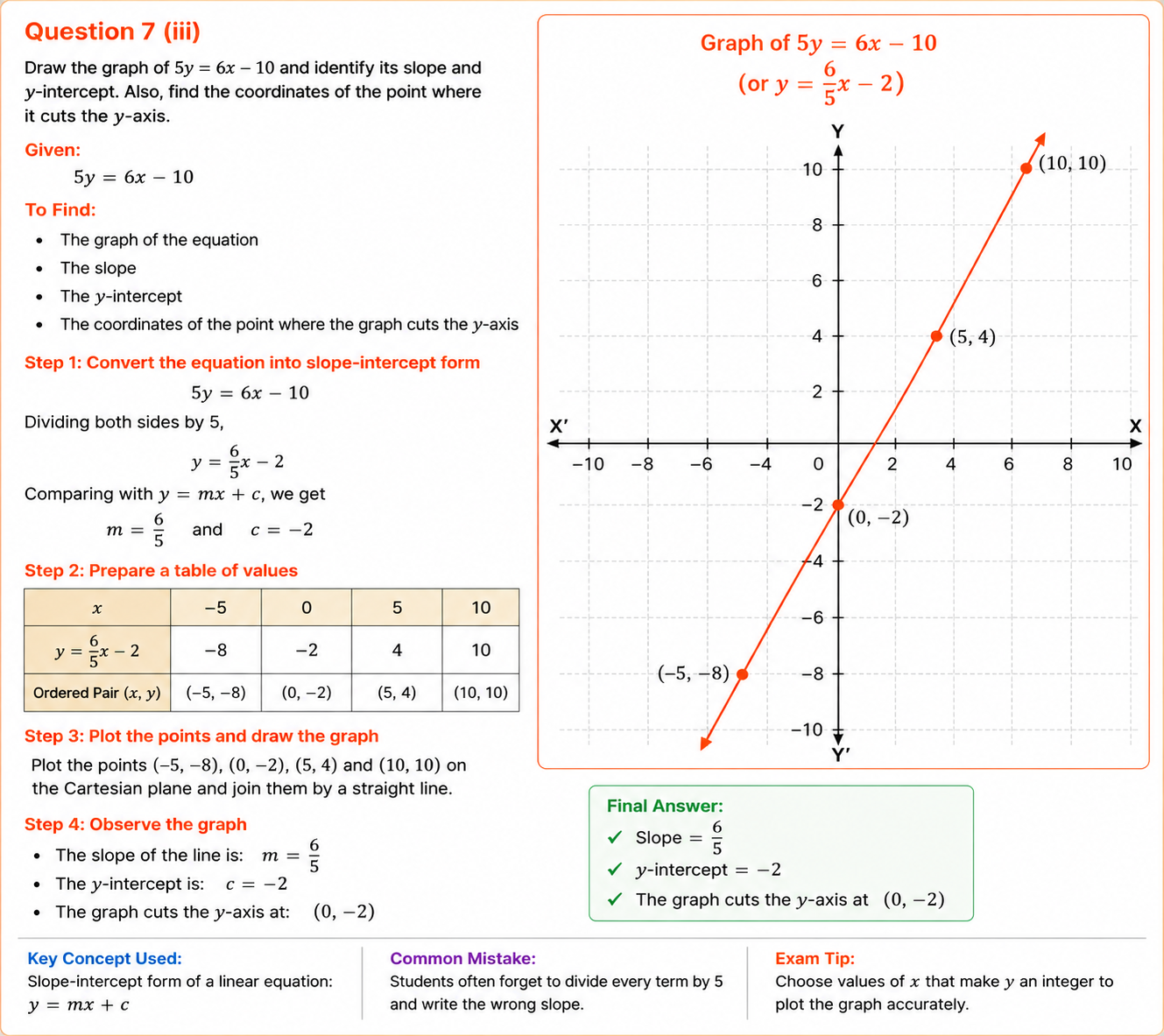
Graph of 5y = 6x − 10
Step 4: Observe the graph
- The slope of the line is: 6 5
- The y-intercept is: −2
- The graph cuts the y-axis at: (0, −2)
- Slope = 6 5
- y-intercept = −2
- The graph cuts the y-axis at (0, −2)
Key Concept Used: Slope-intercept form of a linear equation: y = mx + c
Common Mistake: Students often forget to divide every term by 5 and write the wrong slope.
Exam Tip: Choose values of x that make y an integer to plot the graph accurately.
Question 7 (iv)
Draw the graph of the equation 3y = 6x − 11 and identify its slope and y-intercept. Also, find the coordinates of the point where the graph cuts the y-axis.
Given:
3y = 6x − 11
To Find:
- The graph of the equation.
- The slope of the line.
- The y-intercept.
- The coordinates of the point where the graph cuts the y-axis.
Step 1: Convert the equation into slope-intercept form
3y = 6x − 11
Dividing both sides by 3,
y = 2x − 11 3
Comparing with the standard form
y = mx + c
we get,
m = 2
c = − 11 3
Step 2: Prepare a table of values
| x | −1 | 0 | 1 | 2 |
| y = 2x − 11 3 | − 17 3 | − 11 3 | − 5 3 | 1 3 |
| Decimal Form | −5.67 | −3.67 | −1.67 | 0.33 |
Step 3: Draw the graph
Plot the following points on the Cartesian plane:
- (−1, −5.67)
- (0, −3.67)
- (1, −1.67)
- (2, 0.33)
Join the plotted points by a straight line.
Observe that the graph cuts the y-axis at:
(0, − 11 3 )
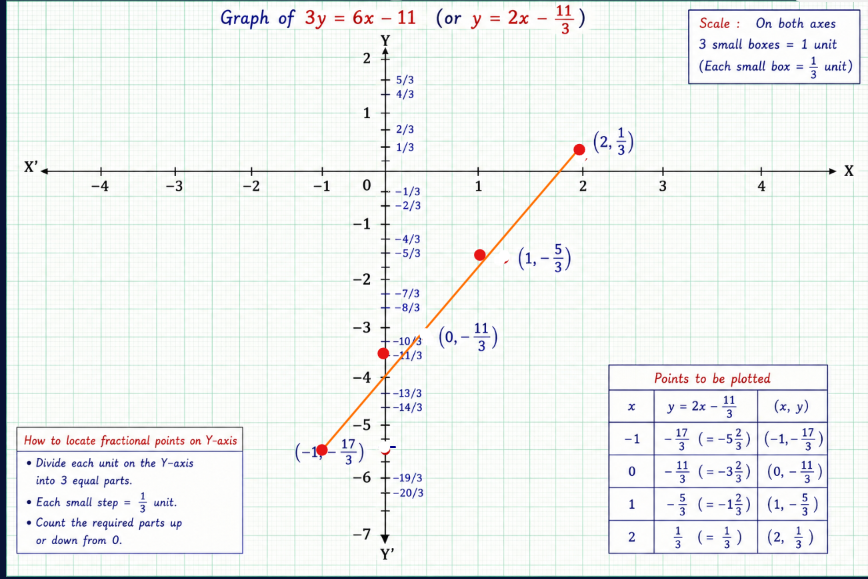
Graph of 3y = 6x − 11
Step 4: Observe the graph
- The slope of the line is: 2
- The y-intercept is: − 11 3
- The graph cuts the y-axis at: (0, − 11 3 )
- Slope = 2
- y-intercept = − 11 3
- The graph cuts the y-axis at (0, − 11 3 )
Key Concept Used: Slope-intercept form of a linear equation: y = mx + c
Common Mistake: Students often forget that the y-intercept can be a fraction.
Exam Tip: When the y-intercept is fractional, write both fractional and decimal values while plotting the graph.
Question 8
If the temperature of a liquid can be measured in Kelvin units as x K and in Fahrenheit units as y °F, the relation between the two systems of measurement is given by
y = 9 5 (x − 273) + 32
(i) Find the temperature of the liquid in Fahrenheit if the temperature is 313 K.
(ii) If the temperature is 158 °F, then find the temperature in Kelvin.
Given:
y = 9 5 (x − 273) + 32
where,
- x = Temperature in Kelvin (K)
- y = Temperature in Fahrenheit (°F)
To Find:
- (i) Temperature in Fahrenheit when x = 313 K
- (ii) Temperature in Kelvin when y = 158 °F
Solution:
(i) When x = 313 K
y = 9 5 (313 − 273) + 32
= 9 5 (40) + 32
= 72 + 32
= 104
Therefore,
Temperature = 104 °F
(ii) When y = 158 °F
158 = 9 5 (x − 273) + 32
158 − 32 = 9 5 (x − 273)
126 = 9 5 (x − 273)
126 × 5 9 = x − 273
70 = x − 273
x = 343
Therefore,
Temperature = 343 K
Practical Insight:
This formula represents a linear relationship between Kelvin and Fahrenheit scales. Such temperature conversions are widely used in science and engineering.
- (i) 313 K = 104 °F
- (ii) 158 °F = 343 K
Key Concept Used: Substitution in a linear equation and solving a linear equation in one variable.
Common Mistake: Students often forget to subtract 32 before solving for the Kelvin temperature.
Exam Tip: Always substitute the given value carefully and solve step-by-step to avoid calculation errors.
Question 9
The work done by a body on the application of a constant force is the product of the constant force and the distance travelled by the body in the direction of the force. Express this in the form of a linear equation in two variables (work w and distance d), and draw its graph by taking the constant force as 3 units. What is the work done when the distance travelled is 2 units? Verify it by plotting it on the graph.
Given:
- Constant force, F = 3 units
- Work done = w
- Distance travelled = d
To Find:
- The linear equation relating work and distance.
- The work done when the distance travelled is 2 units.
Solution:
We know that,
Work done = Force × Distance
Substituting the value of the force,
w = 3 × d
Hence, the required linear equation is
w = 3d
Step 1: Prepare a table of values
| Distance (d) | 0 | 1 | 2 | 3 | 4 |
| Work (w) = 3d | 0 | 3 | 6 | 9 | 12 |
Step 2: Find the work done when distance travelled is 2 units
Substituting d = 2 in the equation
w = 3d
w = 3 × 2
w = 6
Therefore, when the distance travelled is 2 units, the work done is 6 units.
Step 3: Verification using graph
To verify graphically, plot the points:
(0, 0), (1, 3), (2, 6), (3, 9), (4, 12)
and join them by a straight line. The point corresponding to d = 2 gives w = 6, which verifies our answer.
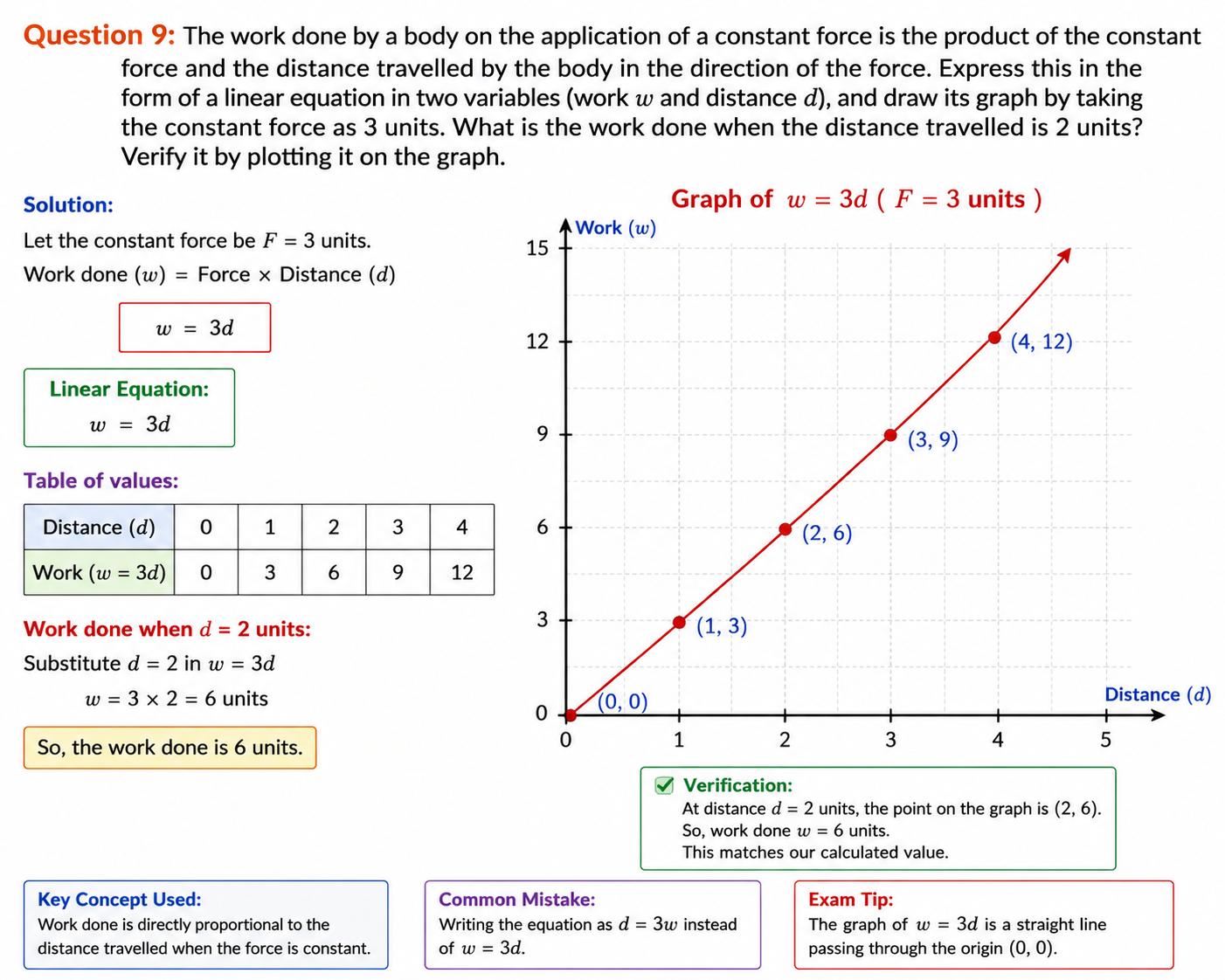
Graph of the linear equation w = 3d
Step 4: Observation from the graph
The point corresponding to distance d = 2 is (2, 6).
Thus, the graph also verifies that the work done is 6 units.
- The required linear equation is: w = 3d
- When the distance travelled is 2 units, the work done is: 6 units
Key Concept Used: The work done by a constant force is directly proportional to the distance travelled.
Common Mistake: Students sometimes interchange the variables and write d = 3w instead of w = 3d.
Exam Tip: When the force is constant, the graph of work done versus distance is always a straight line passing through the origin.
Question 10
The graph of a linear polynomial p(x) passes through the points (1, 5) and (3, 11).
(i) Find the polynomial p(x).
(ii) Find the coordinates where the graph of p(x) cuts the axes.
(iii) Draw the graph of p(x) and verify your answers.
Given:
- The graph of p(x) passes through (1, 5).
- The graph of p(x) passes through (3, 11).
To Find:
- The linear polynomial p(x).
- The points where the graph cuts the coordinate axes.
Solution:
Let the required linear polynomial be
p(x)=mx+c
Since the graph passes through the point (1,5),
5=m(1)+c
m+c=5
… (1)
Also, the graph passes through the point (3,11),
11=m(3)+c
3m+c=11
… (2)
Step 1: Find the value of m
Subtracting equation (1) from equation (2),
(3m+c)−(m+c)=11−5
2m=6
m=3
Step 2: Find the value of c
Substituting m=3 in equation (1),
3+c=5
c=2
Step 3: Find the polynomial
Substituting the values of m and c,
p(x)=3x+2
Step 4: Find the coordinates where the graph cuts the axes
(a) y-axis intercept
On the y-axis,
x=0
Therefore,
p(0)=3(0)+2
=2
Hence, the graph cuts the y-axis at
(0,2)
(b) x-axis intercept
On the x-axis,
p(x)=0
3x+2=0
3x=-2
x=− 2 3
Hence, the graph cuts the x-axis at
( − 2 3 ,0)
Step 5: Verification by graph
To verify graphically, plot the points:
(−2/3,0), (0,2), (1,5), (3,11)
and join them by a straight line.
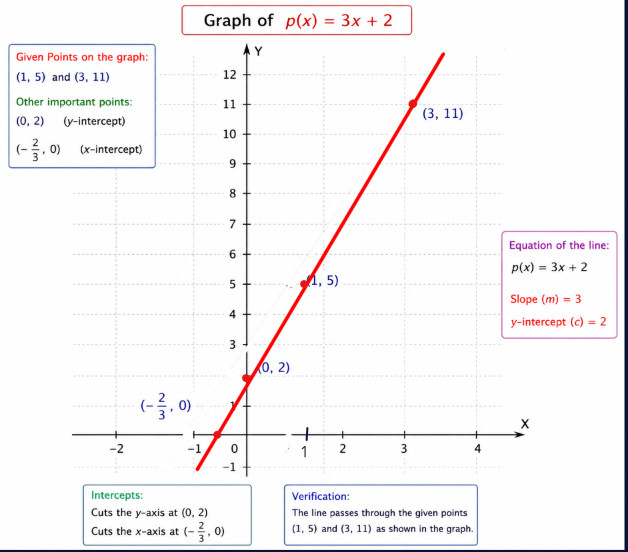
Graph of the linear polynomial p(x)=3x+2
Step 6: Observation from the graph
The graph passes through the points (1,5) and (3,11), cuts the y-axis at (0,2) and cuts the x-axis at ( − 2 3 ,0) . Thus, the graph verifies our answer.
- The required polynomial is: p(x)=3x+2
- The graph cuts the y-axis at: (0,2)
- The graph cuts the x-axis at: ( − 2 3 ,0)
Key Concept Used: A linear polynomial can be written in the form p(x)=mx+c.
Common Mistake: Students often forget that on the x-axis, y=0 and on the y-axis, x=0.
Exam Tip: Always use at least two known points to determine the equation of a straight line.
Question 11
Let p(x) = ax + b and q(x) = cx + d be two linear polynomials such that:
- p(0) = 5
- The polynomial p(x) − q(x) cuts the x-axis at (3, 0)
- The sum p(x) + q(x) is equal to 6x + 4 for all real x
Find the polynomials p(x) and q(x).
Given:
p(x)=ax+b
q(x)=cx+d
and
- p(0)=5
- p(x)−q(x) cuts the x-axis at (3,0)
- p(x)+q(x)=6x+4
To Find:
The polynomials p(x) and q(x).
Solution:
Step 1: Use the condition p(0)=5
Since
p(x)=ax+b
therefore,
p(0)=a(0)+b
=b
But p(0)=5.
Hence,
b=5
Therefore,
p(x)=ax+5
Step 2: Use the condition p(x)+q(x)=6x+4
Substituting the values,
(ax+5)+(cx+d)=6x+4
(a+c)x+(5+d)=6x+4
Comparing coefficients,
a+c=6
5+d=4
Hence,
d=-1
and
c=6-a
Therefore,
q(x)=(6-a)x-1
Step 3: Use the condition that p(x)-q(x) cuts the x-axis at (3,0)
First find p(x)-q(x):
p(x)-q(x)
=(ax+5)-[(6-a)x-1]
=ax+5-6x+ax+1
=(2a-6)x+6
Since the graph cuts the x-axis at (3,0),
p(3)-q(3)=0
Substituting x=3,
(2a-6)(3)+6=0
6a-18+6=0
6a-12=0
6a=12
a=2
Step 4: Find c
Since
a+c=6
therefore,
2+c=6
c=4
Step 5: Write the required polynomials
Substituting the values of a, b, c and d,
p(x)=2x+5
q(x)=4x-1
Quick Verification:
p(0)=2(0)+5=5 ✓
p(x)+q(x)
=(2x+5)+(4x-1)
=6x+4 ✓
p(x)-q(x)
=(2x+5)-(4x-1)
=-2x+6
-2(3)+6=0 ✓
p(x)=2x+5
q(x)=4x-1
Key Concept Used: Comparison of coefficients and the property that the x-coordinate of the point where a graph cuts the x-axis makes the polynomial equal to zero.
Common Mistake: Students often forget that for a graph to cut the x-axis at x=3, the polynomial value at x=3 must be zero.
Exam Tip: When multiple conditions are given, solve them one by one and substitute the obtained values immediately.
Question 12
Look at the first three stages of a growing pattern of hexagons made using matchsticks. A new hexagon gets added at every stage which shares a side with the last hexagon of the previous stage.
Given:
- A hexagon requires 6 matchsticks.
- Each new hexagon shares one side with the previous hexagon.
To Find:
- The number of matchsticks in the next stages.
- The formula for the nth stage.
- The number of matchsticks required for the 15th stage.
- Whether 200 matchsticks can form a stage.
Solution:
A single hexagon requires
6 matchsticks
Since every new hexagon shares one side with the previous hexagon, only
5 new matchsticks
are required at each stage.
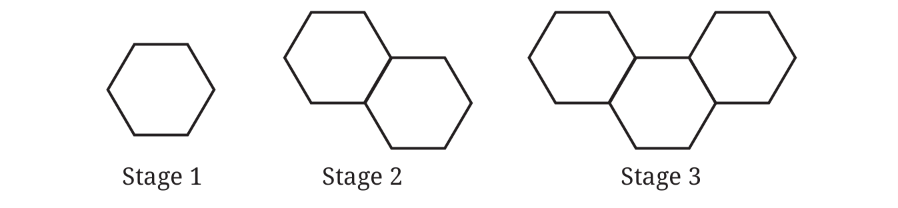
Growing pattern of hexagons made using matchsticks
(i) Number of matchsticks in the next two stages
| Stage Number | 1 | 2 | 3 | 4 | 5 |
| Number of Matchsticks | 6 | 11 | 16 | 21 | 26 |
Therefore,
Stage 4 requires 21 matchsticks.
Stage 5 requires 26 matchsticks.
(ii) Complete the table
| Stage Number | 1 | 2 | 3 | 4 | 5 | … | n |
| Matchsticks | 6 | 11 | 16 | 21 | 26 | … | 5n+1 |
(iii) Find a rule for the nth stage
Observe the pattern carefully:
Stage 1 = 6 = 6 + 0×5
Stage 2 = 11 = 6 + 1×5
Stage 3 = 16 = 6 + 2×5
Stage 4 = 21 = 6 + 3×5
Stage 5 = 26 = 6 + 4×5
Therefore, for the nth stage,
M = 6 + (n − 1) × 5
M = 6 + 5n − 5
M = 5n + 1
Hence, the number of matchsticks required in the nth stage is
M = 5n + 1
(iv) Number of matchsticks required for the 15th stage
Substituting n = 15,
M = 5(15) + 1
= 75 + 1
= 76
Therefore,
The 15th stage requires 76 matchsticks.
(v) Can 200 matchsticks form a stage?
Let,
5n + 1 = 200
5n = 199
n = 199 5
n = 39.8
Since n is not a whole number, 200 matchsticks cannot form a stage in this pattern.
- Stage 4 requires 21 matchsticks.
- Stage 5 requires 26 matchsticks.
- The rule for the nth stage is: M = 5n + 1
- The 15th stage requires: 76 matchsticks.
- 200 matchsticks cannot form a stage in this pattern.
Key Concept Used: Observe the pattern and express the number of matchsticks in terms of n.
Common Mistake: Students often add 6 matchsticks at each stage instead of adding only 5 because one side is shared.
Exam Tip: Before finding the nth term, write the first few stages in the form 6+0×5, 6+1×5, 6+2×5, …
Question 13
Let p(x)=ax+b and q(x)=cx+d be two linear polynomials such that:
- The graph of p(x) passes through the points (2, 3) and (6, 11).
- The graph of q(x) passes through the point (4, −1).
- The graph of q(x) is parallel to the graph of p(x).
Find the polynomials p(x) and q(x). Also, find the coordinates of the points where these lines meet the x-axis.
Given:
- p(x) passes through (2,3) and (6,11).
- q(x) passes through (4,−1).
- q(x) is parallel to p(x).
To Find:
- The polynomials p(x) and q(x).
- The points where they cut the x-axis.
Solution:
Step 1: Find the polynomial p(x)
Let
p(x)=ax+b
Since the graph passes through (2,3),
2a+b=3
…(1)
Also, the graph passes through (6,11),
6a+b=11
…(2)
Subtracting equation (1) from equation (2),
4a=8
a=2
Substituting a=2 in equation (1),
2(2)+b=3
4+b=3
b=-1
Therefore,
p(x)=2x-1
Step 2: Find the polynomial q(x)
Since the graph of q(x) is parallel to the graph of p(x), both have the same coefficient of x.
Hence, let
q(x)=2x+d
Since q(x) passes through (4,−1),
2(4)+d=-1
8+d=-1
d=-9
Therefore,
q(x)=2x-9
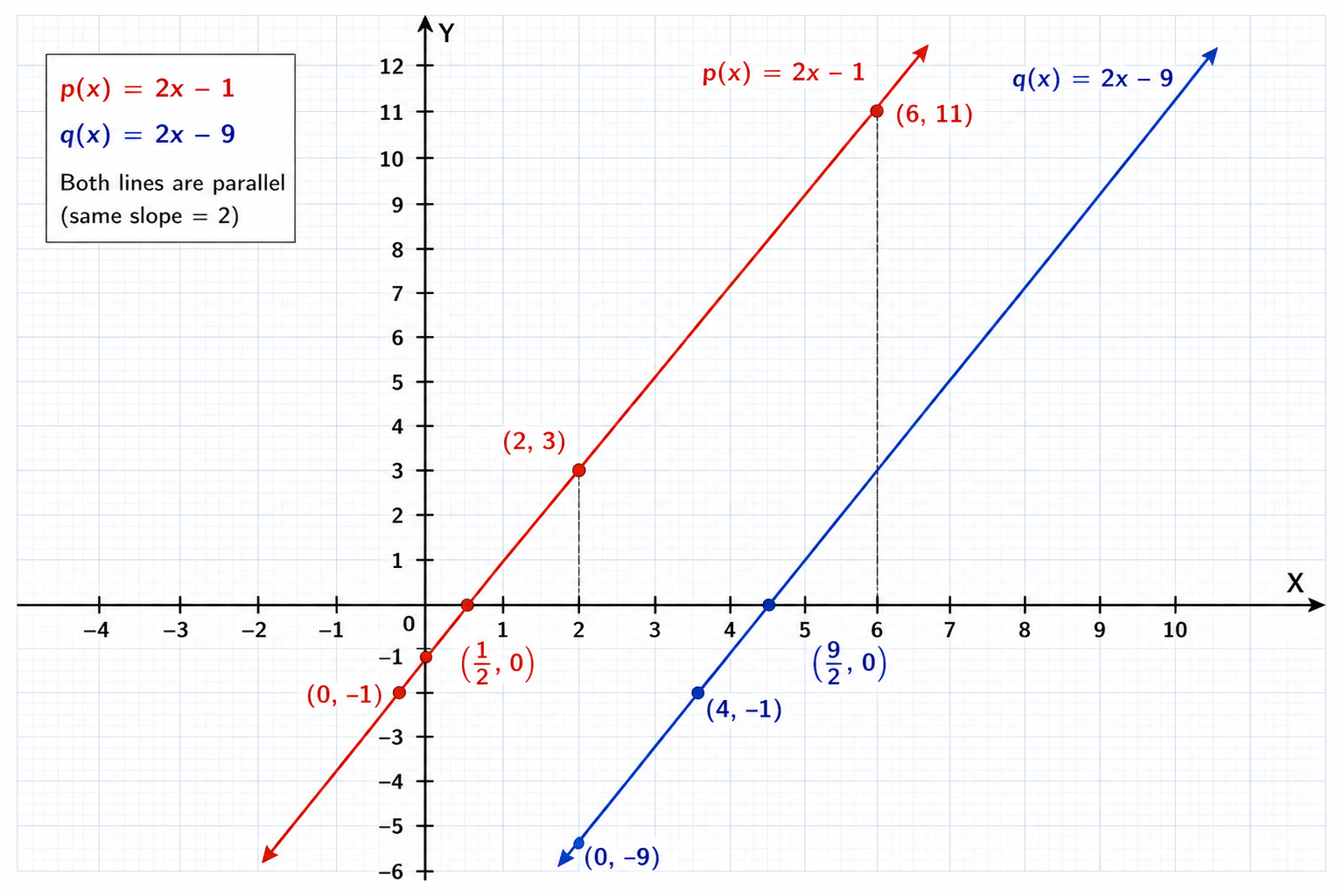
Graphs of the parallel linear polynomials p(x)=2x−1 and q(x)=2x−9
Step 3: Find the point where p(x) cuts the x-axis
On the x-axis,
p(x)=0
2x-1=0
2x=1
x= 1 2
Hence, p(x) cuts the x-axis at
( 1 2 ,0)
Step 4: Find the point where q(x) cuts the x-axis
On the x-axis,
q(x)=0
2x-9=0
2x=9
x= 9 2
Hence, q(x) cuts the x-axis at
( 9 2 ,0)
Verification:
The coefficients of x in both polynomials are equal to 2. Therefore, their graphs are parallel.
Slope of p(x)=2
Slope of q(x)=2
p(x)=2x-1
q(x)=2x-9
p(x) cuts the x-axis at ( 1 2 ,0)
q(x) cuts the x-axis at ( 9 2 ,0)
Key Concept Used: Parallel lines have the same coefficient of x (same slope).
Common Mistake: Students often assume that parallel lines have the same constant term also.
Exam Tip: When two linear polynomials are parallel, first find one polynomial completely and then use the given point to determine the second polynomial.
Question 14
What do all linear functions of the form f(x) = ax + a, a > 0, have in common?
Given:
f(x)=ax+a
where
a > 0
To Find:
The common property of all linear functions of the form f(x)=ax+a.
Solution:
Consider the given linear function:
f(x)=ax+a
We can rewrite it as:
f(x)=a(x+1)
Since a > 0, the coefficient of x (slope) is always positive.
Therefore, the graph of every such function is an increasing straight line.
Finding the y-intercept
At the y-axis,
x=0
Substituting,
f(0)=a(0)+a
=a
Hence, every graph cuts the y-axis at:
(0,a)
Finding the x-intercept
At the x-axis,
f(x)=0
a(x+1)=0
Since a ≠ 0,
x+1=0
x=-1
Hence, every graph cuts the x-axis at:
(-1,0)
Common Property
- All graphs are straight lines.
- All graphs have positive slope.
- All graphs pass through the fixed point (−1,0).
- All graphs intersect the y-axis at (0,a).
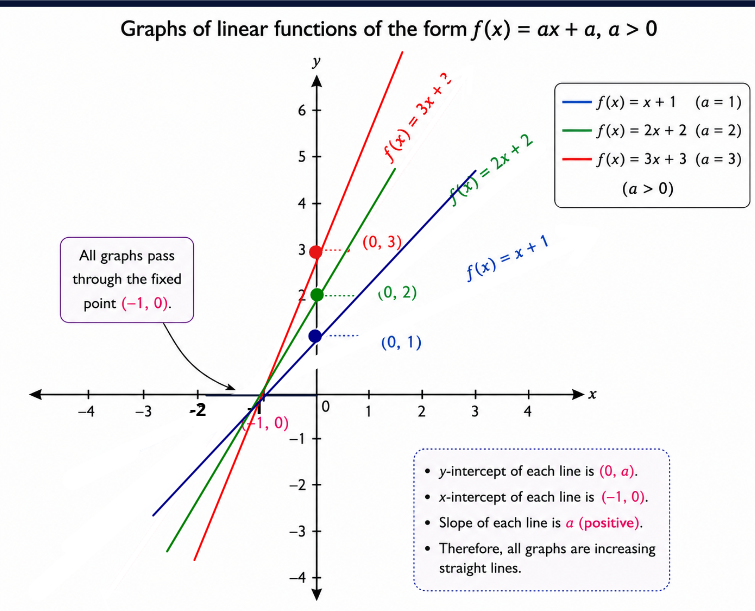
All graphs of the form f(x)=ax+a pass through the fixed point (-1,0)
All linear functions of the form
f(x)=ax+a,\; a>0
have a positive slope and all their graphs pass through the common fixed point
(-1,0).
Key Concept Used: Finding common properties by expressing the function in a simplified form.
Common Mistake: Students often conclude only that the slope is positive and miss the fact that all graphs pass through the fixed point (-1,0).
Exam Tip: Whenever a parameter appears in a linear function, check whether some point remains fixed for all values of the parameter.
🎓 What You Learned in Chapter 2
After completing the Class 9 Maths Chapter 2 End Exercise Solutions, you have revised the most important concepts of Introduction to Linear Polynomials. These concepts form the foundation for many higher-level topics in algebra and coordinate geometry.
Learned how to identify the degree of a polynomial and evaluate polynomial expressions.
Represented mathematical relationships using linear equations and algebraic expressions.
Plotted points accurately and interpreted graphs of linear equations.
Solved mathematical patterns and generalized them using linear expressions.
Applied algebraic concepts to everyday situations through mathematical modelling.
Practised complete CBSE-style questions and strengthened your problem-solving skills.
💡 Final Revision Tip
Before your exam, revise the graphs, polynomial evaluation, linear equations, and pattern-based questions once again. These concepts are frequently used in later chapters and help build a strong foundation for Class 9 and Class 10 Mathematics.
❓ Frequently Asked Questions
Find answers to the most common questions about Class 9 Maths Chapter 2 End Exercise Solutions, the NCERT Ganita Manjari (2026) textbook, and the latest CBSE Class 9 Maths syllabus.
1. Is Class 9 Chapter 2 Introduction to Linear Polynomials important?
Yes. Introduction to Linear Polynomials is one of the most important chapters in Class 9 Maths because it forms the foundation for coordinate geometry, linear equations, functions, graphs, and higher algebra taught in later classes.
2. How many questions are there in Class 9 Maths Chapter 2 End Exercise?
The Class 9 Maths Chapter 2 End Exercise contains 14 questions. These questions cover polynomial evaluation, linear equations, graphs, mathematical patterns, word problems, and real-life applications.
3. Are graph questions important for CBSE Class 9 exams?
Yes. Graph-based questions are important because they test your understanding of linear equations, slope, intercepts, plotting points, and graph interpretation. These concepts are frequently used in higher classes as well.
4. Which is the most difficult question in Chapter 2 End Exercise?
Most students find questions involving graph analysis, pattern recognition, matchstick patterns, and constructing linear polynomials slightly more challenging because they require logical thinking as well as mathematical concepts.
5. Are these Class 9 Maths Chapter 2 End Exercise Solutions based on the latest NCERT book?
Yes. These Class 9 Maths Chapter 2 End Exercise Solutions are prepared according to the latest NCERT Ganita Manjari (2026) textbook and follow the current CBSE Class 9 Maths syllabus and answer-writing pattern.
6. Can I use these solutions for CBSE board and school examinations?
Yes. These solutions follow the latest CBSE Class 9 Maths syllabus and the NCERT Ganita Manjari (2026) textbook. They are useful for school examinations, periodic tests, half-yearly exams, annual exams, and concept revision.
7. How should I prepare Class 9 Maths Chapter 2 for full marks?
First, understand the concepts of linear polynomials and polynomial evaluation. Then practise graph questions, solve all NCERT examples and End Exercise questions, and revise important formulas and concepts regularly.
8. Do these solutions explain every step of the answer?
Yes. Every question is solved using a simple, step-by-step method so that students can easily understand the concept and write answers in the proper CBSE examination format.
9. Are these Class 9 Maths Chapter 2 End Exercise Solutions free to access?
Yes. All Class 9 Maths Chapter 2 End Exercise Solutions available on Maths Gurukulam are completely free for students to study online and revise before examinations.
10. What should I study after completing Chapter 2 End Exercise?
After completing the Class 9 Maths Chapter 2 End Exercise Solutions, revise the important concepts once more and continue with the next NCERT chapter. Regular practice of graphs, linear equations, and polynomial-based questions will strengthen your mathematical foundation for future chapters.
📚 Continue Learning
🔗 Useful Resources
Explore these official educational resources for authentic CBSE and NCERT study materials.
Need Personal Guidance in Maths?
Join Newton Study Point for concept-based Maths coaching by an experienced teacher. Small batches, individual attention, regular tests, and complete CBSE exam preparation for Classes 8, 9, 10, 11 & 12.
📞 Call Now: 8447002272 💬 WhatsApp📍 Newton Study Point • Ankur Vihar, Ghaziabad

Rakesh Kumar Singh
Founder, Maths Gurukulam & Newton Study Point
Teaching CBSE Mathematics Since 2006
These Class 9 Maths Chapter 4 Exercise 4.1 Solutions are carefully prepared according to the latest NCERT Ganita Manjari (2026) and the CBSE curriculum. Every solution follows a clear, step-by-step approach designed to strengthen conceptual understanding, improve problem-solving skills, and help students perform confidently in school and board examinations.