📚 Class 9 Maths → Chapter 3 → The World of Numbers → Exercise 3.2
Class 9 Maths Chapter 3 Exercise 3.2 Solutions
Ganita Manjari (NCERT 2026) – Integers & Number Line
Master Class 9 Maths Chapter 3 Exercise 3.2 Solutions with easy-to-understand, step-by-step NCERT solutions, colourful concept cards, visual number line explanations, rules of Zero (Shunya), integers, and exam-focused learning specially designed for CBSE Class 9 students.
Exercise 3.2
Complete NCERT Solutions
Integers
Positive • Negative • Zero
Visual Learning
Number Line & Concepts
CBSE Ready
Exam-Oriented Solutions
What You’ll Learn in Exercise 3.2
Before solving the NCERT questions, let’s understand the important concepts of integers, zero (Shunya), number line, and their real-life applications. These concepts will make every question in Class 9 Maths Chapter 3 Exercise 3.2 much easier to solve.
Integers
Understand what integers are and how they extend the number system beyond whole numbers.
Positive & Negative Numbers
Learn how positive and negative integers are used to represent gains, losses, temperatures and directions.
Zero (Shunya)
Discover why Shunya (Zero) is one of India’s greatest mathematical contributions and learn its important rules.
Number Line
Represent integers correctly on a number line and understand their position relative to zero.
Integer Operations
Practice addition, subtraction and multiplication involving positive and negative integers with confidence.
Real-Life Applications
See how integers are used in everyday life through temperature, profit & loss, sea level, lifts and banking.
💡 Learning Tip: If you understand these six concepts first, solving every question in Class 9 Maths Chapter 3 Exercise 3.2 Solutions becomes much easier. Spend just a few minutes on these ideas before attempting the NCERT questions.
Learn Before You Solve
Before solving Class 9 Maths Chapter 3 Exercise 3.2 Solutions, understand these four important concepts. They form the foundation of integers and will help you solve every question with confidence.
What are Integers?
Integers are numbers that include positive numbers, negative numbers and zero. They help us represent situations such as gains, losses, temperature and movement in opposite directions.
Positive Integers
Positive integers are numbers greater than zero. Examples: 1, 2, 3, 4, 5… They are located on the right side of zero on the number line.
Negative Integers
Negative integers are numbers less than zero. Examples: −1, −2, −3… They are located on the left side of zero on the number line.
Zero (Shunya)
Zero (Shunya) is neither positive nor negative. It separates positive and negative integers on the number line and is one of the greatest contributions of ancient Indian mathematics.
⚡ Quick Recap
- Integers include positive numbers, negative numbers and zero.
- Positive integers are on the right of zero.
- Negative integers are on the left of zero.
- Zero (Shunya) is neither positive nor negative.
Journey of the Number System
Mathematics developed step by step as people faced new situations in daily life. Each new type of number solved a new problem and made calculations easier.
Natural Numbers
Used for counting objects.
1, 2, 3, 4, 5…
Whole Numbers
Zero (Shunya) was introduced.
0, 1, 2, 3…
Integers
Negative numbers were added.
…, −2, −1, 0, 1, 2…
Modern Mathematics
Integers became the foundation for algebra, science, engineering and technology.
💡 Why Was This Journey Important?
People first learned to count using Natural Numbers. Later, the discovery of Zero (Shunya) gave rise to Whole Numbers. As the need to represent losses, temperatures below zero and opposite directions increased, Integers were introduced. Today, integers form the foundation of modern mathematics and many real-life applications.
Meet Brahmagupta
The story of Zero (Shunya) became one of the greatest achievements in mathematics because of the remarkable work of the Indian mathematician Brahmagupta.
Ancient Indian Mathematician
👤 Who was Brahmagupta?
Brahmagupta (598–668 CE) was one of the greatest Indian mathematicians and astronomers. His book Brahmasphuṭasiddhānta explained many important mathematical ideas, including the use of zero (Shunya) and negative numbers.
🏆 Why is he famous?
Brahmagupta was among the first mathematicians to write clear mathematical rules for performing operations with zero and negative numbers. His work laid the foundation for many ideas used in mathematics today.
⭕ Contribution to Zero (Shunya)
- Explained how to use zero in calculations.
- Described rules for adding, subtracting and multiplying with zero.
- Helped establish zero as an important number in mathematics.
- His ideas later spread to many parts of the world.
💡 Did You Know?
The invention and development of Zero (Shunya) is considered one of India’s greatest contributions to mathematics. Without zero, modern concepts such as algebra, computers, banking and digital technology would not exist in their present form.
Rules of Zero (Shunya)
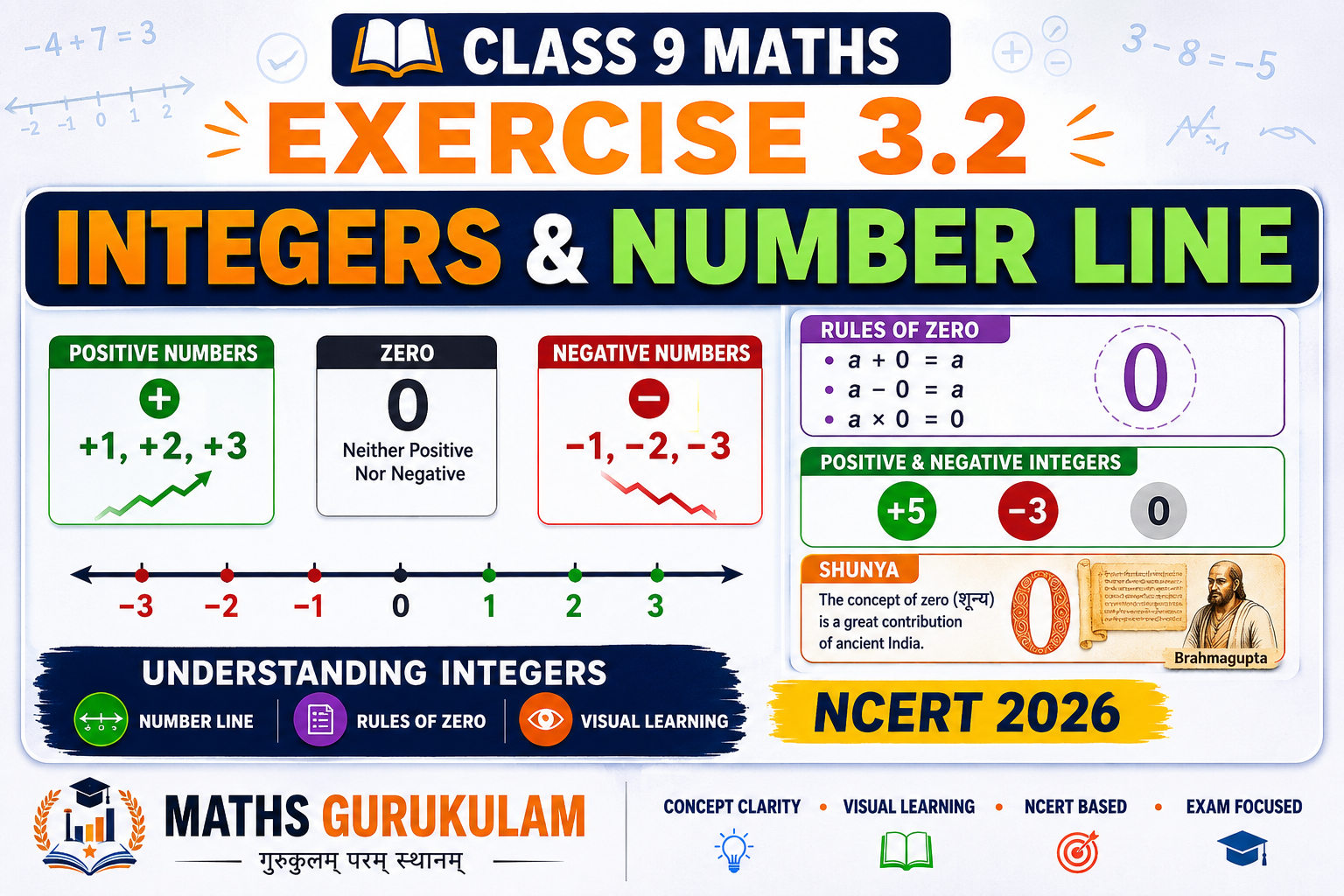
Zero (Shunya) is one of the most important numbers in mathematics. Remember these three basic rules before solving Exercise 3.2.
Addition Rule
a + 0 = a
Adding zero does not change the number.
Subtraction Rule
a − 0 = a
Subtracting zero also leaves the number unchanged.
Multiplication Rule
a × 0 = 0
Any number multiplied by zero is always zero.
🧠 Memory Trick
➕ Zero Adds Nothing
➖ Zero Takes Nothing
✖ Zero Makes Everything Zero
📘 Quick Note
These three rules were explained by the great Indian mathematician Brahmagupta. They are frequently used while performing operations involving integers and are important for solving NCERT Exercise 3.2 questions.
Understanding Integers
Every integer belongs to one of these three groups. Learning the difference between positive numbers, zero, and negative numbers makes solving integer questions much easier.
Positive Numbers
+1, +2, +3, +4 …
Positive numbers are greater than zero. They are located on the right side of zero on the number line.
Zero (Shunya)
0
Zero is neither positive nor negative. It separates positive and negative integers on the number line.
Negative Numbers
−1, −2, −3, −4 …
Negative numbers are less than zero. They are located on the left side of zero on the number line.
📊 Quick Comparison
| Type | Relation to Zero | Examples |
|---|---|---|
| 🟢 Positive Numbers | Greater than 0 | 1, 2, 3, 4 |
| ⚪ Zero | Neither positive nor negative | 0 |
| 🔴 Negative Numbers | Less than 0 | −1, −2, −3 |
🧠 Remember
✔ Numbers on the right of zero are positive.
✔ Numbers on the left of zero are negative.
✔ Zero (Shunya) is the dividing point and is neither positive nor negative.
Understanding Integers on the Number Line
A number line helps us compare integers easily. Numbers increase as we move to the right and decrease as we move to the left. Zero (Shunya) lies exactly between positive and negative integers.
| −5 | −4 | −3 | −2 | −1 | 0 | 1 | 2 | 3 | 4 | 5 |
|
|
||||||||||
| │ | │ | │ | │ | │ | ⭕ | │ | │ | │ | │ | │ |
🟢 Positive Integers
Examples:
3 and 7
These numbers are placed on the right side of zero.
⚪ Zero (Shunya)
0 is the dividing point between positive and negative integers.
🔴 Negative Integers
Examples:
−5 and −2
These numbers are placed on the left side of zero.
💡 Easy Way to Remember
- ➡ Moving right means the numbers become greater.
- ⬅ Moving left means the numbers become smaller.
- Zero is the centre of the number line.
- Every integer has a fixed position on the number line.
Where Do We Use Integers in Daily Life?
Integers are not just used in mathematics—they are part of our everyday lives. From measuring temperature to recording profits and losses, integers help us represent quantities above and below a reference point.
Temperature
Temperatures above 0°C are represented by positive integers, while temperatures below 0°C are represented by negative integers.
Shimla = −5°C
Profit & Loss
Profit is represented using positive integers, whereas loss is represented using negative integers.
Profit = +₹800
Loss = −₹500
Sea Level
Heights above sea level are positive, while depths below sea level are represented by negative integers.
Mountain = +2500 m
Sea Depth = −120 m
Lift Floors
Floors above the ground floor are positive, while basement floors are represented using negative integers.
3rd Floor = +3
Basement = −2
Mountain Height
Mountain peaks are measured above sea level and therefore use positive integers.
Peak Height = +8849 m
Bank Balance
A positive balance means money is available, while an overdraft or debt can be represented using a negative value.
Balance = +₹5000
Debt = −₹1200
💡 Key Takeaway
Integers help us compare quantities that are above or below a fixed reference point. Whether it is temperature, profit and loss, sea level, building floors or banking, integers make it easy to represent real-life situations clearly and accurately.
Golden Rules of Integers
Before solving Exercise 3.2, remember these important rules of integers. They will help you avoid common mistakes in calculations.
Addition
- Positive + Positive = Positive
- Negative + Negative = Negative
- Different signs → Subtract the numbers and keep the sign of the larger number.
Subtraction
- Subtracting a positive number moves left on the number line.
- Subtracting a negative number is the same as adding its positive value.
- Use the number line whenever you are unsure.
Multiplication
| Signs | Result |
| + × + | + |
| + × − | − |
| − × + | − |
| − × − | + |
🧠 Super Memory Trick
😊 Same Signs → Positive (+)
😃 Different Signs → Negative (−)
📘 Exam Note
In Class 9 examinations, students usually lose marks because of incorrect signs rather than incorrect calculations. Always check whether the numbers have the same sign or different signs before performing any operation.
Question 1
Question:
The temperature in the high-altitude desert of Ladakh is recorded as 4°C at noon. By midnight, it drops by 15°C. What is the midnight temperature?
📌 Given
- Temperature at noon = 4°C
- Drop in temperature = 15°C
🎯 To Find
The temperature at midnight.
📝 Step-by-Step Solution
The temperature at noon is 4°C.
Since the temperature drops by 15°C, we move 15 units to the left on the number line.
Midnight Temperature
= 4 − 15
= −11°C
Therefore, the midnight temperature is 11°C below 0°C.
📍 Number Line Representation
Start from 4 and move 15 steps to the left because the temperature decreases.
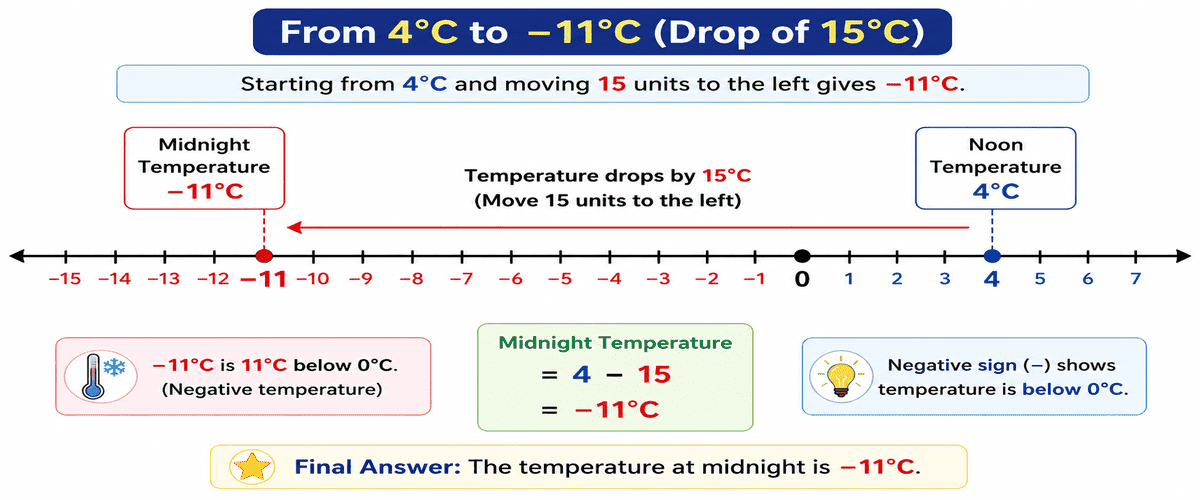
Movement on the number line: 4 → −11
✅ Final Answer
The temperature at midnight is −11°C.
📘 Key Concept Used
A decrease in quantity is represented by moving towards the left on the number line. Numbers become smaller as we move left.
⚠ Common Mistake
Some students write 4 + 15 = 19°C. Remember that the word “drops” means the temperature decreases, so we subtract 15 from 4.
🎯 Exam Tip
Whenever you see words like drops, falls, decreases or goes down, move left on the number line.
🧠 Memory Trick
⬆ Rise = Move Right (+)
⬇ Drop = Move Left (−)
Question 2
Question:
A spice trader takes a loan (debt) of ₹850. The next day, he makes a profit (fortune) of ₹1,200. The following week, he incurs a loss of ₹450. Write this sequence as an equation using integers and calculate his final financial standing.
📌 Given
- Debt = −₹850
- Profit = +₹1200
- Loss = −₹450
🎯 To Find
- Write the situation as an equation using integers.
- Find the trader’s final financial standing.
📝 Step-by-Step Solution
Represent each financial transaction using integers.
- Debt → −850
- Profit → +1200
- Loss → −450
Therefore, the required equation is:
−850 + 1200 − 450
Now simplify step by step.
−850 + 1200 − 450
= 350 − 450
= −100
Since the result is −100, the trader still owes ₹100.
✅ Final Answer
Required equation:
−850 + 1200 − 450 = −100
Therefore, the trader’s final financial standing is
₹100 in debt.
📘 Key Concept Used
Financial situations are represented using integers.
- Profit / Income / Fortune → Positive (+)
- Loss / Debt / Loan → Negative (−)
⚠ Common Mistake
Many students treat every amount as positive. Always identify whether the amount represents a gain or a loss before assigning its sign.
🎯 Exam Tip
Remember the sign convention:
Profit / Income → Positive (+)
Loss / Debt → Negative (−)
🧠 Memory Trick
💰 Money Comes In = +
💸 Money Goes Out = −
Question 3
Question:
Calculate the following using Brahmagupta’s laws:
(i) (−12) × 5
(ii) (−8) × (−7)
(iii) 0 − (−14)
(iv) (−20) ÷ 4
📌 Given
The given expressions are to be evaluated using the rules of integers (Brahmagupta’s laws).
🎯 To Find
Find the value of each expression.
📝 Step-by-Step Solution
(i) (−12) × 5
A negative number × positive number gives a negative number.
(−12) × 5
= −60
(ii) (−8) × (−7)
The product of two negative numbers is always positive.
(−8) × (−7)
= 56
(iii) 0 − (−14)
Subtracting a negative number is the same as adding the corresponding positive number.
0 − (−14)
= 0 + 14
= 14
(iv) (−20) ÷ 4
A negative number ÷ positive number gives a negative number.
(−20) ÷ 4
= −5
✅ Final Answer
| Part | Answer |
|---|---|
| (i) | −60 |
| (ii) | 56 |
| (iii) | 14 |
| (iv) | −5 |
📘 Key Concept Used
- Positive × Positive = Positive
- Negative × Negative = Positive
- Positive × Negative = Negative
- Negative × Positive = Negative
- Subtracting a negative number is equivalent to adding the corresponding positive number.
- Division follows the same sign rules as multiplication.
⚠ Common Mistake
Many students perform the numerical calculation correctly but forget the sign rules. Always determine whether the signs are the same or different before multiplying or dividing integers.
🎯 Exam Tip
Remember the shortcut:
✅ Same Signs → Positive (+)
❌ Different Signs → Negative (−)
🧠 Memory Trick
😊 Same Signs = Positive (+)
😃 Different Signs = Negative (−)
Question 4
Question:
Explain, using a real-world example of debt, why subtracting a negative number is the same as adding a positive number. For example, 10 − (−5) = 15.
📌 Given
- Rahul has ₹10.
- He also has a debt of ₹5.
- Debt is represented by the integer −5.
🎯 To Find
Explain why 10 − (−5) = 15 using a real-life example.
📝 Step-by-Step Solution
Suppose Rahul has ₹10. He also owes ₹5, which is represented by −₹5.
Now imagine that someone pays off Rahul’s debt. Removing a debt means we are subtracting a negative quantity.
10 − (−5)
Since the debt is removed, Rahul effectively gains ₹5. Therefore,
10 − (−5)
= 10 + 5
= 15
Hence, subtracting a negative number increases the value because the debt is cancelled.
💡 Visual Understanding
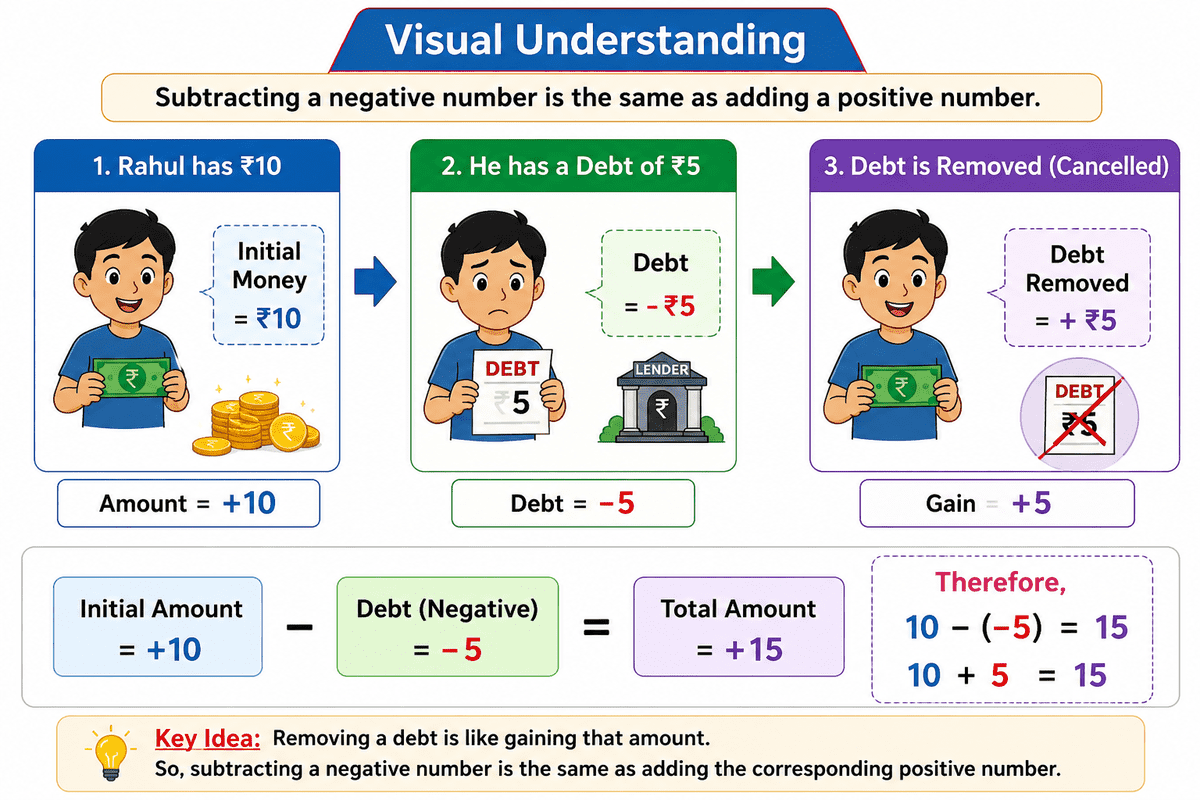
Debt = −₹5 → Debt Removed → Money Increases by ₹5
✅ Final Answer
Removing a debt of
₹5
is the same as gaining
₹5.
Therefore,
10 − (−5)
=
10 + 5
=
15
📘 Key Concept Used
A debt is represented by a negative integer. Removing or cancelling a debt means subtracting a negative number, which is always equivalent to adding the corresponding positive number.
⚠ Common Mistake
Many students think that subtraction always decreases a number. Remember: Subtracting a negative number actually increases the value because a debt is being removed.
🎯 Exam Tip
Always remember the important identity:
a − (−b) = a + b
Whenever you subtract a negative number, convert it into addition.
🧠 Memory Trick
💳 Debt Removed
➜
😊 Money Increases
Minus of Minus = Plus
60-Second Revision
Before you start solving or revise for your exam, go through these important points from Class 9 Maths Chapter 3 Exercise 3.2. They summarize the complete concept in just one minute.
Integers
Integers include positive numbers, negative numbers and zero.
Zero (Shunya)
Zero is neither positive nor negative and lies at the centre of the number line.
Number Line
Numbers become greater towards the right and smaller towards the left.
Positive Numbers
Positive integers are always greater than zero and lie on the right side of the number line.
Negative Numbers
Negative integers are always less than zero and lie on the left side of the number line.
Golden Rule
Always identify whether the number is positive, negative or zero before performing any operation.
🏆 Chapter 3 in One Sentence
Integers = Positive Numbers + Zero (Shunya) + Negative Numbers
Understanding the number line makes comparing and solving integer questions simple and accurate.
Frequently Asked Questions (FAQs)
These frequently asked questions will help you quickly revise the important concepts of Class 9 Maths Chapter 3 Exercise 3.2 Solutions and strengthen your understanding of integers.
1. What are integers in Class 9 Maths?
Integers are numbers that include positive numbers, negative numbers and zero. They are represented on a number line and are used to describe quantities above and below a reference point.
2. What is Shunya (Zero)?
Shunya is the Sanskrit word for Zero. It is neither positive nor negative and separates positive and negative integers on the number line.
3. Who explained the mathematical rules of zero?
The Indian mathematician Brahmagupta explained important mathematical rules involving zero and negative numbers in his famous work Brahmasphuṭasiddhānta.
4. What is the difference between whole numbers and integers?
Whole numbers include 0, 1, 2, 3…, whereas integers include negative numbers, zero and positive numbers.
5. Why are integers important?
Integers help us represent real-life situations such as temperature, profit and loss, sea level, banking transactions and lift floors.
6. How are integers represented on a number line?
Positive integers are placed to the right of zero, negative integers are placed to the left of zero, and zero lies at the centre.
7. What are the basic rules of zero?
The basic rules are:
✔ a + 0 = a
✔ a − 0 = a
✔ a × 0 = 0
8. Is zero a positive or negative integer?
No. Zero is neither positive nor negative. It is the point that separates positive and negative integers on the number line.
9. Where are integers used in daily life?
Integers are used in temperature readings, banking, accounting, sports score differences, sea level measurements, elevator floors and many scientific calculations.
10. How can I score full marks in Exercise 3.2?
Understand the number line, remember the rules of zero, identify positive and negative integers correctly, and practise every NCERT question step by step.
Official Learning Resources
Trusted educational resources for Class 9 Mathematics
While studying Class 9 Maths Chapter 3 Exercise 3.2 Solutions, students should always refer to the latest NCERT Ganita Manjari (2026) textbook and the official CBSE curriculum. The following trusted websites provide authentic textbooks, syllabus updates, academic resources and official notifications.
📘 NCERT Official Website
Download the latest NCERT Ganita Manjari textbook, additional learning resources and educational publications.
🏫 CBSE Academic Website
Access the latest CBSE syllabus, curriculum, circulars, competency-based questions and academic updates.
💡 Maths Gurukulam Recommendation: Use these official websites together with our step-by-step Exercise 3.2 solutions to build concepts, practise confidently and prepare effectively for school exams.
📚 Continue Your Learning Journey
Explore more NCERT Ganita Manjari Class 9 Maths Solutions to strengthen your concepts, master integers, and prepare confidently for school examinations.
🚀 Learn Maths with Confidence
Join Newton Study Point for concept-based Maths learning through Offline Classroom or Online Live Classes.

Mathematics Educator
👨🏫 Reviewed & Prepared By
Rakesh Kumar Singh
Founder, Newton Study Point & Maths Gurukulam | Mathematics Educator Since 2006
Rakesh Kumar Singh has been teaching CBSE Mathematics since 2006 and has guided hundreds of students from Classes 8 to 12. His teaching philosophy focuses on conceptual understanding, logical reasoning, visual learning, and exam-oriented preparation so that students develop confidence in Mathematics.
These Class 9 Maths Chapter 3 Exercise 3.2 Solutions are independently prepared and carefully reviewed according to the latest NCERT Ganita Manjari (2026) textbook. Each solution explains the concepts of integers, positive and negative numbers, zero (Shunya), number line representation, and real-life applications through simple language, step-by-step explanations, and CBSE-oriented methods to help students build strong mathematical concepts.