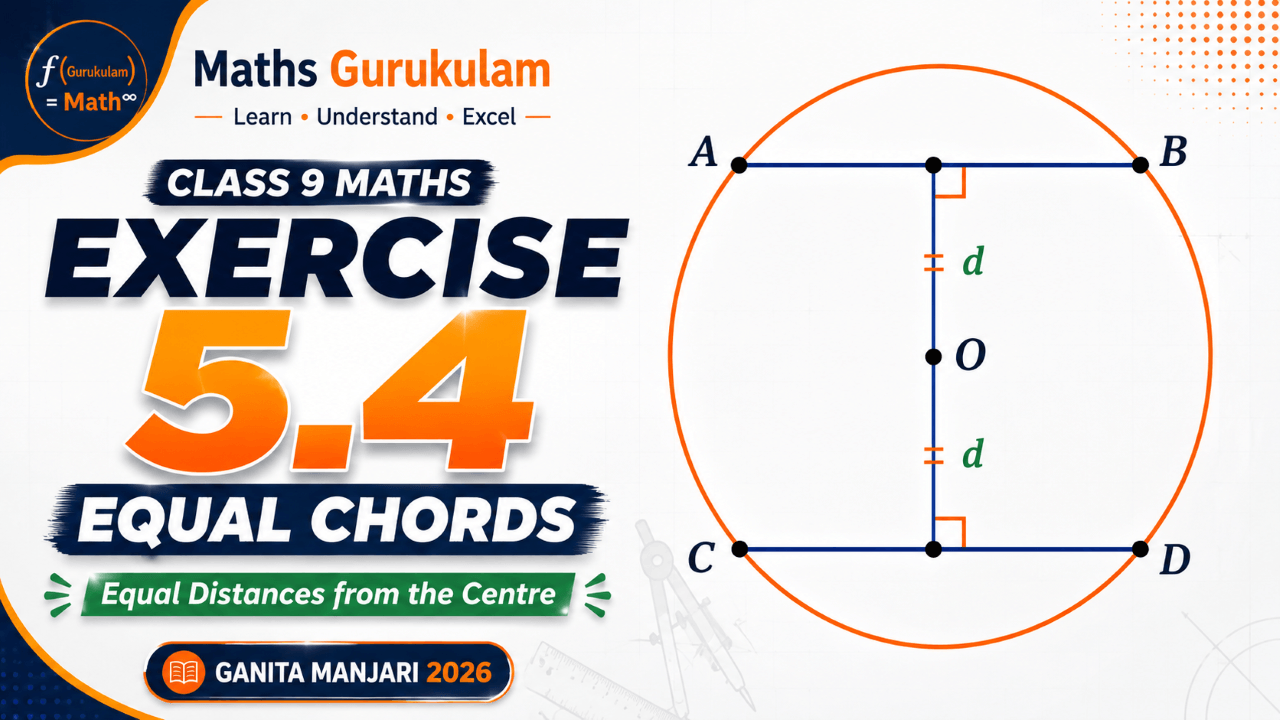
Class 9 Maths Chapter 5 Exercise 5.4 Solutions – equal chords and equal distances from the centre

Class 9 Maths Chapter 5 Exercise 5.4 Solutions (Ganita Manjari 2026) – Equal Chords and Equal Distances

📘 NCERT Ganita Manjari (2026) 📚 CBSE 2026–27 🏆 Step-by-Step Solutions

Class 9 Maths Chapter 5 Exercise 5.4 Solutions

Equal Chords ⇄ Equal Distances from the Centre

Prepare with complete Class 9 Maths Chapter 5 Exercise 5.4 Solutions based on the latest NCERT Ganita Manjari (2026). This exercise develops the relationship between equal chords and their distances from the centre through Theorem 6, Theorem 7 and applications of the Baudhāyana–Pythagoras theorem. Every question is explained through a clear, step-by-step CBSE answer-writing approach.

📖
Exercise
5.4
Questions
3 Questions
📚
Coverage
Equal Chords &
Equal Distances
🧠
Skills
Theorems &
Problem Solving
⏱️
Study Time
30–45 Min
Difficulty
Moderate
🎯
Exam Importance
★★★★★
🎯 By the End of This Exercise, You Will Be Able To…
✅ Understand the Distance of a Chord from the Centre
✅ Understand Theorem 6: Equal Chords Are Equidistant
✅ Understand Theorem 7: Equidistant Chords Are Equal
✅ Follow SSS and RHS Congruence Proofs
✅ Apply Baudhāyana–Pythagoras to Chord Problems
✅ Solve Exercise 5.4 with Clear CBSE Reasoning

📑 Table of Contents

📖 About Class 9 Maths Chapter 5 Exercise 5.4

Class 9 Maths Chapter 5 Exercise 5.4 is the fourth exercise of Chapter 5 – I’m Up and Down, and Round and Round from the latest NCERT Ganita Manjari (2026). This exercise focuses on the relationship between equal chords and their distances from the centre of a circle, along with the related theorems and applications included in this part of the chapter.

This page provides the complete Exercise Set 5.4 with step-by-step NCERT-based solutions for all three questions. It also includes the relevant Theorem 6 and Theorem 7 and applications of the Baudhāyana–Pythagoras theorem. The content is arranged in a clear, student-friendly format for classroom practice, homework, self-study, revision, and examination preparation.

🎯 Exercise Snapshot

📘 What You’ll Find
  • Complete Exercise Set 5.4 coverage.
  • NCERT-based solutions for all three questions.
  • The relevant theorem statements and proofs.
📚 Page Includes
  • Equal chords and their distance from the centre.
  • Theorem 6 and Theorem 7 with relevant explanations.
  • Question-wise solutions with clear reasoning.
🏆 Best For
  • Students studying the NCERT Ganita Manjari (2026) textbook.
  • Homework and classroom practice.
  • Revision and CBSE examination preparation.

Learn Before We Solve Exercise 5.4

Equal Chords ⇄ Equal Distances from the Centre

NCERT Activity: Equal Chords and Their Distance from the Centre

NCERT first uses a simple paper-folding activity to help us understand the distance of a chord from the centre. Let us follow the activity step by step.

Step 1 — Draw a Circle

C
1
Take a paper circle and mark its centre.

Step 2 — Make a Chord

A B C
2
Fold the circle from the boundary inwards. When you open it, the crease forms a chord AB.

Step 3 — Find the Midpoint

A B M C CM
3
Fold again so that the endpoints of the chord meet. The second crease is perpendicular to the chord and meets it at its midpoint M.

What do we learn?

The perpendicular from the centre C to the chord AB meets the chord at its midpoint M. Therefore, CM is the distance of the chord from the centre.

Theorem 6

Chords of a circle having the same length are all at the same distance from the centre of the circle.

Theorem Statement
Chords of a circle having the same length are all at the same distance from the centre of the circle.

Method 1 — By SSS Congruence

Comparing the two triangles formed by the radii and equal chords

Given,
In a circle with centre C, AB and FG are chords having the same length.
E and H are the midpoints of AB and FG, respectively.
AB = FG
To prove,
CE = CH
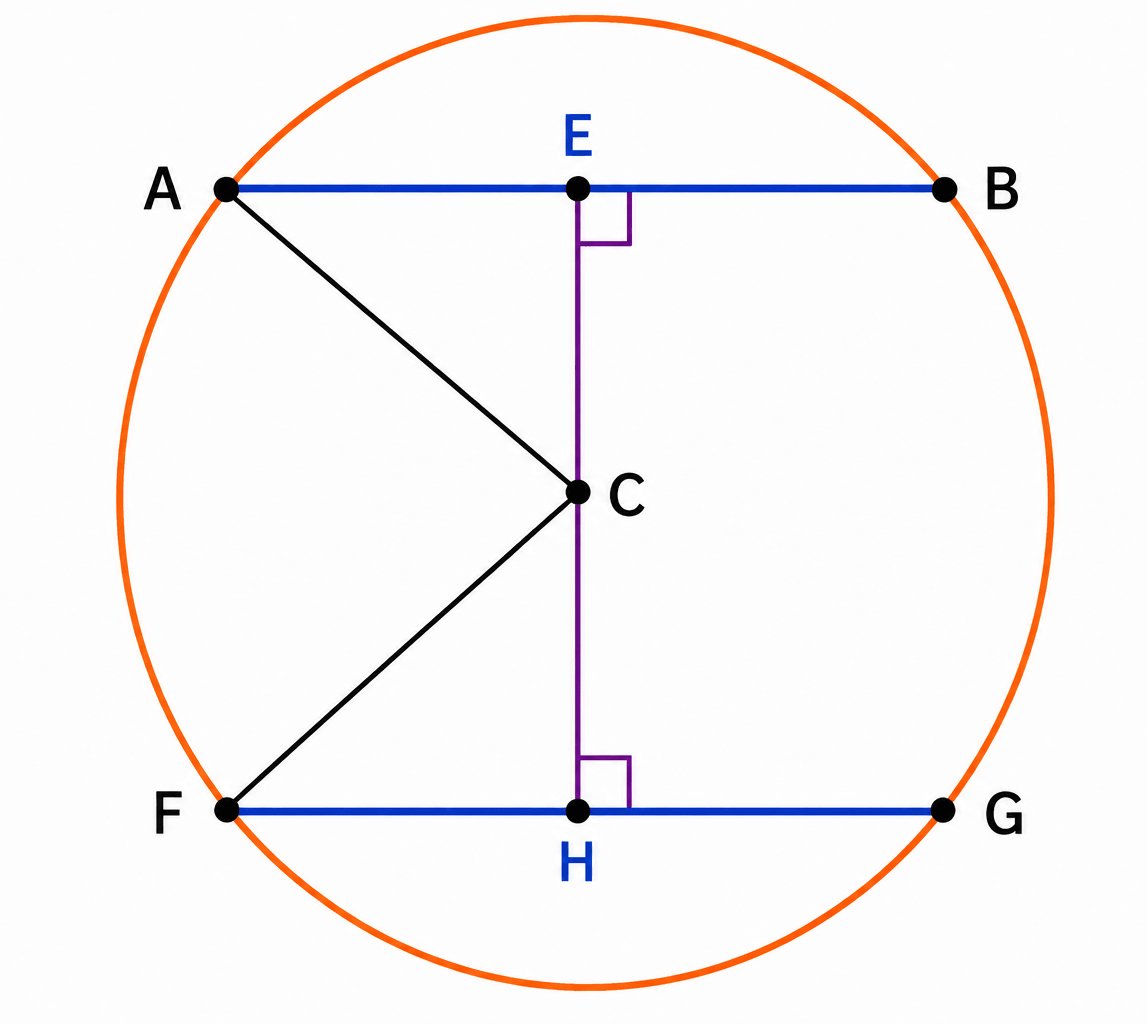
Theorem 6 SSS proof: equal chords equidistant from the centre Class 9 Maths Theorem 6 diagram showing two equal chords AB and FG in a circle with centre C. E and H are the midpoints of the chords. The radii CA, CB, CF and CG are joined to form triangles CAB and CFG, while CE and CH are perpendicular distances from the centre to the chords. A B F G C E H
Consider triangles △CAB and △CFG.
Since CA and CF are radii of the same circle,
CA = CF
(Radii of the same circle)
Similarly,
CB = CG
(Radii of the same circle)
And it is given that,
AB = FG
(Given)
Therefore, the three corresponding sides are equal.
△CAB ≅ △CFG
by SSS congruence
Hence, the corresponding perpendicular distances from the centre are equal.
CE = CH
Hence proved: equal chords are equidistant from the centre.

Method 2 — By RHS Congruence

Comparing the two right-angled triangles

Given,
In a circle with centre C, AB and FG are chords having the same length.
E and H are the midpoints of AB and FG, respectively.
Also,
CE ⟂ AB
CH ⟂ FG
To prove,
CE = CH
Theorem 6 RHS proof: equal chords equidistant from the centre Class 9 Maths Theorem 6 RHS proof diagram showing two equal chords AB and FG in a circle with centre C. E and H are the midpoints of the chords, CE and CH are perpendicular distances, and radii CA and CF form the right triangles CEA and CHF. A B F G C E H
Since E and H are the midpoints of equal chords,
AE = FH
(Halves of equal chords)
Also,
CA = CF
(Radii of the same circle)
Since CE and CH are perpendicular to the chords,
∠CEA = ∠CHF = 90°
Therefore,
△CEA ≅ △CHF
by RHS congruence
Hence, corresponding sides are equal:
CE = CH
Hence proved: equal chords are equidistant from the centre.
🧠 Theorem 6 — Remember
Equal chords ⇨ Equal distances from the centre

Theorem 7

Converse of Theorem 6
Theorem Statement
Chords of a circle that are equidistant from the centre have equal length.
Theorem 6: Equal chords → Equal distances   ⇄   Theorem 7: Equal distances → Equal chords

Method 1 — By RHS Congruence

Direct geometric proof

Given,
In a circle with centre C, AB and FG are two chords.
CE ⟂ AB
CH ⟂ FG
The chords are equidistant from the centre:
CE = CH
To prove,
AB = FG
Theorem 7 RHS proof: equidistant chords are equal Class 9 Maths Theorem 7 diagram showing two chords AB and FG equidistant from centre C. CE and CH are perpendicular and equal, while CA and CF are radii. A B F G C E H
Consider right-angled triangles △CEA and △CHF.
Since CA and CF are radii of the same circle,
CA = CF
(Radii of the same circle)
Also,
CE = CH
(Given)
Since CE ⟂ AB and CH ⟂ FG,
∠CEA = ∠CHF = 90°
Therefore,
△CEA ≅ △CHF
by RHS congruence
Hence, corresponding chords’ halves are equal:
AE = FH
Since E and H are the midpoints of the respective chords,
AB = 2AE
FG = 2FH
∴ AB = FG
Hence proved: the chords are equal in length.

Method 2 — By Baudhāyana–Pythagoras Theorem

A second mathematical understanding of the same result

Given,
The two chords AB and FG are equidistant from the centre C.
CE = CH
Also, CA = CF, since both are radii of the same circle.
To prove,
AB = FG
Theorem 7 Pythagoras method: equidistant chords are equal Circle with centre C, two chords AB and FG, equal perpendicular distances CE and CH, and radii CA and CF forming two right triangles for applying Pythagoras theorem. A B F G C E H
In right-angled triangle CEA, by Baudhāyana–Pythagoras theorem,
CA² = CE² + AE²
Therefore,
AE² = CA² − CE²
In right-angled triangle CHF,
CF² = CH² + FH²
Therefore,
FH² = CF² − CH²
But,
CA = CF
(Radii of the same circle)
CE = CH
(Given)
Therefore,
CA² − CE² = CF² − CH²
AE² = FH²
AE = FH
Since E and H are the midpoints of the chords,
AB = 2AE
FG = 2FH
∴ AB = FG
Hence proved: the chords are equal in length.
🧠 Theorem 6 and Theorem 7 — Remember the Pair
Equal Chords ⇄ Equal Distances from the Centre

Example Question

Two chords of a circle of radius 10 cm are each 16 cm long. Find their distances from the centre and show that they are equal.

Given & To Prove

Given
Radius of the circle = 10 cm
Two equal chords:
AB = CD = 16 cm
To prove
The two chords are at the same distance from the centre.
Two Equal Chords Equidistant from the Centre of a Circle Class 9 Maths diagram showing two equal non-parallel chords AB and CD in a circle with centre O. M and N are the midpoints of the chords. OM and ON are perpendicular distances from the centre to the chords, showing the distances d1 and d2 used to prove that equal chords are equidistant from the centre. A B C D O M N d₁ d₂

Proof

For chord AB, M is its midpoint.
AM = 16 ÷ 2 = 8 cm
In right-angled triangle OMA, by Pythagoras theorem,
10² = OM² + 8²
OM² = 100 − 64 = 36
OM = 6 cm
Similarly, for chord CD, N is its midpoint.
CN = 16 ÷ 2 = 8 cm
In right-angled triangle OCN, by Pythagoras theorem,
10² = ON² + 8²
ON² = 100 − 64 = 36
ON = 6 cm
Therefore,
OM = ON = 6 cm
Hence, the two equal chords are at the same distance from the centre.
Distance of each chord from the centre = 6 cm

📝 Class 9 Maths Chapter 5 Exercise 5.4 Solutions

Solve all three questions of Class 9 Maths Chapter 5 Exercise 5.4 with clear, step-by-step NCERT Ganita Manjari (2026) solutions. This exercise focuses on equal chords, equal distances from the centre, Theorem 6, Theorem 7 and applications of the Baudhāyana–Pythagoras theorem.

📝 Step-by-Step Solutions 🎯 NCERT & CBSE Aligned ⭐ Complete Exercise 5.4
Question 1
Use the Baudhāyana–Pythagoras theorem to show why Theorem 6 must be true.
✍️ Solution
Given:
AB = FG
E and H are the midpoints of AB and FG respectively.
CE ⟂ AB and CH ⟂ FG
C is the centre of the circle.
To prove:
CE = CH
Class 9 Maths Exercise 5.4 Question 1 diagram showing equal chords AB and FG and perpendicular distances from centre C
Fig. 5.14
✍️ Proof
Since E and H are the midpoints of AB and FG,
AE = ½ AB
FH = ½ FG
But AB = FG.
∴ AE = FH
Also, CA and CF are radii of the same circle.
∴ CA = CF
In right-angled triangle CEA, by Baudhāyana–Pythagoras theorem,
CA² = CE² + AE²
CE² = CA² − AE²    …(i)
Similarly, in right-angled triangle CHF,
CF² = CH² + FH²
CH² = CF² − FH²
Since CA = CF and AE = FH,
CH² = CA² − AE²    …(ii)
∴ From eq. (i) and eq. (ii),
CE² = CH²
∴ CE = CH
✅ Hence Proved
Equal chords of a circle are at the same distance from the centre.
Question 2
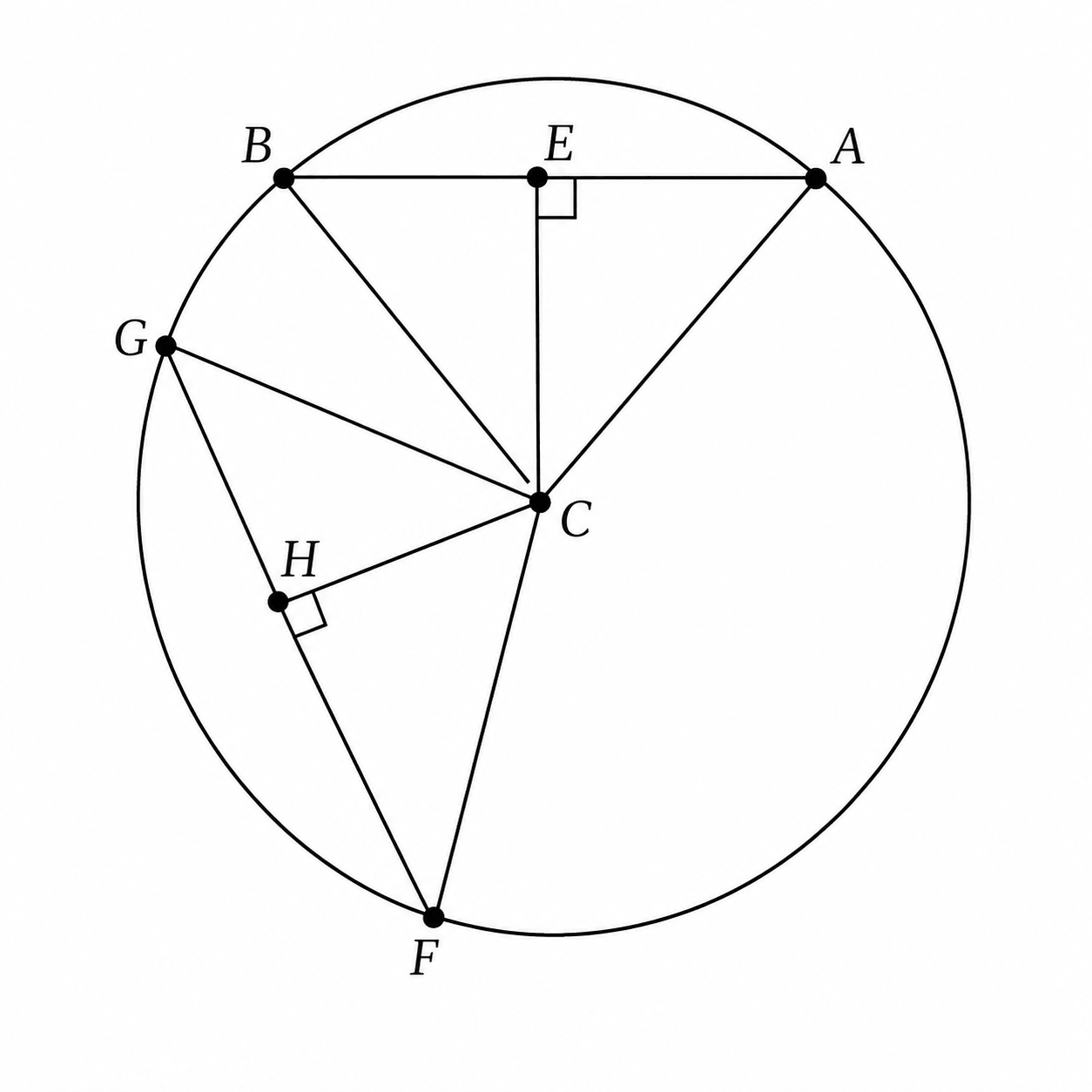
Consider Fig. 5.15. If CE is perpendicular to AB, CH is perpendicular to GH, and CE = CH, show that AB = GF.
✍️ Solution
Given:
CE ⟂ AB,   CH ⟂ GH and CE = CH.
C is the centre of the circle.
To prove:
AB = GF
Class 9 Maths Exercise 5.4 Question 2 diagram showing chords AB and GF, centre C, points E and H, and perpendiculars CE and CH
Fig. 5.15
✍️ Proof
Since CE ⟂ AB, by Theorem 5, the perpendicular from the centre of a circle to a chord bisects the chord.
AE = EB
Similarly, since CH ⟂ GH,
FH = HG
Therefore, E and H are the midpoints of AB and GF respectively.
Now consider right-angled triangles CEA and CHF.
CA = CF
(Radii of the same circle)
CE = CH
(Given)
∠CEA = ∠CHF = 90°
∴ ΔCEA ≅ ΔCHF    (by RHS congruence)
Therefore, corresponding sides are equal.
AE = HF
Multiplying both sides by 2,
2AE = 2HF
Since E and H are the midpoints of AB and GF,
AB = 2AE
GF = 2HF
∴ AB = GF
✅ Hence Proved
AB = GF
Question 3
Solve the previous question using the Baudhāyana–Pythagoras theorem.
✍️ Solution
Given:
CE ⟂ AB,   CH ⟂ GF and CE = CH.
C is the centre of the circle.
To prove:
AB = GF
Class 9 Maths Exercise 5.4 Question 3 diagram showing chords AB and GF, centre C, perpendiculars CE and CH, and points E and H
Fig. 5.15
✍️ Proof
Since CE ⟂ AB and CH ⟂ GF, by Theorem 5, the perpendicular from the centre of a circle to a chord bisects the chord.
AE = EB
FH = HG
Therefore, E and H are the midpoints of AB and GF respectively.
Now consider right-angled triangle CEA.
CA² = CE² + AE²
Similarly, in right-angled triangle CHF,
CF² = CH² + HF²
Since CA and CF are radii of the same circle,
CA = CF
Also, it is given that
CE = CH
Therefore,
CA² = CF²
CE² = CH²
From the first equation,
AE² = CA² − CE²
From the second equation,
HF² = CF² − CH²
Since CA² = CF² and CE² = CH²,
AE² = HF²
∴ AE = HF
Since E and H are the midpoints of AB and GF,
AB = 2AE
GF = 2HF
But AE = HF. Therefore,
∴ AB = GF
✅ Hence Proved
AB = GF

⚡ Quick Revision Dashboard

Exercise 5.4 — Equal Chords and Their Distance from the Centre
🎯 CORE IDEA
Equal Chords ⇄ Equal Distances from the Centre
📌 Theorem 6
Chords of a circle having the same length are all at the same distance from the centre of the circle.
Remember:
Equal chord → Equal distance
🔄 Theorem 7 — Converse
Chords of a circle that are equidistant from the centre have equal length.
Remember:
Equal distance → Equal chord
✍️ Theorem 6 — Two Proof Methods
Method 1 — SSS
CA = CF, CB = CG and AB = FG

ΔCAB ≅ ΔCFG

CE = CH
Method 2 — RHS
CA = CF, AE = FH and right angles

ΔCEA ≅ ΔCHF

CE = CH
🧠 Theorem 7 — Proof Routes
Given: Equal perpendicular distances from the centre.

Goal: Prove the corresponding chords are equal.
Use either congruence or Baudhāyana–Pythagoras.
📐 Baudhāyana–Pythagoras
Radius² = Distance² + Half-chord²
Half-chord² = Radius² − Distance²
Use this whenever the perpendicular distance and half of the chord are involved.
🧩 Proof Memory Chain
Perpendicular
Midpoint
Half-chord
Pythagoras
📝 Exercise 5.4 — Questions at a Glance
1
Prove Theorem 6 using the Baudhāyana–Pythagoras theorem.
2
Given equal distances from the centre, prove AB = GF.
3
Solve Question 2 again using the Baudhāyana–Pythagoras theorem.
✅ Exam Checklist
✓ Identify the centre and chord.
✓ Use Theorem 5 when perpendicular is given.
✓ Establish the midpoint of the chord.
✓ Write equal radii explicitly.
✓ Use half-chord when applying Pythagoras.
✓ Write the final required equality clearly.
⭐ Equal Chords ⇄ Equal Distances from the Centre

📚 Continue Learning

Congratulations! You have completed Class 9 Maths Chapter 5 Exercise 5.4 Solutions. You have now worked through the fourth exercise of Chapter 5 – I’m Up and Down, and Round and Round. Continue your learning journey by revisiting Exercise 5.4, moving to the previous or next exercise, or exploring the complete chapter.

📖 Explore More Class 9 Maths Chapters

❓ Frequently Asked Questions

Find answers to common questions about Class 9 Maths Chapter 5 Exercise 5.4 Solutions. These FAQs help students understand the main ideas of the exercise, the related theorems, and the type of reasoning used in its questions.

What is the main focus of Exercise Set 5.4?

Exercise 5.4 focuses on the relationship between equal chords and their distances from the centre of a circle. The exercise also applies the related theorems and the Baudhāyana–Pythagoras theorem to solve problems.

What does Theorem 6 state?

Theorem 6 states that equal chords of a circle are equidistant from the centre. It establishes the relationship between the length of a chord and its perpendicular distance from the centre.

What does Theorem 7 state?

Theorem 7 is the converse of Theorem 6. It states that chords of a circle that are equidistant from the centre are equal.

What is the relationship between equal chords and equal distances?

The two results work in opposite directions: Equal chords → Equal distances from the centre and Equal distances from the centre → Equal chords. Together, Theorem 6 and Theorem 7 give the key relationship used throughout Exercise 5.4.

Why is the Baudhāyana–Pythagoras theorem used in Exercise 5.4?

The perpendicular from the centre to a chord helps form a right-angled triangle. The Baudhāyana–Pythagoras theorem can then be used to relate the radius, the distance of the chord from the centre, and half of the chord when solving numerical problems.

How many questions are there in Exercise 5.4?

Exercise Set 5.4 contains three questions. The solutions on this page present each question step by step with the reasoning needed to understand the geometry involved.

What should I understand before solving Exercise 5.4?

Students should understand the idea of a chord, centre, midpoint of a chord, perpendicular from the centre to a chord, and the relationship between a chord and its distance from the centre. Theorem 6 and Theorem 7 are especially important for this exercise.

Are these solutions based on Ganita Manjari 2026?

Yes. These Class 9 Maths Chapter 5 Exercise 5.4 Solutions are prepared from Chapter 5 – I’m Up and Down, and Round and Round of the NCERT Ganita Manjari (2026) textbook, with the exercise questions and related concepts presented in a clear, student-friendly format.

📚 Useful Learning Resources

Continue your preparation with more Class 9 Maths resources from Maths Gurukulam, or visit the official NCERT and CBSE websites for the latest textbooks, syllabus, and academic updates.

Need Personal Guidance in Maths?

Find Class 9 Maths Chapter 5 Exercise 5.4 Solutions helpful? For students who need personal support beyond self-study, join Newton Study Point for concept-based Maths coaching by an experienced teacher. Small batches, individual attention, regular tests, and complete CBSE exam preparation are available for Classes 8, 9, 10, 11 & 12.

📞 Call Now: 8447002272 💬 WhatsApp 🏫 Explore Newton Study Point

📍 Newton Study Point • Ankur Vihar, Ghaziabad

Rakesh Kumar Singh - Maths Educator
👨‍🏫 Reviewed & Prepared By

Rakesh Kumar Singh

Founder, Maths Gurukulam & Newton Study Point
Teaching CBSE Mathematics Since 2006

These Class 9 Maths Chapter 5 Exercise 5.4 Solutions are carefully prepared according to the latest NCERT Ganita Manjari (2026) and the CBSE curriculum. The solutions follow a clear, step-by-step approach to help students understand the relationship between equal chords and their distances from the centre, theorem-based reasoning, and the problem-solving methods used in Exercise 5.4.

📘 NCERT Ganita Manjari (2026) 🎯 CBSE Aligned 📝 Step-by-Step Solutions 💡 Concept-Based Learning
Know More About the Author →

Leave A Reply

Your email address will not be published. Required fields are marked *

You May Also Like