📖 About Class 9 Maths Chapter 5 Exercise 5.3
Class 9 Maths Chapter 5 Exercise 5.3 is the third exercise of Chapter 5 – I’m Up and Down, and Round and Round from the latest NCERT Ganita Manjari (2026). This exercise contains three questions based on the concepts developed in this part of the chapter and provides further practice with chords and their relationship with the centre of a circle.
This page provides the complete Exercise Set 5.3 with clear, step-by-step NCERT-based solutions. It includes the relevant theorem statements and proofs, followed by question-wise solutions for all three questions. The presentation follows a student-friendly CBSE answer-writing approach and is designed for classroom practice, homework, self-study, revision, and examination preparation.
🎯 Exercise Snapshot
- Complete Exercise Set 5.3 coverage.
- NCERT-based solutions for all three exercise questions.
- Relevant theorem statements and step-by-step proofs.
- Chords and perpendicular-bisector related content.
- Theorem 4 and Theorem 5 with their proofs.
- Question-wise solutions with clear CBSE-style reasoning.
- Students studying the NCERT Ganita Manjari (2026) textbook.
- Homework and classroom practice.
- Revision and CBSE examination preparation.
📚 Learn Before You Solve
Before solving
Class 9 Maths Chapter 5 Exercise 5.3 Solutions,
let’s quickly understand the important ideas about
chords, their midpoints, perpendiculars from the centre,
and the distance of a chord from the centre.
This
Learn Before You Solve
section follows the
NCERT / Ganita Manjari Class 9 Mathematics
sequence and focuses only on the concepts needed for
Exercise 5.3.
🎯 The main focus is on
the midpoint of a chord, Theorem 4, Theorem 5,
finding the distance of a chord from the centre,
and the distance between parallel chords.
Concepts already covered earlier are not unnecessarily repeated.
Chord and Its Midpoint
AB is a chord of the circle because both A and B lie on the circle.
Now take M as the midpoint of chord AB.
Now join the centre C to the midpoint M.
The line CM joins the centre of the circle to the midpoint of the chord.
AM = MB
Since CA and CB are radii of the same circle,
Therefore,
Hence, by CPCT,
Since CA and CB are radii of the same circle,
Hence, corresponding sides are equal by CPCT.
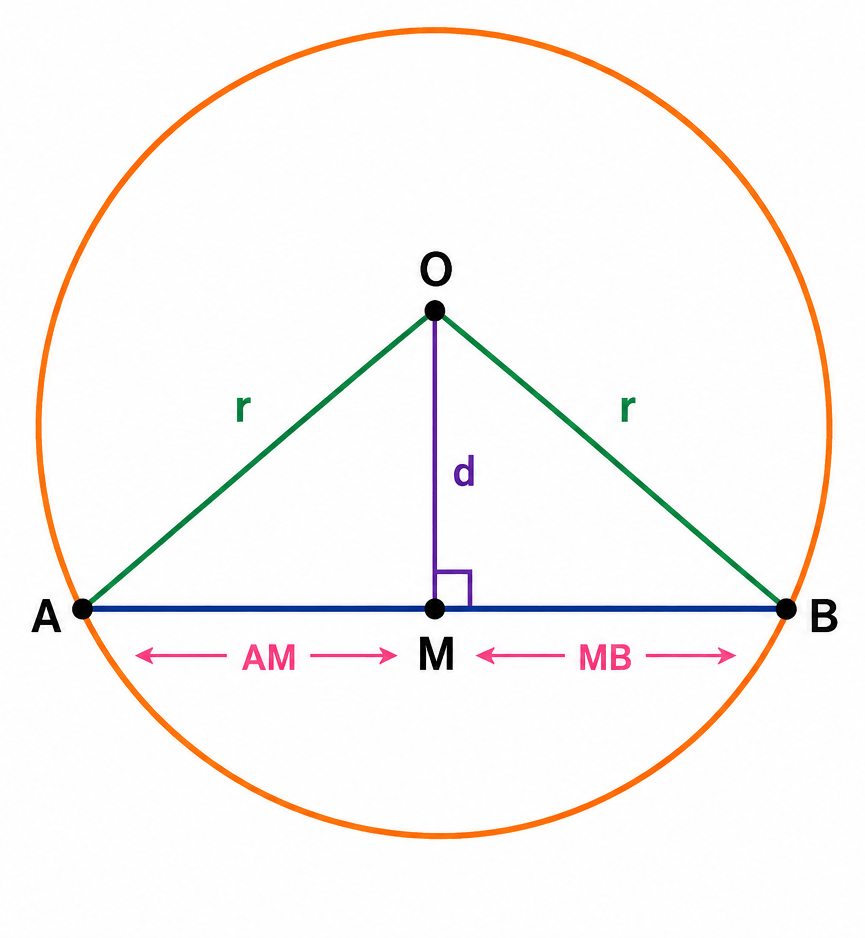
Distance of a Chord from the Centre
Finding the Distance of a Chord from the Centre
Distance Between Two Parallel Chords
Same Side of the Centre
Opposite Sides of the Centre
Solved Example: Distance Between Two Parallel Chords
Finding the Distance of the Chords from the Centre
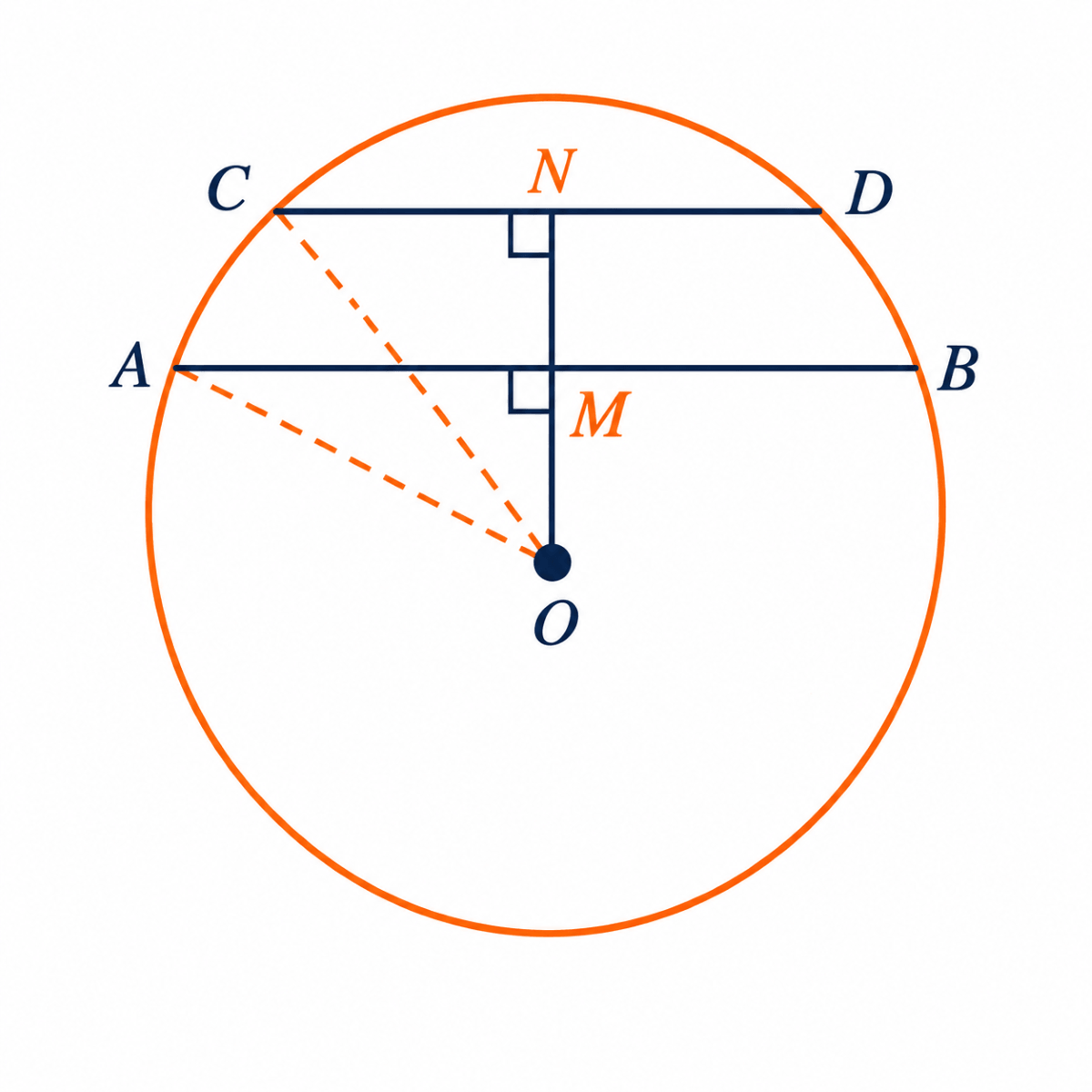
How will we find the distance?
Since the perpendicular from the centre of a circle to a chord bisects the chord, the perpendiculars drawn to AB and CD meet them at their midpoints M and N.
AB = 6 cm
Therefore,
CD = 8 cm
Therefore,
📝 Class 9 Maths Chapter 5 Exercise 5.3 Solutions
Solve all three questions of Class 9 Maths Chapter 5 Exercise 5.3 with clear, step-by-step NCERT Ganita Manjari (2026) solutions. The exercise covers chords, perpendicular bisectors, Theorem 4, Theorem 5, and applications involving parallel chords, with simple CBSE answer-writing and clear reasoning.
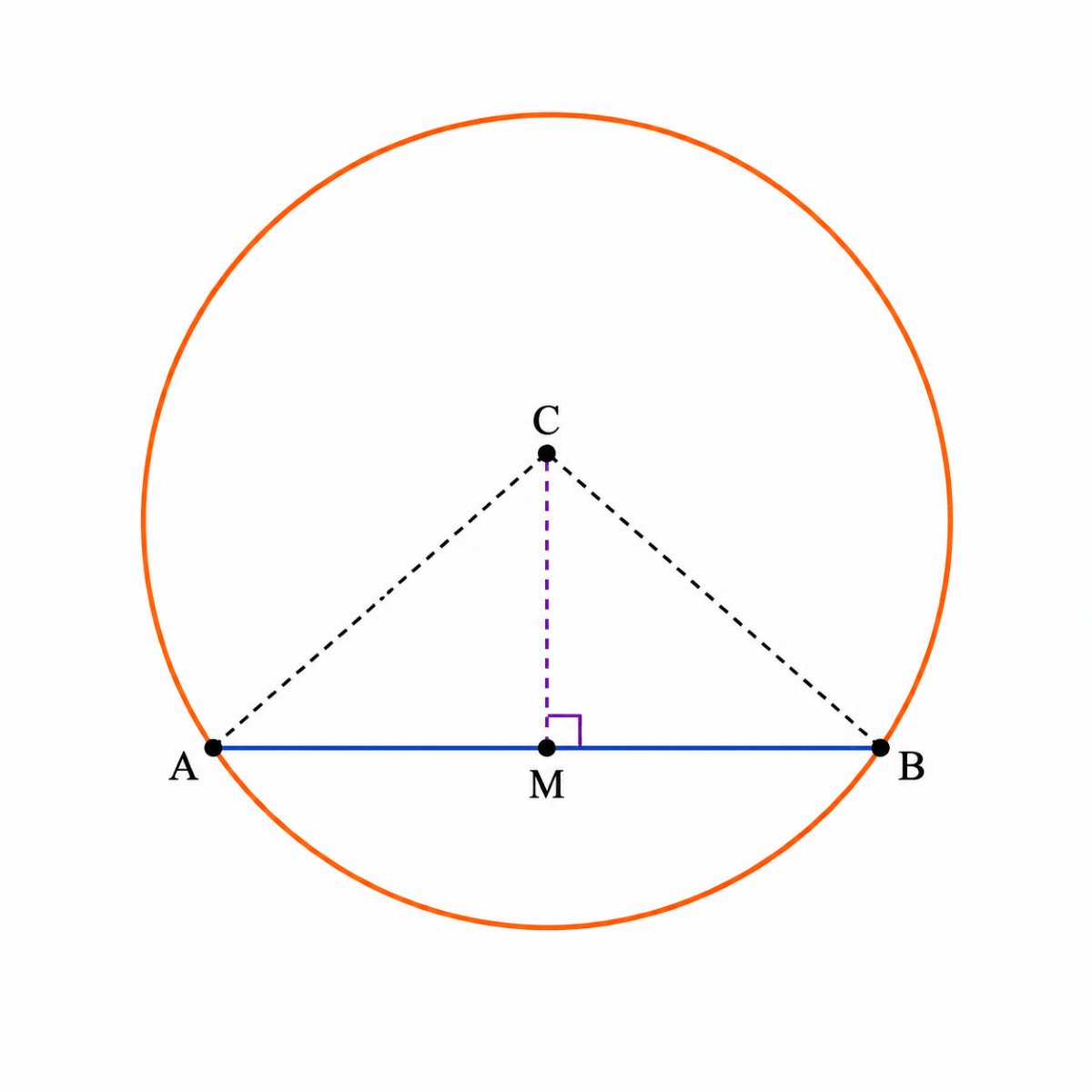
Since CA and CB are radii of the same circle,
Therefore, corresponding sides of congruent triangles are equal by CPCT.
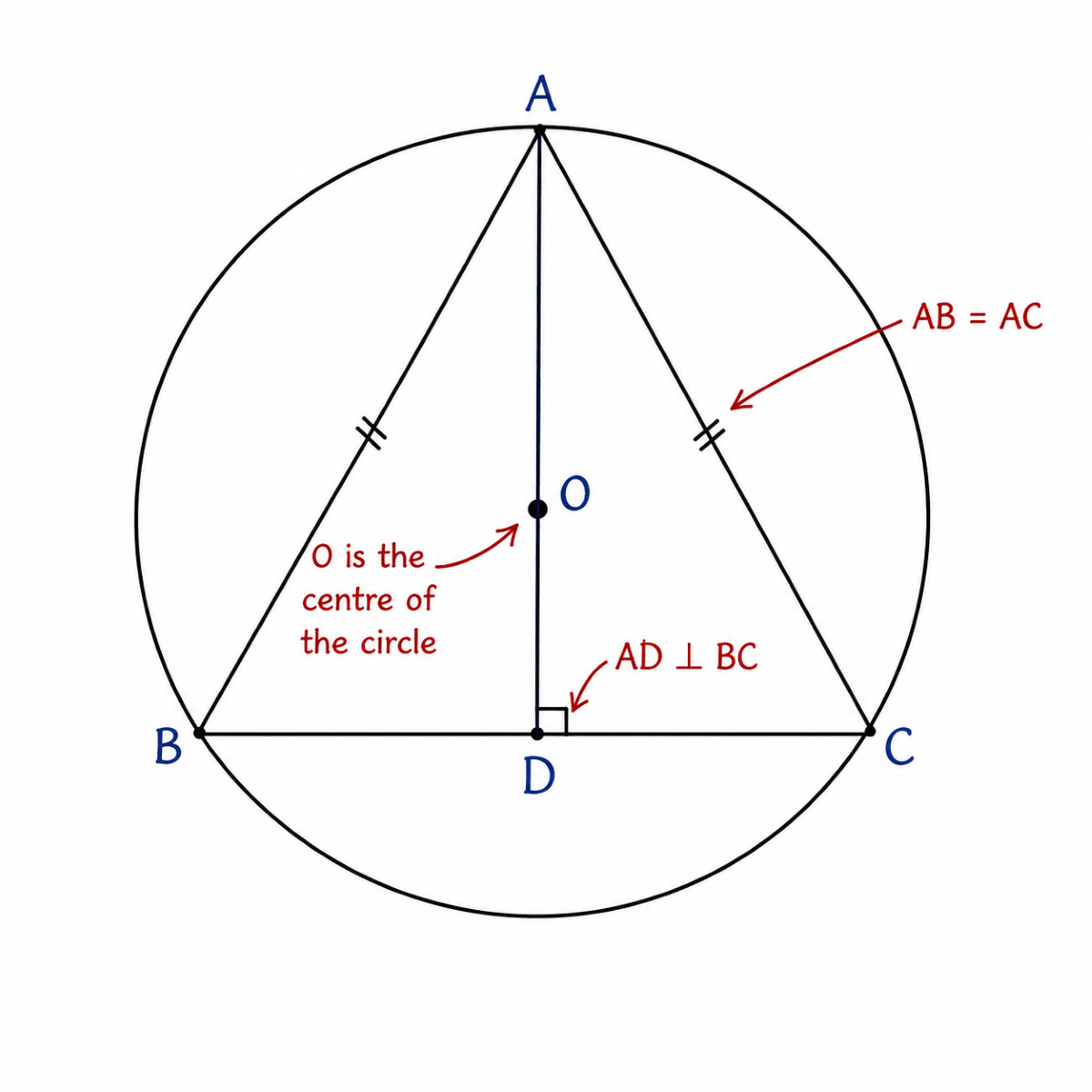
Since AB = AC, we have
Therefore, corresponding sides of congruent triangles are equal by CPCT.
Therefore, AD is the perpendicular bisector of BC.
Now, BC is a chord of the circle and O is its centre. By Theorem 4, the line joining the centre of a circle to the midpoint of a chord is perpendicular to the chord. Therefore,
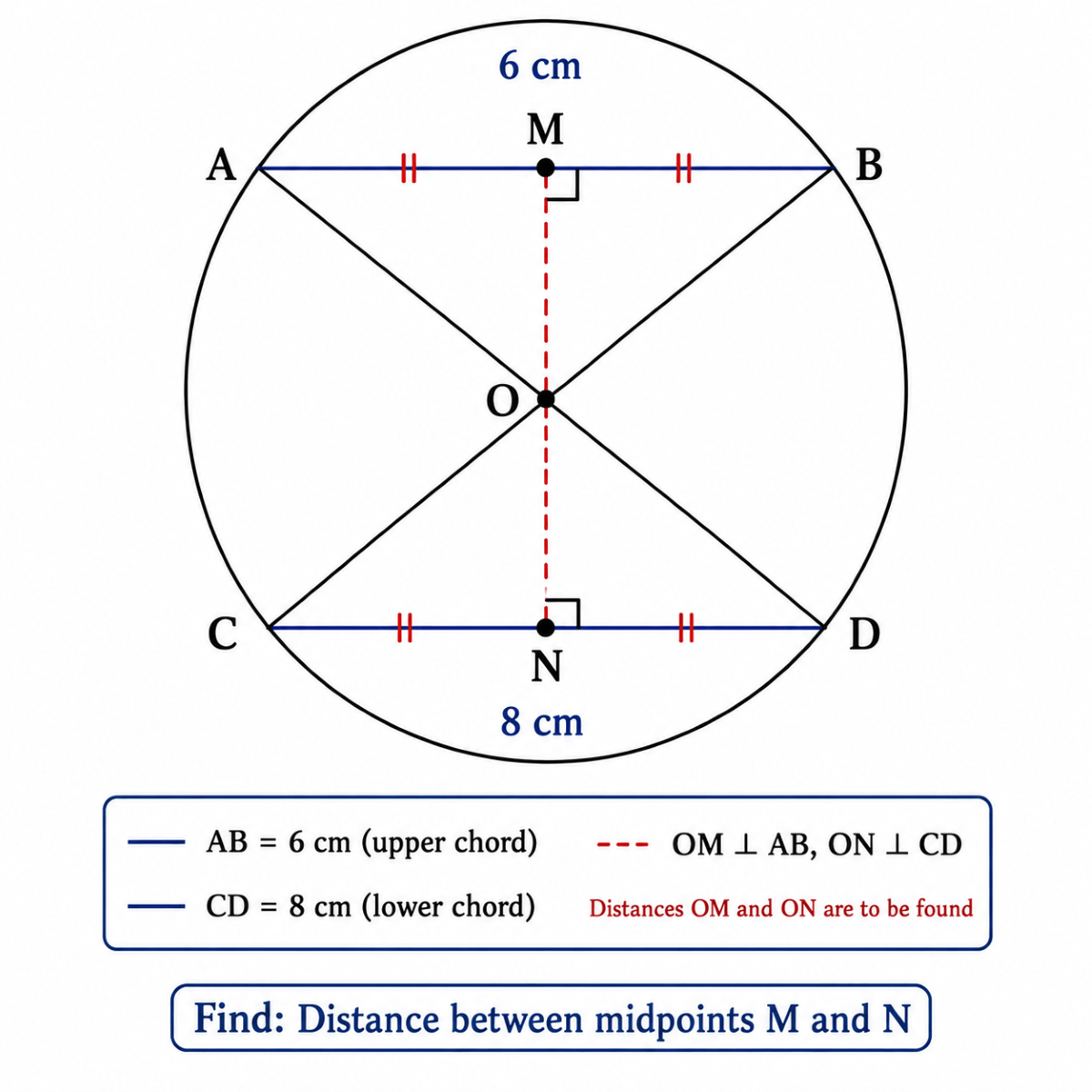
Since the perpendicular from the centre of a circle to a chord bisects the chord,
⚡ Quick Revision Dashboard — Exercise 5.3
Midpoints of Chords • Theorem 4 • Theorem 5 • Pythagoras • Parallel Chords
Theorem 4
The line joining the centre of a circle and the midpoint of a chord is perpendicular to the chord.
Here, M is the midpoint of chord AB.
Theorem 5
The perpendicular from the centre of a circle to a chord bisects the chord.
⟹ AM = MB
This is the converse of Theorem 4.
🔑 Core Chord–Centre Relationship
If a perpendicular is drawn from the centre to a chord, immediately mark the chord’s two halves equal.
📐 Distance of a Chord from Centre
Join the centre to the midpoint of the chord. A right triangle is formed.
r = radius, l = chord length, d = distance of chord from centre.
📏 Parallel Chords — Distance Rule
Both chords lie on the same side of the centre.
The centre lies between the two chords.
🧮 Pythagoras — Quick Steps
1. Take half of the chord.
2. Use radius as the hypotenuse.
3. Apply Pythagoras theorem.
📝 Exercise 5.3 — What Each Question Tests
🧠 One-Line Memory Trick
Same side → Subtract.
Opposite sides → Add.
Opposite Side → d₁ + d₂
✅ Before You Solve — Remember
Centre → perpendicular to chord → midpoint of chord.
Find half the chord first, then use Pythagoras theorem to find its distance from the centre.
Finally, check whether the parallel chords are on the same side or on opposite sides of the centre.
📚 Continue Learning
Congratulations! You have completed Class 9 Maths Chapter 5 Exercise 5.3 Solutions. You have now worked through the third exercise of Chapter 5 – I’m Up and Down, and Round and Round, including perpendicular bisectors of chords and the related theorems.
📖 Explore More Class 9 Maths Chapters
❓ Frequently Asked Questions
Find answers to common student questions about Class 9 Maths Chapter 5 Exercise 5.3 Solutions. These FAQs explain the relationship between the centre of a circle, the midpoint of a chord, perpendicular bisectors, and the theorem-based reasoning used in Exercise Set 5.3.
What is the main focus of Exercise Set 5.3?
Exercise Set 5.3 focuses on the relationship between the centre of a circle and the midpoint of a chord. It uses the result that the line joining the centre of a circle to the midpoint of a chord is perpendicular to the chord, and also the converse result that a perpendicular from the centre to a chord bisects the chord. The exercise then applies these ideas to an isosceles triangle inscribed in a circle and to two parallel chords.
What does Theorem 4 say about the centre and midpoint of a chord?
Theorem 4 states that the line joining the centre of a circle and the midpoint of a chord of the circle is perpendicular to the chord. If AB is a chord, C is the centre and M is the midpoint of AB, then CM ⟂ AB. This result is the starting point for the reasoning used in Exercise Set 5.3.
What is the converse of Theorem 4?
The converse says that a perpendicular from the centre of a circle to a chord bisects the chord. In other words, if a line from the centre meets a chord at a right angle, then it divides that chord into two equal parts. For example, if CM ⟂ AB, where C is the centre and AB is a chord, then AM = BM. This is the key result required in Question 1 of Exercise 5.3.
Why does a perpendicular from the centre bisect a chord?
Suppose AB is a chord and the perpendicular from the centre C meets AB at M. Since CA and CB are radii of the same circle, CA = CB. Also, CM is common and the two angles at M are right angles. Therefore, the two right triangles can be proved congruent. Hence, their corresponding chord segments are equal: AM = BM. Thus, the perpendicular from the centre bisects the chord.
What is asked in Question 2 of Exercise 5.3?
Question 2 considers an isosceles triangle ABC inscribed in a circle, where AB = AC. We have to show that the altitude from A to BC passes through the centre of the circle. The important idea is that the altitude from the vertex of an isosceles triangle also acts as a perpendicular bisector of the base. Since the base BC is a chord of the circle, the result about the perpendicular from the centre to a chord helps establish the required result.
How is Question 3 of Exercise 5.3 solved?
Question 3 gives two parallel chords of lengths 6 cm and 8 cm. They are on opposite sides of the centre of a circle whose radius is 5 cm. For a chord of length 6 cm, its half-length is 3 cm. Using the right triangle formed by the radius and half-chord, the distance of this chord from the centre is √(5² − 3²) = 4 cm. For the chord of length 8 cm, its half-length is 4 cm, so its distance from the centre is √(5² − 4²) = 3 cm. Because the chords lie on opposite sides of the centre, the distance between their midpoints is 4 + 3 = 7 cm. Therefore, the required distance is 7 cm.
Why do we use half of the chord length in Question 3?
The perpendicular from the centre to a chord bisects the chord. Therefore, when the radius is joined to the endpoint of a chord and the perpendicular distance from the centre to the chord is considered, we use half of the chord as one side of the right triangle. For the 6 cm chord: Half of chord = 6 ÷ 2 = 3 cm. For the 8 cm chord: Half of chord = 8 ÷ 2 = 4 cm. These values are then used with the radius of 5 cm.
Are these Class 9 Maths Exercise 5.3 Solutions based on Ganita Manjari 2026?
Yes. This page follows Chapter 5 – I’m Up and Down, and Round and Round from the NCERT Ganita Manjari (2026) textbook and covers Exercise Set 5.3. The page explains the three questions step by step, including the converse of Theorem 4, the isosceles-triangle application, and the calculation involving two parallel chords. These Class 9 Maths Chapter 5 Exercise 5.3 Solutions are presented in a simple, student-friendly format so that students can understand the reasoning instead of only memorising the final answers.

Rakesh Kumar Singh
Founder, Maths Gurukulam & Newton Study Point
Teaching CBSE Mathematics Since 2006
These Class 9 Maths Chapter 5 Exercise 5.2 Solutions are carefully prepared according to the latest NCERT Ganita Manjari (2026) and the CBSE curriculum. The solutions follow a clear, step-by-step approach to help students understand the central-angle and chord relationships, theorem-based reasoning, and problem-solving methods used in Exercise 5.2.