📑 Table of Contents
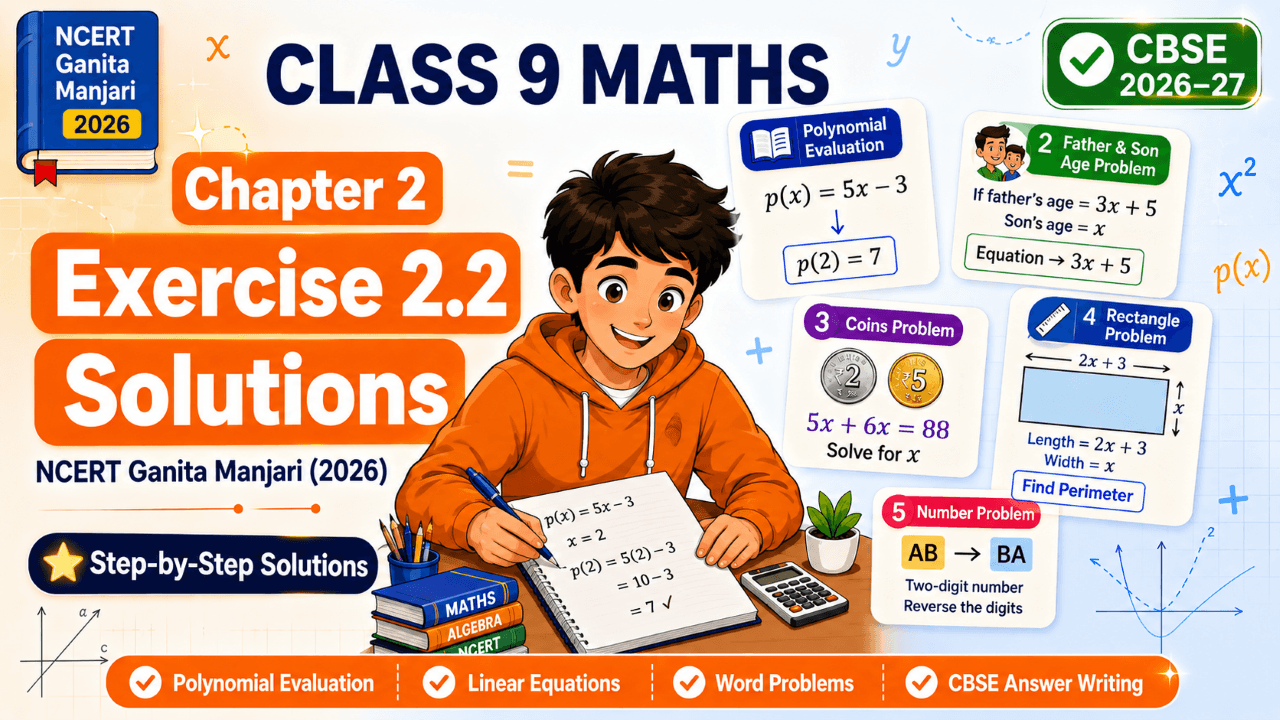
📖 About Class 9 Maths Chapter 2 Exercise 2.2
Class 9 Maths Chapter 2 Exercise 2.2 Solutions help you understand how linear and quadratic polynomials are evaluated by substituting the given value of a variable. This exercise also teaches you how mathematical situations such as age, ratio, money, measurement and real-life word problems can be represented using linear equations and solved step by step. By practising these questions, you learn how algebra connects with everyday situations while strengthening your problem-solving skills.
All the solutions on this page are prepared according to the latest NCERT Ganita Manjari (2026) textbook and the CBSE Class 9 syllabus. Every solution follows a simple CBSE answer-writing format with detailed steps, making this page useful for homework, classroom learning, revision, periodic tests and annual examinations.
🎯 Your Learning Mission
By the time you complete this exercise, your goal is not only to evaluate polynomials correctly but also to understand how real-life situations can be converted into simple linear equations and solved confidently.
- Evaluate linear and quadratic polynomials.
- Substitute values correctly in algebraic expressions.
- Form and solve simple linear equations.
- Solve age, ratio and practical application problems.
- Builds a strong foundation in algebra.
- Improves logical and analytical thinking.
- Helps solve practical real-life problems.
- Prepares you for higher algebra chapters.
- Evaluate every polynomial accurately.
- Represent word problems using equations.
- Solve every NCERT question confidently.
- Avoid common calculation mistakes.
🧮 How Do We Find the Value of a Polynomial?
Whenever a question says “Find the value of the polynomial”, it simply means replace the variable by the given value and then simplify the expression carefully.
Always solve according to the order of operations. First substitute the value, then multiply or divide, and finally perform addition or subtraction.
✏️ Let’s Learn with an Example
Find the value of P(x) when x = −1/2 if
Step 1 : Substitute the value of x
Replace every x by −1/2.
Step 2 : Multiply the fractions
Multiply the numerators together and multiply the denominators together.
Step 3 : Make the denominators equal
Since one number is a fraction and the other is a whole number, write 7 with denominator 4.
✅ Final Answer
Whenever you evaluate a polynomial, remember this simple order: Substitute → Multiply → Add/Subtract. Following these three steps will help you solve every polynomial evaluation question correctly.
Word problems may look difficult at first, but they become easy when you solve them one step at a time. Instead of guessing the answer, first convert the given information into Mathematics. Once the correct equation is formed, the remaining steps become simple.
📝 Follow These 4 Simple Steps
📖 Convert Words into Mathematics
| Words | Mathematical Form |
|---|---|
| Sum | + |
| Difference | − |
| Twice a number | 2x |
| Three times a number | 3x |
| 5 years later | x + 5 |
| 5 years ago | x − 5 |
Now that you know the method, let’s apply it to different types of questions. We will solve each example step by step exactly like a teacher explains in the classroom.
Since the father is 4 times as old,
Father’s age = 4x years
“After 8 years…”
This means we add 8 to both ages.
Father’s age after 8 years = 4x + 8
“The father will be twice as old as the son.”
Therefore,
4x − 2x = 16 − 8
2x = 8
x = 4
Father’s present age = 4 × 4 = 16 years
✔ Father’s present age = 16 years
Now convert each English statement into Mathematics.
| English Statement | Mathematical Form |
|---|---|
| Three-fourths of a number | 3 4 x |
| Twice the number | 2x |
| 18 less than twice the number | 2x − 18 |
8x − 3x = 72
5x = 72
x = 72 5 = 14.4
Since the sum of the digits is 11,
Two-digit number = 10 × Tens digit + Ones digit
= 9x + 11
Ones digit = x
= 110 − 9x
“The new number is 27 greater than the original number.”
Therefore,
=
(9x + 11) + 27
110 − 38 = 18x
72 = 18x
x = 4
✔ Ones digit = 7
✔ Therefore, the original number is 47
We have to find
- Number of ₹10 notes
- Number of ₹20 notes
Since the question says that the number of ₹20 notes is 15 more,
=
Number of Notes × Value of One Note
Value of one note = ₹10
Total value
10 × x = ₹10x
Value of one note = ₹20
Total value
20(x + 15)
Therefore,
30x = 600
x = 20
₹10 notes = x
₹20 notes = x + 15
Therefore,
✔ Number of ₹20 notes = 35
Find the original length and breadth.
Let the breadth be x cm
Since the length is 6 cm more,
Length = x + 6 cm
New Breadth = x + 2
New Length = x + 8
Since the new area is 52 cm² more,
New Area = Original Area + 52
x² + 10x + 16 = x² + 6x + 52
Subtract x² from both sides.
10x + 16 = 6x + 52
10x − 6x = 52 − 16
4x = 36
x = 9
Therefore,
Breadth = 9 cm
Length = 9 + 6 = 15 cm
Original Length = 15 cm
Excellent! You have learned how to evaluate linear polynomials, substitute values correctly, and form linear equations from real-life word problems. These are the main concepts required to solve the Class 9 Maths Chapter 2 Exercise 2.2 Solutions based on the latest NCERT Ganita Manjari (2026) textbook.
📝 Class 9 Maths Chapter 2 Exercise 2.2 Solutions
Learn and solve every question of Class 9 Maths Chapter 2 Exercise 2.2 with simple, step-by-step NCERT Ganita Manjari (2026) solutions. Each answer follows the latest CBSE answer-writing format to help students understand the concepts of Linear Polynomials clearly, build confidence, and score better in exams.
- (i) x = 0
- (ii) x = −1
- (iii) x = 2
(i) When x = 0
= 0 − 3
= −3
(ii) When x = −1
= −5 − 3
= −8
(iii) When x = 2
= 10 − 3
= 7
✔ For x = −1, p(x) = −8
✔ For x = 2, p(x) = 7
- (i) s = 0
- (ii) s = −3
- (iii) s = 4
(i) When s = 0
= 7(0) − 0 + 6
= 6
(ii) When s = −3
= 7(9) + 12 + 6
= 63 + 12 + 6
= 81
(iii) When s = 4
= 7(16) − 16 + 6
= 112 − 16 + 6
= 102
✔ For s = −3, p(s) = 81
✔ For s = 4, p(s) = 102
• After 5 years, the sum of their ages will be 70 years.
Salil’s age = (x + 5) years
Mother’s age = (3x + 5) years
According to the question,
x + 5 + 3x + 5 = 70
4x + 10 = 70
4x = 70 − 10
4x = 60
x = 15
Salil’s present age = 15 years
Mother’s present age = 3 × 15 = 45 years
Verification
After 5 years,
Mother’s age = 45 + 5 = 50 years
20 + 50 = 70 ✓
✔ Salil’s mother’s present age = 45 years
• The ratio of the two integers is 2 : 5.
3x = 63
x = 21
First integer = 2 × 21 = 42
Second integer = 5 × 21 = 105
✔ Second integer = 105
• Total amount = ₹88.
| Coin | Number | Value | Total |
|---|---|---|---|
| ₹5 Coin | x | ₹5 | 5x |
| ₹2 Coin | 3x | ₹2 | 2 × 3x = 6x |
11x = 88
x = 8
Number of ₹5 coins = 8
Number of ₹2 coins = 3 × 8 = 24
✔ Number of ₹2 coins = 24
• Longer piece = 4 × shorter piece
5x = 300
x = 60
Shorter piece = 60 feet
Longer piece = 4 × 60 = 240 feet
✔ Longer piece = 240 feet
• Perimeter of the rectangle = 24 cm
2(3x + 3) = 24
6x + 6 = 24
6x = 18
x = 3
Width = 3 cm
Length = 2 × 3 + 3 = 9 cm
✔ Width of the rectangle = 3 cm
📚 Continue Learning
Continue learning Class 9 Maths Chapter 2 – Introduction to Linear Polynomials by revising the previous exercise or practising the remaining NCERT questions.
📖 Explore More Class 9 Maths Chapters
🚀 Quick Revision Dashboard
Revise the most important concepts of Class 9 Maths Chapter 2 Exercise 2.2 Solutions in just one minute. This dashboard helps you remember the correct method for evaluating polynomials and solving linear equation word problems.
📌 Question-wise Method
| Polynomial Value | Substitute → Simplify |
| Age Problem | Assume age = x |
| Ratio / Number | Express using x |
| Coin / Geometry | Form one equation |
📖 Formula & Method Sheet
p(x)=ax+b
Quadratic Polynomial
p(x)=ax²+bx+c
Finding Value
Substitute the given value of the variable and simplify using BODMAS.
Word Problem Method
Assume → Form Equation → Solve → Write Final Answer.
❌ Common Mistakes
- Forget brackets while substituting negative values.
- Choose the wrong variable while forming equations.
- Translate word statements incorrectly.
- Forget to write the answer with units.
🎯 CBSE Exam Tips
- Always define the variable first.
- Convert every statement into an equation carefully.
- Solve each algebraic step neatly.
- Check whether the final answer satisfies the question.
❓ Frequently Asked Questions
Find answers to the most common questions about Class 9 Maths Chapter 2 Exercise 2.2 Solutions, evaluating polynomials, solving linear equation word problems, and important CBSE exam concepts.
What is taught in Class 9 Maths Chapter 2 Exercise 2.2?
Exercise 2.2 of Class 9 Maths Chapter 2 teaches students how to evaluate linear and quadratic polynomials, solve word problems using linear equations, and represent real-life situations using algebraic expressions.
How do we find the value of a polynomial?
To find the value of a polynomial, substitute the given value of the variable into the polynomial and simplify carefully by following the BODMAS rule.
Why are brackets important while substituting negative values?
Brackets prevent sign errors. For example, when x = −3, always write (−3)² instead of −3², because (−3)² = 9.
How do we solve word problems using linear equations?
First assume a variable for the unknown quantity, then form a linear equation using the given information, solve the equation step by step, and finally write the answer with the correct unit.
Are these Class 9 Maths Chapter 2 Exercise 2.2 solutions based on the latest NCERT Ganita Manjari (2026) syllabus?
Yes. These Class 9 Maths Chapter 2 Exercise 2.2 Solutions are prepared strictly according to the latest NCERT Ganita Manjari (2026) textbook and follow the current CBSE Class 9 Mathematics syllabus and answer-writing pattern.
📚 Useful Learning Resources
Need Personal Guidance in Maths?
Join Newton Study Point for concept-based Maths coaching by an experienced teacher. Small batches, individual attention, regular tests, and complete CBSE exam preparation for Classes 8, 9, 10, 11 & 12.
📞 Call Now: 8447002272 💬 WhatsApp📍 Newton Study Point • Ankur Vihar, Ghaziabad

Rakesh Kumar Singh
Founder, Maths Gurukulam & Newton Study Point
Teaching CBSE Mathematics Since 2006
These Class 9 Maths Chapter 2 Exercise 2.2 Solutions are carefully prepared according to the latest NCERT Ganita Manjari (2026) and the CBSE curriculum. Every solution follows a clear, step-by-step approach designed to strengthen conceptual understanding, improve problem-solving skills, and help students perform confidently in school and board examinations.