📘 NCERT Ganita Manjari (2026)
📚 CBSE 2026–27
🏆 Step-by-Step Solutions
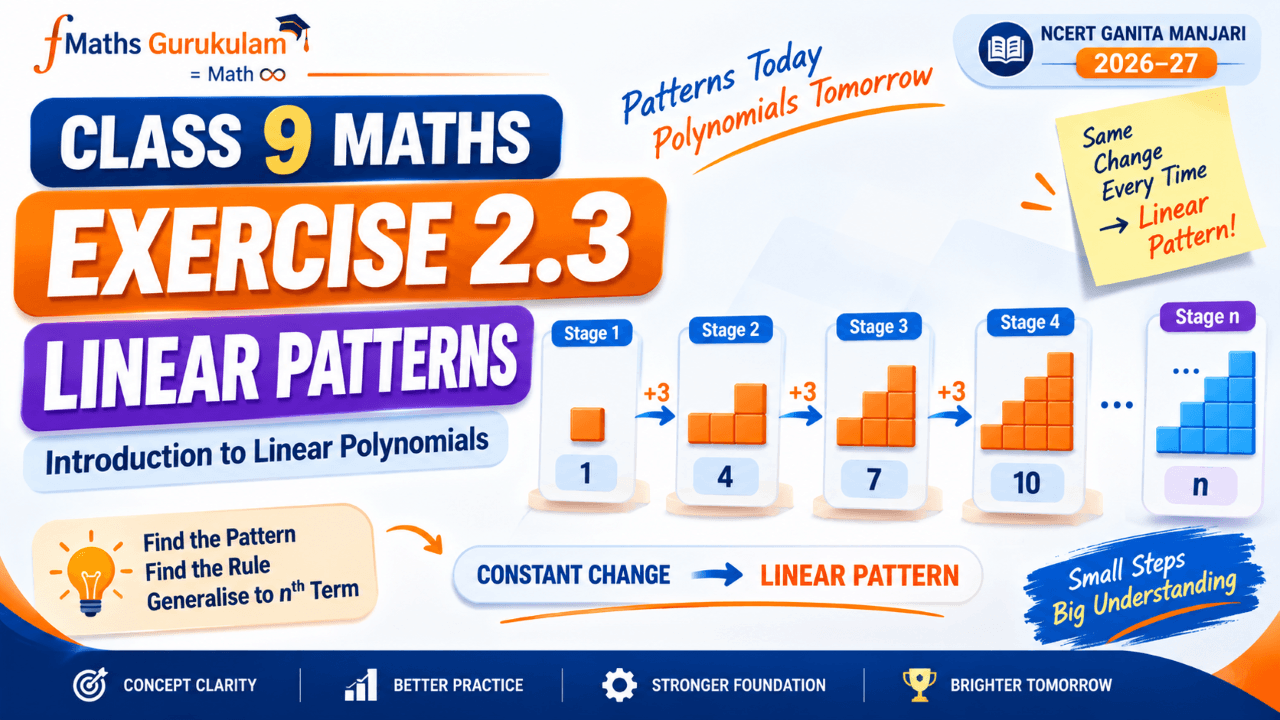
Class 9 Maths Chapter 2 Exercise 2.3 Solutions
Linear Patterns & Linear Expressions
Prepare with complete
Exercise 2.3 solutions from
Chapter 2 – Introduction to Linear Polynomials,
based on the latest NCERT Ganita Manjari (2026).
This exercise focuses on recognising
linear patterns, linear growth, linear decay,
and forming linear expressions from real-life situations.
All five questions are explained in a clear,
step-by-step CBSE answer-writing style.
📈
Main Concept
Linear
Patterns
🧩
Key Skill
Find the
nth Term
🧮
Linear Pattern
= Starting Value ± Change
🌱
Applications
Growth &
Decay
🎯 By the End of Exercise 2.3, You Will Be Able To…
✅ Identify Linear Patterns
✅ Find the nth Term of a Pattern
✅ Form Linear Expressions
✅ Understand Linear Growth and Decay
✅ Apply Patterns to Real-Life Situations
✅ Solve Questions 1–5 Step by Step
📖 About Class 9 Maths Chapter 2 Exercise 2.3
Class 9 Maths Chapter 2 Exercise 2.3 Solutions cover
Exercise Set 2.3 from
Chapter 2 – Introduction to Linear Polynomials in the
latest NCERT Ganita Manjari (2026) textbook. This page
provides complete, reliable and easy-to-follow
NCERT Class 9 Maths solutions for students looking for
Exercise 2.3 Class 9 answers in one place.
The NCERT Class 9 Maths Chapter 2 Exercise 2.3 Solutions
are presented question-wise in a clear,
student-friendly CBSE answer-writing format. The exercise
includes questions based on linear patterns and their
applications in situations involving savings, decreasing quantities, area,
volume and daily-life patterns. These solutions are useful for
homework, classroom practice, self-study, revision and
CBSE examination preparation.
🎯 Exercise Snapshot
📘 What You’ll Find
- Complete coverage of Exercise Set 2.3.
- NCERT-based solutions for all five questions.
- Question-wise answers for Class 9 students.
📚 Page Includes
- Step-by-step NCERT solutions.
- Complete Exercise 2.3 question coverage.
- Simple CBSE answer-writing approach.
🏆 Best For
- Students following Ganita Manjari (2026).
- Homework and classroom practice.
- Revision and CBSE examination preparation.
📚 Learn Before You Solve
✨ Solve करने से पहले कुछ सीखें
Exercise Set 2.3 को आसानी से हल करने से पहले,
आइए linear patterns को समझें —
pattern को पहचानने से लेकर उसका
nth term बनाने तक।
यहाँ हम सीखेंगे कि
constant difference से linear pattern
कैसे पहचाना जाता है, table और relationship की मदद से
general rule कैसे बनाया जाता है, और real-life situations
तथा formulas में छिपे linear patterns को कैसे पहचाना जाए।
अंत में हम यह भी समझेंगे कि किसी दिए हुए value से
unknown stage कैसे खोजा जाता है।
🎯 इस LBWS में हम क्या सीखेंगे?
👆 किसी भी concept पर click करके सीधे उस section पर जाएँ।
🔎 What Makes a Pattern Linear?
First understand what a linear pattern means.
Then learn how to recognise one.
📘 Definition: What is a Linear Pattern?
A linear pattern is a sequence in which the
difference between consecutive terms remains constant.
4, 7, 10, 13, 16, …
+3 +3 +3 +3
Since the difference is always +3, this is a
linear pattern.
💡 In simple words
A linear pattern grows or decreases by the
same amount every time.
Same change every time
=
Linear Pattern
👀 Step 1: Observe the Pattern
Now that we know the definition, let’s look at a fresh
pattern and investigate it ourselves.
🔍 Step 2: Compare Consecutive Terms
Don’t just look at the numbers. Find the change from one
term to the next.
8 − 5
= +3
11 − 8
= +3
14 − 11
= +3
💡 Step 3: Discover What Makes It Linear
Every comparison gave us the same result:
+3 +3 +3
The difference between consecutive terms is
constant.
Therefore, the sequence is a
linear pattern.
⚠️ Step 4: Check Before You Decide
A pattern may keep increasing and still not
be linear. Always check the differences.
2, 5, 10, 17, 26
+3 +5 +7 +9
Differences are changing → Not a linear pattern.
🧠 What Have We Learned?
To identify a linear pattern:
Find the difference
→
Check whether it stays constant
→
Recognise the linear pattern
🚀 Now comes the next question
We now know that the pattern changes by the same amount
every time.
But what if we want a far-away term?
For example, the 20th stage?
We need a rule that can give us the value of
any stage.
🔢 From a Pattern to the nth Term
How can we describe the pattern for
any stage, not just the next one?
🎯 We know the pattern — but can we describe the whole pattern?
Suppose rows of seats are being arranged for an event.
Each new stage adds 4 more seats.
6, 10, 14, 18, …
Finding the next term is easy.
But what if we want the number of seats at
Stage 10 or Stage 25?
Let’s look for a relationship instead of continuing
the pattern again and again.
📋 Step 1: Put the Pattern into a Table
A table helps us see the connection between the
stage and the number of seats.
|
Stage
|
1 |
2 |
3 |
4 |
|
Seats
|
6 |
10 |
14 |
18 |
🧠 Think Strategy: How Do We Discover the Rule?
These three ideas help us understand the thinking
behind a linear pattern. They are not extra solution steps.
①
Start with the change
Look at how the quantity changes from one stage to the next:
6 → 10 → 14 → 18
.
Each time, 4 is added.
②
Let the stage number control the change
The stage tells us how many groups of 4
we need to consider:
4 × 1 = 4
|
4 × 2 = 8
|
4 × 3 = 12
|
4 × 4 = 16
③
Compare and find what is still missing
Compare 4 × Stage with the actual number
of seats.
|
Stage
|
4 × Stage
|
Actual
|
Extra
|
| 1 |
4 |
6 |
+2 |
| 2 |
8 |
10 |
+2 |
| 3 |
12 |
14 |
+2 |
| 4 |
16 |
18 |
+2 |
Aha! The actual number of seats is always
2 more than
4 × Stage.
So the relationship is:
Actual number = 4 × Stage + 2
The +2 was not guessed — we discovered it
by comparing the two rows.
🔍 Step 2: Look for a Relationship
Now compare the stage number with the
number of seats.
1
4×1+2
6
2
4×2+2
10
3
4×3+2
14
4
4×4+2
18
What do you notice?
Seats = 4 × Stage + 2
🧠 Step 3: Generalise the Pattern
We don’t want a separate calculation for every stage.
So let the stage number be represented by
n.
Number of seats at Stage n
= 4n + 2
This is the general rule.
It works for any stage number.
🔎 What does n mean?
Here, n simply stands for the
stage number.
n = 1
6
n = 2
10
n = 3
14
n = 10
42
🚀 Step 4: Use the Rule for a Far-Away Stage
Suppose we want the number of seats at
Stage 25.
Seats = 4 × 25 + 2
= 102
We reached Stage 25 directly — without listing
all the stages before it.
🔗 Step 5: See the Full Connection
The same pattern can now be understood in two ways:
Pattern
6, 10, 14, 18, …
+4 each time
The table helps us discover the relationship;
the general rule describes the pattern for
any stage.
🧩 Think Like a Mathematician
When you meet a new linear pattern, ask:
①
What does the stage number represent?
②
What quantity is changing?
③
Can I make a table?
④
What relationship connects the two rows?
⭐ The Big Idea
Make a table
→
find the relationship
→
replace the stage number by
n
→
get the general rule
The general rule tells us the value at the
nth stage.
📈 Reading Linear Change in Real Life
How can a real-life situation become a
linear pattern?
🌍 Linear Patterns Are Everywhere
A linear pattern does not have to look like a number
sequence on a page.
It can describe something that changes regularly in
real life.
The situation changes in some way, but the important
question is:
Does it change by the same amount each time?
🧠 The 4-Question Thinking System
Whenever a real-life situation changes regularly,
pause and ask these four questions.
1
What is the starting value?
Find the amount or quantity we have at the beginning.
2
What quantity is changing?
Identify exactly what is becoming larger or smaller.
3
How much does it change each time?
Look for the same fixed increase or decrease
from one stage or interval to the next.
4
What does n represent?
Decide what is being counted:
minutes, items, stages, kilometres, or something else.
💧 Example 1: Water Level Rising
A tank contains 18 litres of water.
A tap adds 3 litres every minute.
🔎 Ask the four questions
1.
Starting value =
18 L
2.
Changing quantity =
water
3.
Change each minute =
+3 L
4.
n
=
number of minutes
|
Minutes
|
0 |
1 |
2 |
3 |
|
Water (L)
|
18 |
21 |
24 |
27 |
The amount starts at
18 and increases by
3 for every minute.
Therefore the amount after
n
minutes can be represented by:
18 + 3n
📈 Increasing Linear Change
When a quantity starts at a certain value and increases
by the same fixed amount each time,
the pattern is linear.
Start
+
fixed increase
×
number of changes
🌡️ Example 2: Temperature Falling
At 6 p.m., the temperature is 20°C.
It falls by 2°C every hour.
🔎 Ask the four questions
1.
Starting value =
20°C
2.
Changing quantity =
temperature
3.
Change each hour =
−2°C
4.
n
=
number of hours
|
Hours
|
0 |
1 |
2 |
3 |
|
Temperature (°C)
|
20 |
18 |
16 |
14 |
Here the change is negative because the temperature is
falling.
After
n hours:
20 − 2n
📉 Decreasing Linear Change
A decreasing situation can be linear too.
The key is that the quantity decreases by the
same fixed amount each time.
Start
−
fixed decrease
×
number of changes
🎟️ Example 3: A Cost That Grows with Each Item
A craft kit costs ₹80 for the first item.
Each additional item costs ₹12.
🔎 Read the situation carefully
Starting value
₹80
Changing quantity
Total cost
Fixed change
+₹12 per additional item
n represents
Number of items
Notice the important language:
“each additional item”.
The first item gives the starting situation;
the later items create repeated equal changes.
🚶 Example 4: Distance Increasing at a Constant Rate
A person walks 400 metres every 5 minutes.
The distance walked is measured from the starting point.
🔎 The four questions still work
1. Starting value:
0 m
2. Changing quantity:
distance
3. Fixed change:
+400 m every 5 minutes
4. What does n represent?
number of 5-minute intervals
The same thinking system works even though the
interval is now 5 minutes rather than
1 minute.
🧩 One Method for Every Situation
① Starting value
What do we have at the beginning?
② Changing quantity
What is getting larger or smaller?
③ Fixed change
How much is added or removed each time?
④ Meaning of n
What does one stage, interval, item, or unit of
n
represent?
⚖️ Increasing or Decreasing?
📈 Increasing
+ fixed change
12, 16, 20, 24, …
📉 Decreasing
− fixed change
30, 26, 22, 18, …
The direction may change, but the key idea remains:
the change must stay constant.
⚠️ Don’t Miss the Meaning of n
n does not always mean “time”.
Its meaning depends on the situation.
💧 Water → n = minutes
🌡️ Temperature → n = hours
🎟️ Cost → n = number of items
🚶 Distance → n = number of intervals
🧠 Think Strategy
Before writing any expression, translate the words
into four pieces of information:
Starting value
+
or
−
fixed change
×
number of changes
Then make sure you know exactly what
n
is counting.
⭐ The Big Idea
Real-life situation
→
starting value
→
fixed change
→
meaning of
n
→
linear rule
If the change is the same each time,
the situation can form a linear pattern.
📐 When a Formula Produces a Linear Pattern
A formula can hide a linear pattern inside it.
Let’s learn how to spot it.
🔍 A Formula Can Hide a Pattern
We already know that a linear pattern appears when a
quantity changes by the same amount each time.
But sometimes the pattern is not given as a list of numbers.
It is hidden inside a formula.
Area = fixed length × changing breadth
If the length stays fixed while the breadth increases
by the same amount each time, the area will also change
by the same amount each time.
▭ Example 1: Area of a Rectangle
Consider a rectangle whose length remains fixed at
9 cm.
Its breadth changes as follows:
|
Breadth (cm)
|
2 |
4 |
6 |
8 |
|
Area (cm²)
|
18 |
36 |
54 |
72 |
What is happening?
Breadth changes:
+2 cm each time
Length remains:
9 cm
Area changes:
+18 cm² each time
💡 Look inside the formula
Area = 9 × breadth
The factor 9 stays fixed,
while breadth changes regularly.
🧠 The Mathematical Discovery
Notice something important:
the formula itself has not changed.
Only one quantity inside it is changing.
Changing quantity
breadth
Breadth increases by the same amount
→
area increases by the same amount.
📦 Example 2: Volume with a Changing Height
A box has a fixed length of 6 cm
and a fixed breadth of 4 cm.
Its height changes by 2 cm at a time.
Volume = length × breadth × height
|
Height (cm)
|
1 |
3 |
5 |
7 |
|
Volume (cm³)
|
24 |
72 |
120 |
168 |
The height increases by
2 cm each time.
The fixed part of the formula is:
6 × 4 = 24
Therefore:
Volume = 24 × height
Every extra 2 cm of height adds
48 cm³ of volume.
So the volumes form a linear pattern.
🔗 Why Does the Pattern Stay Linear?
Suppose a formula contains a fixed factor and a quantity
that changes by a constant amount.
Fixed factor × changing quantity
↓
The result changes by a constant amount too.
The fixed factors act like a constant multiplier.
They do not change the fact that the changing quantity
moves in equal steps.
⚠️ One Condition Matters
This idea works when the other factors remain
fixed.
✓ Linear pattern
Fixed factors + one quantity changing
by equal amounts.
✗ Be careful
If two or more factors change together,
the result may not form a linear pattern.
🧠 Transfer the Idea to a New Formula
When you see a geometry or measurement formula,
don’t immediately calculate.
First ask:
①
Which quantities are fixed?
②
Which quantity is changing?
③
Does that quantity change by the same amount each time?
④
If yes, will the formula produce equal changes in the result?
⭐ The Big Idea
Fixed factors
+
regularly changing quantity
↓
Linear change in the result
A linear pattern can be hidden inside a formula.
Learn to spot the changing quantity and the
fixed factors.
🔄 Think Backwards: Find the Unknown Stage
We usually go from a stage to its value.
But what if the value is given and
the stage is unknown?
🎯 Forward Is Easy — Can We Go Backwards?
Consider the pattern:
7, 11, 15, 19, 23, …
We can easily find the value at a given stage.
But suppose someone tells us that the value is
47.
At which stage does 47 occur?
📋 Step 1: Understand the Pattern
Each new term increases by 4.
Put the first few stages into a table.
|
Stage
|
1 |
2 |
3 |
4 |
|
Value
|
7 |
11 |
15 |
19 |
➡️ First: Go Forward
If the stage is known, the value can be found using
the relationship in the pattern.
Value = 4 × Stage + 3
For example, at Stage 6:
4 × 6 + 3 = 27
Known stage → find the value
🔄 Now Reverse the Thinking
This time, the value is known,
but the stage is unknown.
Value = 47
Which stage produces 47?
We are no longer looking for the output.
We are looking for the input
that produces the output 47.
🔍 Step 2: Turn the Rule into an Equation
The rule says:
Value = 4 × Stage + 3
We know the value is 47.
Let the unknown stage be n.
47 = 4n + 3
The pattern rule has now become an equation
because the value is known.
🧮 Step 3: Solve for the Unknown Stage
We need to find the value of n.
47 = 4n + 3
47 − 3 = 4n
44 = 4n
n = 11
Therefore, the value 47 occurs at
Stage 11.
✅ Check the Answer
A good habit is to put the stage back into the original
rule and see whether it gives the required value.
4 × 11 + 3
= 44 + 3
= 47
✔ The reverse calculation is correct.
↔️ Forward vs Backward Thinking
➡️ Forward
Stage → Value
Put the stage into the rule.
🔄 Backward
Value → Stage
Use the known value to find the stage.
Same linear rule — just a different direction of thinking.
💡 Why Is This Useful?
In many situations, we are given the final value and
need to discover when or
at which stage it happens.
🎯 Given a stage → find the value
🔄 Given a value → find the stage
This is reverse use of a linear rule.
🧠 Think Strategy
①
First find or use the linear rule.
②
If the stage is known, substitute it and find the value.
③
If the value is known, replace the unknown stage by
n
and form an equation.
④
Solve for n
and check it in the original rule.
⭐ The Big Idea
Stage
→
Value
Value
→
Stage
A linear expression can work in both directions.
When the value is known and the stage is unknown,
the expression becomes an equation.
🎯 CORE IDEA
Constant Change → Linear Pattern → General Rule
🔎 1. Recognise a Linear Pattern
A linear pattern is a sequence in which
the difference between consecutive terms remains constant.
4, 7, 10, 13, 16, …
+3, +3, +3, +3
Constant difference → Linear pattern
⚠️ Linear or Not?
Do not decide only by looking at whether the numbers
increase or decrease.
Check the differences between consecutive terms.
2, 5, 10, 17, 26, …
+3, +5, +7, +9
The differences change, so the pattern is
not linear.
🔢 2. Find the nth Term
To describe the whole pattern, do not guess the
expression directly.
Use the pattern itself:
Build a Table
→
Observe Change
→
Compare with n
→
Generalise
🧠 How Do We Discover the Rule?
Suppose the pattern is:
6, 10, 14, 18, …
The change is always
+4.
Compare the pattern with multiples of 4:
4 × Stage → 4, 8, 12, 16
Actual → 6, 10, 14, 18
The actual value is always
2 more.
Therefore:
Actual value = 4 × Stage + 2
📈 3. Read Linear Change in Real Life
When a pattern comes from a real situation, ask
four questions:
① Starting value
② What changes?
③ Fixed change?
④ What does n mean?
Fixed increase → add each time
Fixed decrease → subtract each time
💡 Real-Life Thinking
A water tank contains 18 L of water
initially. It gains 3 L every minute.
Here:
Starting value = 18 L
Fixed change = +3 L per minute
n = number of minutes
Water after n minutes = 18 + 3n
📐 4. Spot a Linear Pattern in a Formula
A formula can also hide a linear pattern.
If one quantity changes by a constant amount while
the other factors remain fixed, the result can change
by a constant amount too.
Fixed factor × Changing quantity
Equal change in the input
→ Equal change in the output
⚠️ Important Condition
A formula-based pattern is linear only when the
changing quantity and the other factors behave
appropriately.
One quantity changes regularly + other factors fixed
→ resulting values can form a linear pattern.
🔄 5. Think Backwards
A linear rule can be used in two directions.
Stage
→
Value
↔
Value
→
Stage
Forward: given the stage, find the value.
Backward: given the value, find the stage.
🧩 Reverse Thinking
For the pattern
7, 11, 15, 19, 23, …
the rule is:
Value = 4n + 3
If the value is 47, the stage is
unknown.
47 = 4n + 3
n = 11
Value → Stage means form an equation
and solve for n.
🔗 The Complete Thinking Flow
Recognise
→
Generalise
→
Model
→
Formula
→
Reverse
Pattern → Rule → Use → Reverse
✅ Exam Checklist
✓ Check consecutive differences.
✓ Constant difference means linear pattern.
✓ Use a table to discover the rule.
✓ Identify what n represents.
✓ Check fixed factors in formula-based patterns.
✓ For a known value, think backwards and find n.
⭐ Constant Difference → Linear Pattern
|
Table → Relationship → nth Term
|
Stage ↔ Value
📝 Class 9 Maths Chapter 2 Exercise 2.3 Solutions
Solve all five questions of Class 9 Maths Chapter 2 Exercise 2.3
with clear, step-by-step NCERT Ganita Manjari (2026) solutions.
This exercise focuses on linear patterns, linear growth, linear decay
and applications of linear expressions in real-life situations.
Each question is explained in a simple,
student-friendly CBSE answer-writing format.
📝 Step-by-Step Solutions
🎯 NCERT & CBSE Aligned
⭐ Complete Exercise 2.3
Question 1
A student has ₹500 in her savings bank account. She gets ₹150 every month as pocket money. How much money will she have at the end of every month from the second month onwards? Find a linear expression to represent the amount she will have in the nth month.
Given & To Find
Given:
- Initial amount in the savings account = ₹500
- Pocket money received every month = ₹150
To Find:
- The amount of money at the end of each month.
- A linear expression for the amount in the nth month.
Solution
At the beginning, the student has
₹500
At the end of the first month, she receives ₹150.
Amount after first month
= 500 + 150
= ₹650
Similarly,
| Month |
Amount (₹) |
| 1 |
500 + 1 × 150 = 650 |
| 2 |
500 + 2 × 150 = 800 |
| 3 |
500 + 3 × 150 = 950 |
| 4 |
500 + 4 × 150 = 1100 |
| … |
… |
Observe the pattern:
1st month = 500 + 1 × 150
2nd month = 500 + 2 × 150
3rd month = 500 + 3 × 150
4th month = 500 + 4 × 150
Therefore, in the nth month,
Amount = 500 + n × 150
A(n) = 500 + 150n
Final Answer:
The amount of money in the nth month is
A(n) = 500 + 150n
Question 2
A rally starts with 120 members. Each hour, 9 members drop out of the group. How many members will remain after 1, 2, 3, … hours? Find a linear expression to represent the number of members at the end of the nth hour.
Given & To Find
Given:
- Initial number of members = 120
- Number of members dropping out every hour = 9
To Find:
- The number of members remaining after each hour.
- The linear expression for the number of members remaining after the nth hour.
Solution
Initially, the rally has
120 members
After 1 hour, 9 members leave the rally.
Number of members after 1 hour
= 120 − 9
= 111
Similarly, we can continue the pattern:
| Hour |
Number of Members |
| 1 |
120 − 1 × 9 = 111 |
| 2 |
120 − 2 × 9 = 102 |
| 3 |
120 − 3 × 9 = 93 |
| 4 |
120 − 4 × 9 = 84 |
| … |
… |
Observe the Linear Pattern:
After 1 hour = 120 − 1 × 9
After 2 hours = 120 − 2 × 9
After 3 hours = 120 − 3 × 9
After 4 hours = 120 − 4 × 9
Since 9 members leave the rally every hour, the number of members decreases by 9 at each step.
Therefore, the number of members remaining after the nth hour is:
M(n) = 120 − n × 9
M(n) = 120 − 9n
Final Answer:
M(n) = 120 − 9n
Question 3
Suppose the length of a rectangle is 13 cm. Find the area if the breadth is (i) 12 cm, (ii) 10 cm, (iii) 8 cm. Find the linear pattern representing the area.
Given & To Find
Given:
- Length of the rectangle = 13 cm
- Breadth = 12 cm, 10 cm and 8 cm
To Find:
- The area of the rectangle for the given breadths.
- The linear pattern representing the area.
Solution
We know that,
Area of a Rectangle = Length × Breadth
(i) When breadth = 12 cm
A = 13 × 12
= 156 cm²
(ii) When breadth = 10 cm
A = 13 × 10
= 130 cm²
(iii) When breadth = 8 cm
A = 13 × 8
= 104 cm²
Arrange the values in a table:
| Breadth (cm) |
12 |
10 |
8 |
… |
b |
| Area (cm²) |
156 |
130 |
104 |
… |
13b |
Observe the Linear Pattern:
A = 13 × 12 = 156
A = 13 × 10 = 130
A = 13 × 8 = 104
If the breadth of the rectangle is
b cm,
then the area of the rectangle will be
A = 13 × b
A = 13b
Final Answer:
-
When breadth = 12 cm, Area = 156 cm²
-
When breadth = 10 cm, Area = 130 cm²
-
When breadth = 8 cm, Area = 104 cm²
Linear Pattern:
A = 13b
Question 4
Suppose the length of a rectangular box is 7 cm and breadth is 11 cm. Find the volume if the height is (i) 5 cm, (ii) 9 cm, (iii) 13 cm. Find the linear pattern representing the volume of the rectangular box.
Given & To Find
Given:
- Length of the rectangular box = 7 cm
- Breadth of the rectangular box = 11 cm
- Height = 5 cm, 9 cm and 13 cm
To Find:
- The volume of the rectangular box for the given heights.
- The linear pattern representing the volume.
Solution
We know that,
Volume of a Rectangular Box
= Length × Breadth × Height
(i) When height = 5 cm
V = 7 × 11 × 5
= 77 × 5
= 385 cm³
(ii) When height = 9 cm
V = 7 × 11 × 9
= 77 × 9
= 693 cm³
(iii) When height = 13 cm
V = 7 × 11 × 13
= 77 × 13
= 1001 cm³
Arrange the values in a table:
| Height (cm) |
5 |
9 |
13 |
… |
h |
| Volume (cm³) |
385 |
693 |
1001 |
… |
77h |
Observe the Linear Pattern:
V = 7 × 11 × 5 = 385
V = 7 × 11 × 9 = 693
V = 7 × 11 × 13 = 1001
If the height of the rectangular box is
h cm,
then the volume of the rectangular box will be
V = 7 × 11 × h
V = 77h
Final Answer:
-
When height = 5 cm, Volume = 385 cm³
-
When height = 9 cm, Volume = 693 cm³
-
When height = 13 cm, Volume = 1001 cm³
Linear Pattern:
V = 77h
Question 5
Sarita is reading a book of 500 pages. She reads 20 pages every day. How many pages will be left after 15 days? Express this as a linear pattern.
Given & To Find
Given:
- Total number of pages in the book = 500
- Number of pages read every day = 20
To Find:
- The number of pages left after 15 days.
- The linear pattern representing the pages left after n days.
Solution
Initially, the book contains
500 pages
After 1 day, Sarita reads 20 pages.
Pages left after 1 day
= 500 − 20
= 480
Similarly,
| Day |
1 |
2 |
3 |
… |
n |
| Pages Left |
500 − 1 × 20 = 480 |
500 − 2 × 20 = 460 |
500 − 3 × 20 = 440 |
… |
500 − 20n |
Observe the pattern:
After 1 day = 500 − 1 × 20
After 2 days = 500 − 2 × 20
After 3 days = 500 − 3 × 20
Therefore, after n days, the number of pages left will be
P = 500 − 20n
Pages left after 15 days
Substituting n = 15,
P = 500 − 20(15)
= 500 − 300
= 200
Therefore, after 15 days,
Pages left = 200
Final Answer:
- The number of pages left after 15 days is 200.
Linear pattern:
P = 500 − 20n
📚 Continue Learning
Congratulations! You have completed the
Class 9 Maths Chapter 2 Exercise 2.3 Solutions.
You have now worked through Exercise 2.3 of
Chapter 2 – Introduction to Linear Polynomials.
Continue your learning journey by moving to the previous or next exercise,
or revisiting Exercise 2.3 whenever you need a quick revision.
📖 Explore More Class 9 Maths Chapters
❓ Frequently Asked Questions
Find quick answers to common questions about
Class 9 Maths Chapter 2 Exercise 2.3 Solutions.
These FAQs help students understand the key ideas covered in the exercise,
how the questions are approached, and how to use the solutions effectively
for learning, revision, and examination preparation.
What is taught in Class 9 Maths Chapter 2 Exercise 2.3?
Exercise 2.3 of Class 9 Maths Chapter 2 focuses on
linear patterns and their applications. Students work
with patterns, linear expressions, and situations involving
linear growth and linear decay.
How do you identify a linear pattern?
A pattern is linear when the difference between consecutive
terms remains constant. This constant difference helps us
recognise the pattern and describe its terms using a linear expression.
Is Exercise 2.3 important for Class 9 Maths exams?
Yes. Exercise 2.3 is useful for building understanding of
linear patterns, algebraic expressions, and their
real-life applications. Practising these questions also helps
students develop clear step-by-step problem-solving skills for school
and CBSE-style examinations.
What is the general form of a linear expression?
The general form of a linear expression in one variable is
ax + b, where a and b
are constants and x is a variable.
What types of problems are included in Exercise 2.3?
The exercise includes questions based on
linear patterns, increasing or decreasing quantities,
linear expressions, and real-life situations. Students apply
the pattern or expression to find the required quantity or term.
How can I solve Exercise 2.3 questions more easily?
First, identify the pattern or relationship given in the question.
Then determine how the quantity changes from one step to the next.
Form the appropriate linear expression and substitute
the required value carefully. Finally, check whether the answer fits
the original pattern or situation.
Where can I find complete Class 9 Maths Chapter 2 Solutions?
You can explore the complete
Class 9 Maths Chapter 2 Solutions on Maths Gurukulam,
including the different exercise sets and the
End of Chapter Exercise. Each solution is presented
step by step to support classroom practice, homework, self-study, and
revision.
Are these Class 9 Maths Exercise 2.3 Solutions based on Ganita Manjari 2026?
Yes. These Class 9 Maths Chapter 2 Exercise 2.3 Solutions
are prepared for the latest NCERT Ganita Manjari (2026)
textbook and follow the concepts and questions covered in
Exercise Set 2.3. The solutions are presented in a
student-friendly, step-by-step format for classroom practice, self-study,
revision, and CBSE examination preparation.
📚 Useful Learning Resources
Continue your preparation with more
Class 9 Maths resources from Maths Gurukulam,
or visit the official NCERT and CBSE websites for the latest textbooks,
syllabus, and academic updates.
Need Personal Guidance in Maths?
Find Class 9 Maths Chapter 2 Exercise 2.3 Solutions helpful?
For students who need personal support beyond self-study, join
Newton Study Point for concept-based Maths coaching by an
experienced teacher. Small batches, individual attention, regular tests, and
complete CBSE exam preparation are available for Classes 8, 9, 10, 11 & 12.
📞 Call Now: 8447002272
💬 WhatsApp
🏫 Explore Newton Study Point
📍 Newton Study Point • Ankur Vihar, Ghaziabad
👨🏫 Reviewed & Prepared By
Rakesh Kumar Singh
Mathematics Educator • Founder of
Maths Gurukulam & Newton Study Point
18+ Years of Mathematics Teaching Experience • Teaching Since 2006
These Class 9 Maths Chapter 2 Exercise 2.3 Solutions are
carefully prepared according to the latest NCERT Ganita Manjari
(2026) and the CBSE curriculum. The solutions follow
a clear, step-by-step approach to help students understand the questions
in Exercise 2.3 and build confidence in solving
linear pattern and linear expression problems.
📘 NCERT Ganita Manjari (2026)
🎯 CBSE Aligned
📝 Step-by-Step Solutions
💡 Concept-Based Learning
Know More About the Author →