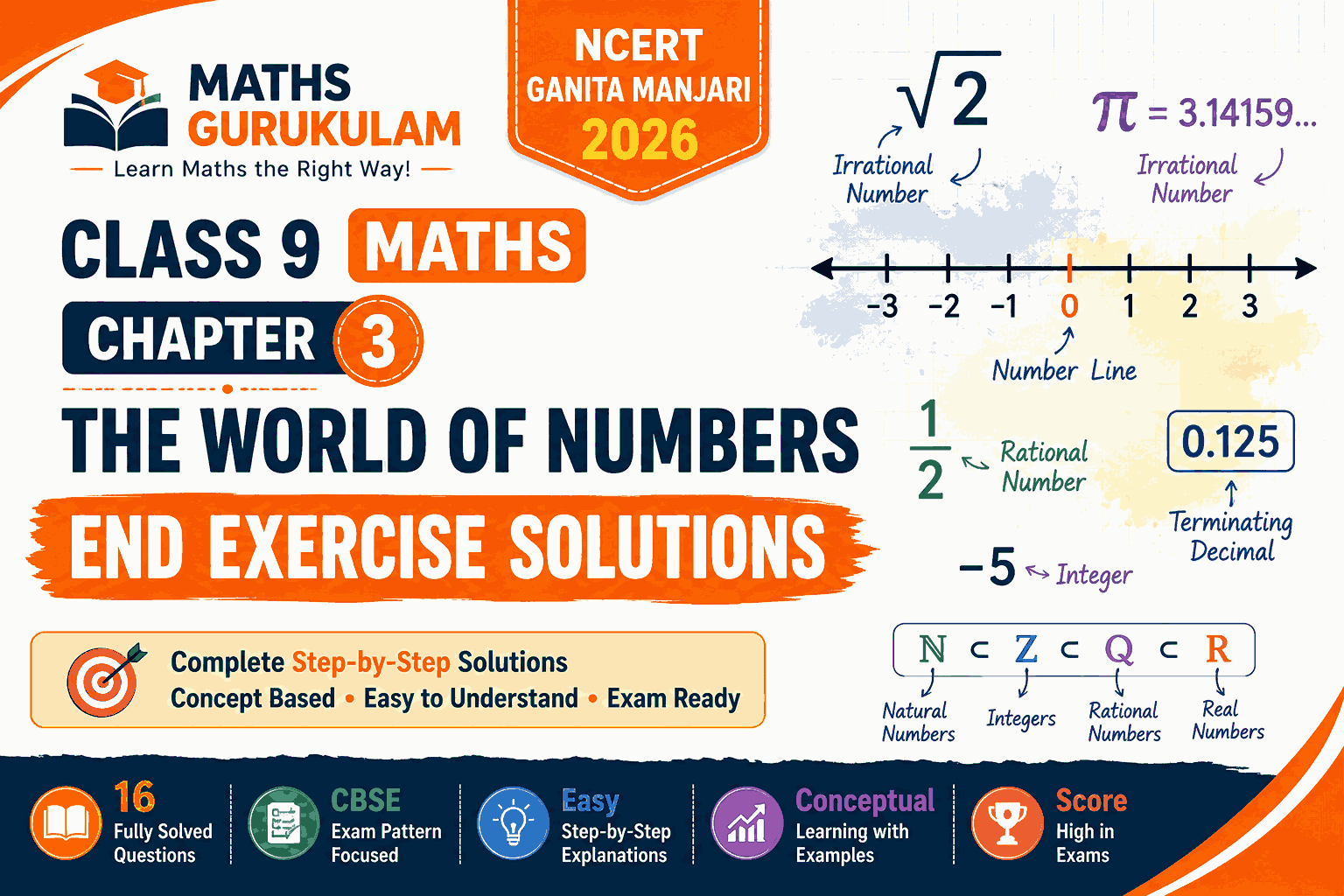
Class 9 Maths Chapter 3 End Exercise Solutions
Prepare for your CBSE exams with complete step-by-step solutions of Class 9 Maths Chapter 3 End Exercise. Every solution is explained in simple language with concept clarity, exam tips, common mistakes, and student-friendly methods based on the latest NCERT Ganita Manjari 2026 textbook.
Table of Contents
Jump directly to any section of this chapter and quickly find revision notes, important concepts, formulas, and step-by-step solutions.
Learn Before You Solve
Before solving the Class 9 Maths Chapter 3 End Exercise, take just 2 minutes to revise the important concepts of The World of Numbers. This quick revision will help you understand the questions faster and avoid common mistakes in the exam.
🔢 Natural Numbers
Natural Numbers are the counting numbers {1, 2, 3, …}. They were the first numbers used by humans for counting objects and formed the foundation of mathematics.
➖ Integers
Integers include positive numbers, negative numbers and zero. They help represent situations like temperature, profit-loss and elevation.
½ Rational Numbers
A Rational Number is any number that can be written in the form p/q where q ≠ 0. All integers are also rational numbers.
√ Irrational Numbers
Irrational Numbers cannot be written as p/q. Their decimal expansion never ends and never repeats.
🌍 Real Numbers
Real Numbers include both Rational Numbers and Irrational Numbers. Every point on the number line represents a real number.
🔍 Decimal Expansion
Rational numbers have terminating or repeating decimal expansions, while irrational numbers have non-terminating, non-repeating decimal expansions.
🎯 Before You Start Solving
- ✔ Remember that q ≠ 0 in every rational number.
- ✔ Reduce fractions to their simplest form whenever possible.
- ✔ Check whether the denominator has only 2 and/or 5 as prime factors to identify terminating decimals.
- ✔ Remember that √2, √5 and π are irrational numbers.
- ✔ Read each question carefully before applying any property or formula.
Complete Chapter Revision Dashboard
Revise every important concept of Chapter 3 – The World of Numbers before solving the End Exercise. This quick revision will strengthen your concepts and boost your confidence for the CBSE examination.
🌍 Journey of Numbers
Numbers evolved gradually to solve different mathematical problems.
Irrational Numbers also belong to Real Numbers
0️⃣ Zero & Integers
- Zero is neither positive nor negative.
- Adding zero does not change a number.
- Any number multiplied by zero becomes zero.
- Integers include positive numbers, negative numbers and zero.
- Integers are used in temperature, profit-loss and elevation.
½ Rational Numbers
A rational number is any number that can be written in the form
(q ≠ 0)
- Every integer is a rational number.
- Equivalent fractions represent the same rational number.
- Always simplify fractions into lowest form.
Important Rules & Closure Properties
Before solving the End Exercise, remember which operations are closed and not closed for different number systems. These properties are frequently tested in CBSE examinations.
🔢 Natural Numbers (N)
- Addition (+)
- Multiplication (×)
- Subtraction (−)
- Division (÷)
➖ Integers (Z)
- Addition (+)
- Subtraction (−)
- Multiplication (×)
- Division (÷)
½ Rational Numbers (Q)
- Addition (+)
- Subtraction (−)
- Multiplication (×)
- Division (÷)*
Division is possible only when the divisor is not zero.
🌍 Real Numbers (R)
- Addition (+)
- Subtraction (−)
- Multiplication (×)
- Division (÷)*
Division by 0 is not defined.
🎯 Exam Tip
A common CBSE question is: “Is the given number system closed under a particular operation?” Remember: Natural Numbers are not closed under subtraction and division, while Integers, Rational Numbers, and Real Numbers are closed under addition, subtraction, and multiplication. Division is allowed only when the divisor is not zero.
Chapter 3 Formula Sheet
Revise the most important formulas and mathematical rules of Chapter 3 – The World of Numbers before solving the End Exercise. These formulas are frequently used in CBSE examinations.
↓
Terminating
🧠 Memory Shortcut
✔ Distance on Number Line → |a − b|
✔ Rational Number → p/q (q ≠ 0)
✔ Average of Two Numbers → (a + b) / 2
✔ Real Numbers = Rational + Irrational
✔ Denominator has only 2 and/or 5 → Terminating Decimal
Decimal Expansion Decision Tree
Without performing long division, you can easily predict whether a rational number will have a terminating decimal or a non-terminating repeating decimal. Just follow this simple decision tree.
3/20 → 0.15
13/250 → 0.052
2/9 = 0.222…
4/15 = 0.2666…
🧠 Memory Trick
Only 2 and/or 5 in the denominator (after simplifying the fraction)
👉 Terminating Decimal
If the denominator contains any other prime factor such as
3, 7, 11, 13…
👉 Non-Terminating Repeating Decimal
🎯 CBSE Exam Tip
Always reduce the fraction to its lowest form before checking the denominator. Only then decide whether the decimal expansion will be terminating or repeating.
Rational Numbers vs Irrational Numbers
Many students confuse rational and irrational numbers. This quick comparison will help you identify them easily before solving the End Exercise.
| Feature | ½ Rational Numbers (Q) | √ Irrational Numbers (I) |
|---|---|---|
| Definition |
Can be written as p/q (q ≠ 0) |
Cannot be written as p/q |
| Decimal Expansion |
✅ Terminating or ✅ Non-Terminating Repeating |
❌ Non-Terminating ❌ Non-Repeating |
| Fraction Form | ✔ Possible | ✘ Not Possible |
| Examples | 3/5, −7/4, 5, 0.25, 0.333… | √2, √5, π |
| Number Line | Represented on the number line | Also represented on the number line |
🧠 Memory Trick
Fraction → Rational
No Fraction → Irrational
Repeating Decimal → Rational
Never Repeating Decimal → Irrational
Common Mistakes Students Make
Many students lose marks in the End Exercise because of small conceptual mistakes. Revise these carefully before attempting the questions.
❌ Mistake 1
√5 = 2.5
Correct: √5 is an irrational number. Its value is approximately 2.236…, not 2.5.
❌ Mistake 2
Every Decimal Number is Rational
Correct: Only terminating or repeating decimals are rational. Non-terminating, non-repeating decimals are irrational.
❌ Mistake 3
Denominator can be Zero
Correct: A rational number is written as p/q where q ≠ 0. Division by zero is not defined.
❌ Mistake 4
Every Non-Terminating Decimal is Irrational
Correct: A non-terminating repeating decimal is still a rational number. Only non-terminating, non-repeating decimals are irrational.
❌ Mistake 5
Checking Decimal Type Without Simplifying
Correct: Always write the fraction in its lowest form before checking the prime factors of the denominator.
❌ Mistake 6
Assuming Every Integer is Not Rational
Correct: Every integer can be written as n/1 so every integer is also a rational number.
🎯 Maths Gurukulam Exam Tip
Most mistakes in Chapter 3 happen because students memorize definitions instead of understanding concepts. Before answering, always ask yourself: Can this number be written as p/q? If yes, it is rational. If not, it is irrational.
Memory Tricks for Chapter 3
Use these quick memory tricks to remember important concepts of Chapter 3 – The World of Numbers and solve questions with confidence.
🔢 Decimal Shortcut
⬇
✅ Terminating
Any Other Prime Factor
⬇
🔁 Repeating
½ Rational Number Rule
q ≠ 0
If a number can be written as p/q, it is a rational number.
🌍 Real Number Rule
=
Rational + Irrational
√ Irrational Reminder
Always Irrational
📚 Evolution Trick
Remember: Irrational Numbers also belong to Real Numbers.
🎯 Exam Memory Tip
Instead of memorizing definitions, remember these five shortcuts. They are enough to solve most conceptual questions from Chapter 3 – The World of Numbers.
Exam Tips – What the Examiner Expects
Follow these important CBSE exam tips while solving the Chapter 3 End Exercise. They will help you avoid common mistakes and score full marks in concept-based questions.
📝 Read the Question Carefully
Identify whether the question is asking for a rational number, an irrational number, or a decimal expansion before starting your solution.
✍ Write Mathematical Statements Clearly
Use proper mathematical notation like p/q (q ≠ 0) and write every calculation step neatly.
🔍 Simplify Before Deciding
Reduce every fraction to its lowest form before checking whether its decimal expansion is terminating or repeating.
📐 Draw Number Lines Neatly
For questions involving number line representation, mark the scale correctly and label every important point clearly.
🧮 Show Every Step
Do not skip intermediate calculations. CBSE awards step marks for correct mathematical working.
✅ Check Your Final Answer
Before moving to the next question, verify signs, simplify fractions, and make sure the final answer satisfies the question.
🏆 Maths Gurukulam Pro Tip
In Chapter 3, CBSE focuses more on conceptual understanding than lengthy calculations. If you clearly understand: ✔ Rational Numbers ✔ Irrational Numbers ✔ Decimal Expansion ✔ Real Numbers ✔ Number Line Representation you will be able to solve most End Exercise questions confidently.
Class 9 Maths Chapter 3 End Exercise Solutions
Below are the complete Class 9 Maths Chapter 3 End Exercise Solutions based on the latest NCERT Ganita Manjari 2026. Every question is solved using the CBSE answer-writing format with step-by-step explanations, key concepts, common mistakes, exam tips, and student-friendly methods.
In these Class 9 Maths Chapter 3 End Exercise Solutions, Question 1 explains how to convert rational numbers into terminating and non-terminating repeating decimals using the long division method.
(i) 3 50 (ii) 2 9
📌 Given
(i) 3 50
(ii) 2 9
🎯 To Find
Convert each rational number into its decimal form using the process of long division and identify whether the decimal expansion is terminating or non-terminating repeating.
💡 Concept Reminder
- Convert every rational number into decimal form by long division.
- If the remainder becomes 0, the decimal expansion is terminating.
- If the same remainder repeats, the decimal expansion is non-terminating repeating.
✍ Step-by-Step Solution
(i) Convert 3 50 into decimal form.
Divide 3 by 50 using the long division method.
             0.06
50 ) 3.000
     0
     ----
      30
       0
     ----
      300
      300
     ----
        0
Therefore, 3 ÷ 50 = 0.06
The remainder becomes 0. Hence, 0.06 is a terminating decimal.
(ii) Convert 2 9 into decimal form.
Divide 2 by 9 using the long division method.
             0.22222...
9 ) 2.00000
    18
    ----
     20
     18
    ----
      20
      18
    ----
       20
       ...
Therefore, 2 ÷ 9 = 0.22222… (0.2)
The remainder repeats continuously. Hence, 0.22222… is a non-terminating repeating decimal.
✅ Final Answer
| Rational Number | Decimal Expansion | Decimal Type |
|---|---|---|
| 3 50 | 0.06 | Terminating Decimal |
| 2 9 | 0.22222… | Non-terminating Repeating Decimal |
📘 Key Concept Used
- Every rational number can be converted into decimal form using the long division method.
- If the remainder becomes 0, the decimal expansion is a terminating decimal.
- If the remainder repeats continuously, the decimal expansion is a non-terminating repeating decimal.
⚠️ Common Mistake
- Stopping the long division before identifying the repeating pattern.
- Writing 2 ÷ 9 = 0.2 instead of 0.22222….
- Forgetting to mention whether the decimal is terminating or non-terminating repeating.
🎯 CBSE Exam Tip
In CBSE examinations, always show the complete long division steps and clearly mention whether the decimal expansion is terminating or non-terminating repeating. This helps you earn full step marks.
🧠 Memory Trick
Remainder becomes 0 → Terminating Decimal
Same remainder repeats → Non-Terminating Repeating Decimal
In these Class 9 Maths Chapter 3 End Exercise Solutions, Question 2 proves that √5 is an irrational number using the method of contradiction as explained in the latest NCERT Ganita Manjari (2026).
📌 Given
The number is √5.
🎯 To Find
Prove that √5 is an irrational number.
✍ Step-by-Step Solution
We will use the method of contradiction, exactly as explained in the NCERT textbook.
Step 1: Assume that √5 is a rational number.
Then it can be written in the form
√5 = p/q
where p and q are co-prime integers (having no common factor other than 1) and q ≠ 0.
Step 2: Square both sides.
5 = p²/q²
Multiplying both sides by q²,
p² = 5q²
Therefore, p² is divisible by 5. Hence, p is also divisible by 5.
So, let
p = 5k
where k is an integer.
Step 3: Substitute p = 5k in the equation
p² = 5q²
We get,
(5k)² = 5q²
25k² = 5q²
Dividing both sides by 5,
5k² = q²
Therefore, q² is also divisible by 5. Hence, q is divisible by 5.
Thus, both p and q are divisible by 5. This contradicts our assumption that p and q are co-prime.
Prime Divisibility theorem
Prime Divisibility Theorem ⓘ
If a prime number divides the square of an integer,
then it also divides that integer.
Example:
If
5 | p²
then
5 | p
In these Class 9 Maths Chapter 3 End Exercise Solutions, Question 3 explains how to convert terminating and non-terminating repeating decimals into the form p/q using the latest NCERT Ganita Manjari (2026) methods.
Question
Convert the following decimal numbers into the form of p/q.
📌 Given
Nine decimal numbers (both terminating and recurring decimals).
🎯 To Find
Convert each decimal number into the form p/q and write the fraction in its lowest terms.
✍ Solution
Ignoring the leading zeros,
Divide the numerator and denominator by 40.
✍ Solution
Let
x = 3.0252525…
Multiply both sides by 10 to remove the non-repeating digit.
10x = 30.252525…
Now multiply both sides by 100.
1000x = 3025.252525…
Subtract,
1000x − 10x = 3025.252525… − 30.252525…
990x = 2995
x = 2995 990
= 599 198
✍ Solution
Let
x = 1.2353535…
There is one non-repeating digit (2) and two repeating digits (35).
Multiply both sides by 10.
10x = 12.353535…
Now multiply both sides by 100.
1000x = 1235.353535…
Subtract the two equations.
1000x − 10x = 1235.353535… − 12.353535…
990x = 1223
x = 1223 990
Since 1223 and 990 have no common factor, the fraction is already in its lowest form.
✍ Solution
Let
x = 0.23232323…
Since the repeating block contains 2 digits (23), multiply both sides by 100.
100x = 23.23232323…
Subtract the first equation from the second equation.
100x − x = 23.232323… − 0.232323…
99x = 23
x = 23 99
Since 23 and 99 have no common factor other than 1, the fraction is already in its lowest form.
✍ Solution
Let
x = 2.05555…
There is one non-repeating digit (0) and one repeating digit (5).
Multiply both sides by 10.
10x = 20.5555…
Multiply both sides again by 10.
100x = 205.5555…
Subtract the two equations.
100x − 10x = 205.5555… − 20.5555…
90x = 185
x = 185 90
Divide the numerator and denominator by 5.
= 37 18
✍ Solution
Let
x = 2.125555…
There are two non-repeating digits (12) and one repeating digit (5).
Multiply both sides by 100.
100x = 212.5555…
Multiply both sides again by 10.
1000x = 2125.5555…
Subtract the two equations.
1000x − 100x = 2125.5555… − 212.5555…
900x = 1913
x = 1913 900
Since 1913 and 900 have no common factor other than 1, the fraction is already in its lowest form.
✍ Solution
Let
x = 3.125555…
There are two non-repeating digits (12) and one repeating digit (5).
Multiply both sides by 100.
100x = 312.5555…
Multiply both sides again by 10.
1000x = 3125.5555…
Subtract the two equations.
1000x − 100x = 3125.5555… − 312.5555…
900x = 2813
x = 2813 900
Since 2813 and 900 have no common factor other than 1, the fraction is already in its lowest form.
✍ Solution
Let
x = 2.162516251625…
There is no non-repeating part and 1625 is the repeating block.
Since the repeating block contains 4 digits, multiply both sides by 10000.
10000x = 21625.16251625…
Subtract the first equation from the second equation.
10000x − x = 21625.16251625… − 2.16251625…
9999x = 21623
x = 21623 9999
Since 21623 and 9999 have no common factor other than 1, the fraction is already in its lowest form.
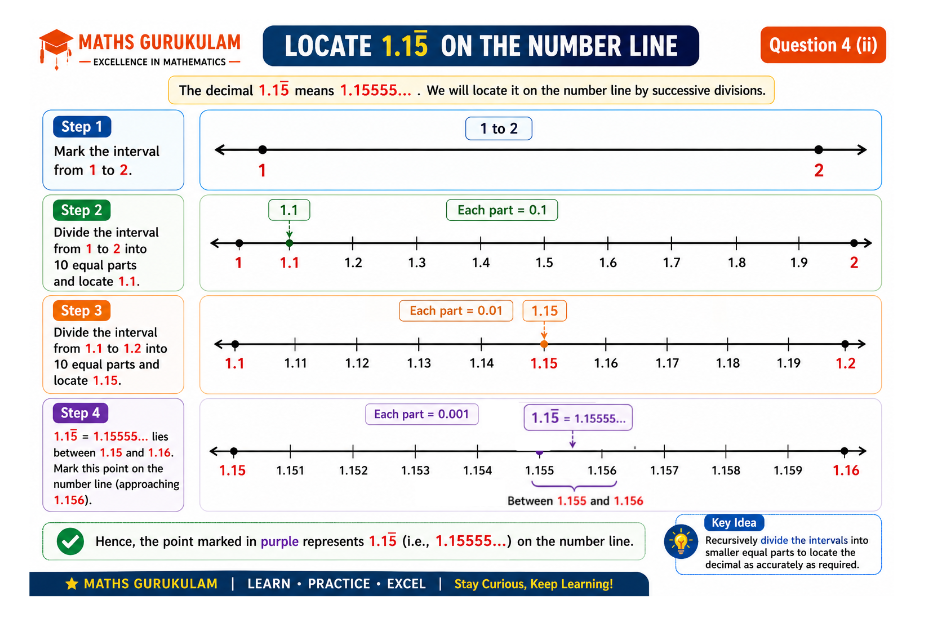
In these Class 9 Maths Chapter 3 End Exercise Solutions, we learn how to locate rational numbers on the number line using step-by-step construction according to the latest NCERT Ganita Manjari (2026).
Question
Locate the following rational numbers on the number line.
(i) 0.532
(ii) 1.15
📌 Given
(i) 0.532
(ii) 1.15
🎯 To Find
Locate the given rational numbers on the number line.
✍ Solution (i)
Locate 0.532
Since
0.532 = 532 1000
it lies between 0 and 1 on the number line.
Step 1: Mark the interval from 0 to 1.
Step 2: Divide this interval into 10 equal parts and locate 0.5.
Step 3: Divide the interval from 0.5 to 0.6 into 10 equal parts and locate 0.53.
Step 4: Divide the interval from 0.53 to 0.54 into 10 equal parts. Mark the 2nd division after 0.53.
Hence, the required point represents 0.532.
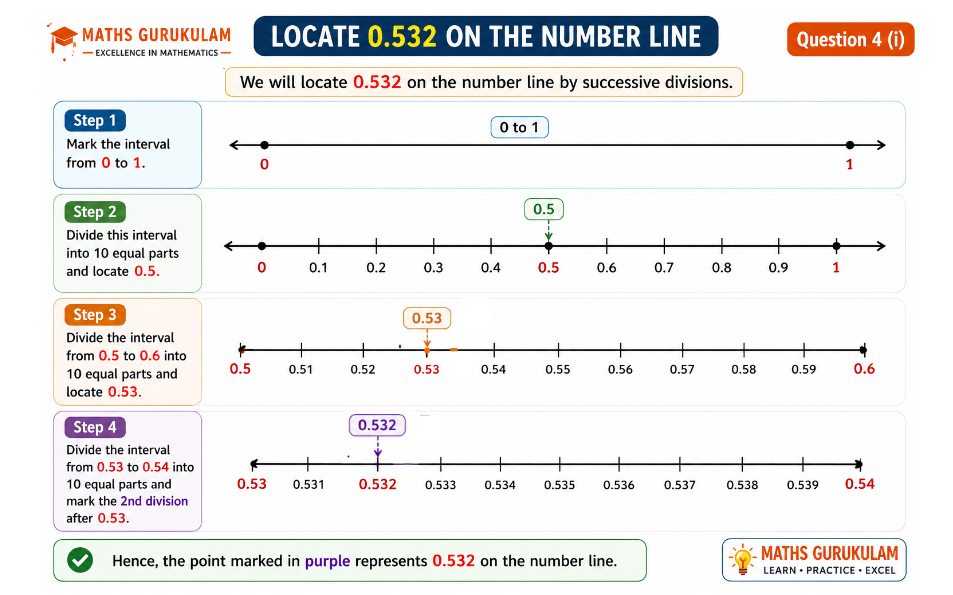
Figure 4.1: Step-by-step construction showing how to locate 0.532 on the number line.
Find 6 rational numbers between 3 and 4.
📌 Given
The given rational numbers are 3 and 4.
🎯 To Find
Find six rational numbers lying between 3 and 4.
✍ Solution
First, express both numbers with denominator 1.
Since we need 6 rational numbers between them, multiply the numerator and denominator of each fraction by 7.
Therefore,
The numerators lying between 21 and 28 are 22, 23, 24, 25, 26 and 27.
Hence, the required six rational numbers are
✅ Final Answer
The six rational numbers lying between 3 and 4 are
📘 Key Concept Used
- Express the given numbers as equivalent fractions having the same denominator.
- Choose a denominator large enough to obtain the required number of rational numbers between the given numbers.
- The fractions formed by the intermediate numerators are the required rational numbers.
⚠️ Common Mistake
- Using different denominators for the two fractions.
- Choosing a denominator that does not produce enough rational numbers.
- Writing only five numbers instead of the required six rational numbers.
- Forgetting to write the fractions in their correct order.
🎯 CBSE Exam Tip
In CBSE examinations, do not write the final answer directly. Always show how you convert the given numbers into equivalent fractions with the same denominator, explain why the denominator is chosen, and then write the required rational numbers. This stepwise method helps you score full marks.
🧠 Memory Trick
↓
Count the Numerators
↓
Write the Fractions
Whenever you are asked to find rational numbers between two given numbers, first make the denominators the same, count the numerators lying between them, and then write the corresponding fractions.
Find 5 rational numbers between 2 5 and 3 5 .
📌 Given
The given rational numbers are 2 5 and 3 5
🎯 To Find
Find five rational numbers lying between the given fractions.
✍ Solution
The given fractions already have the same denominator.
There is no integer between 2 and 3. Therefore, convert both fractions into equivalent fractions having a larger denominator.
Since we need 5 rational numbers, multiply the numerator and denominator of each fraction by 6.
Thus,
The integers between 12 and 18 are 13, 14, 15, 16 and 17.
Hence, the required five rational numbers are
✅ Final Answer
The required five rational numbers between 2 5 and 3 5 are
📘 Key Concept Used
- Equivalent fractions represent the same rational number.
- When there are no integers between the numerators, convert the fractions into equivalent fractions having a larger denominator.
- The numerators lying between the new numerators give the required rational numbers.
⚠️ Common Mistake
- Trying to write fractions directly between 2 5 and 3 5 without converting them into equivalent fractions.
- Choosing a multiplier that does not produce enough rational numbers.
- Writing fewer or more than the required five rational numbers.
🎯 CBSE Exam Tip
Always explain why you choose the multiplier. In this question, multiplying by 6 gives the equivalent fractions 12 30 and 18 30 so that exactly five numerators lie between them. Showing this reasoning helps you score full marks.
🧠 Memory Trick
↓
Equivalent Fractions
↓
Count the Numerators
↓
Write the Fractions
Whenever two fractions have no integers between their numerators, first convert them into equivalent fractions with a larger denominator. Then write the fractions whose numerators lie between the new numerators.
Find 5 rational numbers between 1 6 and 2 5 .
📌 Given
The given rational numbers are 1 6 and 2 5 .
🎯 To Find
Find five rational numbers lying between the given fractions.
✍ Solution
First, convert the given fractions into equivalent fractions having the same denominator.
The LCM of 6 and 5 is 30.
Thus, the given fractions become
The integers lying between 5 and 12 are 6, 7, 8, 9, 10 and 11.
Hence, any five of the following fractions are the required rational numbers.
✅ Final Answer
One possible set of five rational numbers between 1 6 and 2 5 is
📘 Key Concept Used
- To find rational numbers between two fractions, first convert them into equivalent fractions having the same denominator.
- The LCM of the denominators is used to obtain equivalent fractions.
- The fractions formed by the numerators lying between the new numerators are the required rational numbers.
- There can be many correct sets of rational numbers between two given rational numbers.
⚠️ Common Mistake
- Not taking the LCM of the denominators before comparing the fractions.
- Choosing fractions that are not actually between the given fractions.
- Writing more or fewer than the required five rational numbers.
- Thinking that there is only one correct answer. Any valid five rational numbers between the given fractions are acceptable.
🎯 CBSE Exam Tip
In CBSE examinations, always show the LCM of the denominators, convert the fractions into equivalent fractions, and then write the rational numbers between them. Showing these intermediate steps helps you score full marks.
🧠 Memory Trick
↓
Make Same Denominator
↓
Choose the Numerators
↓
Write the Fractions
Whenever two fractions have different denominators, first take the LCM, convert them into equivalent fractions, and then choose the fractions lying between them.
✍ Solution
Given,
Taking the LCM of 3 and 5, we get 15.
Adding the fractions,
Multiply both sides by 15.
Divide both sides by 8.
✅ Final Answer
The required rational number is
📘 Key Concept Used
- Take the LCM of the denominators before adding rational numbers.
- Add like fractions by keeping the denominator the same.
- Solve the resulting linear equation to find the value of the unknown.
⚠️ Common Mistake
- Adding the denominators directly.
- Using an incorrect LCM.
- Forgetting to divide both sides by 8 after obtaining 8x = 16.
🎯 CBSE Exam Tip
In CBSE examinations, write every algebraic step clearly: LCM → Addition of Fractions → Simplification → Solve for x. Showing each step helps you score full marks.
🧠 Memory Trick
Take LCM ↓ Add Numerators ↓ Remove Denominator ↓ Solve for x
Let a and b be two non-zero rational numbers such that a + 1 b = 0. Without assigning any numerical values, determine whether ab is positive or negative. Justify your answer.
📌 Given
- a and b are non-zero rational numbers.
- a + 1 b = 0
🎯 To Find
Determine whether ab is positive or negative and justify your answer.
✍ Solution
Given,
Subtract 1 b from both sides.
Multiply both sides by b.
Since b ≠ 0, the factor b cancels.
Since −1 is a negative rational number, ab is negative.
✅ Final Answer
We have obtained
Since −1 is a negative rational number, ab is negative.
📘 Key Concept Used
- Use transposition to isolate the required term.
- Multiply both sides of an equation by the same non-zero quantity.
- If b ≠ 0, then b cancels from both sides.
- Determine the sign from the final value obtained.
⚠️ Common Mistake
- Forgetting that b ≠ 0 before cancelling b.
- Writing ab = 1 instead of ab = −1.
- Giving only the answer without proper justification.
🎯 CBSE Exam Tip
Always justify your conclusion by showing every algebraic step. Write: Given → Transpose → Multiply → Simplify → Conclusion to score full marks in CBSE examinations.
🧠 Memory Trick
Transpose ↓ Multiply ↓ Cancel ↓ Identify the Sign
A rational number has a terminating decimal expansion whose last non-zero digit occurs in the 4th decimal place. Show that such a number can be written in the form p 10⁴ where p is an integer not divisible by 10. Is it necessary that the denominator of this rational number, when written in its lowest form, is divisible by 2⁴ or 5⁴? Give reasons.
📌 Given
A rational number has a terminating decimal expansion whose last non-zero digit occurs in the 4th decimal place.
🎯 To Find
- Show that the number can be written in the form p 10⁴ where p is an integer not divisible by 10.
- State whether the denominator in the lowest form must be divisible by 2⁴ or 5⁴.
✍ Solution
Since the last non-zero digit occurs in the 4th decimal place, the decimal has exactly four decimal places after removing any trailing zeros.
Therefore, the given rational number can be written as
where p is an integer.
Since the last non-zero digit occurs in the fourth decimal place, the numerator p cannot end with the digit 0.
Now write the denominator in prime factor form.
When the fraction is reduced to its lowest form, any common factors of the numerator and denominator are cancelled.
If p is divisible by 2 or 5, the corresponding factors are cancelled from the denominator.
Therefore, after simplification, the denominator may no longer contain the factors 2⁴ or 5⁴.
✅ Final Answer
The given rational number can always be written in the form
where p is an integer not divisible by 10.
However, it is not necessary that the denominator in its lowest form remains divisible by 2⁴ or 5⁴, because common factors of the numerator and denominator are cancelled while reducing the fraction to its lowest form.
📘 Key Concept Used
- A terminating decimal having four decimal places can be written with denominator 10⁴.
- 10⁴ = 2⁴ × 5⁴.
- While reducing a fraction to its lowest form, common factors of the numerator and denominator are cancelled.
- Therefore, the denominator in lowest form may not contain 2⁴ or 5⁴.
⚠️ Common Mistake
- Thinking that the denominator always remains 10⁴ after simplification.
- Forgetting to express 10⁴ as 2⁴ × 5⁴.
- Ignoring the cancellation of common factors while reducing the fraction.
🎯 CBSE Exam Tip
In proof-based questions, always write the argument in sequence: Decimal Form → Fraction Form → Prime Factorisation → Cancellation → Conclusion. This systematic approach helps you score full marks in CBSE examinations.
🧠 Memory Trick
Decimal ↓ 10⁴ ↓ 2⁴ × 5⁴ ↓ Cancel Common Factors ↓ Lowest Form
🎉 Chapter 3 End Exercise Completed
You have successfully completed all solutions of the Class 9 Maths Chapter 3 End Exercise (Ganita Manjari 2026). Practice these questions regularly to strengthen your understanding of rational numbers and score excellent marks in your CBSE examinations.
Without performing division, determine whether the decimal expansion of 18 125 is terminating or non-terminating. If it terminates, state the number of decimal places.
📌 Given
The rational number is 18 125
🎯 To Find
Determine whether its decimal expansion is terminating or non-terminating. If it is terminating, find the number of decimal places.
✍ Solution
A rational number has a terminating decimal expansion if, after writing the fraction in its lowest form, the denominator has only the prime factors 2 and/or 5.
The given fraction is
Since 18 and 125 have no common factor other than 1, the fraction is already in its lowest form.
Now find the prime factorisation of the denominator.
The denominator contains only the prime factor 5.
Therefore, the decimal expansion of 18 125 is terminating.
Since the highest power of 5 in the denominator is 3, the decimal expansion will have 3 decimal places.
✅ Final Answer
The denominator of the fraction 18 125 contains only the prime factor 5.
Therefore, its decimal expansion is terminating.
Since 125 = 5³, the decimal expansion contains 3 decimal places.
📘 Key Concept Used
- Write the rational number in its lowest form.
- Find the prime factors of the denominator.
- If the denominator contains only the prime factors 2 and/or 5, the decimal expansion is terminating.
- The number of decimal places is equal to the greater power of 2 or 5 in the denominator.
⚠️ Common Mistake
- Performing long division even though the question clearly says “without performing division”.
- Not reducing the fraction to its lowest form before checking the denominator.
- Thinking that only denominators with factor 2 terminate. A denominator containing only 5 also gives a terminating decimal.
- Writing the wrong number of decimal places.
🎯 CBSE Exam Tip
In CBSE examinations, never perform division when the question asks you not to. Simply write the fraction in its lowest form, find the prime factors of the denominator, and use the rule of terminating decimals. This method is faster and helps you score full marks.
🧠 Memory Trick
Lowest Form ↓ Prime Factors of Denominator ↓ Only 2 and/or 5 ? ↓ Yes → Terminating ↓ Highest Power = Decimal Places
A rational number in its lowest form has denominator 23 × 5. How many decimal places will its decimal expansion have? Explain your answer.
📌 Given
The denominator of the rational number in its lowest form is 23 × 5.
🎯 To Find
Find the number of decimal places in its terminating decimal expansion and justify the answer.
✍ Solution
The denominator is already in its lowest form.
A rational number has a terminating decimal expansion if its denominator contains only the prime factors 2 and/or 5.
Here, the denominator contains only the prime factors 2 and 5. Therefore, the decimal expansion is terminating.
The number of decimal places is equal to the greater of the powers of 2 and 5.
Power of 5 = 1
The greater power is 3.
Hence, the decimal expansion will have 3 decimal places.
✅ Final Answer
The denominator is 23 × 5, which contains only the prime factors 2 and 5.
Therefore, the decimal expansion is terminating.
The greater power of 2 and 5 is 3. Hence, the decimal expansion will have 3 decimal places.
📘 Key Concept Used
- Write the denominator in its prime factorised form.
- If the denominator contains only the prime factors 2 and/or 5, the decimal expansion is terminating.
- The number of decimal places is equal to the greater power of 2 or 5.
⚠️ Common Mistake
- Adding the powers of 2 and 5 (3 + 1 = 4), which is incorrect.
- Using the smaller power instead of the greater power.
- Forgetting that this rule applies only when the fraction is in its lowest form.
🎯 CBSE Exam Tip
Always remember this important CBSE rule: Decimal Places = Greater power of 2 or 5 in the denominator (after reducing the fraction to its lowest form). Write this rule before giving your answer to score full marks.
🧠 Memory Trick
Lowest Form
↓
Prime Factors
↓
Only 2 & 5
↓
Take the Greater Power
↓
Decimal Places
Let a = 7 12 and b = 5 6 . Express both a and b in the form k₁ m and k₂ m where k₁, k₂ and m are integers and k₂ − k₁ > 6. Using the same denominator m, write exactly five distinct rational numbers lying between a and b. Explain why the condition k₂ − k₁ > n + 1 is necessary to find n such rational numbers by this method.
📌 Given
a = 7 12 b = 5 6
🎯 To Find
- Express both fractions with the same denominator m.
- Write exactly five rational numbers between them.
- Explain why k₂ − k₁ > n + 1 is required.
✍ Solution
First, write both fractions with the same denominator. The LCM of 12 and 6 is 12.
Thus,
Here,
Since 3 ≤ 6, there are not enough integers between 7 and 10 to write five rational numbers. Therefore, we choose a larger common denominator.
Multiply both numerator and denominator of each fraction by 3.
Now,
Since 30 − 21 = 9 > 6, there are enough integers between 21 and 30 to obtain exactly five rational numbers.
The integers lying between 21 and 30 are
Any five of these numerators will give rational numbers lying between a and b. Choosing the first five,
These are the required five distinct rational numbers lying between 7 12 and 5 6 .
The condition k₂ − k₁ > n + 1 is necessary because there must be at least n integers between k₁ and k₂ to obtain n distinct rational numbers having the same denominator.
✅ Final Answer
Five rational numbers between 7 12 and 5 6 are
The condition k₂ − k₁ > n + 1 ensures that there are enough integers between k₁ and k₂ to obtain exactly n rational numbers.
📘 Key Concept Used
- Convert the given fractions into equivalent fractions having the same denominator.
- Choose a denominator large enough so that sufficient integers lie between the numerators.
- The intermediate numerators give the required rational numbers.
- For finding n rational numbers, the condition k₂ − k₁ > n + 1 must be satisfied.
⚠️ Common Mistake
- Using the LCM denominator directly without checking whether enough numerators are available.
- Writing fewer or more than the required five rational numbers.
- Not explaining why a larger denominator is chosen.
- Ignoring the condition k₂ − k₁ > n + 1.
🎯 CBSE Exam Tip
In CBSE examinations, always show these steps: LCM → Equivalent Fractions → Difference of Numerators → Required Rational Numbers → Reason for Choosing a Larger Denominator. This complete method helps you secure full marks.
🧠 Memory Trick
Same Denominator
↓
Enough Numerators
↓
Choose the Middle Fractions
↓
Write the Answer
Three rational numbers x, y and z satisfy
xy + yz + zx = 0
Show that all the rational numbers x, y and z must be simultaneously zero.
📌 Given
x + y + z = 0
xy + yz + zx = 0
🎯 To Find
Show that x = y = z = 0.
✍ Solution
From the first equation,
Therefore,
Substitute this value of z into the second equation.
Expand the brackets.
Simplify the equation.
Now use the identity
Multiplying both sides of x² + xy + y² = 0 by 4, we get
Since both terms are squares (or positive multiples of squares), each term must be zero.
Since
both terms on the left-hand side are non-negative because they are squares (or positive multiples of squares). The sum of two non-negative numbers can be zero only when each term is zero.
Therefore,
and
3y² = 0
Hence,
y = 0
Substituting y = 0 into 2x + y = 0, we get
From the first given equation,
Substituting x = 0 and y = 0,
Hence,
✅ Final Answer
The only rational numbers satisfying
xy + yz + zx = 0
are
📘 Key Concept Used
- Substitute one variable using the first equation.
- Simplify the second equation.
- Use the identity 4(x² + xy + y²) = (2x + y)² + 3y².
- The sum of two non-negative numbers can be zero only if each is zero.
⚠️ Common Mistake
- Expanding xy + yz + zx incorrectly after substitution.
- Not using the identity correctly.
- Concluding directly that x = y = 0 without proving each squared term is zero.
- Forgetting to substitute the values back to find z.
🎯 CBSE Exam Tip
For proof questions, write the complete sequence: Substitution → Simplification → Identity → Sum of Squares → Conclusion. Never skip the reasoning that a sum of non-negative numbers can be zero only when each number is zero.
🧠 Memory Trick
Substitute
↓
Simplify
↓
Use Identity
↓
Squares = 0
↓
x = y = z = 0
Show that the rational number a + b 2 lies between the rational numbers a and b.
📌 Given
Let a and b be rational numbers such that
🎯 To Find
Show that
✍ Solution
To prove that
consider the difference
Taking LCM,
Since a < b, we have b − a > 0. Therefore,
Hence,
Now, we shall prove that a + b 2 < b in Part 2.
Now, we prove that
Consider the difference
Taking LCM,
Since a < b, we have b − a > 0. Therefore,
Hence,
Combining the results obtained in Part 1 and Part 2,
Thus, a + b 2 lies between the rational numbers a and b.
✅ Final Answer
Therefore,
Hence, the rational number a + b 2 lies between a and b.
📘 Key Concept Used
- To prove one number lies between two numbers, prove both inequalities separately.
- If a < b, then b − a > 0.
- A positive quantity divided by a positive number remains positive.
- The average of two rational numbers always lies between them.
⚠️ Common Mistake
- Proving only one inequality and forgetting the other.
- Making mistakes while taking the LCM.
- Using a − b instead of b − a.
- Not writing the final combined inequality.
🎯 CBSE Exam Tip
For proof-based questions, always show both parts separately: First prove the number is greater than the lower limit, then prove it is smaller than the upper limit. Finally, combine both inequalities to complete the proof.
🧠 Memory Trick
Greater than a
↓
Less than b
↓
Combine Both
↓
Average Lies Between
Find the lengths of the hypotenuses of all the right triangles in Fig. 3.14, which is referred to as the Square Root Spiral.
📌 Given
A square root spiral is formed by joining several right triangles.
Each new triangle has one perpendicular side of length 1 unit.
🎯 To Find
Find the length of the hypotenuse of each right triangle using the Pythagoras Theorem.
✍ Solution
According to the Pythagoras Theorem,
Now, calculate the hypotenuse of each triangle one by one.
Triangle 1
Base = 1 unit
Perpendicular = 1 unit
Triangle 2
Base = √2
Perpendicular = 1
Triangle 3
Base = √3
Perpendicular = 1
Triangle 4
Base = 2
Perpendicular = 1
Triangle 5
Base = √5
Perpendicular = 1
Similarly, continue the same process for the remaining triangles.
Triangle 6
Base = √6
Perpendicular = 1
Triangle 7
Base = √7
Perpendicular = 1
Triangle 8
Base = √8
Perpendicular = 1
Triangle 9
Base = 3
Perpendicular = 1
Triangle 10
Base = √10
Perpendicular = 1
Triangle 11
Base = √11
Perpendicular = 1
✅ Final Answer
The lengths of the hypotenuses of the successive right triangles are:
📘 Key Concept Used
- Each new triangle is a right triangle.
- One side is always 1 unit.
- The previous hypotenuse becomes the base of the next triangle.
- Apply the Pythagoras Theorem repeatedly.
⚠️ Common Mistake
- Using the wrong base for the next triangle.
- Forgetting that the previous hypotenuse becomes the next base.
- Writing √8 as 8 or √12 as 12.
- Not applying the Pythagoras Theorem at every step.
🎯 CBSE Exam Tip
Always calculate the hypotenuse of one triangle before moving to the next. In the Square Root Spiral, the previous hypotenuse becomes the base of the next right triangle. Showing each step using the Pythagoras Theorem helps you score full marks in CBSE examinations.
🧠 Memory Trick
Previous Hypotenuse
↓
Add 1²
↓
Apply Pythagoras
↓
Next Square Root
Chapter 3 Summary – What You Learned
Congratulations! 🎉 You have completed the Class 9 Maths Chapter 3 End Exercise Solutions. Here’s a quick one-page revision of the important concepts you learned from The World of Numbers.
🔢 Number Systems
You learned how numbers evolved from Natural Numbers to Integers, Rational Numbers, Irrational Numbers, and finally Real Numbers.
½ Rational Numbers
You learned that every rational number can be written in the form p/q, where q ≠ 0, and how to perform operations on rational numbers.
√ Irrational Numbers
You understood why numbers like √2, √5, and π are irrational and cannot be expressed as fractions.
🌍 Real Numbers
You learned that the set of Real Numbers includes both Rational and Irrational Numbers, and every real number can be represented on the number line.
🔄 Decimal Expansion
You learned how to identify whether a decimal expansion is terminating, repeating, or non-terminating and non-repeating.
🎯 Exam Readiness
You revised important formulas, common mistakes, memory tricks, CBSE exam tips, and solved all End Exercise questions using a step-by-step approach.
⭐ Key Takeaways
- ✔ Natural Numbers, Integers, Rational Numbers, Irrational Numbers, and Real Numbers are all connected.
- ✔ Every rational number has either a terminating or a non-terminating repeating decimal expansion.
- ✔ Irrational numbers have non-terminating, non-repeating decimal expansions.
- ✔ Every real number has a unique position on the number line.
- ✔ Always simplify fractions before deciding the type of decimal expansion.
- ✔ Strong conceptual understanding is the key to solving CBSE questions confidently.
🎉 Congratulations!
You have successfully completed Class 9 Maths Chapter 3 – The World of Numbers and the End Exercise Solutions. Keep practising regularly and continue your learning journey with the next chapter.
Class 9 Maths Chapter 3 End Exercise FAQs
Here are the most frequently asked questions about Class 9 Maths Chapter 3 End Exercise Solutions (Ganita Manjari 2026). These answers will help you quickly revise important concepts before your CBSE examination.
1. What is a rational number?
A rational number is any number that can be written in the form p/q, where p and q are integers and q ≠ 0.
2. What is an irrational number?
An irrational number cannot be expressed as p/q. Its decimal expansion is non-terminating and non-repeating. Examples include √2, √5 and π.
3. Are all integers rational numbers?
Yes. Every integer can be written in the form n/1, so every integer is a rational number.
4. How can I identify a terminating decimal?
After writing the fraction in its lowest form, if the denominator has only the prime factors 2 and/or 5, the decimal expansion is terminating.
5. How can I identify a repeating decimal?
If the denominator contains any prime factor other than 2 or 5, the decimal expansion is non-terminating but repeating.
6. Is √2 a rational number?
No. √2 is an irrational number because it cannot be written in the form p/q.
7. What are real numbers?
Real numbers include all rational numbers and all irrational numbers. Every point on the number line represents a real number.
8. Why should fractions be simplified before checking decimal expansion?
The rule about prime factors of the denominator works only when the fraction is in its lowest form.
9. What are the important topics in Chapter 3?
Important topics include integers, rational numbers, irrational numbers, real numbers, decimal expansion, number line representation and square roots.
10. Is Chapter 3 important for CBSE exams?
Yes. Questions related to rational numbers, irrational numbers, decimal expansions and number line representation are frequently asked in CBSE Class 9 Mathematics examinations.
11. Are these solutions based on the latest Ganita Manjari 2026 book?
Yes. All solutions on Maths Gurukulam are prepared according to the latest NCERT Ganita Manjari 2026 edition and follow the CBSE answer-writing pattern.
12. How should I prepare for the Chapter 3 End Exercise?
First revise the concepts, formulas, important rules and decimal expansion tricks. Then solve each question step by step and check your answers carefully.
Official Learning Resources
For authentic study material and the latest CBSE syllabus, always refer to the official educational resources listed below. These websites provide reliable information for Class 9 Mathematics students.
📘 NCERT
Download the latest NCERT Ganita Manjari textbook, supplementary learning material, and official educational resources.
Visit NCERT →🏫 CBSE
Visit the official CBSE website for the latest syllabus, circulars, sample papers, and examination updates.
Visit CBSE →🎓 DIKSHA
Access official digital learning content, interactive resources, and QR-linked NCERT materials for Class 9 students.
Visit DIKSHA →💡 Study Smart
Use these official resources along with the Maths Gurukulam Class 9 Maths Chapter 3 End Exercise Solutions for better concept clarity, regular practice, and effective CBSE exam preparation.
📚 Continue Your Learning Journey
Continue exploring Class 9 Maths Chapter 3 End Exercise Solutions and strengthen your understanding of The World of Numbers with step-by-step NCERT solutions based on the latest Ganita Manjari 2026 textbook.

Mathematics Educator
👨🏫 Reviewed & Prepared By
Rakesh Kumar Singh
Founder, Newton Study Point & Maths Gurukulam | Mathematics Educator Since 2006
Rakesh Kumar Singh has been teaching CBSE Mathematics since 2006 and has guided hundreds of students from Classes 8 to 12. His teaching philosophy focuses on conceptual understanding, logical reasoning, visual learning, and exam-oriented preparation so that students develop confidence in Mathematics.
These Class 9 Maths Chapter 3 End Exercise Solutions are independently prepared and carefully reviewed according to the latest NCERT Ganita Manjari (2026) textbook and the current CBSE curriculum. Every solution follows a structured approach with Given, To Find, Step-by-Step Solution, Final Answer, Key Concept, Common Mistake, Exam Tip, and Memory Tricks. This chapter covers the complete journey of numbers, including Natural Numbers, Integers, Rational Numbers, Irrational Numbers, Real Numbers, Number Line, Decimal Expansions, Square Roots, and other important concepts in a simple, student-friendly manner to build strong mathematical understanding.