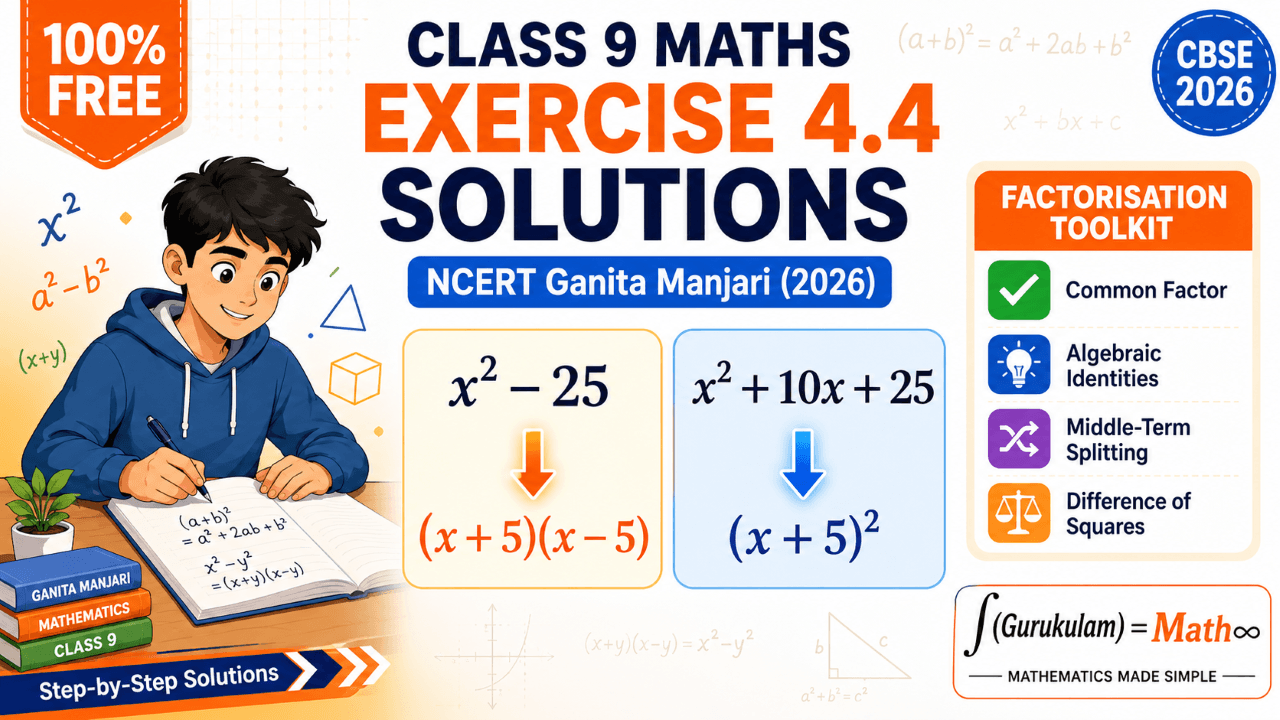
Class 9 Maths Chapter 4 Exercise 4.4 Solutions with step-by-step factorisation using algebraic identities based on the latest NCERT Ganita Manjari (2026) CBSE syllabus.

Class 9 Maths Chapter 4 Exercise 4.4 Solutions (Ganita Manjari 2026) – Exploring Algebraic Identities

📘 NCERT Ganita Manjari (2026) 📚 CBSE 2026–27 ✅ Step-by-Step Solutions

Class 9 Maths Chapter 4 Exercise 4.4 Solutions

Learn Class 9 Maths Chapter 4 Exercise 4.4 Solutions with easy, step-by-step NCERT solutions based on the latest Ganita Manjari (2026). In this exercise, you will learn how to identify the correct algebraic identity, perform mental calculations using identities, understand the difference of squares, and factorise algebraic expressions using simple CBSE methods. Every solution is explained in easy language to help Class 9 students build strong concepts, improve problem-solving skills, and prepare confidently for school and board examinations.

📖
Exercise
4.4
Questions
3 (15 Parts)
🧠
Concept
Identities & Factorisation
Difficulty
Easy to Moderate
⏱️
Study Time
25–35 Min
🎯
Exam Importance
★★★★★
📌 Main Algebraic Identities Used in Exercise 4.4
(a + b)2 = a2 + 2ab + b2
(a − b)2 = a2 − 2ab + b2
(a + b)(a − b) = a2 − b2
a2 − b2 = (a + b)(a − b)
(a + b + c)2 = a2 + b2 + c2 + 2ab + 2bc + 2ca
💡 Student Tip: Before solving any question, carefully observe the given expression. First identify whether it involves a square, a difference of two squares, or factorisation. Choosing the correct algebraic identity before starting the calculation makes every solution faster, easier, and more accurate.
🎯 What You’ll Master in Exercise 4.4
✅ Choosing the correct algebraic identity
✅ Difference of Squares concept
✅ Mental calculations using identities
✅ Factorising algebraic expressions
✅ Applying identities correctly
✅ Avoiding common algebraic mistakes

📑 Table of Contents

📖 About Class 9 Maths Chapter 4 Exercise 4.4

Class 9 Maths Chapter 4 Exercise 4.4 Solutions help you understand how algebraic identities can make mathematical calculations simpler, faster, and more accurate. Instead of solving every question through lengthy multiplication or expansion, this exercise teaches you to recognise patterns and apply the most suitable method at the right time. These skills not only help in solving NCERT questions but also strengthen your logical thinking and problem-solving ability.

All the solutions on this page are prepared according to the latest NCERT Ganita Manjari (2026) textbook and the CBSE Class 9 syllabus. Every solution follows a simple, step-by-step approach that is easy to understand, making this page useful for homework, classroom learning, revision, and exam preparation.

🎯 Your Learning Mission

By the time you complete this exercise, your goal is not just to get the correct answers but to understand how to identify the correct algebraic identity and apply it confidently in different situations. Once you learn this skill, solving similar questions becomes much easier.

📘 You Will Learn
  • Recognise the correct algebraic identity.
  • Apply identities to simplify calculations.
  • Know when to expand and when to factorise.
🚀 Why It Matters
  • Reduces lengthy calculations.
  • Improves mathematical thinking.
  • Builds confidence for CBSE examinations.
🏆 Your Goal
  • Choose the correct method independently.
  • Solve every NCERT question with confidence.
  • Avoid common mistakes while solving.
💡 Maths Gurukulam Tip: Don’t try to memorise identities blindly. Learn to recognise the pattern first. Once you identify the correct pattern, choosing the right identity becomes easy, and solving the question takes much less time.

🎯 Jump to Any Question

Click any question below to jump directly to its complete step-by-step solution.

🟧 Question 1

🟦 Question 2

🟩 Question 3

📚 Learn Before You Solve
Revise the important concepts before solving Exercise 4.4.

🎯 Today You Will Learn

🔍
Recognise Patterns
🧩
Choose the Correct Identity
✂️
Factorise Expressions
Solve NCERT Questions

🔄 From Exercise 4.3 to Exercise 4.4

Exercise 4.3 Exercise 4.4
Expand Expressions Factorise Expressions
Apply Identities Choose the Correct Identity
Simplify Reverse the Process

📒 Formula Revision Sheet

① (a + b)² = a² + 2ab + b²
② (a − b)² = a² − 2ab + b²
③ a² − b² = (a + b)(a − b)
④ (a + b + c)² = a² + b² + c² + 2ab + 2bc + 2ca
⭐ Ready for the Next Step?
✔ Revise the identities
✔ Observe the pattern
✔ Choose the correct identity
✔ Start solving confidently
🔍 Identity Selection Guide
Learn how to recognise the correct algebraic identity by observing the pattern.

👀 Step 1 : Observe the Expression

Two Terms
Difference
²
Square Present?
Look for Pattern

📒 Which Identity Should You Use?

If You See… Use This Identity
(a + b)² Square of Sum
(a − b)² Square of Difference
a² − b² Difference of Squares
a² + 2ab + b² Perfect Square Trinomial
a² − 2ab + b² Perfect Square Trinomial

🧠 Can You Identify the Identity?

(x+y)²
👉 Square of Sum
m²−n²
👉 Difference of Squares
p²−2pq+q²
👉 Square of Difference
💡 Maths Gurukulam Smart Tip
✔ Don’t memorise identities blindly.
✔ Observe the pattern first.
✔ Pattern → Identity → Solution.
🔄 Reverse Maths
Factorisation is the Reverse Journey of Expansion

💡 One Concept to Remember

Expansion
(a+3)(a+5)
a² + 8a + 15
Factorisation
a² + 8a + 15
(a+3)(a+5)

📊 What’s the Difference?

Expansion Factorisation
Start with Factors Start with Expression
Multiply Split into Factors
Final Answer is an Expression Final Answer is Product of Factors

⭐ Remember This

Expansion
Multiply the factors.
Factorisation
Split the expression into factors.
🔄
Easy Trick
Factorisation is simply the reverse of expansion.
🧠 Mini Challenge
(x+4)(x+2)
?
Expand it first. Then try to factorise your answer again.
🔄 Expansion vs Factorisation
Factorisation is simply the reverse process of expansion.

📊 Compare Both Processes

Expansion Factorisation
Multiply the brackets Split into brackets
(x+2)(x+3) x²+5x+6
x²+5x+6 (x+2)(x+3)

🔁 Think in Reverse

Observe
Look carefully at the expression.
Recognise
Find the matching identity.
Factorise
Write the expression as factors.

⚡ Quick Examples

(a+b)²
a²+2ab+b²
a²+2ab+b²
(a+b)²
💡 Maths Gurukulam Tip
✔ Expansion → Multiply
✔ Factorisation → Reverse the process
✔ Same identity, opposite direction
Factorisation
Method 1
Middle Term Splitting Method
🎯 When should we use this method?
Use this method when the algebraic expression is in the standard form
x2 + bx + c
The coefficient of is 1.

💡 Learn Through an Example
Instead of remembering the rule, let’s understand the method by solving one example.
Factorise
x2 + 5x + 6

👀 Step 1 : Observe the Expression
First compare the given expression with the standard form.
Given Expression
x2 + 5x + 6
Standard Form
x2 + (a+b)x + ab

🔍 Step 2 : Identify the Values
Now compare the corresponding terms.
From the Given Expression We Get
5x a+b = 5
6 ab = 6
Think like a mathematician 💡

We are looking for two numbers whose:
  • Sum is 5.
  • Product is 6.
These numbers will help us split the middle term.
🎯 Step 3 : Find the Two Numbers
We need two numbers whose
  • Sum is 5.
  • Product is 6.
Numbers Sum Product Result
1 and 6 7 6
2 and 3 5 6
Therefore, a = 2 and b = 3

✏️ Step 4 : Split the Middle Term
Replace 5x by 2x + 3x because
2 + 3 = 5
x2 + 5x + 6

x2 + 2x + 3x + 6

🧩 Step 5 : Make Two Groups
Group the first two terms together and the last two terms together.
(x2 + 2x) + (3x + 6)

🟢 Step 6 : Take the Common Factor
Take the common factor from each group.
(x2 + 2x) + (3x + 6)

= x(x + 2) + 3(x + 2)
📦 Step 7 : Take the Common Bracket
Both terms contain the common bracket (x + 2).
Take it common.
x(x + 2) + 3(x + 2)

= (x + 2)(x + 3)

📝 Complete Solution
x2 + 5x + 6
= x2 + 2x + 3x + 6
= (x2 + 2x) + (3x + 6)
= x(x + 2) + 3(x + 2)
= (x + 2)(x + 3)

✅ Final Answer
x2 + 5x + 6 = (x + 2)(x + 3)

💡 Remember This Method
Whenever an expression is in the form
x2 + bx + c
Step What to Do
1 Identify a+b and ab.
2 Find two numbers whose sum = a+b and product = ab.
3 Split the middle term using those two numbers.
4 Make two groups.
5 Take the common factor from each group.
6 Take the common bracket to get the final factorised form.
📌 Shortcut to Remember
Identify → Find Numbers → Split → Group → Common Factor → Common Bracket
Factorisation
Method 2
Using Identity (a² − b²)
🎯 When Should We Use This Method?
Use this method when
  • the first term is a perfect square,
  • the second term is also a perfect square, and
  • there is a minus (−) sign between them.
💡 Observation
Whenever you see
Perfect Square − Perfect Square
there is a high chance that the identity (a² − b²) can be used.

📘 Identity Used
a² − b² = (a + b)(a − b)
This identity is called the Difference of Two Squares Identity.

📝 Learn Through an Example
Factorise
x² − 49

🔍 Step 1 : Check Whether Both Terms Are Perfect Squares
Write each term as a square.
Given Term Can be Written As Perfect Square?
(x)² ✅ Yes
49 (7)² ✅ Yes
🧠 Think Like a Mathematician
We found that
  • x² = (x)²
  • 49 = (7)²
  • There is a minus (−) sign between them.
Therefore, this expression matches the identity a² − b².
🧩 Step 2 : Compare with the Identity
Compare the given expression with the standard identity.
Given Expression Identity
x² − 49 a² − b²
📌 Observation
Both expressions have the same pattern.

So, we can directly use the identity

a² − b² = (a + b)(a − b)

🎯 Step 3 : Identify a and b
Compare each square with the identity.
Identity Given Expression Value
a = x
49 = 7² b = 7
a = x
b = 7

✏️ Step 4 : Apply the Identity
Substitute a = x and b = 7 into the identity.
a² − b² = (a + b)(a − b)

x² − 7² = (x + 7)(x − 7)

x² − 49 = (x + 7)(x − 7)
💡 Think Like a Mathematician
There is no need to split terms or make groups.

As soon as you recognize the pattern Perfect Square − Perfect Square, you can directly apply the identity.
Factorisation
Method 3
Using Three-Term Identity
🎯 When Should We Use This Method?
Use this method when an algebraic expression contains
  • three perfect square terms,
  • three cross-product terms, and
  • all six terms match the pattern of a perfect square identity.
💡 Observation
Whenever you find
3 Square Terms + 3 Cross Terms
the expression may be factorised using the identity (a + b + c)².

📘 Identity Used
(a + b + c)2
=
a2 + b2 + c2
+ 2ab + 2bc + 2ca

📝 Learn Through an Example
Factorise
x2 + 4xy + 4y2
+ 6xz + 12yz + 9z2

👀 Step 1 : Recognize the Pattern
Observe each term carefully and identify whether it is a square term or a cross-product term.
🟩 Square Terms
Given Term Recognise It As Perfect Square?
x2 (x)2 ✅ Yes
4y2 (2y)2 ✅ Yes
9z2 (3z)2 ✅ Yes
🟧 Cross Terms
Given Term Recognise It As
4xy 2 × x × 2y
6xz 2 × x × 3z
12yz 2 × 2y × 3z
🧠 Think Like a Mathematician
We found three perfect square terms and the remaining terms are of the form 2ab, 2bc and 2ca.

Therefore, this expression follows the identity (a + b + c)².
🔍 Step 2 : Identify a, b and c
From the three square terms,
Square Term Recognise It As Value
x2 (x)2 a = x
4y2 (2y)2 b = 2y
9z2 (3z)2 c = 3z
a = x
b = 2y
c = 3z

✏️ Step 3 : Apply the Identity
Substitute a = x, b = 2y and c = 3z into the identity.
(a + b + c)2
= (x + 2y + 3z)2


x2 + 4xy + 4y2
+ 6xz + 12yz + 9z2
= (x + 2y + 3z)2
🧠 Think Like a Mathematician
After identifying the values of a, b and c, there is no need for further calculation.

Simply replace them in the identity to obtain the factorised form.

How to Choose the Correct Factorisation Method?

Before solving any question, first observe the expression carefully. Then choose the correct method.
Observe the Expression Use This Method
x² − 25
49a² − 16
✅ Difference of Squares
x² + 6x + 9
4x² + 12x + 9
✅ Perfect Square Identity
x² + 7x + 12
2x² + 5x + 3
✅ Middle-Term Splitting

Quick Decision Guide
Look at the Expression │ ▼ Is it of the form a² − b² ? │Yes │No ▼ ▼ Difference Is it a of Squares Perfect Square? │Yes │No ▼ ▼ Perfect Square Middle-Term Identity Splitting

💡 Remember
Don’t start solving immediately.

Always spend a few seconds observing the expression first. Choosing the correct factorisation method makes the solution easier and saves time in exams.

Common Mistakes to Avoid in Factorisation

Many students know the method but lose marks because of small mistakes. Check these points before writing your final answer.
# Common Mistake Correct Practice
1 Choosing wrong numbers while splitting the middle term. Choose numbers whose sum is the middle coefficient and whose product is the product of the first and last coefficients.
2 Ignoring negative signs. Always check the signs before selecting the numbers.
3 Stopping after splitting the middle term. Group the terms and take the common factor from each group.
4 Not checking the answer. Multiply the factors again to verify the original expression.

✔ Final Exam Tip
Don’t start solving immediately.

Before writing your final answer, ask yourself:
  • Did I choose the correct factorisation method?
  • Did I split the middle term correctly?
  • Did I take the common factor properly?
  • Does multiplying the factors give the original expression?
If all four answers are Yes, your solution is most likely correct.

Final Revision Before Solving NCERT Questions

Spend one minute revising these important points. They will help you solve the questions correctly and confidently.
Remember This
Factorisation is the reverse process of multiplication.
Always observe the expression first, then choose the correct factorisation method.
For middle-term splitting, choose two numbers whose sum is the middle coefficient and whose product is the product of the first and last coefficients.
Take the common factor carefully after splitting the middle term.
Multiply the factors once to check your final answer.

🎉 You Are Ready!
You have learned:
  • ✔ What factorisation means.
  • ✔ Important algebraic identities.
  • ✔ How to choose the correct factorisation method.
  • ✔ Why the middle term is split.
  • ✔ How algebra tiles explain factorisation.
  • ✔ Common mistakes to avoid.
Now you are ready to solve the NCERT Exercise with confidence.

📝 Class 9 Maths Chapter 4 Exercise 4.1 Solutions

Solve every question of Class 9 Maths Chapter 4 Exercise 4.1 with easy, step-by-step NCERT Ganita Manjari (2026) solutions. Every answer is prepared according to the latest CBSE answer-writing format to help students understand the concepts of Factorisation clearly and score better in exams.

📖 NCERT Solutions 📝 Step-by-Step 🎯 CBSE Ready
Question 1

Fill in the blanks to complete the following identities:

(i) s2 − 11s + 24 = () ()
(ii) () (x + 1) = (3x2 − 4x − 7)
(iii) 10x2 − 11x − 6 = (2x − ) ( + 2)
(iv) 6x2 + 7x + 2 = () ()
✅ Solution (i)
Sub Question
s2 − 11s + 24 = ( ______ ) ( ______ )
Step 1: Find two numbers

We need two numbers whose:

  • Product = 24
  • Sum = −11
Step 2: Choose the numbers

The numbers −3 and −8 satisfy both conditions because

(−3) × (−8) = 24

(−3) + (−8) = −11
Step 3: Write the factors
s2 − 11s + 24 = (s − 3)(s − 8)
Final Answer
s2 − 11s + 24 = (s − 3)(s − 8)
✅ Solution (ii)
Sub Question
( ______ ) (x + 1) = 3x2 − 4x − 7
Step 1: Find two numbers

We need two numbers whose

  • Product = 3 × (−7) = −21
  • Sum = −4

The required numbers are −7 and 3.

Step 2: Split the middle term
3x2 − 4x − 7

= 3x2 − 7x + 3x − 7
Step 3: Factorise by grouping
= x(3x − 7) + 1(3x − 7)

= (3x − 7)(x + 1)
Step 4: Fill in the blank

Comparing

( ______ )(x + 1) = (3x − 7)(x + 1)

The missing factor is 3x − 7.

Final Answer
(3x − 7)(x + 1) = 3x2 − 4x − 7
✅ Solution (iii)
Sub Question
10x2 − 11x − 6 = (2x − ____) (____ + 2)
Step 1: Find two numbers

We need two numbers whose

  • Product = 10 × (−6) = −60
  • Sum = −11

The required numbers are −15 and 4.

Step 2: Split the middle term
10x2 − 11x − 6

= 10x2 − 15x + 4x − 6
Step 3: Factorise by grouping
= 5x(2x − 3) + 2(2x − 3)

= (2x − 3)(5x + 2)
Step 4: Fill in the blanks

Comparing

(2x − ____) (____ + 2)

= (2x − 3) (5x + 2)

The blanks are:

  • First blank = 3
  • Second blank = 5x
Final Answer
10x2 − 11x − 6 = (2x − 3)(5x + 2)
✅ Solution (iv)
Sub Question
6x2 + 7x + 2 = ( ______ ) ( ______ )
Step 1: Find two numbers

We need two numbers whose

  • Product = 6 × 2 = 12
  • Sum = 7

The required numbers are 3 and 4.

Step 2: Split the middle term
6x2 + 7x + 2
= 6x2 + 3x + 4x + 2
Step 3: Factorise by grouping
= 3x(2x + 1) + 2(2x + 1)
= (2x + 1)(3x + 2)
Step 4: Fill in the blanks

Comparing both sides,

( ______ )( ______ )
= (2x + 1)(3x + 2)

Therefore, the blanks are:

  • 2x + 1
  • 3x + 2
Final Answer
6x2 + 7x + 2 = (2x + 1)(3x + 2)
Question 2

Select and use the identity that will help you to find the following products without multiplying directly.

(i) (41)2
(ii) (27)2
(iii) (23 × 17)
(iv) (135)2
(v) (97)2
(vi) (18 × 29)
(vii) (34 × 43)
(viii) (205)2
✅ Solution (i)
Sub Question
(41)2
Step 1: Rewrite the number

41 is 1 more than 40.

41 = 40 + 1
Step 2: Choose the identity

Since the number is written as the sum of two terms, we use (a + b)2.

(a + b)2 = a2 + 2ab + b2
Step 3: Substitute the values

Here, a = 40 and b = 1.

(41)2 = (40 + 1)2
= 402 + 2 × 40 × 1 + 12
= 1600 + 80 + 1
= 1681
Final Answer
(41)2 = 1681
✅ Solution (ii)
Sub Question
(27)2
Step 1: Rewrite the number

27 is 3 less than 30.

27 = 30 − 3
Step 2: Choose the identity

Since the number is written as the difference of two terms, we use (a − b)2.

(a − b)2 = a2 − 2ab + b2
Step 3: Substitute the values

Here, a = 30 and b = 3.

(27)2 = (30 − 3)2
= 302 − 2 × 30 × 3 + 32
= 900 − 180 + 9
= 729
Final Answer
(27)2 = 729
✅ Solution (iii)
Sub Question
23 × 17
Step 1: Rewrite the numbers

23 and 17 are equally distant from 20.

23 = 20 + 3      17 = 20 − 3
Step 2: Choose the identity

Since the numbers are of the form (a + b) and (a − b), we use the identity

(a + b)(a − b) = a2 − b2
Step 3: Substitute the values

Here, a = 20 and b = 3.

23 × 17 = (20 + 3)(20 − 3)
= 202 − 32
= 400 − 9
= 391
Final Answer
23 × 17 = 391
✅ Solution (iv)
Sub Question
(135)2
Step 1: Rewrite the number

Write 135 as the sum of three numbers.

135 = 100 + 30 + 5
Step 2: Choose the identity

Since the number has three terms, we use (a + b + c)2.

(a + b + c)2 = a2 + b2 + c2 + 2ab + 2bc + 2ca
Step 3: Substitute the values

Here, a = 100, b = 30 and c = 5.

(135)2 = (100 + 30 + 5)2
= 1002 + 302 + 52 + 2×100×30 + 2×30×5 + 2×100×5
= 10000 + 900 + 25 + 6000 + 300 + 1000
= 18225
Final Answer
(135)2 = 18225
✅ Solution (v)
Sub Question
(97)2
Step 1: Rewrite the number

97 is 3 less than 100.

97 = 100 − 3
Step 2: Use the identity
(a − b)2 = a2 − 2ab + b2
Step 3: Substitute the values

Here, a = 100 and b = 3.

(97)2 = (100 − 3)2
= 1002 − 2 × 100 × 3 + 32
= 10000 − 600 + 9
= 9409
Final Answer
(97)2 = 9409
✅ Solution (vi)
Sub Question
18 × 29
Step 1: Rewrite the numbers
18 = 20 − 2      29 = 20 + 9
Step 2: Use the identity
(x + a)(x + b) = x² + (a + b)x + ab
Step 3: Substitute the values

Here, x = 20, a = −2 and b = 9.

18 × 29 = (20 − 2)(20 + 9)
= 20² + (−2 + 9) × 20 + (−2 × 9)
= 400 + 7 × 20 − 18
= 400 + 140 − 18
= 522
Final Answer
18 × 29 = 522
✅ Solution (vii)
Sub Question
34 × 43
Step 1: Rewrite the numbers
34 = 30 + 4      43 = 30 + 13
Step 2: Use the identity
(x + a)(x + b) = x² + (a + b)x + ab
Step 3: Substitute the values

Here, x = 30, a = 4 and b = 13.

34 × 43 = (30 + 4)(30 + 13)
= 30² + (4 + 13) × 30 + 4 × 13
= 900 + 17 × 30 + 52
= 900 + 510 + 52
= 1462
Final Answer
34 × 43 = 1462
✅ Solution (viii)
Sub Question
(205)2
Step 1: Rewrite the number
205 = 200 + 5
Step 2: Use the identity
(a + b)2 = a2 + 2ab + b2
Step 3: Substitute the values

Here, a = 200 and b = 5.

(205)2 = (200 + 5)2
= 2002 + 2 × 200 × 5 + 52
= 40000 + 2000 + 25
= 42025
Final Answer
(205)2 = 42025
Question 3
Factor the following:
(i)   9a² + b² + 4c² − 6ab + 12ac − 4bc
(ii)   16s² + 25t² − 40st
(iii)   r² − r − 42
(iv)   49g² + 14gh + h²
(v)   64u² + 121v² + 4w² − 176uv − 32uw + 44vw
✅ Solution (i)
Sub Question
(i)
9a2 + b2 + 4c2 − 6ab + 12ac − 4bc
Given
9a2 + b2 + 4c2 − 6ab + 12ac − 4bc
Identity Used
(x + y + z)2 = x2 + y2 + z2 + 2xy + 2yz + 2zx
Step 1: Compare with the identity
x2 = 9a2
y2 = b2
z2 = 4c2
2xy = −6ab
2yz = −4bc
2zx = 12ac
Step 2: Identify the terms
x = 3a      y = −b   ← Terms containing b are negative, so y = −b.      z = 2c
Step 3: Verify the middle terms
2 × 3a × (−b) = −6ab ✓
2 × (−b) × 2c = −4bc ✓
2 × 2c × 3a = 12ac ✓
Step 4: Write the factorised form
9a2 + b2 + 4c2 − 6ab + 12ac − 4bc
= (x + y + z)2
= (3a − b + 2c)2
Final Answer
9a2 + b2 + 4c2 − 6ab + 12ac − 4bc
= (3a − b + 2c)2
✅ Solution (ii)
Sub Question
(ii)  16s2 + 25t2 − 40st
Given
The algebraic expression is
16s2 + 25t2 − 40st
Identity Used
(a − b)2 = a2 − 2ab + b2
Step 1: Compare with the identity
a2 = 16s2
2ab = 40st
b2 = 25t2
Step 2: Identify the terms
a = 4s

b = 5t
Step 3: Write the factorised form
16s2 + 25t2 − 40st
=
(4s − 5t)2
Final Answer
16s2 + 25t2 − 40st = (4s − 5t)2
✅ Solution (ii)
Sub Question
(ii)  16s2 + 25t2 − 40st
Given
The algebraic expression is
16s2 + 25t2 − 40st
Identity Used
(a − b)2 = a2 − 2ab + b2
Step 1: Compare with the identity
a2 = 16s2
2ab = 40st
b2 = 25t2
Step 2: Identify the terms
a = 4s

b = 5t
Step 3: Write the factorised form
16s2 + 25t2 − 40st
= (4s − 5t)2
Final Answer
16s2 + 25t2 − 40st
= (4s − 5t)2
✅ Solution (iii)
Sub Question
(iii)  r2 − r − 42
Given
The algebraic expression is
r2 − r − 42
Step 1: Find two numbers
We need two numbers whose
Product = −42
Sum = −1

The required numbers are
−7 and 6
Step 2: Split the middle term
r2 − r − 42
= r2 − 7r + 6r − 42
Step 3: Factor by grouping
= r(r − 7) + 6(r − 7)
= (r − 7)(r + 6)
Final Answer
r2 − r − 42
= (r − 7)(r + 6)
✅ Solution (iv)
Sub Question
(iv)  49g2 + 14gh + h2
Given
The algebraic expression is
49g2 + 14gh + h2
Identity Used
(a + b)2 = a2 + 2ab + b2
Step 1: Compare with the identity
a2 = 49g2
2ab = 14gh
b2 = h2
Step 2: Identify the terms
a = 7g
b = h
Step 3: Write the factorised form
49g2 + 14gh + h2
= (7g + h)2
Final Answer
49g2 + 14gh + h2
= (7g + h)2
✅ Solution (v)
Sub Question
(v)
64u2 + 121v2 + 4w2 − 176uv − 32uw + 44vw
Given
The algebraic expression is
64u2 + 121v2 + 4w2 − 176uv − 32uw + 44vw
Identity Used
(x + y + z)2 = x2 + y2 + z2 + 2xy + 2yz + 2zx
Step 1: Compare with the identity
x2 = 64u2
y2 = 121v2
z2 = 4w2
2xy = −176uv
2yz = 44vw
2zx = −32uw
Step 2: Identify the terms
x = −8u     y = 11v     z = 2w   ← Terms containing u are negative, so x = −8u.
Step 3: Verify the middle terms
2 × (−8u) × 11v = −176uv ✓
2 × 11v × 2w = 44vw ✓
2 × 2w × (−8u) = −32uw ✓
Step 4: Write the factorised form
64u2 + 121v2 + 4w2 − 176uv − 32uw + 44vw
= (x + y + z)2
= (−8u + 11v + 2w)2
Final Answer
64u2 + 121v2 + 4w2 − 176uv − 32uw + 44vw
= (−8u + 11v + 2w)2

📚 Continue Learning

Continue exploring Class 9 Maths Chapter 4 – Factorisation by revising the previous exercise or moving to the chapter-end exercise.


📖 Explore More Class 9 Maths Chapters

🚀 Quick Revision Dashboard

Quickly revise the important concepts of Class 9 Maths Chapter 4 Exercise 4.4. This one-minute dashboard will help you remember the correct factorisation method, important identities, common mistakes, and useful CBSE exam tips.

📌 Method Selection Guide

Common Factor Take HCF first
x² + bx + c Split the middle term
a² − b² Difference of Squares
Perfect Square Use Identity

📖 Formula & Identity Sheet

(a + b)2 = a2 + 2ab + b2

(a − b)2 = a2 − 2ab + b2

(a + b + c)2 = a2 + b2 + c2 + 2ab + 2bc + 2ca

a2 − b2 = (a + b)(a − b)

❌ Common Mistakes

  • Ignore the common factor.
  • Choose wrong numbers.
  • Make sign mistakes.
  • Skip answer verification.

🎯 CBSE Exam Tips

  • Observe the expression first.
  • Choose the correct method.
  • Write every step neatly.
  • Verify by multiplying the factors.

❓ Frequently Asked Questions

Find answers to the most common questions related to Class 9 Maths Chapter 4 Exercise 4.1 Solutions. These FAQs will help you understand factorisation methods, algebraic identities, and important CBSE exam concepts.

What is the main concept of Class 9 Maths Chapter 4 Exercise 4.1?

Exercise 4.1 introduces the basic methods of factorisation. Students learn how to factorise algebraic expressions using common factors, algebraic identities, middle-term splitting, and the difference of squares.

How do I choose the correct factorisation method?

First observe the given expression carefully. If there is a common factor, take it out first. Then check whether the expression matches an algebraic identity, the difference of squares, or requires middle-term splitting.

Why is middle-term splitting important in factorisation?

Middle-term splitting helps factorise quadratic expressions of the form ax² + bx + c. Choose two numbers whose sum equals the middle coefficient and whose product equals the product of the first and last coefficients.

Are these Exercise 4.1 solutions based on the latest NCERT book?

Yes. These solutions are prepared according to the latest NCERT Ganita Manjari (2026) textbook and follow the current CBSE Class 9 Mathematics syllabus and answer-writing format.

How can I check whether my factorisation is correct?

Multiply the obtained factors. If the product is exactly the same as the original algebraic expression, then your factorisation is correct.

📚 Useful Learning Resources

Need Personal Guidance in Maths?

Join Newton Study Point for concept-based Maths coaching by an experienced teacher. Small batches, individual attention, regular tests, and complete CBSE exam preparation for Classes 8, 9, 10, 11 & 12.

📞 Call Now: 8447002272 💬 WhatsApp

📍 Newton Study Point • Ankur Vihar, Ghaziabad

Rakesh Kumar Singh - Maths Educator
👨‍🏫 Reviewed & Prepared By

Rakesh Kumar Singh

Founder, Maths Gurukulam & Newton Study Point
Teaching CBSE Mathematics Since 2006

These Class 9 Maths Chapter 4 Exercise 4.4 Solutions are carefully prepared according to the latest NCERT Ganita Manjari (2026) and the CBSE curriculum. Every solution follows a clear, step-by-step approach designed to strengthen conceptual understanding, improve problem-solving skills, and help students perform confidently in school and board examinations.

📘 NCERT Ganita Manjari 2026 🎯 CBSE Aligned 📝 Step-by-Step Solutions 💡 Concept-Based Learning
Know More About the Author →

Leave A Reply

Your email address will not be published. Required fields are marked *

You May Also Like