📘 NCERT Ganita Manjari (2026)
📚 CBSE 2026–27
✅ Step-by-Step Solutions
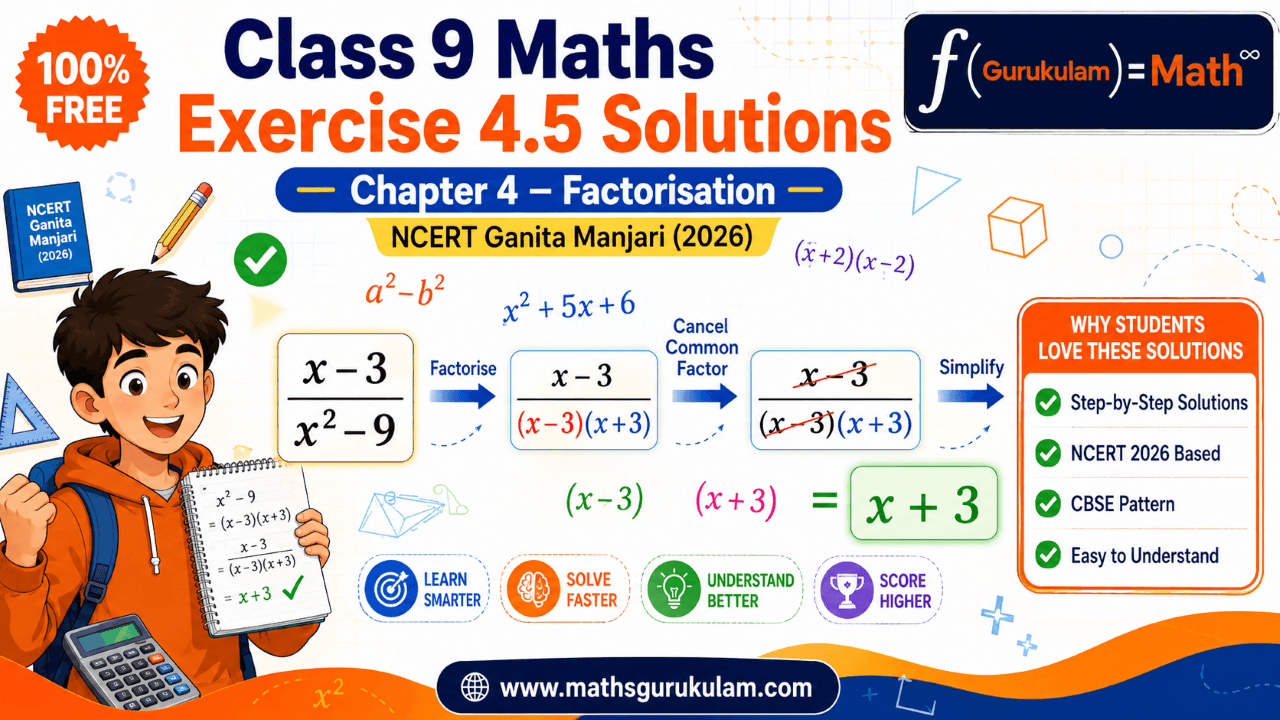
Class 9 Maths Chapter 4 Exercise 4.5 Solutions
Simplifying Rational Expressions
Learn Class 9 Maths Chapter 4 Exercise 4.5 Solutions with easy,
step-by-step NCERT solutions based on the latest
Ganita Manjari (2026). In this exercise, you will learn
how to simplify rational expressions by first
factorising the numerator and denominator, identifying
common factors, and cancelling them correctly to obtain the
simplest form. Every solution follows the
CBSE answer-writing style and is explained in simple language
to help Class 9 students understand the complete simplification
process with confidence and prepare effectively for school examinations.
🧠
Concept
Simplifying
Rational Expressions
⭐
Difficulty
Easy to Moderate
📌 Quick Identity Revision
Before simplifying rational expressions, you may need these algebraic identities to factorise the numerator and denominator.
(a + b)2 = a2 + 2ab + b2
(a − b)2 = a2 − 2ab + b2
a2 − b2 = (a + b)(a − b)
(a + b + c)2 = a2 + b2 + c2 + 2ab + 2bc + 2ca
🎯 What You’ll Master in Exercise 4.5
✅ Understanding Rational Expressions
✅ Factorising Numerator & Denominator
✅ Finding Common Factors
✅ Cancelling Common Factors Correctly
✅ Simplifying Rational Expressions
✅ Avoiding Common Simplification Mistakes
📖 About Class 9 Maths Chapter 4 Exercise 4.5
Class 9 Maths Chapter 4 Exercise 4.5 Solutions focus on one of the most important applications of algebraic factorisation—simplifying rational expressions. In this exercise, you will use the concepts learned throughout Chapter 4 to solve algebraic fractions in a simple and systematic way. It helps you understand how previously learned factorisation techniques are applied in practical mathematical problems.
All the solutions on this page are prepared according to the latest
NCERT Ganita Manjari (2026) textbook and the
CBSE Class 9 syllabus. Every question is explained step by step using an easy, student-friendly approach that makes the solutions suitable for classroom learning, homework, revision, and exam preparation.
🎯 Exercise Snapshot
📘 What You’ll Study
- Simplifying rational expressions.
- Applying factorisation techniques.
- Using algebraic concepts in practical problems.
📚 Page Includes
- Complete NCERT solutions.
- Easy step-by-step explanations.
- Quick identity revision sheet.
🏆 Best For
- Homework practice.
- Concept revision.
- CBSE exam preparation.
🎯 Jump to Any Question
Quickly navigate to any part of
Class 9 Maths Chapter 4 Exercise 4.5 Solutions
using the links below.
📝 Question 1
Simplify the following rational expressions.
📚 Learn Before You Solve
Understand the basic concepts before simplifying rational expressions.
📖 What is a Rational Expression?
A Rational Expression is an algebraic fraction in which both the
numerator and the denominator are algebraic expressions.
Instead of numbers, they contain variables and algebraic terms.
🔺
Numerator
Expression written above the fraction bar.
🔻
Denominator
Expression written below the fraction bar.
🔤
Variables
Both expressions contain variables like x, y, a, b etc.
✏️ Example of a Rational Expression
Here,
x² − 9
is the Numerator and
x² − 5x + 6
is the Denominator.
💡 Remember
✔ A rational expression is an algebraic fraction.
✔ It has a numerator and a denominator.
✔ Both are algebraic expressions.
✔ Exercise 4.5 teaches how to simplify these expressions.
✨ What Does “Simplify” Mean?
The goal of Exercise 4.5 is to write a rational expression in its simplest form.
🎯 Meaning of Simplification
To simplify means to write an expression in its
lowest or simplest equivalent form without changing its value.
Just like ordinary fractions, we remove the common factors to make the expression easier to understand and solve.
🔢 First Understand with Numbers
Both fractions have the same value, but
2/3 is the simpler form.
🔗 The Same Idea in Algebra
🧩
Factorise
Convert expressions into factors.
✂️
Cancel
Remove only the common factors.
✅
Simplify
Write the remaining expression neatly.
💡 Maths Gurukulam Tip
✔ Simplify means “make it simpler”, not “change its value”.
✔ The value of the expression always remains the same.
✔ In algebra, simplify by cancelling common factors only.
📒 Formula Revision Sheet
Revise these important algebraic identities before simplifying rational expressions.
⭐ Important Algebraic Identities
① Square of a Sum
(x + y)² = x² + 2xy + y²
② Square of a Difference
(x − y)² = x² − 2xy + y²
③ Square of Three Terms
(x + y + z)² = x² + y² + z² + 2xy + 2yz + 2zx
④ Difference of Squares
(x + y)(x − y) = x² − y²
⑤ Product of Two Binomials
(x + a)(x + b) = x² + (a + b)x + ab
⑥ Product of Two Linear Expressions
(ax + b)(cx + d) = acx² + (ad + bc)x + bd
⑦ Difference of Cubes
x³ − y³ = (x − y)(x² + xy + y²)
⑧ Sum of Cubes
x³ + y³ = (x + y)(x² − xy + y²)
⑨ Cube of a Sum
(x + y)³ = x³ + 3x²y + 3xy² + y³
⑩ Cube of a Difference
(x − y)³ = x³ − 3x²y + 3xy² − y³
⑪ Three Variable Identity
x³ + y³ + z³ − 3xyz
= (x + y + z)(x² + y² + z² − xy − yz − zx)
👀 Before Solving, Think…
❓
Can I cancel x² with x² ?
🤔
Can anything be cancelled now?
💡
Which identity will help?
⏸️
Don’t solve immediately!
Take a few seconds and answer these questions in your mind.
Then move to the next section to check your thinking.
👀 Before Solving, Think…
❓
Can I cancel x² with x² ?
🤔
Can anything be cancelled now?
💡
Which identity will help?
⏸️
Don’t solve immediately!
Take a few seconds and answer these questions in your mind.
Then move to the next section to check your thinking.
🧑🏫 Teacher Asks…
Can we cancel x² with
x² ?
🤔 Why Not?
➕
x² is joined by
− (minus)
➖
These are
terms, not factors.
💡 Golden Rule
We can cancel only common factors.
We cannot cancel terms connected by
+ or − signs.
❌ Cannot Cancel
x² is part of a subtraction.
✔ First Factorise
(x + 3)(x − 3)
(x − 2)(x − 3)
Now (x − 3) is a common factor.
👉 Next Step
Now let’s factorise the numerator and denominator properly,
then cancel the common factor.
✍️ Learn the Method
Follow these simple steps to simplify the rational expression.
x² − 9
= x² − 3²
= (x + 3)(x − 3)
Factorise the denominator:
x² − 5x + 6
= (x − 2)(x − 3)
(x + 3)(x − 3)
(x − 2)(x − 3)
Cancel the common factor:
(x + 3)
(x − 3)
(x − 2)
(x − 3)
=
🎉
Great! You Have Learned the Method
Now you know how to simplify a rational expression.
✔ First factorise the numerator.
✔ Then factorise the denominator.
✔ Cancel only the common factors.
✔ Never cancel terms joined by + or −.
👉 Now let’s solve the NCERT questions one by one.
📝 Class 9 Maths Chapter 4 Exercise 4.5 Solutions
Solve every question of Class 9 Maths Chapter 4 Exercise 4.5 with simple, step-by-step NCERT Ganita Manjari (2026) solutions. Each solution follows the latest CBSE answer-writing format and helps students learn how to simplify rational expressions using factorisation with complete clarity and confidence.
📖 NCERT Solutions
📝 Step-by-Step
🎯 CBSE Ready
Question 1
Simplify the following rational expressions assuming that the expressions in the denominators are not equal to zero.
(i)
3p² − 3pq − 18q²
p² + 3pq − 10q²
(ii)
n³ − 3n²m + 3nm² − m³
5m² − 10mn + 5n²
(iii)
w³ − v³ + x³ + 3wvx
w² + v² + x² − 2wv − 2vx + 2wx
(iv)
4y² − 20yz + 25z²
25z² − 4y²
(v)
(x² + x − 6)(x² − 7x + 12)
(x² − 6x + 8)(x² − 9)
✅ Solution (i)
Sub Question
(i)
3p² − 3pq − 18q²
p² + 3pq − 10q²
Solution
📘 Using Middle Term Splitting
=
3(p² − pq − 6q²)
p² + 3pq − 10q²
=
3(p² − 3pq + 2pq − 6q²)
p² + 5pq − 2pq − 10q²
=
3[p(p − 3q) + 2q(p − 3q)]
p(p + 5q) − 2q(p + 5q)
=
3(p − 3q)(p + 2q)
(p + 5q)(p − 2q)
Observe the Factors
Numerator :
3(p − 3q)(p + 2q)
Denominator :
(p + 5q)(p − 2q)
No Common Factor is Present
Hence, the rational expression cannot be simplified further.
Final Answer
(i)
3(p − 3q)(p + 2q)
(p + 5q)(p − 2q)
✅ Solution (ii)
Sub Question
(ii)
n³ − 3n²m + 3nm² − m³
5m² − 10mn + 5n²
Given
n³ − 3n²m + 3nm² − m³
5m² − 10mn + 5n²
Solution
📘 Using Algebraic Identity
=
n³ − 3n²m + 3nm² − m³
5(m² − 2mn + n²)
=
(n − m)(n − m)(n − m)
5(n − m)(n − m)
=
(n − m)²(n − m)
5(n − m)²
Cancel the Common Factor (n − m)²
✅ Solution (iii)
Sub Question
(iii)
w³ − v³ + x³ + 3wvx
w² + v² + x² − 2wv − 2vx + 2wx
Given
w³ − v³ + x³ + 3wvx
w² + v² + x² − 2wv − 2vx + 2wx
Solution
📘 Using Algebraic Identities
=
w³ + (−v)³ + x³ − 3·w·(−v)·x
w² + (−v)² + x² + 2·w(−v) + 2(−v)x + 2·wx
Using Algebraic Identities
a³ + b³ + c³ − 3abc = (a + b + c)(a² + b² + c² − ab − bc − ca)
(a + b + c)² = a² + b² + c² + 2ab + 2bc + 2ca
=
(w − v + x)(w² + v² + x² + wv + vx − wx)
(w − v + x)²
=
(w − v + x)(w² + v² + x² + wv + vx − wx)
(w − v + x)(w − v + x)
=
(w − v + x)(w² + v² + x² + wv + vx − wx)
(w − v + x)(w − v + x)
Cancel the Common Factor (w − v + x)
Final Answer
(iii)
w² + v² + x² + wv + vx − wx
w − v + x
✅ Solution (iv)
Sub Question
(iv)
4y² − 20yz + 25z²
25z² − 4y²
Given
4y² − 20yz + 25z²
25z² − 4y²
Solution
=
(2y)² − 2(2y)(5z) + (5z)²
(5z)² − (2y)²
Using Algebraic Identities
Numerator :
a² − 2ab + b² = (a − b)²
Denominator :
a² − b² = (a − b)(a + b)
=
(2y − 5z)²
(5z − 2y)(5z + 2y)
=
(2y − 5z)(2y − 5z)
−(2y − 5z)(2y + 5z)
=
(2y − 5z)(2y − 5z)
−(2y − 5z)(2y + 5z)
Cancel the Common Factor (2y − 5z)
“`
Solution (v)
Question
(x² + x − 6)(x² − 7x + 12)
(x² − 6x + 8)(x² − 9)
Given
(x² + x − 6)(x² − 7x + 12)
(x² − 6x + 8)(x² − 9)
Solution
Factorise the first bracket:
x² + x − 6
= x² + 3x − 2x − 6
= x(x + 3) − 2(x + 3)
= (x + 3)(x − 2)
Factorise the second bracket:
x² − 7x + 12
= x² − 3x − 4x + 12
= x(x − 3) − 4(x − 3)
= (x − 3)(x − 4)
Factorise the third bracket:
x² − 6x + 8
= x² − 2x − 4x + 8
= x(x − 2) − 4(x − 2)
= (x − 2)(x − 4)
Factorise the fourth bracket:
x² − 9
= x² − 3²
= (x − 3)(x + 3)
Substitute all the factors in the given expression:
(x + 3)(x − 2)(x − 3)(x − 4)
(x − 2)(x − 4)(x − 3)(x + 3)
Cancel the common factors:
(x + 3)
(x − 2)
(x − 3)
(x − 4)
(x − 2)
(x − 4)
(x − 3)
(x + 3)
= 1
Solution (vi)
Solution
p⁴ − 16
= (p²)² − 4²
= (p² − 4)(p² + 4)
= (p − 2)(p + 2)(p² + 4)
Factorise the denominator:
p² − 4p + 4
= (p − 2)²
Substitute the factors in the given expression:
(p − 2)(p + 2)(p² + 4)
(p − 2)(p − 2)
Cancel the common factor:
(p − 2)
(p + 2)(p² + 4)
(p − 2)
(p − 2)
=
📚 Continue Learning
Congratulations! You have completed Class 9 Maths Chapter 4 Exercise 4.5 Solutions . Now revise the previous exercise or continue with the Chapter End Exercise to strengthen your understanding of algebraic identities and rational expressions.
📖 Explore More Class 9 Maths Chapters
🚀 Quick Revision Dashboard
Revise the important concepts of Class 9 Maths Chapter 4 Exercise 4.5 Solutions before solving NCERT questions. Remember the algebraic identities, follow the correct simplification steps, and avoid common mistakes to score full marks in the CBSE examination.
📌 Simplification Strategy
| Step 1 |
Factorise the numerator completely. |
| Step 2 |
Factorise the denominator completely. |
| Step 3 |
Use algebraic identities wherever required. |
| Step 4 |
Write every factor separately. |
| Step 5 |
Cancel only common factors. |
| Step 6 |
Write the simplified answer. |
❌ Common Mistakes
- Cancelling terms instead of factors.
- Not factorising completely.
- Using the wrong algebraic identity.
- Making sign mistakes while factorising.
- Cancelling before factorisation.
- Ignoring the condition that the denominator must not be zero.
📖 Chapter Formula Sheet
(x + y)² = x² + 2xy + y²
(x − y)² = x² − 2xy + y²
(x + y)(x − y) = x² − y²
(x + a)(x + b) = x² + (a + b)x + ab
(ax + b)(cx + d) = acx² + (ad + bc)x + bd
x³ − y³ = (x − y)(x² + xy + y²)
x³ + y³ = (x + y)(x² − xy + y²)
(x + y)³ = x³ + 3x²y + 3xy² + y³
(x − y)³ = x³ − 3x²y + 3xy² − y³
x³ + y³ + z³ − 3xyz = (x + y + z)(x² + y² + z² − xy − yz − zx)
🎯 CBSE Exam Tips
- Identify the correct algebraic identity before factorising.
- Always factorise both numerator and denominator completely.
- Cancel only common factors, never individual terms.
- Write every factorisation step clearly.
- Keep the denominator in factorised form until the final step.
- Check that no common factor remains after simplification.
❓ Frequently Asked Questions
Find answers to the most common questions related to Class 9 Maths Chapter 4 Exercise 4.5 Solutions. These FAQs will help you understand how to simplify rational expressions, apply algebraic identities, and avoid common mistakes in the CBSE examination.
What is the main concept of Class 9 Maths Chapter 4 Exercise 4.5?
Exercise 4.5 focuses on simplifying rational expressions. Students first factorise the numerator and denominator completely, then cancel only the common factors to obtain the simplest form.
Why should I factorise the numerator and denominator before simplifying?
Factorisation helps identify the common factors present in both the numerator and denominator. These common factors can then be cancelled correctly to simplify the rational expression.
Can I cancel individual terms in a rational expression?
No. You should never cancel individual terms. Only complete common factors can be cancelled after the numerator and denominator have been factorised completely.
Which algebraic identities are commonly used in Exercise 4.5?
The most commonly used identities include (a + b)(a − b) = a² − b², perfect square identities, the product of two binomials, and the identities for the sum and difference of cubes. Choosing the correct identity makes factorisation easier.
Are these Exercise 4.5 solutions based on the latest NCERT Ganita Manjari (2026)?
Yes. These solutions are prepared according to the latest NCERT Ganita Manjari (2026) textbook and follow the current CBSE Class 9 Mathematics syllabus with step-by-step notebook-style answer writing.
📚 Useful Learning Resources
Continue your learning with more Class 9 Maths resources or visit the official NCERT and CBSE websites for the latest syllabus, textbooks, and academic updates.
Need Personal Guidance in Maths?
Join Newton Study Point for concept-based Maths coaching by an experienced teacher. Small batches, individual attention, regular tests, and complete CBSE exam preparation for Classes 8, 9, 10, 11 & 12.
📞 Call Now: 8447002272
💬 WhatsApp
📍 Newton Study Point • Ankur Vihar, Ghaziabad
👨🏫 Reviewed & Prepared By
Rakesh Kumar Singh
Founder, Maths Gurukulam & Newton Study Point
Teaching CBSE Mathematics Since 2006
These Class 9 Maths Chapter 4 Exercise 4.5 Solutions are carefully prepared according to the latest NCERT Ganita Manjari (2026) and the CBSE curriculum. Every solution follows a clear, step-by-step approach designed to strengthen conceptual understanding, improve problem-solving skills, and help students perform confidently in school and board examinations.
📘 NCERT Ganita Manjari 2026
🎯 CBSE Aligned
📝 Step-by-Step Solutions
💡 Concept-Based Learning
Know More About the Author →