📑 Table of Contents
📖 About Class 9 Maths Chapter 5 Exercise 5.1
Class 9 Maths Chapter 5 Exercise 5.1 Solutions cover the first exercise of Chapter 5 – I’m Up and Down, and Round and Round from the latest NCERT Ganita Manjari (2026). This exercise begins the chapter’s study of circles through geometric constructions and observations involving triangles, circumcircles, and the circumcentre. The questions help students develop a clear understanding of these ideas through practical geometric work.
This page provides clear, question-wise explanations based on the NCERT Ganita Manjari (2026) textbook and follows a student-friendly CBSE approach. The solutions are arranged systematically to support classroom learning, homework, self-study, revision, and examination preparation while keeping the focus on the actual requirements of Exercise Set 5.1.
🎯 Exercise Snapshot
- Complete Exercise Set 5.1 coverage.
- NCERT-based question-wise solutions.
- Clear explanations of the constructions and observations required.
- Question-wise step-by-step solutions.
- Triangle and circumcircle construction guidance.
- Simple CBSE answer-writing approach.
- Understanding the beginning of Chapter 5.
- Homework and classroom practice.
- Revision and CBSE examination preparation.
🎯 Jump to Any Question
Quickly jump to any question of Class 9 Maths chapter 5 Exercise 5.1 Solutions. Each card highlights the main concept or task covered in the question, so you can quickly reach the solution you need.
📚 Learn Before You Solve
What is a Circle?
A circle is the set of all points in a plane that are at the same distance from a fixed point.
The common distance is called the radius.
All radii of the same circle are equal.
Centre of a Circle
The fixed point from which every point on the circle is at the same distance is called the centre.
Radius
The line segment joining the centre to any point on the circle is called a radius.
Length of radius = r
Chord
A line segment joining any two points on the circle is called a chord.
Diameter
A chord that passes through the centre of the circle is called the diameter.
Chord vs Diameter
A line segment joining any two points on the circle.
A chord whose two endpoints lie on the circle and which passes through the centre.
but every chord is not a diameter.
Relation Between Diameter and Radius
The diameter of a circle is twice its radius.
⭐ The One Idea to Remember
All the basic terms of a circle are connected to one central idea:
⚠️ Common Mistakes
- Calling every chord a diameter.
- Forgetting that a diameter must pass through the centre.
- Thinking a circle has only one radius.
- Confusing the radius with the diameter.
- Writing d = r instead of d = 2r.
Quick Check
Before moving ahead, make sure you can answer these questions:
Perpendicular Bisector
A perpendicular bisector is a line that cuts a line segment into two equal parts and is also perpendicular to it.
Why Are the Distances Equal?
This is the most important property to remember.
For example, if P lies on the perpendicular bisector:
↓
PA = PB
Theorem: Equal Distances
Every point on the perpendicular bisector of a line segment is equidistant from its two endpoints.
PE is the perpendicular bisector of AB.
Proof
How Does It Help Find the Centre?
Now comes the important connection with circles.
Constructing a Perpendicular Bisector
Use a ruler and compass. Follow the four steps carefully.
Draw the given line segment AB.
With A as centre, draw arcs above and below AB. Keep the compass opening fixed.
Without changing the compass opening, draw arcs from B. They meet at P and Q.
Join P and Q. This line is the perpendicular bisector of AB.
Why Does the Construction Work?
Look at the two points where the equal-radius arcs meet: P and Q.
Therefore both points lie on the perpendicular bisector.
⭐ Remember This
Whenever two points of a circle are known, think about their perpendicular bisector.
Can More Than One Circle Pass Through A and B?
Yes. In fact, infinitely many circles can pass through the same two fixed points A and B.
The important question is: Where should their centres be?
Where Can the Centre Be?
Let O be the centre of a circle passing through A and B.
Why Are There Infinitely Many Circles?
The points A and B remain fixed. But the centre can move to any point on the perpendicular bisector.
Every new position of the centre gives a new circle through A and B.
Therefore, infinitely many circles can pass through A and B.
What Happens When the Centre Moves?
A circle’s radius is the distance from its centre to any point on the circle.
⭐ Minimum Possible Radius
This idea is especially important for questions such as Q4 of Exercise 5.1.
Suppose the distance between A and B is fixed. The centre must lie on the perpendicular bisector.
The shortest distance from the perpendicular bisector to either fixed point is obtained when the centre is exactly at the midpoint E of AB.
🎯 Quick Thinking for Q4
Find the midpoint of AB.
Take the midpoint as centre.
Radius = half of AB.
⭐ Remember the Whole Idea
Three Non-Collinear Points
Suppose three points A, B and C are given, and they are not on the same straight line.
Why Exactly One Circle?
From the previous concept, we know that the centre of a circle passing through two points lies on the perpendicular bisector of the segment joining those points.
Circumcentre and Circumcircle
Therefore one circle centred at O passes through A, B and C.
⭐ Theorem
The perpendicular bisectors of the sides of a triangle are concurrent.
Step-by-Step Proof
ABC is a non-collinear triangle. The perpendicular bisectors of AB and AC meet at O.
Construction: Circumcentre and Circumcircle
Given a triangle ABC, we can construct its circumcircle using the perpendicular bisectors of two sides.
Draw the given non-collinear triangle ABC.
Construct the perpendicular bisector of AB using equal-radius arcs.
Construct the perpendicular bisector of AC. Let the two bisectors meet at O.
Take O as centre and OA as radius. Draw the circle.
Why Are Two Perpendicular Bisectors Enough?
We do not need to construct all three perpendicular bisectors.
⭐ Remember This for Exercise 5.1
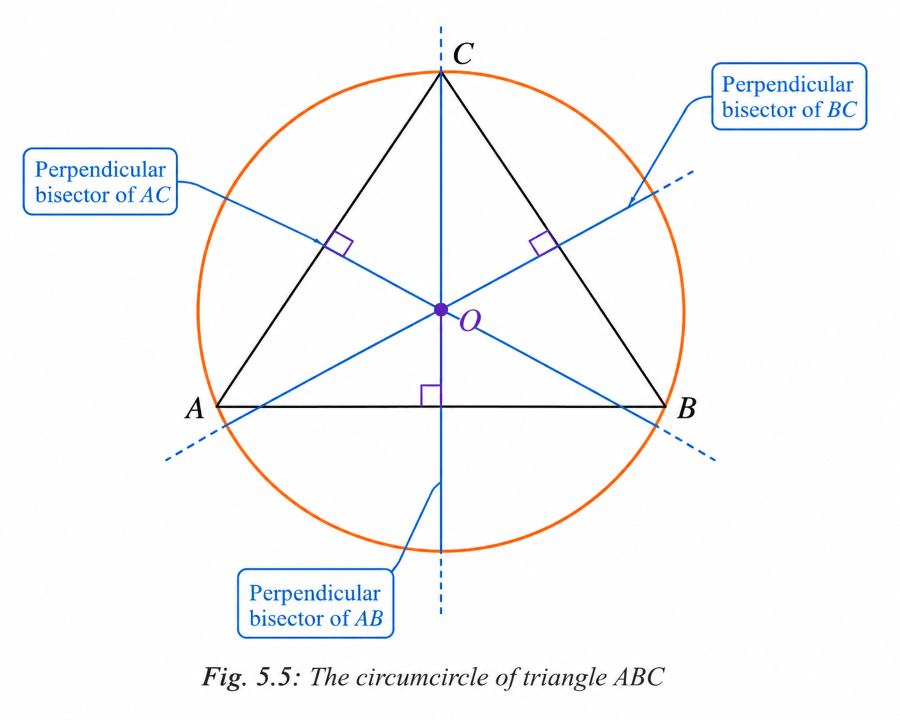
Let its centre be O.
Since OA = OB, the point O lies on the perpendicular bisector of AB.
Similarly, since OA = OC, the point O lies on the perpendicular bisector of AC.
The points A, B and C are non-collinear. Therefore the perpendicular bisectors of AB and AC are two distinct intersecting lines.
Two intersecting lines meet at exactly one point. Hence their intersection point O is unique.
Therefore the centre O of the circle is uniquely determined.
Now draw a circle with centre O and radius OA. Since
Thus, a circle passing through the three non-collinear points exists and its centre is unique.
Perpendicular bisectors of the sides → meet at the centre
📝 Class 9 Maths Chapter 5 Exercise 5.1 Solutions
Solve every question of Class 9 Maths Chapter 5 Exercise 5.1 with clear, step-by-step NCERT Ganita Manjari (2026) solutions. This exercise introduces important geometric ideas involving triangles, circumcircles, perpendicular bisectors, circumcentres, and related constructions. Each solution is presented in a simple, student-friendly CBSE answer-writing style with the required construction steps and reasoning, making it useful for classroom work, homework, revision, and examination preparation.
2. The circumcircle of △ABC
3. The position of its circumcentre
📐 Construction Figure
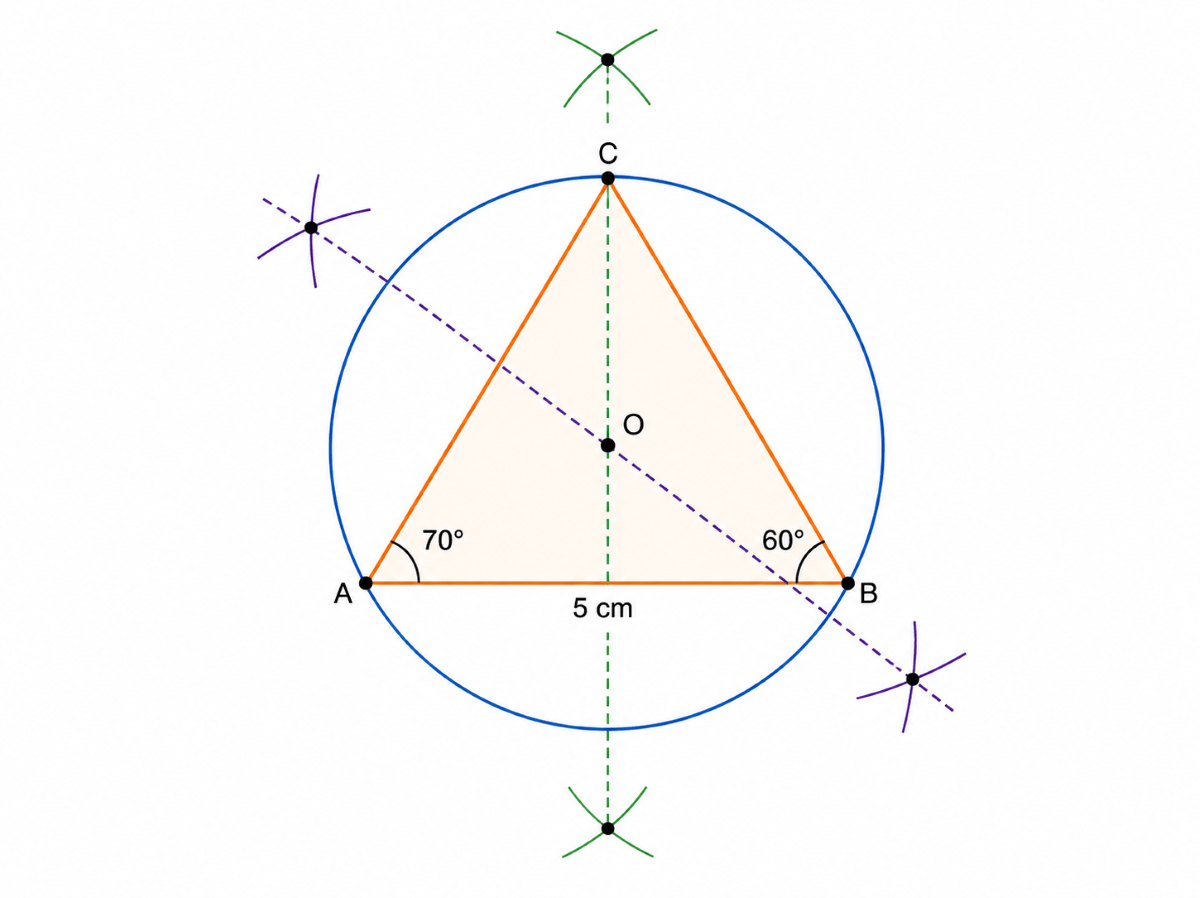
Figure: Construction of △ABC, its circumcircle and perpendicular bisectors meeting at O.
✏️ Construction
🔍 Observation
∠C = 180° − 70° − 60° = 50°.
All three angles of △ABC are less than 90°. Therefore, △ABC
is an acute-angled triangle, and its circumcentre lies
inside the triangle.
The circumcircle of △ABC is constructed successfully. Its centre O lies inside the triangle.
2. The circumcircle of △ABC
3. The position of its circumcentre
📐 Construction Figure
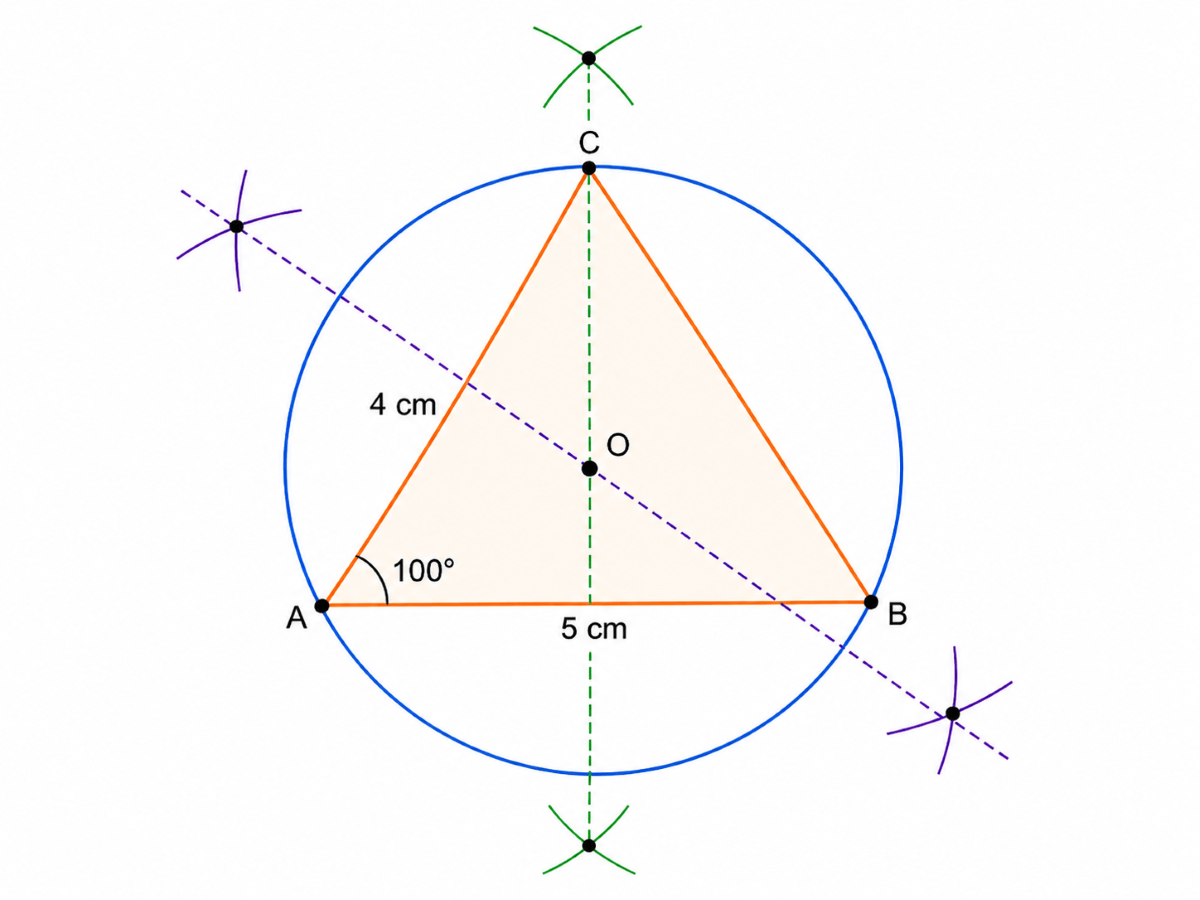
Figure: Triangle ABC with its circumcircle, perpendicular bisectors and circumcentre O.
✏️ Construction
🔍 Observation
Given,
∠A = 100°, which is greater than 90°.
Therefore, △ABC is an obtuse-angled triangle.
The circumcentre of an obtuse-angled triangle lies
outside the triangle.
The circumcircle of △ABC is constructed successfully. Its centre O lies outside the triangle.
2. The circumcircle of △ABC
3. Measure OA, OB and OC
📐 Construction Figure
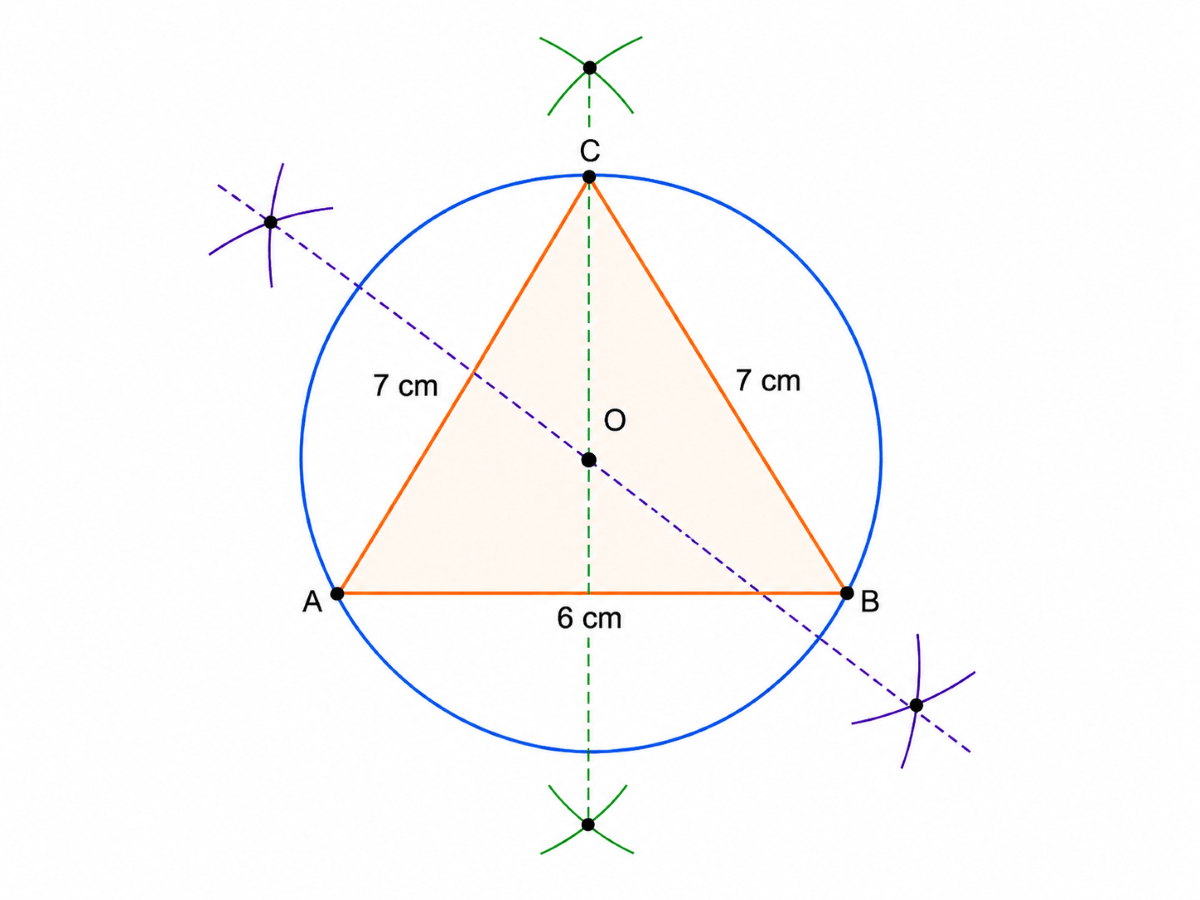
Figure: Triangle ABC with its circumcircle and circumcentre O.
✏️ Construction
📏 Measurement
On measuring the three radii of the circumcircle,
OA ≈ 3.9 cm
OB ≈ 3.9 cm
OC ≈ 3.9 cm
🔍 Observation
The measured values of OA, OB and OC are equal. Hence, O is equidistant from A, B and C and is therefore the circumcentre of △ABC.
OA ≈ OB ≈ OC ≈ 3.9 cm.
📐 Geometrical Figure
Figure: Different circles through A and B have their centres M, O₁ and O₂ on the perpendicular bisector of AB.
🔍 Explanation
📌 Conclusion
The smallest possible radius is obtained when the centre is the midpoint of AB. In this case, AB is the diameter.
Least possible radius = AB/2
📚 Continue Learning
Congratulations! You have completed the Class 9 Maths chapter 5 Exercise 5.1 Solutions. You have now worked through the first exercise of Chapter 5 – I’m Up and Down, and Round and Round. Continue your learning journey by moving to the next exercise, exploring the complete chapter, or revisiting Exercise 5.1 whenever you need a quick revision.
📖 Explore More Class 9 Maths Chapters
⚡ Quick Revision Dashboard
Revise the complete Class 9 Maths Chapter 5 — Circles in a few minutes before solving Exercise 5.1. Think of this as your whole lesson in short. 🎯
✔ Radius: distance from the centre to any point on the circle.
✔ Chord: joins any two points on the circle.
✔ Diameter: chord passing through the centre.
💡 Remember: Diameter = 2 × Radius
✔ Every point on it is equidistant from the endpoints.
✔ For segment AB, a point O on its perpendicular bisector gives: OA = OB.
🎯 Key use: It helps us locate the centre of a circle.
✔ Their intersection is the circumcentre O.
✔ Then: OA = OB = OC.
💡 Don’t guess the centre — construct it.
✔ Take OA (or OB or OC) as the radius.
✔ Draw the circle through A, B and C.
🎯 This circle is called the circumcircle.
✔ Right triangle → Circumcentre is the midpoint of hypotenuse.
✔ Obtuse triangle → Circumcentre is outside.
✔ SAS: Two sides + included angle → construct the angle, then mark the second side.
✔ ASA: Two angles + included side → construct both endpoint angles; their rays meet at the third vertex.
💡 Always follow the measurements carefully.
❓ Frequently Asked Questions
Find answers to common questions about Class 9 Maths Exercise 5.1 Solutions. These FAQs are designed to help you understand the ideas behind the exercise, avoid common construction mistakes, and prepare confidently for Chapter 5 – I’m Up and Down, and Round and Round.
What is the main focus of Exercise Set 5.1?
Exercise Set 5.1 introduces the construction-based ideas of Chapter 5 – I’m Up and Down, and Round and Round. The four questions involve constructing triangles, drawing their circumcircles, identifying the position of the circumcentre, measuring the radii of a circumcircle, and understanding the least possible radius of a circle through two given points.
What should I know before attempting Exercise 5.1?
You should be familiar with basic triangle construction, perpendicular bisectors, circles, radius, and the idea of a circumcircle and circumcentre. It is also important to understand that the perpendicular bisectors of the sides of a triangle meet at its circumcentre. These ideas are developed in the beginning of Chapter 5 before Exercise Set 5.1.
How do I construct the circumcircle of a triangle?
First construct the given triangle. Then construct the perpendicular bisectors of any two of its sides. Their point of intersection is the circumcentre. Taking this point as the centre and the distance to any vertex as the radius, draw the circle. The circle passes through all three vertices of the triangle and is called its circumcircle.
Where does the circumcentre lie in different types of triangles?
For an acute-angled triangle, the circumcentre lies inside the triangle. For an obtuse-angled triangle, it lies outside the triangle. For a right-angled triangle, the circumcentre lies at the midpoint of the hypotenuse.
Why are OA, OB and OC equal in Question 3?
In Question 3, O is the circumcentre of triangle ABC. Therefore A, B and C all lie on the same circumcircle with centre O. Since the radii of the same circle are equal, the distances from O to A, B and C are equal. Hence, OA = OB = OC.
What is the least possible radius of a circle passing through two points?
For two given points A and B, infinitely many circles can pass through them. The least possible radius is obtained when the centre is at the midpoint of AB. In that case, the radius is the distance from the midpoint of AB to either A or B.
What are the common mistakes in Exercise Set 5.1?
Common mistakes include constructing only one perpendicular bisector, incorrectly locating the circumcentre, drawing the circumcircle with an incorrect radius, and confusing the position of the circumcentre in acute and obtuse triangles. Students should also take care to use accurate construction and measurement.
Are these Class 9 Maths Exercise 5.1 Solutions based on Ganita Manjari 2026?
Yes. The solutions on this page are prepared from Chapter 5 – I’m Up and Down, and Round and Round of the NCERT Ganita Manjari (2026) Grade 9 textbook. Exercise Set 5.1 contains four questions covering triangle construction, circumcircles, circumcentre, measurement of radii, and the least possible radius through two given points.
📚 Useful Learning Resources
Continue your preparation with more Class 9 Maths resources from Maths Gurukulam, or visit the official NCERT and CBSE websites for the latest textbooks, syllabus, and academic updates.
Need Personal Guidance in Maths?
Find Class 9 Maths Chapter 5 Exercise 5.1 Solutions helpful? For students who need personal support beyond self-study, join Newton Study Point for concept-based Maths coaching by an experienced teacher. Small batches, individual attention, regular tests, and complete CBSE exam preparation are available for Classes 8, 9, 10, 11 & 12.
📞 Call Now: 8447002272 💬 WhatsApp 🏫 Explore Newton Study Point📍 Newton Study Point • Ankur Vihar, Ghaziabad

Rakesh Kumar Singh
Founder, Maths Gurukulam & Newton Study Point
Teaching CBSE Mathematics Since 2006
These Class 9 Maths Chapter 5 Exercise 5.1 Solutions are carefully prepared according to the latest NCERT Ganita Manjari (2026) and the CBSE curriculum. The solutions follow a clear, step-by-step approach to help students understand the construction and reasoning used in Exercise 5.1 and build confidence in circle geometry.