Class 9 Maths Chapter 4 End of Chapter Exercise Solutions

Class 9 Maths Chapter 4 End of Chapter Exercise Solutions | Ganita Manjari 2026 – Exploring Algebraic Identities

📘 NCERT Ganita Manjari (2026) 📚 CBSE 2026–27 🏆 Step-by-Step Solutions

Class 9 Maths Chapter 4 End of Chapter Exercise Solutions

Complete Chapter Revision with Step-by-Step NCERT Solutions

Prepare for your Class 9 Maths examination with complete Class 9 Maths Chapter 4 End of Chapter Exercise Solutions based on the latest NCERT Ganita Manjari (2026). This chapter-end exercise brings together important concepts from Chapter 4 – Exploring Algebraic Identities, including algebraic identities, expansions, factorisation, cube identities, rational expressions and application-based problems. Each question is explained in a clear, step-by-step CBSE answer-writing style to help students choose the correct method, understand the algebraic process and revise the chapter confidently.

📖
Exercise
End of Chapter Exercise
❓
Questions
13 Questions
📚
Coverage
Entire
Chapter
🧠
Skills
Mixed Problem Solving
⏱️
Study Time
90–120 Min
⭐
Difficulty
Moderate to Challenging
🎯
Exam Importance
★★★★★
🎯 By the End of This Exercise, You Will Be Able To…
✅ Choose the Correct Algebraic Identity
✅ Expand Algebraic Expressions Accurately
✅ Factorise Expressions Completely
✅ Simplify Rational Expressions Correctly
✅ Solve Application-Based Problems
✅ Write CBSE Exam-Ready Solutions

📑 Table of Contents

📖 About Class 9 Maths Chapter 4 End of Chapter Exercise

Class 9 Maths Chapter 4 End of Chapter Exercise Solutions provide complete, step-by-step answers to the questions given at the end of Chapter 4 – Exploring Algebraic Identities. This chapter-end exercise brings together important concepts studied throughout the chapter and gives students an opportunity to apply algebraic identities, expansions, factorisation and related algebraic methods in different types of questions.

These NCERT Class 9 Maths solutions are prepared according to the latest NCERT Ganita Manjari (2026) textbook and are aligned with the CBSE Class 9 Mathematics curriculum. Each answer is presented in a clear, student-friendly, step-by-step format to support classroom practice, homework, self-study, chapter revision and examination preparation.

🎯 Exercise Snapshot

📘 What You’ll Find
  • Complete Chapter 4 end-of-chapter revision.
  • NCERT questions with question-wise solutions.
  • Clear, step-by-step CBSE answer-writing approach.
📚 Page Includes
  • Complete End of Chapter Exercise solutions.
  • Important Chapter 4 concepts for revision.
  • Simple and exam-ready explanations.
🏆 Best For
  • Students following Ganita Manjari (2026).
  • Homework, classroom practice and self-study.
  • CBSE Class 9 exam preparation and revision.

🔎 Jump to Any Question

Quickly jump to any question from the 13 End-of-Chapter Exercises of Class 9 Maths Chapter 4.

Regular Question ★ Higher-Order Question

📚 Learn Before You Solve

🎯 Are You Ready for the End-of-Chapter Exercise?

Before solving the Class 9 Maths Chapter 4 End-of-Chapter Exercise, quickly revise the important methods and concepts from Chapter 4 – Exploring Algebraic Identities. This revision guide connects you directly to the important Class 9 Maths Chapter 4 learning sections so that you can review a method before attempting the End of Chapter Exercise.

Most questions in the Class 9 Maths Chapter 4 End of Chapter Exercise are based on the concepts you have already learned throughout this chapter. However, a few questions introduce new concepts for the first time. Don’t worry! Before solving the exercise, let’s understand these concepts in a simple classroom style with easy explanations and worked examples.

🔢 How to Solve a Quadratic Equation?

A quadratic equation is an equation in which the highest power of the variable is 2. In this chapter, we will solve quadratic equations using the factorisation method.

Example
x² − 5x + 6 = 0
👨‍🏫 Teacher Explains

Don’t try to factorise the expression immediately. First, carefully observe the middle term. We need to split the middle term into two parts so that we can take common factors from each group.

Step 1 — Split the Middle Term

Find two numbers whose product is +6 and whose sum is −5. These numbers are −2 and −3.

x² − 5x + 6 = 0
x² − 2x − 3x + 6 = 0
👉 What Next?

Now that we have split the middle term, we can group the terms and take common factors. This is the key idea behind the factorisation method.

Step 2 — Group the Terms

Now group the first two terms and the last two terms. This helps us take a common factor from each group separately.

(x² − 2x) − (3x − 6) = 0
Step 3 — Take the Common Factor

From the first group, the common factor is x. From the second group, the common factor is −3. Taking these common factors gives both groups the same bracket.

x(x − 2) − 3(x − 2) = 0
💡 Observe Carefully

Look at both terms carefully.

x(x − 2)
−3(x − 2)

Both terms contain the common factor (x − 2). Since the same bracket appears in both terms, we can take it common.

Step 4 — Take the Common Bracket

Take (x − 2) common from both terms.

(x − 2)(x − 3) = 0

Excellent! We have successfully factorised the quadratic equation.

Step 5 — Find the Value of x

The product of two factors is zero.

(x − 2)(x − 3)=0

This is possible only when at least one factor is equal to zero.

x − 2 = 0
or
x − 3 = 0

x = 2
or
x = 3
✍️ Student Notebook Solution
x² − 5x + 6 = 0
x² − 2x − 3x + 6 = 0
x(x − 2) − 3(x − 2) = 0
(x − 2)(x − 3) = 0
x − 2 = 0   or   x − 3 = 0
x = 2   or   x = 3
✅ Remember
✔ Split the middle term correctly.
✔ Take common factors carefully.
✔ Factorise completely before solving.
✔ Write both values of the variable.

📝 How to Solve Word Problems?

Word problems may look lengthy, but they become easy if we solve them step by step. We simply convert the given information into Mathematics and then solve the equation carefully.

👨‍🏫 Teacher Explains

Let’s understand the complete method through a simple example. Read every step carefully and notice why we perform each operation.

Example

The product of two consecutive positive integers is 56. Find the integers.

Step 1 — Assume the Variable

Suppose the first integer is x. Since the integers are consecutive, the next integer will be x + 1.

First Integer = x
Second Integer = x + 1
Step 2 — Form the Equation

The product of the two integers is 56.

x(x + 1)=56
Step 3 — Convert into a Quadratic Equation

First expand the brackets and then bring every term to one side.

x² + x = 56
x² + x − 56 = 0
Step 4 — Solve by Factorisation

Now solve this quadratic equation exactly as we learned earlier.

x² + 8x − 7x − 56 = 0
x(x + 8) − 7(x + 8) = 0
(x + 8)(x − 7)=0
x + 8 =0   or   x − 7 =0
x = −8   or   x = 7
👉 Final Observation

The question asks for positive integers. Therefore, we reject −8 and take only 7.
∴ x = 7 and other integer be x + 1 = 7 + 1 = 8

Required Integers = 7 and 8
✍️ Student Notebook Solution
Let the first integer = x
Second integer = x + 1

x(x + 1)=56
x² + x − 56 =0
x² + 8x − 7x − 56 =0
x(x + 8) − 7(x + 8)=0
(x + 8)(x − 7)=0
x = −8   or   x =7
The question asks for positive integers.
we reject −8 and take only 7
∴ x = 7 and other integer be x + 1 = 7 + 1 = 8
Required integers are 7 and 8
✅ Remember
✔ Read the question carefully.
✔ Assume the unknown quantity.
✔ Form the equation correctly.
✔ Reject impossible values.
✔ Always answer in words.

🧠 Strategy to Solve Any Question

Feeling confused about where to begin? Follow this simple five-step strategy whenever you solve an algebra question. It will help you identify the correct concept, choose the appropriate method, and avoid unnecessary mistakes while solving the Class 9 Maths Chapter 4 questions.

📖
Read the Question
➡️
🔍
Identify the Concept
➡️
🧩
Choose the Correct Method
➡️
✍️
Solve Step by Step
➡️
✅
Verify the Answer
💡 Teacher’s Advice

Never rush to solve the question immediately. First identify which concept the question is testing. Once you choose the correct method, solving the question becomes much easier. This simple strategy works for almost every algebra question in Class 9 Maths Chapter 4.

🌳 Which Method Should I Use?

Not sure how to start a question? Don’t worry! Follow this simple decision tree. Answer each question one by one, and you’ll know exactly which method to use while solving Class 9 Maths Chapter 4 questions.

📖 Read the Question Carefully
⬇
🔍 What Type of Question Is It?
⬇

🧩 Is it an Expression?

⬇
Does it match an Algebraic Identity?
⬇
YES ✅

Use the suitable algebraic identity.

NO ❌

Can it be factorised?

⬇
Choose the Correct Method
  • Take Common Factor
  • Use Identity
  • Middle-term Splitting

➗ Is it a Rational Expression?

⬇
Follow these Steps
1️⃣ Factorise Numerator
2️⃣ Factorise Denominator
3️⃣ Cancel Common Factors
4️⃣ Simplify

📝 Is it a Word Problem?

⬇
Follow these Steps
1️⃣ Assume the Variable
2️⃣ Form the Equation
3️⃣ Is it Quadratic?
4️⃣ Factorise
5️⃣ Find the Roots
6️⃣ Verify the Answer
⬇
🎯 Final Answer

Choose the correct method first, then solve the question step by step. This simple strategy works for almost every question in Chapter 4 – Exploring Algebraic Identities.

📒 Complete Formula Revision Sheet
Revise every important algebraic identity from Chapter 4 before solving the End Exercise.

⭐ Basic Algebraic Identities

① Square of a Sum
(a + b)² = a² + 2ab + b²
② Square of a Difference
(a − b)² = a² − 2ab + b²
③ Difference of Squares
a² − b² = (a + b)(a − b)
④ Square of Three Terms
(a + b + c)² = a² + b² + c² + 2ab + 2bc + 2ca

⭐ Product Formulae

⑤ Product of Two Binomials
(x + a)(x + b) = x² + (a + b)x + ab
⑥ General Product Formula
(ax + b)(cx + d) = acx² + (ad + bc)x + bd

⭐ Cube Identities

⑦ Cube of a Sum
(a + b)³ = a³ + 3a²b + 3ab² + b³
⑧ Cube of a Difference
(a − b)³ = a³ − 3a²b + 3ab² − b³
⑨ Sum of Cubes
a³ + b³ = (a + b)(a² − ab + b²)
⑩ Difference of Cubes
a³ − b³ = (a − b)(a² + ab + b²)

⭐ Special Identities

⑪ Three Variable Cube Identity
x³ + y³ + z³ − 3xyz = (x + y + z)(x² + y² + z² − xy − yz − xz)
⑫ Important Result
If  x + y + z = 0,

then  x³ + y³ + z³ = 3xyz

or

x³ + y³ + z³ − 3xyz = 0

⭐ Useful Factorisation Formula

Product of Two Binomials
(x + a)(x + b) = x² + (a + b)x + ab

⭐ Middle-Term Splitting Pattern

x² + bx + c

Find two numbers whose

➕ Sum = b
✖ Product = c
Then split the middle term.

⭐ Rational Expression Reminder

1️⃣ Factorise the Numerator
⬇
2️⃣ Factorise the Denominator
⬇
3️⃣ Cancel only Common Factors
⬇
4️⃣ Write the Simplified Expression

⭐ Quadratic Equation Reminder

ax² + bx + c = 0
Split the Middle Term
⬇
Factorise Completely
⬇
Apply the Zero Product Property
⬇
Find Both Roots

⚡ Quick Revision Dashboard

Before solving the Class 9 Maths Chapter 4 End Exercise, quickly revise the key identities, factorisation methods, rational expressions, and applications you have studied throughout Exploring Algebraic Identities.

📘 1. Identity Toolkit — Know the Patterns

Square of a Sum
(a + b)2 = a2 + 2ab + b2
Use when a binomial is squared.
Square of a Difference
(a − b)2 = a2 − 2ab + b2
Remember: the middle term is negative.
Square of Three Terms
(a + b + c)2 = a2 + b2 + c2 + 2ab + 2bc + 2ca
Difference of Squares
a2 − b2 = (a + b)(a − b)
Look for two perfect squares with a subtraction sign.
Cubes
(a + b)3 = a3 + 3a2b + 3ab2 + b3
(a − b)3 = a3 − 3a2b + 3ab2 − b3
Sum & Difference of Cubes
a3 − b3 = (a − b)(a2 + ab + b2)
a3 + b3 = (a + b)(a2 − ab + b2)
Three-Variable Cube Identity
a3 + b3 + c3 − 3abc = (a + b + c)(a2 + b2 + c2 − ab − bc − ca)

🔍 2. Recognise the Pattern Before You Calculate

Binomial Squared?

Think of (a + b)2 or (a − b)2.

Two Squares with −?

Check for a2 − b2.

Cubic Expression?

Check for sum or difference of cubes.

Three Terms with Squares?

Check whether (a + b + c)2 applies.

🧩 3. Factorisation Toolkit — Work from Structure

Step 1 — Common Factor

First check whether every term has a common factor.

Step 2 — Identity

Check whether the expression matches a known algebraic identity.

Step 3 — Middle-Term Splitting

For expressions such as x2 + (a+b)x + ab, find two numbers whose sum gives the coefficient of x and whose product gives the constant term.

Step 4 — Verify

Multiply the factors when needed to check that the original expression is obtained.

➗ 4. Simplifying Rational Expressions

1️⃣ Factorise the numerator
2️⃣ Factorise the denominator
3️⃣ Identify common factors
4️⃣ Cancel common factors
5️⃣ Write the simplest form
Important: Cancel only common factors, not individual terms. The denominator must not be equal to zero.

📝 5. Apply Factorisation to Problems

Rectangle / Area

Express the area, factorise it, and interpret the factors as possible dimensions.

Cuboid / Volume

Factorise the volume expression and identify possible length, breadth and height.

Word Problem

Assume the variable, form the equation, factorise, find the possible values, and reject values that do not make physical sense.

🚫 6. Check These Before Moving On

✘ Choosing the wrong identity
✘ Losing the sign of the middle term
✘ Incorrect middle-term splitting
✘ Cancelling terms instead of factors
✘ Forgetting the denominator condition
✘ Accepting an impossible value in an application

🎯 7. Can You Recall the Chapter?

Identity:
Can I recognise the pattern before expanding?
Factorisation:
Can I choose the correct method?
Rational Expression:
Can I factorise before cancelling?
Application:
Can I interpret the factors in the problem?
Study Tip: Do not just read the formulas. Look at an expression, identify its pattern, recall the suitable identity or factorisation method, and then solve it step by step. You are ready for the End Exercise when you can choose the method before starting the calculation.

📝 Class 9 Maths Chapter 4 End Exercise Solutions

Solve every question of the Class 9 Maths Chapter 4 End Exercise with easy, step-by-step NCERT Ganita Manjari (2026) solutions. This End Exercise combines all the important concepts of the chapter, including algebraic identities, expanding expressions, factorisation, middle-term splitting, rational expressions, cube identities, quadratic equations, and word problems. Every solution follows the latest CBSE answer-writing style with complete working, making it ideal for homework, revision, and exam preparation.

📝 Step-by-Step Solutions 🎯 NCERT & CBSE Aligned ⭐ Complete End Exercise
Question 1 9 Parts (i–ix)

📝 Question 1

Use suitable identities to find the following products.

(i)   (−3x + 4)²
(ii)   (2s + 7)(2s − 7)
(iii)   ( p² + 1 2 ) ( p² − 1 2 )
(iv)   (2n + 7)(2n − 7)
(v)   (s − 2t)(s² + 2st + 4t²)
(vi)   ( 1 2r − 4r )²
(vii)   (−3m + 4k − l)²
(viii)   (x − ⅓y)³
(ix)   ( 7r − 2m 3 )³
Question 1 (i)
Use Suitable Identity
Find:
(-3x + 4)²
✍️ Solution
Given,
(-3x + 4)²
Using the identity,
(a + b)² = a² + 2ab + b²
Here,
a = -3x,    b = 4
∴ (-3x + 4)²
= (-3x)² + 2 × (-3x) × 4 + 4²
= 9x² + 2 × (-3x) × 4 + 16
= 9x² + (-24x) + 16
= 9x² − 24x + 16
Therefore,
(-3x + 4)² = 9x² − 24x + 16
✅ Final Answer
(-3x + 4)² = 9x² − 24x + 16
Question 1 (ii)
Use Suitable Identity
Find:
(2s + 7)(2s − 7)
✍️ Solution
Given,
(2s + 7)(2s − 7)
Using the identity,
(a + b)(a − b) = a² − b²
Here,
a = 2s,    b = 7
∴ (2s + 7)(2s − 7)
= (2s)² − 7²
= 4s² − 49
Therefore,
(2s + 7)(2s − 7) = 4s² − 49
✅ Final Answer
(2s + 7)(2s − 7) = 4s² − 49
Question 1 (iii)
Use Suitable Identity
Find:
( p² + 1 2 ) ( p² − 1 2 )
✍️ Solution
Given,
( p² + 1 2 ) ( p² − 1 2 )
Using the identity,
(a + b)(a − b) = a² − b²
Here,
a = p²,    b = 1 2
∴ ( p² + 1 2 ) ( p² − 1 2 )
= (p²)² − ( 1 2 )²
= p⁴ − 1² 2²
= p⁴ − 1 4
Therefore,
( p² + 1 2 ) ( p² − 1 2 ) = p⁴ − 1 4
✅ Final Answer
( p² + 1 2 ) ( p² − 1 2 ) = p⁴ − 1 4
Question 1 (iii)
Use Suitable Identity
Find:
( p² + 1 2 ) ( p² − 1 2 )
✍️ Solution
Given,
( p² + 1 2 ) ( p² − 1 2 )
Using the identity,
(a + b)(a − b) = a² − b²
Here,
a = p²,   b = 1 2
∴ ( p² + 1 2 ) ( p² − 1 2 )
= (p²)² − ( 1 2 )²
= p⁴ − 1² 2²
= p⁴ − 1 4
✅ Final Answer
( p² + 1 2 ) ( p² − 1 2 ) = p⁴ − 1 4
Question 1 (iv)
Use Suitable Identity
Find:
(2n + 7)(2n − 7)
✍️ Solution
Given,
(2n + 7)(2n − 7)
Using the identity,
(a + b)(a − b) = a² − b²
Here,
a = 2n,    b = 7
∴ (2n + 7)(2n − 7)
= (2n)² − 7²
= 4n² − 49
✅ Final Answer
(2n + 7)(2n − 7)
= 4n² − 49
Question 1 (v)
Use Suitable Identity
Find:
(s − 2t)(s² + 2st + 4t²)
✍️ Solution
Given,
(s − 2t)(s² + 2st + 4t²)
Using the identity,
(a − b)(a² + ab + b²) = a³ − b³
Here,
a = s,    b = 2t
∴ (s − 2t)(s² + 2st + 4t²)
= s³ − (2t)³
= s³ − 2³t³
= s³ − 8t³
✅ Final Answer
(s − 2t)(s² + 2st + 4t²) = s³ − 8t³
Question 1 (vi)
Use Suitable Identity
Find:
( 1 2r − 4r )²
✍️ Solution
Given,
( 1 2r − 4r )²
Using the identity,
(a − b)² = a² − 2ab + b²
Here,
a = 1 2r ,    b = 4r
∴ ( 1 2r − 4r )²
= 1 2r ² − 2 × 1 2r × 4r + (4r)²
= 1² (2r)² − 8r 2r + 16r²
= 1 4r² − 4 + 16r²
✅ Final Answer
( 1 2r − 4r )² = 1 4r² − 4 + 16r²
Question 1 (vii)
Use Suitable Identity
Find:
(-3m + 4k − l)²
✍️ Solution
Given,
(-3m + 4k − l)²
Using the identity,
(a + b + c)² = a² + b² + c² + 2ab + 2bc + 2ca
Here,
a = -3m,   b = 4k,   c = -l
∴ (-3m + 4k − l)²
= (-3m)² + (4k)² + (-l)²
  + 2 × (-3m) × 4k
  + 2 × 4k × (-l)
  + 2 × (-3m) × (-l)
= 9m² + 16k² + l²
  − 24mk − 8kl + 6ml
= 9m² + 16k² + l² − 24mk + 6ml − 8kl
✅ Final Answer
(-3m + 4k − l)² = 9m² + 16k² + l² − 24mk + 6ml − 8kl
Question 1 (viii)
Use Suitable Identity
Find:
( x − 1 3 y )³
✍️ Solution
Given,
( x − 1 3 y )³
Using the identity,
(a − b)³ = a³ − 3a²b + 3ab² − b³
Here,
a = x,   b = 1 3 y
∴ ( x − 1 3 y )³
= x³ − 3 × x² × 1 3 y + 3 × x × ( 1 3 y )² − ( 1 3 y )³
= x³ − x²y + 3x × y² 9 − y³ 27
= x³ − x²y + xy² 3 − y³ 27
✅ Final Answer
( x − 1 3 y )³ = x³ − x²y + xy² 3 − y³ 27
Question 1 (ix)
Use Suitable Identity
Find:
( 7 2 k − 2 3 m )³
✍️ Solution
Given,
( 7 2 k − 2 3 m )³
Using the identity,
(a − b)³ = a³ − 3a²b + 3ab² − b³
Here,
a = 7 2 k,    b = 2 3 m
∴ ( 7 2 k − 2 3 m )³
= ( 7 2 k )³ − 3 × ( 7 2 k )² × 2 3 m + 3 × ( 7 2 k ) × ( 2 3 m )² − ( 2 3 m )³
= 343 8 k³ − 147 4 k²m + 28 3 km² − 8 27 m³
✅ Final Answer
( 7 2 k − 2 3 m )³ = 343 8 k³ − 147 4 k²m + 28 3 km² − 8 27 m³
Question 2
Find the Values Using Suitable Identities
Find the values using suitable identities:
(i)  17 × 21
(ii)  104 × 96
(iii)  24 × 16
(iv)  147³
(v)  199³
(vi)  127³
(vii)  (−107)³
(viii)  (−299)³
Question 2 (i)
Use Suitable Identity
Find:
17 × 21
✍️ Solution
Given,
17 × 21
Write the numbers as,
17 = 19 − 2
21 = 19 + 2
∴ 17 × 21
= (19 − 2)(19 + 2)
Using the identity,
(a − b)(a + b) = a² − b²
= 19² − 2²
= 361 − 4
= 357
✅ Final Answer
17 × 21 = 357
Question 2 (ii)
Use Suitable Identity
Find:
104 × 96
✍️ Solution
Given,
104 × 96
Write the numbers as,
104 = 100 + 4
96 = 100 − 4
∴ 104 × 96
= (100 + 4)(100 − 4)
Using the identity,
(a + b)(a − b) = a² − b²
= 100² − 4²
= 10000 − 16
= 9984
✅ Final Answer
104 × 96 = 9984
Question 2 (iii)
Use Suitable Identity
Find:
24 × 16
✍️ Solution
Given,
24 × 16
Write the numbers as,
24 = 20 + 4
16 = 20 − 4
∴ 24 × 16
= (20 + 4)(20 − 4)
Using the identity,
(a + b)(a − b) = a² − b²
= 20² − 4²
= 400 − 16
= 384
✅ Final Answer
24 × 16 = 384
Question 2 (iv)
Use Suitable Identity
Find:
147³
✍️ Solution
Given,
147³
Write the number as,
147 = 150 − 3
∴ 147³
= (150 − 3)³
Using the identity,
(a − b)³ = a³ − 3a²b + 3ab² − b³
= 150³ − 3 × 150² × 3 + 3 × 150 × 3² − 3³
= 3375000 − 202500 + 4050 − 27
= 3176523
✅ Final Answer
147³ = 3176523
Question 2 (v)
Use Suitable Identity
Find:
199³
✍️ Solution
Given,
199³
Write the number as,
199 = 200 − 1
∴ 199³
= (200 − 1)³
Using the identity,
(a − b)³ = a³ − 3a²b + 3ab² − b³
= 200³ − 3 × 200² × 1
  + 3 × 200 × 1² − 1³
= 8000000 − 120000 + 600 − 1
= 7880599
✅ Final Answer
199³ = 7880599
Question 2 (vi)
Use Suitable Identity
Find:
127³
✍️ Solution
Given,
127³
Write the number as,
127 = 120 + 7
∴ 127³
= (120 + 7)³
Using the identity,
(a + b)³ = a³ + 3a²b + 3ab² + b³
= 120³ + 3 × 120² × 7
  + 3 × 120 × 7² + 7³
= 1728000 + 302400 + 17640 + 343
= 2048383
✅ Final Answer
127³ = 2048383
Question 2 (vii)
Use Suitable Identity
Find:
(−107)³
✍️ Solution
Given,
(−107)³
Write the number as,
−107 = (−100 − 7)
∴ (−107)³
= (−100 − 7)³
Using the identity,
(a − b)³ = a³ − 3a²b + 3ab² − b³
= (−100)³ − 3 × (−100)² × 7
  + 3 × (−100) × 7² − 7³
= −1000000 − 210000 − 14700 − 343
= −1225043
✅ Final Answer
(−107)³ = −1225043
Question 2 (viii)
Use Suitable Identity
Find:
(−299)³
✍️ Solution
Given,
(−299)³
Write the number as,
−299 = (−300 + 1)
∴ (−299)³
= (−300 + 1)³
Using the identity,
(a + b)³ = a³ + 3a²b + 3ab² + b³
= (−300)³ + 3 × (−300)² × 1
  + 3 × (−300) × 1² + 1³
= −27000000 + 270000 − 900 + 1
= −26730999
✅ Final Answer
(−299)³ = −26730999
Question 3
Factor the Following Algebraic Expressions
Factor the following algebraic expressions:
(i)   4y² + 1 + 1 16y²
(ii)   9m² − 1 25n²
(iii)   27b³ − 1 64b³
(iv)   x² + 5x 6 + 1 6
(v)   27u³ − 1 125 − 27u² 5 + 9u 25
(vi)   64y³ + 1 125 z³
(vii)   p³ + 27q³ + r³ − 9pqr
(viii)   9m² − 12m + 4
(ix)   9x³ − 8 3 y³ + z³ 3 + 6xyz
(x)   4x² + 9y² + 36z²
+ 12xz + 36yz + 24xy
(xi)   27u³ − 1 216 − 9u² 2 + u 4
Question 3
Factor the Following Algebraic Expressions
Factor the following algebraic expressions:
(i)   4y² + 1 + 1 16y²
(ii)   9m² − 1 25n²
(iii)   27b³ − 1 64b³
(iv)   x² + 5x 6 + 1 6
(v)   27u³ − 1 125 − 27u² 5 + 9u 25
(vi)   64y³ + 1 125 z³
(vii)   p³ + 27q³ + r³ − 9pqr
(viii)   9m² − 12m + 4
(ix)   9x³ − 8 3 y³ + z³ 3 + 6xyz
(x)   4x² + 9y² + 36z² + 12xz + 36yz + 24xy
(xi)   27u³ − 1 216 − 9u² 2 + u 4
Question 3 (i)
Factorise
Factorise:
4y² + 1 + 1 16y²
✍️ Solution
Given,
4y² + 1 + 1 16y²
Rewrite each term as,
4y² = (2y)²
1 = 2 × (2y) × 1 4y
1 16y² = ( 1 4y )²
∴ 4y² + 1 + 1 16y²
= (2y)² + 2 × (2y) × 1 4y + ( 1 4y )²
Using the identity,
a² + 2ab + b² = (a + b)²
= ( 2y + 1 4y )²
✅ Final Answer
4y² + 1 + 1 16y² = ( 2y + 1 4y )²
Question 3 (ii)
Factorise
Factorise:
9m² − 1 25n²
✍️ Solution
Given,
9m² − 1 25n²
Observe that,
9m² = (3m)²
1 25n² = ( 1 5n )²
∴ 9m² − 1 25n²
= (3m)² − ( 1 5n )²
Using the identity,
a² − b² = (a + b)(a − b)
Here,
a = 3m,   b = 1 5n
∴ = ( 3m + 1 5n ) ( 3m − 1 5n )
✅ Final Answer
9m² − 1 25n² = ( 3m + 1 5n ) ( 3m − 1 5n )
Question 3 (iii)
Factorise
Factorise:
27b³ − 1 64b³
✍️ Solution
Given,
27b³ − 1 64b³
Observe that,
27b³ = (3b)³
1 64b³ = ( 1 4b )³
∴ 27b³ − 1 64b³
= (3b)³ − ( 1 4b )³
Using the identity,
a³ − b³ = (a − b)(a² + ab + b²)
Here,
a = 3b,   b = 1 4b
∴ = ( 3b − 1 4b ) [ (3b)² + (3b) ( 1 4b ) + ( 1 4b )² ]
= ( 3b − 1 4b ) ( 9b² + 3b 4 + 1 16b² )
✅ Final Answer
27b³ − 1 64b³ = ( 3b − 1 4b ) ( 9b² + 3b 4 + 1 16b² )
Question 3 (iv)
Factorise
Factorise:
x² + 5x 6 + 1 6
✍️ Solution
Given,
x² + 5x 6 + 1 6
Taking LCM of 6,
= 6x² + 5x + 1 6
Now factorise the numerator:
6x² + 5x + 1
= 6x² + 3x + 2x + 1
= 3x(2x + 1) + 1(2x + 1)
= (3x + 1)(2x + 1)
Therefore,
6x² + 5x + 1 6
= (3x + 1)(2x + 1) 6
✅ Final Answer
x² + 5x 6 + 1 6 = (3x + 1)(2x + 1) 6
Q.3 (iv) 2nd Method
Factorise:
x² + 5x 6 + 1 6
✍️ Solution
Given,
x² + 5x 6 + 1 6
To factorise, we need two numbers whose
Sum = 5 6
Product = 1 6
These numbers are
1 and 1 6
because,
1 + 1 6 = 7 6
So these numbers are not correct.
Instead, take
1 2 and 1 3
because, 1 2 + 1 3 = 5 6
and 1 2 × 1 3 = 1 6
∴ x² + 5x 6 + 1 6
= x² + x 2 + x 3 + 1 6
= x² + x ( 1 2 + 1 3 ) + 1 6
= x² + x 2 + x 3 + 1 6
= ( x + 1 2 ) ( x + 1 3 )
✅ Final Answer
x² + 5x 6 + 1 6 = ( x + 1 2 ) ( x + 1 3 )
Question 3 (v)
Factorise
Factorise:
27u³ − 1 125 − 27u² 5 + 9u 25
✍️ Solution
Given,
27u³ − 1 125 − 27u² 5 + 9u 25
Observe that,
27u³ = (3u)³
1 125 = ( 1 5 )³
27u² 5 = 3(3u)² × 1 5
9u 25 = 3(3u) × 1 25
Therefore, the given expression can be written as
(3u)³ − 3(3u)² 1 5 + 3(3u) 1 5 2 − ( 1 5 ) 3
Using the identity,
a³ − 3a²b + 3ab² − b³ = (a − b)³
Here,
a = 3u,    b = 1 5
Therefore,
= (a − b)³
= ( 3u − 1 5 )³
✅ Final Answer
27u³ − 1 125 − 27u² 5 + 9u 25 = ( 3u − 1 5 )³
Q 3 (v) 2nd method
Factorise:
27u³ − 1 125 − 27u² 5 + 9u 25
✍️ Solution
Given,
27u³ − 1 125 − 27u² 5 + 9u 25
Taking LCM of 125,
= 3375u³ − 675u² + 45u − 1 125
Now factorise the numerator:
3375u³ − 675u² + 45u − 1
= (15u)³ − 3(15u)²(1) + 3(15u)(1)² − 1³
Using the identity,
a³ − 3a²b + 3ab² − b³ = (a − b)³
Here,
a = 15u,    b = 1
∴ 3375u³ − 675u² + 45u − 1
= (15u − 1)³
Therefore,
= (15u − 1)³ 125
= ( 15u − 1 5 )³
✅ Final Answer
27u³ − 1 125 − 27u² 5 + 9u 25 = ( 15u − 1 5 )³
Question 3 (vi)
Factorise
Factorise:
64y³ + 1 125 z³
✍️ Solution
Given,
64y³ + 1 125 z³
Observe that,
64y³ = (4y)³
1 125 z³ = ( z 5 )³
Therefore,
64y³ + 1 125 z³ = (4y)³ + ( z 5 )³
Using the identity,
a³ + b³ = (a + b)(a² − ab + b²)
Here,
a = 4y
b = z 5
∴
= ( 4y + z 5 ) [ (4y)² − (4y) z 5 + ( z 5 )² ]
= ( 4y + z 5 ) ( 16y² − 4yz 5 + z² 25 )
✅ Final Answer
64y³ + 1 125 z³ = ( 4y + z 5 ) ( 16y² − 4yz 5 + z² 25 )
Question 3 (vii)
Factorise
Factorise:
p³ + 27q³ + r³ − 9pqr
✍️ Solution
Given,
p³ + 27q³ + r³ − 9pqr
Observe that,
27q³ = (3q)³
9pqr = 3(p)(3q)(r)
Therefore,
p³ + (3q)³ + r³ − 3(p)(3q)(r)
Using the identity,
a³ + b³ + c³ − 3abc
= (a + b + c)(a² + b² + c² − ab − bc − ca)
Here,
a = p,   b = 3q,   c = r
∴
= (p + 3q + r)
× [p² + (3q)² + r² − p(3q) − (3q)r − rp]
= (p + 3q + r)
× (p² + 9q² + r² − 3pq − 3qr − pr)
✅ Final Answer
p³ + 27q³ + r³ − 9pqr
= (p + 3q + r)(p² + 9q² + r² − 3pq − 3qr − pr)
Question 3 (viii)
Factorise
Factorise:
9m² − 12m + 4
✍️ Solution
Given,
9m² − 12m + 4
Using the identity,
(a − b)² = a² − 2ab + b²
Here,
a = 3m,    b = 2
∴
9m² − 12m + 4
= (3m)² − 2(3m)(2) + 2²
= (3m − 2)²
✅ Final Answer
9m² − 12m + 4 = (3m − 2)²
Question 3 (ix)
Factorise
Factorise:
9x³ − 8 3 y³ + z³ 3 + 6xyz
✍️ Solution
Given,
9x³ − 8 3 y³ + z³ 3 + 6xyz
Taking 1 3 common,
= 1 3 [27x³ − 8y³ + z³ + 18xyz]
Using the identity,
a³ + b³ + c³ − 3abc = (a + b + c)(a² + b² + c² − ab − bc − ca)
Here,
a = 3x,   b = −2y,   c = z
∴
= 1 3 (3x − 2y + z)
× [9x² + 4y² + z² + 6xy + 2yz − 3xz]
✅ Final Answer
9x³ − 8 3 y³ + z³ 3 + 6xyz
= 1 3 (3x − 2y + z)
× (9x² + 4y² + z² + 6xy + 2yz − 3xz)
Question 3 (x)
Factorise
Factorise:
4x² + 9y² + 36z² + 12xz + 36yz + 24xy
✍️ Solution
Given,
4x² + 9y² + 36z² + 12xz + 36yz + 24xy
Using the identity,
(a + b + c)² = a² + b² + c² + 2ab + 2bc + 2ca
Here,
a = 2x,   b = 3y,   c = 6z
Therefore,
4x² + 9y² + 36z² + 12xz + 36yz + 24xy
= (2x)² + (3y)² + (6z)²
  + 2(2x)(3y) + 2(3y)(6z) + 2(6z)(2x)
= (2x + 3y + 6z)²
✅ Final Answer
4x² + 9y² + 36z² + 12xz + 36yz + 24xy
= (2x + 3y + 6z)²
Question 3 (xi)
Factorise
Factorise:
27u³ − 1 216 − 9u² 2 + u 4
✍️ Solution
Given,
27u³ − 1 216 − 9u² 2 + u 4
Observe that,
27u³ = (3u)³
1 216 = ( 1 6 )³
9u² 2 = 3(3u)² × 1 6
u 4 = 3(3u) × 1 36
Therefore, the expression can be written as
(3u)³ − 3(3u)² 1 6 + 3(3u) 1 6 ² − ( 1 6 )³
Using the identity,
a³ − 3a²b + 3ab² − b³ = (a − b)³
Here,
a = 3u
b = 1 6
∴
= (a − b)³
= ( 3u − 1 6 )³
✅ Final Answer
27u³ − 1 216 − 9u² 2 + u 4
= ( 3u − 1 6 )³
Question 4
Simplify the following:
(i) 4x² + 4x + 1 4x² − 1
(ii) 9(3a³ − 24b³) 9a² − 36b²
(iii) s³ + 125t³ s² − 2st − 35t²
Question 4 (i)
✍️ Solution
Given,
= 4x² + 4x + 1 4x² − 1
Factorising the numerator,
4x² + 4x + 1
= (2x)² + 2(2x)(1) + 1²
= (2x + 1)²
Factorising the denominator,
4x² − 1
= (2x)² − 1²
= (2x − 1)(2x + 1)
Therefore,
= (2x + 1)² (2x − 1)(2x + 1)
Cancelling the common factor (2x + 1),
= (2x + 1) (2x − 1) (2x + 1)
= 2x + 1 2x − 1
Therefore,
= 2x + 1 2x − 1
✅ Final Answer
4x² + 4x + 1 4x² − 1 = 2x + 1 2x − 1
Question 4 (ii)
✍️ Solution
Given,
= 9(3a³ − 24b³) 9a² − 36b²
Factorising the numerator,
9(3a³ − 24b³)
= 9 × 3(a³ − 8b³)
= 27(a³ − (2b)³)
Using the identity,
a³ − b³ = (a − b)(a² + ab + b²)
a³ − (2b)³ = (a − 2b)(a² + 2ab + 4b²)
Therefore,
9(3a³ − 24b³) = 27(a − 2b)(a² + 2ab + 4b²)
Factorising the denominator,
9a² − 36b²
= 9(a² − 4b²)
= 9(a² − (2b)²)
Using the identity,
a² − b² = (a − b)(a + b)
a² − (2b)² = (a − 2b)(a + 2b)
Therefore,
9a² − 36b² = 9(a − 2b)(a + 2b)
Therefore,
= 27(a − 2b)(a² + 2ab + 4b²) 9(a − 2b)(a + 2b)
Cancelling the common factors 9 and (a − 2b),
= 27 (a − 2b) (a² + 2ab + 4b²) 9 (a − 2b) (a + 2b)
= 3 a² + 2ab + 4b² a + 2b
Therefore,
= 3 a² + 2ab + 4b² a + 2b
✅ Final Answer
3 a² + 2ab + 4b² a + 2b
Question 4 (iii)
✍️ Solution
Given,
= s³ + 125t³ s² − 2st − 35t²
Factorising the numerator,
s³ + 125t³
= s³ + (5t)³
Using the identity,
a³ + b³ = (a + b)(a² − ab + b²)
s³ + (5t)³ = (s + 5t)(s² − 5st + 25t²)
Factorising the denominator,
s² − 2st − 35t²
= s² − 7st + 5st − 35t²
= s(s − 7t) + 5t(s − 7t)
= (s + 5t)(s − 7t)
Therefore,
= (s + 5t)(s² − 5st + 25t²) (s + 5t)(s − 7t)
Cancelling the common factor (s + 5t),
= (s + 5t) (s² − 5st + 25t²) (s + 5t) (s − 7t)
= s² − 5st + 25t² s − 7t
Therefore,
= s² − 5st + 25t² s − 7t
✅ Final Answer
s² − 5st + 25t² s − 7t
Question 5
Find possible expressions for the length and breadth of each of the following rectangles whose areas are given by the following expressions in square units.
(i) 25a² − 30ab + 9b²
Area = 25a² − 30ab + 9b² square units
(ii) 36s² − 49t²
Area = 36s² − 49t² square units
Question 5 (i)
✍️ Solution
Given,
Area = 25a² − 30ab + 9b² square units
We need to find the possible expressions for the length and breadth.
Factorising the given expression,
25a² − 30ab + 9b²
= (5a)² − 2(5a)(3b) + (3b)²
Using the identity,
a² − 2ab + b² = (a − b)²
Here,
a = 5a,   b = 3b
Therefore,
25a² − 30ab + 9b² = (5a − 3b)²
Since,
Area = Length × Breadth
= (5a − 3b)(5a − 3b)
Therefore, possible expressions for the length and breadth are
Length = 5a − 3b
Breadth = 5a − 3b
✅ Final Answer
Length = 5a − 3b
Breadth = 5a − 3b
Question 5 (ii)
✍️ Solution
Given,
Area = 36s² − 49t² square units
We need to find the possible expressions for the length and breadth.
Factorising the given expression,
36s² − 49t²
= (6s)² − (7t)²
Using the identity,
a² − b² = (a − b)(a + b)
Here,
a = 6s,   b = 7t
Therefore,
36s² − 49t²
= (6s − 7t)(6s + 7t)
Since,
Area = Length × Breadth
= (6s − 7t)(6s + 7t)
Therefore, possible expressions for the length and breadth are
Length = 6s − 7t
Breadth = 6s + 7t
✅ Final Answer
Length = 6s − 7t
Breadth = 6s + 7t
Question 6
Find possible expressions for the length, breadth, and height of each of the following cuboids whose volumes are given by the following expressions in cubic units.
(i) 6a² − 24b²
Volume = 6a² − 24b² cubic units
(ii) 3ps² − 15ps + 12p
Volume = 3ps² − 15ps + 12p cubic units
Question 6 (i)
✍️ Solution
Given,
Volume = 6a² − 24b² cubic units
We know that,
Volume = Length × Breadth × Height
Factorising the given expression,
6a² − 24b²
= 6(a² − 4b²)
= 6[a² − (2b)²]
Using the identity,
a² − b² = (a − b)(a + b)
Here,
a = a,   b = 2b
Therefore,
6a² − 24b²
= 6(a − 2b)(a + 2b)
Hence, the volume can be written as
Volume = 6 × (a − 2b) × (a + 2b)
Therefore, possible expressions for the three dimensions are:
Length = 6
Breadth = a − 2b
Height = a + 2b
✅ Final Answer
Length = 6
Breadth = a − 2b
Height = a + 2b
Question 6 (ii)
✍️ Solution
Given,
Volume = 3ps² − 15ps + 12p cubic units
We know that,
Volume = Length × Breadth × Height
Factorising the given expression,
3ps² − 15ps + 12p
= 3p(s² − 5s + 4)
= 3p(s² − s − 4s + 4)
= 3p[s(s − 1) − 4(s − 1)]
= 3p(s − 1)(s − 4)
Hence, the volume can be written as
Volume = 3p × (s − 1) × (s − 4)
Therefore, possible expressions for the three dimensions are:
Length = 3p
Breadth = s − 1
Height = s − 4
✅ Final Answer
Length = 3p
Breadth = s − 1
Height = s − 4
Question 7
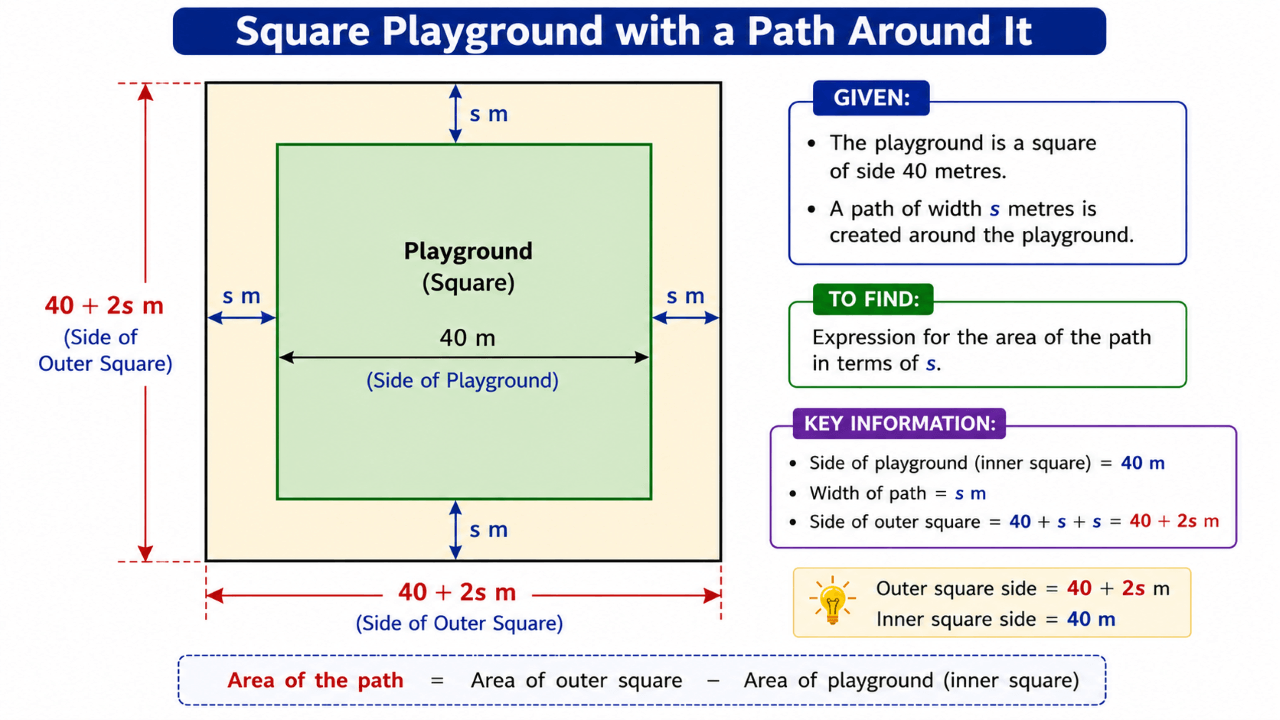
The village playground is shaped as a square of side 40 metres. A path of width s metres is created around the playground for people to walk. Find an expression for the area of the path in terms of s.
✍️ Solution
Given,
Side of the square playground = 40 m
Width of the path = s m
Class 9 Maths Chapter 4 End Exercise Question 7 square playground of side 40 metres with path of width s metres
Square playground of side 40 m surrounded by a path of width s m.
We have to find the area of the path.
The path is created around the playground.
Therefore, the side of the outer square
= 40 + s + s
= 40 + 2s m
Area of the outer square
= (40 + 2s)²
Area of the playground
= 40²
Therefore,
Area of the path
= Area of outer square − Area of playground
= (40 + 2s)² − 40²
Using the identity,
a² − b² = (a − b)(a + b)
We get,
= [(40 + 2s) − 40][(40 + 2s) + 40]
= (2s)(80 + 2s)
= 2s × 2(40 + s)
= 4s(s + 40)
Therefore, the required area of the path is
✅ Final Answer
Area of the path = 4s(s + 40) m²
Question 8
If a number plus its reciprocal equals 10 3 , find the number.
✍️ Solution
Let the number be x.
Then its reciprocal = 1 x
According to the question,
x + 1 x = 10 3
Multiplying both sides by x,
x² + 1 = 10x 3
3x² + 3 = 10x
3x² − 10x + 3 = 0
Factorising,
3x² − 9x − x + 3 = 0
3x(x − 3) − 1(x − 3) = 0
(3x − 1)(x − 3) = 0
Therefore,
3x − 1 = 0    or    x − 3 = 0
x = 1 3    or    x = 3
✅ Final Answer
The numbers are 1 3 and 3.
Question 9
A rectangular pool has area 2x² + 7x + 3 square hastas. If its width is 2x + 1 hastas, find its length.
✍️ Solution
Given,
Area of the rectangular pool = 2x² + 7x + 3 square hastas
Width = 2x + 1 hastas
We know that,
Area = Length × Width
Therefore,
Length = 2x² + 7x + 3 2x + 1 hastas
Factorising the numerator,
2x² + 7x + 3
= 2x² + 6x + x + 3
= 2x(x + 3) + 1(x + 3)
= (2x + 1)(x + 3)
Hence,
Length = (2x + 1) (x + 3) (2x + 1)
= x + 3 hastas
✅ Final Answer
Length = (x + 3) hastas
Question 10 — Solution
✍️ Solution
Given,
x − 2 and x − 1 2 are factors of px² + 5x + r.
Therefore,
px² + 5x + r = k(x − 2) ( x − 1 2 )
Now,
(x − 2) ( x − 1 2 ) = x² − 1 2 x − 2x + 1
= x² − 5 2 x + 1
Multiplying k,
px² + 5x + r = k ( x² − 5 2 x + 1 )
px² + 5x + r = kx² − 5k 2 x + k
Since both expressions are equal, comparing the corresponding terms on both sides,
Comparing the coefficients of x²:
p = k
Comparing the coefficients of x:
5 = − 5k 2
k = −2
Therefore, p = −2
Comparing the constant terms:
r = k
r = −2
Hence,
p = r
✅ Final Answer
p = r = −2
Question 11
If a + b + c = 5 and ab + bc + ca = 10, then prove that
a³ + b³ + c³ − 3abc = −25
✍️ Solution
Given,
a + b + c = 5
ab + bc + ca = 10
First, find a² + b² + c².
Using the identity,
(a + b + c)² = a² + b² + c² + 2(ab + bc + ca)
Substituting the given values,
5² = a² + b² + c² + 2(10)
25 = a² + b² + c² + 20
a² + b² + c² = 25 − 20
a² + b² + c² = 5
Now, using the identity,
a³ + b³ + c³ − 3abc
= (a + b + c) (a² + b² + c² − ab − bc − ca)
Substituting the values,
= 5(5 − 10)
= 5(−5)
= −25
Hence,
a³ + b³ + c³ − 3abc = −25
Hence proved.
✅ Final Answer
a³ + b³ + c³ − 3abc = −25
Question 12 — Solution
By factoring the expression, check that n³ − n is always divisible by 6 for all natural numbers n. Give reasons.
✍️ Solution
Factorising,
n³ − n = n(n² − 1)
= n(n² − 1²)
= n(n − 1)(n + 1)
Thus, n − 1, n, and n + 1 are three consecutive integers.
Divisibility by 2:
Among any three consecutive integers, at least one is even.
∴ n(n − 1)(n + 1) is divisible by 2.
Divisibility by 3:
When n is divided by 3, the remainder can only be 0, 1 or 2.
If remainder = 0, then n is divisible by 3.
If remainder = 1, then n − 1 is divisible by 3.
If remainder = 2, then n + 1 is divisible by 3.
Hence, in all cases, one of n − 1, n, n + 1 is divisible by 3.
∴ n(n − 1)(n + 1) is divisible by 3.
Therefore, the product is divisible by both 2 and 3.
2 × 3 = 6
Hence,
n³ − n is divisible by 6.
Hence proved for all natural numbers n.
✅ Final Answer
n³ − n is always divisible by 6.
💡 Alternative Method
We have,
n³ − n = n(n − 1)(n + 1)
By Euclid Division Lemma,
n = 3q + r,    r = 0, 1 or 2
Thus, when n is divided by 3, there are only three possible remainders: 0, 1 and 2.
If r = 0:
Then n is divisible by 3.
If r = 1:
Then n − 1 = 3q so n − 1 is divisible by 3.
If r = 2:
Then n + 1 = 3q + 3 = 3(q + 1) so n + 1 is divisible by 3.
Therefore, in all three cases, one of n − 1, n, n + 1 is divisible by 3.
Also, n − 1, n, and n + 1 are three consecutive integers. Therefore, one of them is even.
Hence, the product
n(n − 1)(n + 1)
is divisible by both 2 and 3.
2 × 3 = 6
Therefore,
n³ − n is divisible by 6.
Hence proved.
Question 13
Find the value of
(i)
x³ + y³ − 12xy + 64 , when  x + y = −4
(ii)
x³ − 8y³ − 36xy − 216 , when  x = 2y + 6
Question 13 (i)
Find the value of
x³ + y³ − 12xy + 64
when  x + y = −4
✍️ Solution
We have,
x³ + y³ − 12xy + 64
Since,
64 = 4³
12xy = 3(x)(y)(4)
Therefore,
x³ + y³ + 4³ − 3(x)(y)(4)
Using the identity,
a³ + b³ + c³ − 3abc
= (a + b + c) (a² + b² + c² − ab − bc − ca)
Here,
a = x,   b = y,   c = 4
Hence,
= (x + y + 4) (x² + y² + 16 − xy − 4y − 4x)
Given,
x + y = −4
x + y + 4 = 0
= 0 × (x² + y² + 16 − xy − 4y − 4x)
= 0
Hence, the required value is 0.
✅ Final Answer
0
Question 13 (ii)
Find the value of
x³ − 8y³ − 36xy − 216
when  x = 2y + 6
✍️ Solution
We have,
x³ − 8y³ − 36xy − 216
Since,
8y³ = (2y)³
216 = 6³
36xy = 3(x)(−2y)(−6)
Therefore,
x³ + (−2y)³ + (−6)³ − 3(x)(−2y)(−6)
Using the identity,
a³ + b³ + c³ − 3abc
= (a + b + c) (a² + b² + c² − ab − bc − ca)
Here,
a = x,   b = −2y,   c = −6
Hence,
= (x − 2y − 6) [x² + (−2y)² + (−6)² − x(−2y) − (−2y)(−6) − (−6)x]
Given,
x = 2y + 6
x − 2y − 6 = 0
= 0 × [expression]
= 0
Hence, the required value is 0.
✅ Final Answer
0

📚 Continue Learning

Congratulations! You have completed the Class 9 Maths Chapter 4 End of Chapter Exercise Solutions. This page provides step-by-step solutions for the complete end-of-chapter exercise based on NCERT Ganita Manjari (2026). Use these solutions to revise algebraic identities, factorisation, rational expressions, cube identities, and quadratic equations, or revisit any Chapter 4 exercise for additional practice before your Class 9 Maths examination.


📖 Explore More Class 9 Maths Chapters

📚 Need a Quick Revision?
Revise the important Chapter 4 concepts before attempting the Class 9 Maths Chapter 4 End of Chapter Exercise.

The Class 9 Maths Chapter 4 End of Chapter Exercise brings together concepts studied throughout Exploring Algebraic Identities. If you need to revise a particular concept, use the chapter resources below and then return to the NCERT End of Chapter Exercise with confidence.

🌐 Chapter 4 Learning Hub

Explore the complete Class 9 Maths Chapter 4 learning resources, including algebraic identities, visual proofs, algebra tiles, factorisation methods, chapter exercises, and revision material based on NCERT Ganita Manjari (2026).

👉 Explore Chapter 4 Solutions
🟪 Exercise 4.4 — Factorisation

Revise factorisation methods and practise applying suitable algebraic identities and factorisation techniques to algebraic expressions.

👉 Revise Exercise 4.4
🟧 Exercise 4.1

Revise important algebraic identities and practise their use in different algebraic expressions.

👉 Revise Exercise 4.1
🟦 Exercise 4.2

Practise algebraic identities and their applications through step-by-step NCERT-based questions.

👉 Revise Exercise 4.2
🟩 Exercise 4.3

Practise expanding and simplifying algebraic expressions using appropriate identities and step-by-step methods.

👉 Revise Exercise 4.3
🟨 Exercise 4.5

Revise the algebraic methods required to simplify expressions and apply factorisation correctly.

👉 Revise Exercise 4.5
🎯 Ready for the End of Chapter Exercise?

Once you have revised the required concepts, practise the complete Class 9 Maths Chapter 4 End of Chapter Exercise with step-by-step NCERT Ganita Manjari (2026) solutions.

🚀 Solve the End of Chapter Exercise →
✅ Revision Complete?
If you are comfortable with the concepts covered in Chapter 4, you are ready to attempt the Class 9 Maths Chapter 4 End of Chapter Exercise. Use the relevant exercise page whenever you need a quick revision before continuing your practice.

❓ Frequently Asked Questions

Find quick answers to common questions about Class 9 Maths Chapter 4 End of Chapter Exercise Solutions. These FAQs help students understand the important topics covered in the chapter, choose suitable methods, and use the solutions effectively for revision, practice, and CBSE examination preparation.

What is covered in the Class 9 Maths Chapter 4 End of Chapter Exercise?

The End of Chapter Exercise brings together important concepts from Chapter 4 – Exploring Algebraic Identities. The questions require students to apply ideas related to algebraic identities, expansion, factorisation, rational expressions, cube identities, quadratic equations, and application-based problems.

Which topics should I revise before solving Chapter 4 End Exercise?

Before attempting the Class 9 Maths Chapter 4 End of Chapter Exercise, revise algebraic identities, expansion of expressions, factorisation methods, middle-term splitting, rational expressions, cube identities, quadratic equations, and word problems. Revising these concepts makes it easier to identify the correct method for each question.

How do I choose the correct factorisation method in Chapter 4?

First observe the algebraic expression carefully. Check whether a common factor can be taken out, whether an algebraic identity can be applied, or whether middle-term splitting is required. Selecting the correct factorisation method first makes the remaining steps simpler and helps reduce calculation errors.

How are quadratic equations approached in Class 9 Chapter 4?

In the relevant Chapter 4 questions, quadratic expressions can be handled by factorisation. After factorising the expression, use the appropriate equality condition to obtain the required values and check the result. Writing each step clearly is important for a complete CBSE-style solution.

What common mistakes should students avoid in the Chapter 4 End Exercise?

Students should avoid choosing the wrong identity, making errors while splitting the middle term, cancelling terms instead of common factors in rational expressions, and skipping important algebraic steps. Always identify the method first and write the solution systematically.

Are these Class 9 Maths Chapter 4 End of Chapter Exercise Solutions based on NCERT Ganita Manjari 2026?

Yes. These Class 9 Maths Chapter 4 End of Chapter Exercise Solutions are prepared according to the latest NCERT Ganita Manjari (2026) textbook and are presented in a clear, step-by-step format for Class 9 Mathematics. They are designed to support classroom practice, self-study, chapter revision, homework, and examination preparation.

How can these Chapter 4 End of Chapter solutions help with exam preparation?

The solutions show the questions in a step-by-step CBSE answer-writing style. Students can use them to revise important Chapter 4 concepts, understand how different algebraic methods are applied, identify common errors, and practise writing complete mathematical solutions before their examination.

Are these solutions useful for complete Chapter 4 revision?

Yes. The Class 9 Maths Chapter 4 End of Chapter Exercise Solutions are useful for revising the chapter as a whole because the End Exercise requires students to apply concepts from different parts of Exploring Algebraic Identities. Students can first revise the required concepts and then use the step-by-step solutions for practice and examination preparation.

📚 Useful Learning Resources

Continue your learning with more Class 9 Maths resources or visit the official NCERT and CBSE websites for the latest syllabus, textbooks, and academic updates.

Need Personal Guidance in Maths?

Join Newton Study Point for concept-based Maths coaching by an experienced teacher. Small batches, individual attention, regular tests, and complete CBSE exam preparation for Classes 8, 9, 10, 11 & 12.

📞 Call Now: 8447002272 💬 WhatsApp 🏫 Explore Newton Study Point

📍 Newton Study Point • Ankur Vihar, Ghaziabad

Rakesh Kumar Singh - CBSE Mathematics Educator
👨‍🏫 Reviewed & Prepared By

Rakesh Kumar Singh

Founder, Maths Gurukulam & Newton Study Point
Teaching CBSE Mathematics Since 2006

These Class 9 Maths Chapter 4 End of Chapter Exercise Solutions are carefully prepared using the latest NCERT Ganita Manjari (2026) and aligned with the CBSE Class 9 Mathematics curriculum. The solutions are presented in a clear, step-by-step format to help students understand algebraic identities, factorisation, rational expressions, quadratic equations and other concepts covered in Chapter 4, while developing accurate mathematical answer-writing skills.

📘 NCERT Ganita Manjari (2026) 🎯 CBSE Class 9 Mathematics 📝 Step-by-Step Solutions 💡 Concept-Based Learning
Know More About the Author →

Leave A Reply

Your email address will not be published. Required fields are marked *

You May Also Like