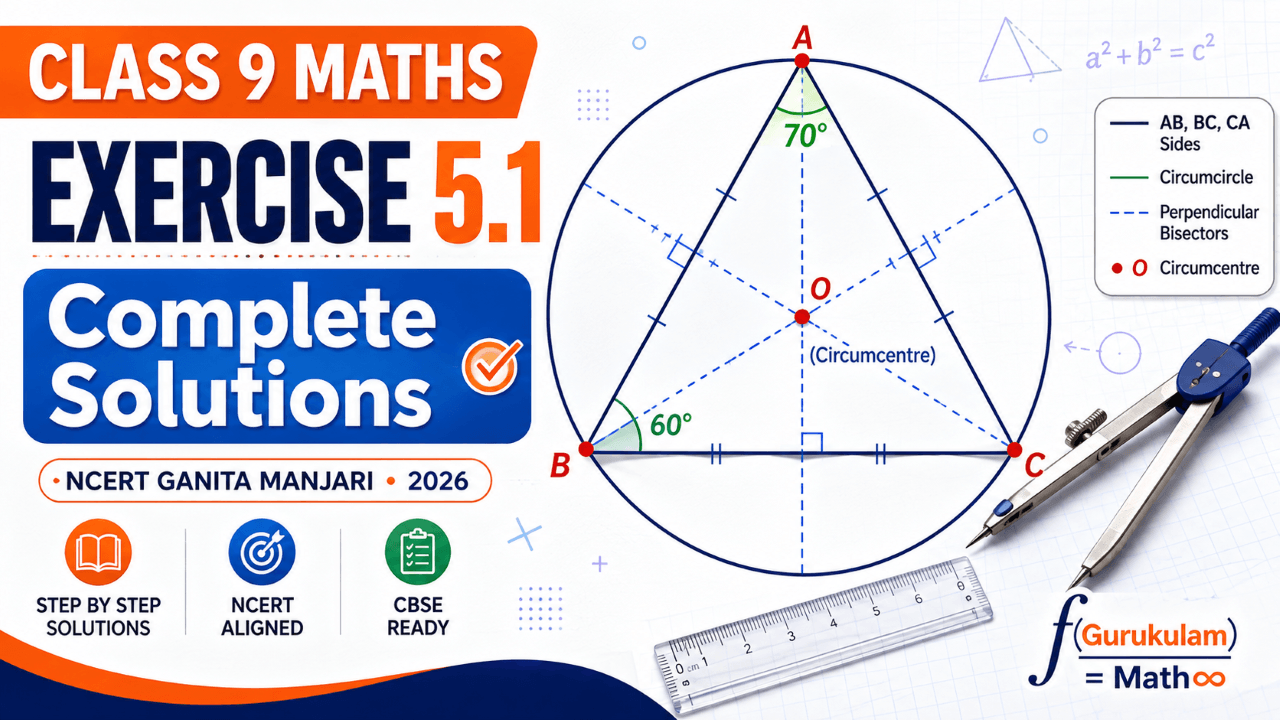
Class 9 Maths Chapter 5 Exercise 5.1 Solutions – triangle and circumcircle construction

Class 9 Maths Chapter 5 Exercise 5.1 Solutions (Ganita Manjari 2026) – I’m Up and Down, and Round and Round

📘 NCERT Ganita Manjari (2026) 📚 CBSE 2026–27 🏆 Step-by-Step Solutions

Class 9 Maths Exercise 5.1 Solutions

Circles, Circumcircles and Circumcentre – Step-by-Step NCERT Solutions

Prepare with complete Class 9 Maths Chapter 5 Exercise 5.1 Solutions based on the latest NCERT Ganita Manjari (2026). This exercise focuses on constructing triangles and their circumcircles, locating the circumcentre, understanding whether the circumcentre lies inside or outside a triangle, and finding the least possible radius of a circle passing through two given points. Every solution is presented in a simple step-by-step CBSE answer-writing style to make construction-based circle problems easier to understand and practise.

📖
Exercise
5.1
Questions
4 Questions
📚
Coverage
Circles &
Circumcircles
🧠
Skills
Construction &
Reasoning
⏱️
Study Time
45–60 Min
Difficulty
Moderate
🎯
Exam Importance
★★★★★
🎯 By the End of This Exercise, You Will Be Able To…
✅ Construct a Circumcircle of a Triangle
✅ Locate the Circumcentre Using Perpendicular Bisectors
✅ Identify the Position of the Circumcentre
✅ Understand Circumcircle and Equal Radii
✅ Find the Least Possible Radius Through Two Points
✅ Write Construction-Based CBSE Answers Clearly

📑 Table of Contents

📖 About Class 9 Maths Chapter 5 Exercise 5.1

Class 9 Maths Chapter 5 Exercise 5.1 Solutions cover the first exercise of Chapter 5 – I’m Up and Down, and Round and Round from the latest NCERT Ganita Manjari (2026). This exercise begins the chapter’s study of circles through geometric constructions and observations involving triangles, circumcircles, and the circumcentre. The questions help students develop a clear understanding of these ideas through practical geometric work.

This page provides clear, question-wise explanations based on the NCERT Ganita Manjari (2026) textbook and follows a student-friendly CBSE approach. The solutions are arranged systematically to support classroom learning, homework, self-study, revision, and examination preparation while keeping the focus on the actual requirements of Exercise Set 5.1.

🎯 Exercise Snapshot

📘 What You’ll Find
  • Complete Exercise Set 5.1 coverage.
  • NCERT-based question-wise solutions.
  • Clear explanations of the constructions and observations required.
📚 Page Includes
  • Question-wise step-by-step solutions.
  • Triangle and circumcircle construction guidance.
  • Simple CBSE answer-writing approach.
🏆 Best For
  • Understanding the beginning of Chapter 5.
  • Homework and classroom practice.
  • Revision and CBSE examination preparation.

🎯 Jump to Any Question

Quickly jump to any question of Class 9 Maths chapter 5 Exercise 5.1 Solutions. Each card highlights the main concept or task covered in the question, so you can quickly reach the solution you need.

📚 Learn Before You Solve
Understand the basic concepts of circles before solving Exercise Set 5.1.

What is a Circle?

A circle is the set of all points in a plane that are at the same distance from a fixed point.

The fixed point is called the centre of the circle.
The common distance is called the radius.
Circle with centre O and equal radii A circle with centre O and points A, B, C and D on its circumference. Line segments from O to these points represent equal radii. O A B C D
OA = OB = OC = OD

Centre of a Circle

The fixed point from which every point on the circle is at the same distance is called the centre.

Centre O of a circle A circle with the fixed centre marked O. The centre lies inside the circle. O Centre
Remember: The centre is a point, not a line segment.

Radius

A radius is the line segment joining the centre of a circle to any point on the circle.

Radius OA of a circle A line segment OA joins centre O to point A on the circle. Therefore OA represents a radius. O A radius
OA is a radius.

A circle has many radii, but all radii of the same circle have equal length.

Chord

A chord is a line segment whose two endpoints lie on the circle.

Chord AB of a circle A line segment AB joins two points A and B on the circle. The segment does not pass through the centre and is therefore a chord. A B chord AB
Key point: A chord does not have to pass through the centre.

Diameter

A diameter is a chord that passes through the centre of the circle.

Diameter AB passing through centre O A chord AB passes through the centre O of the circle. Therefore AB is a diameter. A O B diameter AB
Diameter = chord passing through the centre

Chord vs Diameter

Chord

A line segment joining any two points on the circle.

Centre condition: It may or may not pass through the centre.
Diameter

A chord whose two endpoints lie on the circle and which passes through the centre.

Centre condition: It always passes through the centre.
Every diameter is a chord, but every chord is not a diameter.

Relation Between Diameter and Radius

If AB is a diameter and O is the centre, then O divides the diameter into two radii.

Diameter AB consists of two equal radii Diameter AB passes through centre O and is made up of two equal radii AO and OB. A O B r r
Since AB is a diameter,
AB = AO + OB
Since AO and OB are radii of the same circle,
AO = OB = r
Therefore,
AB = r + r
Hence,
Diameter = 2 × Radius
d = 2r
Therefore, r = d/2

⭐ The One Idea to Remember

All the basic terms of a circle are connected to one central idea:

Every point on a circle is at the same distance from its centre.
Centre → Radius → Chord → Diameter

⚠️ Common Mistakes

  • Calling every chord a diameter.
  • Forgetting that a diameter must pass through the centre.
  • Thinking a circle has only one radius.
  • Confusing the radius with the diameter.
  • Writing d = r instead of d = 2r.

Quick Check

Before moving ahead, make sure you can answer these questions:

✓ What is a circle?
✓ What is the centre?
✓ What is a radius?
✓ What is a chord?
✓ What makes a chord a diameter?
✓ What is the relation between diameter and radius?
📐 Perpendicular Bisector — The Key Tool
The simple idea that helps us find the centre of a circle.

Perpendicular Bisector

A perpendicular bisector is a line that cuts a line segment into two equal parts and is also perpendicular to it.

① It bisects AB
The midpoint E divides AB into two equal parts.
AE = EB
② It is perpendicular
The angle made with AB at E is a right angle.
PE ⟂ AB
PQ ABE PQ ⟂ AB PQ is the perpendicular bisector
AE = EB    and    PE ⟂ AB

Why Are the Distances Equal?

This is the most important property to remember.

Every point on the perpendicular bisector is equally far from A and B.

For example, if P lies on the perpendicular bisector:

PA = PB
Point P is equally distant from A and B Point P lies on the perpendicular bisector of AB. The two segments PA and PB are equal. P A B PA PB
P is on the perpendicular bisector

PA = PB

Theorem: Equal Distances

Statement

Every point on the perpendicular bisector of a line segment is equidistant from its two endpoints.

Given:

PE is the perpendicular bisector of AB.

To prove:
PA = PB

Proof

Since PE is the perpendicular bisector of AB,
AE = EB
Also, PE is perpendicular to AB.
∠PEA = ∠PEB = 90°
PE is common to both triangles.
PE = PE
Therefore,
△PEA ≅ △PEB
by SAS congruence.
Therefore,
PA = PB
Hence proved.

How Does It Help Find the Centre?

Now comes the important connection with circles.

A and B are on the circle
So OA and OB are both radii.
Radii are equal
OA = OB
Therefore
O is equidistant from A and B.
Therefore, the centre O lies on the perpendicular bisector of AB.
Circle through two fixed points A and B A circle with centre O passes exactly through A and B. OA and OB are equal radii. E is the midpoint of AB and OE is perpendicular to AB. O A B E OA OB Perpendicular bisector OA = OB Equal radii E is the midpoint of AB

Constructing a Perpendicular Bisector

Use a ruler and compass. Follow the four steps carefully.

Step 1 — Draw AB

Draw the given line segment AB.

A B
Step 2 — Arcs from A

With A as centre, draw arcs above and below AB. Keep the compass opening fixed.

A B
Step 3 — Arcs from B

Without changing the compass opening, draw arcs from B. They meet at P and Q.

P Q A B
Step 4 — Join P and Q

Join P and Q. This line is the perpendicular bisector of AB.

P Q A B E
Same compass opening  →  arcs meet at P and Q  →  join P and Q  →  perpendicular bisector

Why Does the Construction Work?

Look at the two points where the equal-radius arcs meet: P and Q.

At P
PA = PB
At Q
QA = QB
Both P and Q are equally distant from A and B.
Therefore both points lie on the perpendicular bisector.

⭐ Remember This

Circle passes through A and B
OA = OB
O is equidistant from A and B
O lies on the perpendicular bisector of AB
This is the idea you will use in Exercise 5.1.
Whenever two points of a circle are known, think about their perpendicular bisector.
📚 Circles Through Two Points
Discover why many circles can pass through the same two points.

Can More Than One Circle Pass Through A and B?

Yes. In fact, infinitely many circles can pass through the same two fixed points A and B.

The important question is: Where should their centres be?

We already know the answer:
The centre must lie on the perpendicular bisector of AB.

Where Can the Centre Be?

Let O be the centre of a circle passing through A and B.

A and B are on the circle
Therefore OA and OB are radii.
All radii are equal
OA = OB
Therefore O is equidistant
O is equally far from A and B.
Therefore, O lies on the perpendicular bisector of AB.
Circle through two fixed points A and B A circle with centre O passes exactly through A and B. OA and OB are equal radii. E is the midpoint of AB and OE is perpendicular to AB. O A B E OA OB Perpendicular bisector OA = OB Equal radii E is the midpoint of AB

Why Are There Infinitely Many Circles?

The points A and B remain fixed. But the centre can move to any point on the perpendicular bisector.

Every new position of the centre gives a new circle through A and B.

Several circles through the same two points A and B Several circles pass through fixed points A and B. Their centres O1, O2 and O3 all lie on the same perpendicular bisector of AB. A B O₁ O₂ O₃ Centre Centre Centre All centres lie on this line
O₁ gives one circle through A and B.
O₂ gives another circle through A and B.
O₃ gives yet another circle through A and B.
The centre can keep moving along the perpendicular bisector.
Therefore, infinitely many circles can pass through A and B.

What Happens When the Centre Moves?

A circle’s radius is the distance from its centre to any point on the circle.

Centre closer to AB
The radius is smaller.
Centre farther from AB
The radius becomes larger.
Important: Moving the centre along the perpendicular bisector does not move A or B. It changes only the radius of the circle.

⭐ Minimum Possible Radius

This idea is especially important for questions such as Q4 of Exercise 5.1.

Suppose the distance between A and B is fixed. The centre must lie on the perpendicular bisector.

Minimum radius of a circle through two fixed points The midpoint E of AB is the centre of the smallest circle passing through A and B. Its radius is AE, which equals EB, so the minimum radius is AB divided by 2. A E B AE AB = diameter Smallest possible circle through A and B
Why is this the minimum?

The shortest distance from the perpendicular bisector to either fixed point is obtained when the centre is exactly at the midpoint E of AB.

Since E is the midpoint of AB,
AE = EB = AB ÷ 2
Therefore,
Minimum radius = AB ÷ 2

🎯 Quick Thinking for Q4

If the distance AB is known:
Step 1
Find the midpoint of AB.
Step 2
Take the midpoint as centre.
Step 3
Radius = half of AB.
Memory rule: If two fixed points A and B must lie on a circle, the minimum radius occurs when the centre is at the midpoint of AB.

⭐ Remember the Whole Idea

Two fixed points A and B
Centre lies on perpendicular bisector
Move the centre
Radius changes
Midpoint of AB → Minimum radius = AB ÷ 2
📚 Circle Through Three Non-Collinear Points
How three points determine one unique circle.

Three Non-Collinear Points

Suppose three points A, B and C are given, and they are not on the same straight line.

Non-collinear means that A, B and C do not lie on one straight line.
A, B and C form a triangle.
Three non-collinear points A, B and C Points A, B and C form a triangle and are not on one straight line. A B C A, B and C are non-collinear

Why Exactly One Circle?

From the previous concept, we know that the centre of a circle passing through two points lies on the perpendicular bisector of the segment joining those points.

For A and B
The centre must lie on the perpendicular bisector of AB.
For A and C
The centre must lie on the perpendicular bisector of AC.
The two bisectors meet once
Their unique intersection is the centre of the circle.
Key idea: Since the triangle is non-collinear, the perpendicular bisectors of two sides are not parallel. They meet at exactly one point. That point is the circumcentre.

Circumcentre and Circumcircle

📍 Circumcentre
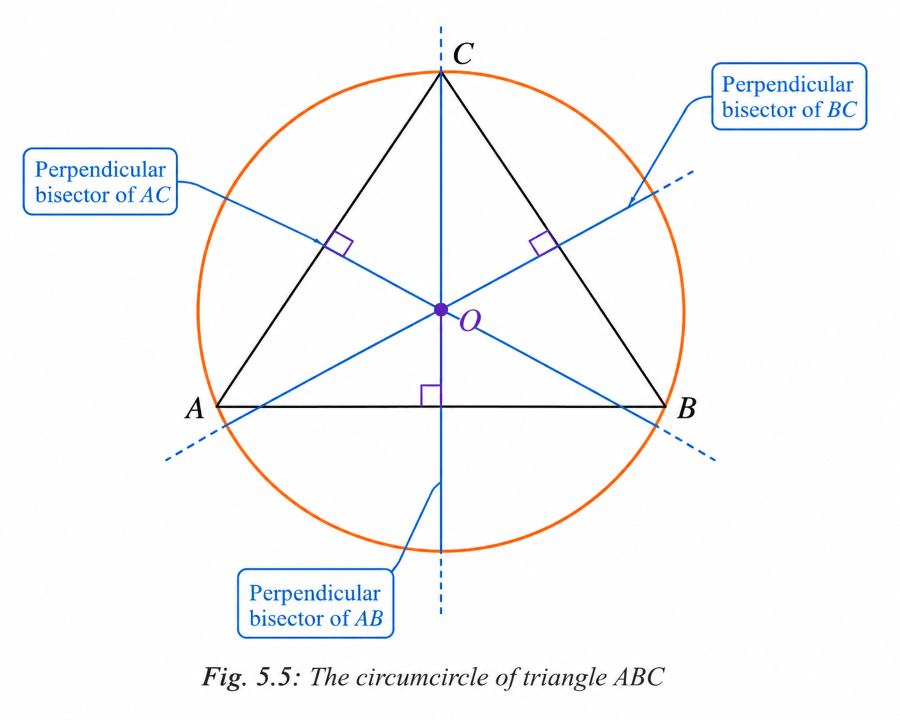
The common point where the perpendicular bisectors of the sides of a triangle meet is called its circumcentre.
⭕ Circumcircle
The circle passing through all three vertices A, B and C is called the circumcircle of the triangle.
Circumcentre of a triangle formed by perpendicular bisectors A B C O D E OA OB OC
The perpendicular bisectors of AB and AC meet at O.
OA = OB = OC
OA = OB = OC
Therefore one circle centred at O passes through A, B and C.

⭐ Theorem

Statement

The perpendicular bisectors of the sides of a triangle are concurrent.

Their common point is equidistant from the three vertices of the triangle.
OA = OB = OC

Step-by-Step Proof

Given:

ABC is a non-collinear triangle. The perpendicular bisectors of AB and AC meet at O.

To prove:
OA = OB = OC
1
O lies on the perpendicular bisector of AB.
OA = OB
2
O also lies on the perpendicular bisector of AC.
OA = OC
3
From the two equalities,
OA = OB
and
OA = OC
Therefore,
OA = OB = OC
4
Thus O is equally distant from A, B and C. Therefore a circle with centre O and radius OA passes through all three points.
Hence the circle through A, B and C exists.
And it is unique.

Construction: Circumcentre and Circumcircle

Given a triangle ABC, we can construct its circumcircle using the perpendicular bisectors of two sides.

Step 1 — Draw triangle ABC

Draw the given non-collinear triangle ABC.

A B C
Step 2 — Bisect AB

Construct the perpendicular bisector of AB using equal-radius arcs.

A B D
Step 3 — Bisect AC

Construct the perpendicular bisector of AC. Let the two bisectors meet at O.

O A B C
Step 4 — Draw the circle

Take O as centre and OA as radius. Draw the circle.

O A B C OA OB OC
Draw triangle → Bisect AB → Bisect AC → Their intersection is O → Take OA as radius → Draw circumcircle

Why Are Two Perpendicular Bisectors Enough?

We do not need to construct all three perpendicular bisectors.

If O lies on the perpendicular bisector of AB,
OA = OB
If O lies on the perpendicular bisector of AC,
OA = OC
Therefore,
OA = OB = OC
So the circle centred at O automatically passes through all three vertices.

⭐ Remember This for Exercise 5.1

Three non-collinear points
Perpendicular bisectors of two sides
Common point O
OA = OB = OC
One unique circumcircle
Exam connection: The point where the perpendicular bisectors meet is the circumcentre, and the circle through all three vertices is the circumcircle.
📍 Position of the Circumcentre
The position of the circumcentre depends on the type of triangle.
Acute Triangle
All three angles are less than 90°.
A B C O
Circumcentre O → INSIDE
Right Triangle
One angle is exactly 90°.
A B C O
O → Midpoint of the Hypotenuse
Obtuse Triangle
One angle is greater than 90°.
A B C O
Circumcentre O → OUTSIDE
Acute → Inside   |   Right → Midpoint of Hypotenuse   |   Obtuse → Outside
📐 How to Construct a Triangle with Given Measurements
Learn the correct construction method for SSS, SAS and ASA cases.
SSS
Three sides given
SAS
Two sides + included angle
ASA
Two angles + included side
QUESTION 1 — SSS
Construct a triangle ABC in which:
AB = 6 cm   |   BC = 5 cm   |   CA = 4 cm

Solution — Construction

Given:
AB = 6 cm,   BC = 5 cm,   CA = 4 cm
Method: SSS
All three sides are given, so we use the SSS construction.
Step 1 — Draw BC
Draw BC = 5 cm.
B C 5 cm
Step 2 — Arc from B
With B as centre and radius 6 cm, draw an arc.
B C 6 cm
Step 3 — Draw the Arc from C
Now change the compass opening to 4 cm. Take C as centre and draw an arc. It intersects the first arc at A.
SSS construction: two arcs intersecting at A BC is the base of length 5 centimetres. A construction arc of radius 6 centimetres is drawn with B as centre. A second construction arc of radius 4 centimetres is drawn with C as centre. The two arcs intersect at A. A B C 6 cm from B 4 cm from C
Step 4 — Join A to B and C
Join AB and AC.
A B C
✓ Required Triangle Constructed
Therefore, △ABC is the required triangle.
SSS: Draw one side → draw an arc from each endpoint → their intersection gives the third vertex → join the sides.
QUESTION 2 — SAS
Construct a triangle ABC in which:
AB = 6 cm   |   AC = 5 cm   |   ∠BAC = 60°

Solution — Construction

Given:
AB = 6 cm,   AC = 5 cm,   ∠BAC = 60°
Method: SAS
The two given sides meet at A, and the angle between them is given. Therefore, we use the SAS construction.
Step 1 — Draw AB
Draw AB = 6 cm.
A B 6 cm
Step 2 — Construct 60° at A
At A, construct ∠BAC = 60° and draw the required ray.
A B 60°
Step 3 — Mark C
On the ray, mark AC = 5 cm. Mark this point as C.
A B C 5 cm
Step 4 — Join BC
Join BC to complete the triangle.
A B C AB = 6 cm AC = 5 cm
✓ Required Triangle Constructed
Therefore, △ABC is the required triangle.
SAS: Draw one side → construct the included angle → mark the second side → join the remaining vertices.
QUESTION 3 — ASA
Construct a triangle ABC in which:
BC = 6 cm   |   ∠ABC = 50°   |   ∠ACB = 60°

Solution — Construction

Given:
BC = 6 cm,   ∠ABC = 50°,   ∠ACB = 60°
Method: ASA
The side BC and the two angles at its endpoints are given. Therefore, we use the ASA construction.
Step 1 — Draw BC
Draw BC = 6 cm.
B C 6 cm
Step 2 — Construct 50° at B
At B, construct ∠ABC = 50° and draw the ray.
B C 50°
Step 3 — Construct 60° at C
At C, construct ∠ACB = 60°. The two rays meet at A.
A B C 50° 60°
Step 4 — Complete the Triangle
The two rays meet at A. Thus, △ABC is constructed.
A B C BC = 6 cm 50° 60°
✓ Required Triangle Constructed
Therefore, △ABC is the required triangle.
ASA: Draw the given side → construct the given angle at each endpoint → the two rays meet at the third vertex.
🎯 Let’s Put It All Together!
One complete model problem — from constructing the triangle to finding its circumcentre and circumcircle.
👨‍🏫 Rakesh Sir says:
“Ab hum ek complete question karenge. Pehle triangle banayenge, phir uska circumcentre find karenge, aur finally circumcircle draw karenge. Agar ye samajh aa gaya, Exercise 5.1 kaafi easy lagegi!” 😊
MODEL QUESTION
Construct a triangle ABC such that:
AB = 5 cm   |   BC = 6 cm   |   CA = 7 cm
Then construct its circumcentre and circumcircle. Also state the position of the circumcentre.
🤔 Before We Start — Think!
Look carefully at the information given in the question.
AB = 5 cm
BC = 6 cm
CA = 7 cm
Three sides are given.
💡 Therefore → SSS Construction
SSS = Side – Side – Side
🧭 Our Plan
Draw Triangle
Find Circumcentre
Draw Circumcircle
🚀 Ready? Let’s construct the triangle first!
In the next step, we will use the three given sides to construct △ABC.
✏️ Step 1 — Construct the Triangle
Let’s use the SSS method to construct △ABC.
Given: AB = 5 cm   |   BC = 6 cm   |   CA = 7 cm
Step 1 — Draw BC
Draw a line segment BC = 6 cm.
B C 6 cm
Step 2 — Arc from B
With B as centre and radius 5 cm, draw an arc.
B C 5 cm
Step 3 — Arc from C
With C as centre and radius 7 cm, draw another arc.
A B C
Step 4 — Join A to B and C
The arcs meet at A. Join AB and AC.
A B C BC = 6 cm AB = 5 cm AC = 7 cm
🎉 Triangle ABC is ready!
We used the three given sides to construct the triangle.
Next, we will find its circumcentre. 🎯
🎯 Step 2 — Find the Circumcentre
The perpendicular bisectors will help us locate the centre.
👨‍🏫 Remember the trick!
The centre of a circle passing through two points must lie on the perpendicular bisector of the segment joining those points.
Step 1 — Bisect AB
Construct the perpendicular bisector of AB.
B C A Midpoint
Every point on this line is equally distant from A and B.
Step 2 — Bisect BC
Now construct the perpendicular bisector of BC.
B C A Perpendicular bisector
Every point on this line is equally distant from B and C.
Step 3 — Meet at O
The two perpendicular bisectors meet at O.
B C A O
🎯 O is the Circumcentre
💡 Why does O become the centre?
O lies on the perpendicular bisector of AB, so:
OA = OB
O also lies on the perpendicular bisector of BC, so:
OB = OC
Therefore, OA = OB = OC
🎉 We found the centre!
Now that we know O, the next step is easy: we will use O as the centre to draw the circumcircle. ⭕
⭕ Step 3 — Draw the Circumcircle
We know the centre. Now let’s use it to draw the circle.
🤔 What do we need now?
We already know the centre O. Which point can we use to get the radius?
💡 OA
Step 1 — Take OA as the Radius
Place the compass point at O and open it up to A.
A B C O OA
Radius = OA
Step 2 — Draw the Circle
Keeping O fixed as the centre, draw the complete circle.
A B C O Circumcircle
🎯 Look What Happened!
The same radius OA reaches all three vertices of the triangle.
OA = OB = OC
So A, B and C all lie on the same circle.
👨‍🏫 Rakesh Sir says:
“Centre mil gaya, radius mil gaya — बस circle draw kar do!” 😊
This circle is called the circumcircle of △ABC.
Next: Let’s check where the circumcentre lies and verify our construction. 🎯
✅ Position & Verification
Let’s check our construction and understand where O lies.
🤔 One last thing!
We have found the circumcentre O. Now, where is it located?
The sides of the triangle are 5 cm, 6 cm and 7 cm. This forms an acute triangle.
🎯 Circumcentre O lies INSIDE the triangle.
🔎 Our Complete Construction
A B C O
O is clearly inside the acute triangle.
🔍 Let’s Verify
✓ OA = OB
✓ OB = OC
✓ OA = OC
✓ Circle passes through A
✓ Circle passes through B
✓ Circle passes through C
🧠 Remember the Complete Process
3 sides given
Construct △ABC
Perpendicular bisectors
O = Circumcentre
Draw circumcircle
🎉 You Got It!
👨‍🏫 “Triangle banana → perpendicular bisectors → O mil gaya → radius OA liya → circle draw kar diya!” 😊
Now you are ready to tackle the construction questions in Exercise 5.1. 💪

📝 Class 9 Maths Chapter 5 Exercise 5.1 Solutions

Solve every question of Class 9 Maths Chapter 5 Exercise 5.1 with clear, step-by-step NCERT Ganita Manjari (2026) solutions. This exercise introduces important geometric ideas involving triangles, circumcircles, perpendicular bisectors, circumcentres, and related constructions. Each solution is presented in a simple, student-friendly CBSE answer-writing style with the required construction steps and reasoning, making it useful for classroom work, homework, revision, and examination preparation.

📝 Step-by-Step Solutions 🎯 NCERT & CBSE Aligned ⭐ Complete Exercise 5.1
Question 1
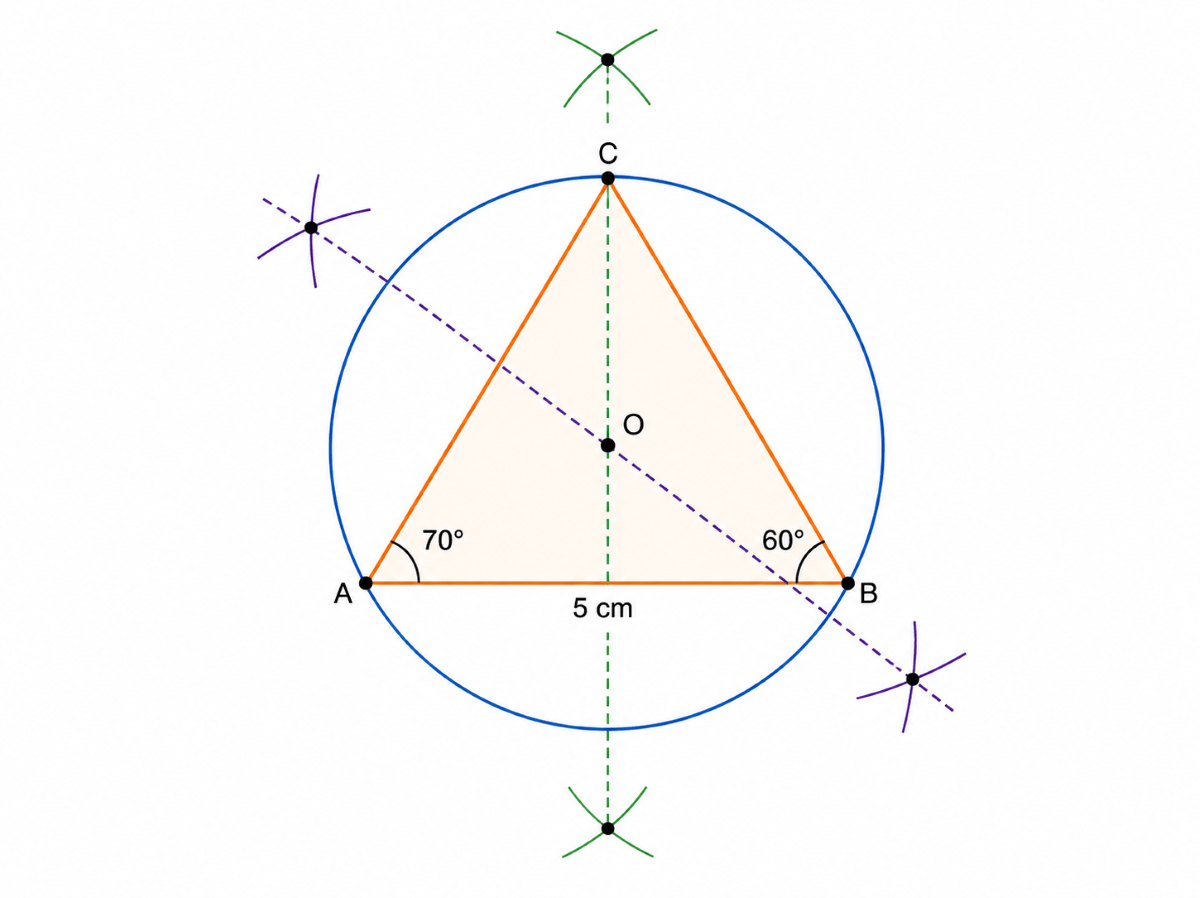
Draw △ABC with AB = 5 cm, ∠A = 70° and ∠B = 60°. Draw the circumcircle of △ABC. Is the centre inside or outside the triangle?
✍️ Solution
Given,
AB = 5 cm
∠A = 70°
∠B = 60°
To construct,
1. △ABC
2. The circumcircle of △ABC
3. The position of its circumcentre
Construction: First construct △ABC using the given side and angles. Then construct the perpendicular bisectors to locate the circumcentre and draw the circumcircle.

📐 Construction Figure

Class 9 Maths Chapter 5 Exercise 5.1 triangle ABC with circumcircle and perpendicular bisectors

Figure: Construction of △ABC, its circumcircle and perpendicular bisectors meeting at O.

✏️ Construction

Step 1. Draw AB = 5 cm.
Step 2. At A, construct ∠BAC = 70° and draw ray AC.
Step 3. At B, construct ∠ABC = 60° and draw ray BC.
Step 4. Let the rays AC and BC meet at C. Thus, △ABC is constructed.
Step 5. Construct the perpendicular bisector of AB.
Step 6. Construct the perpendicular bisector of AC.
Step 7. Let the two perpendicular bisectors meet at O. Then O is the circumcentre of △ABC.
Step 8. With O as centre and OA as radius, draw the circumcircle.

🔍 Observation

∠C = 180° − 70° − 60° = 50°.
All three angles of △ABC are less than 90°. Therefore, △ABC is an acute-angled triangle, and its circumcentre lies inside the triangle.

✅ Final Answer

The circumcircle of △ABC is constructed successfully. Its centre O lies inside the triangle.

Question 2
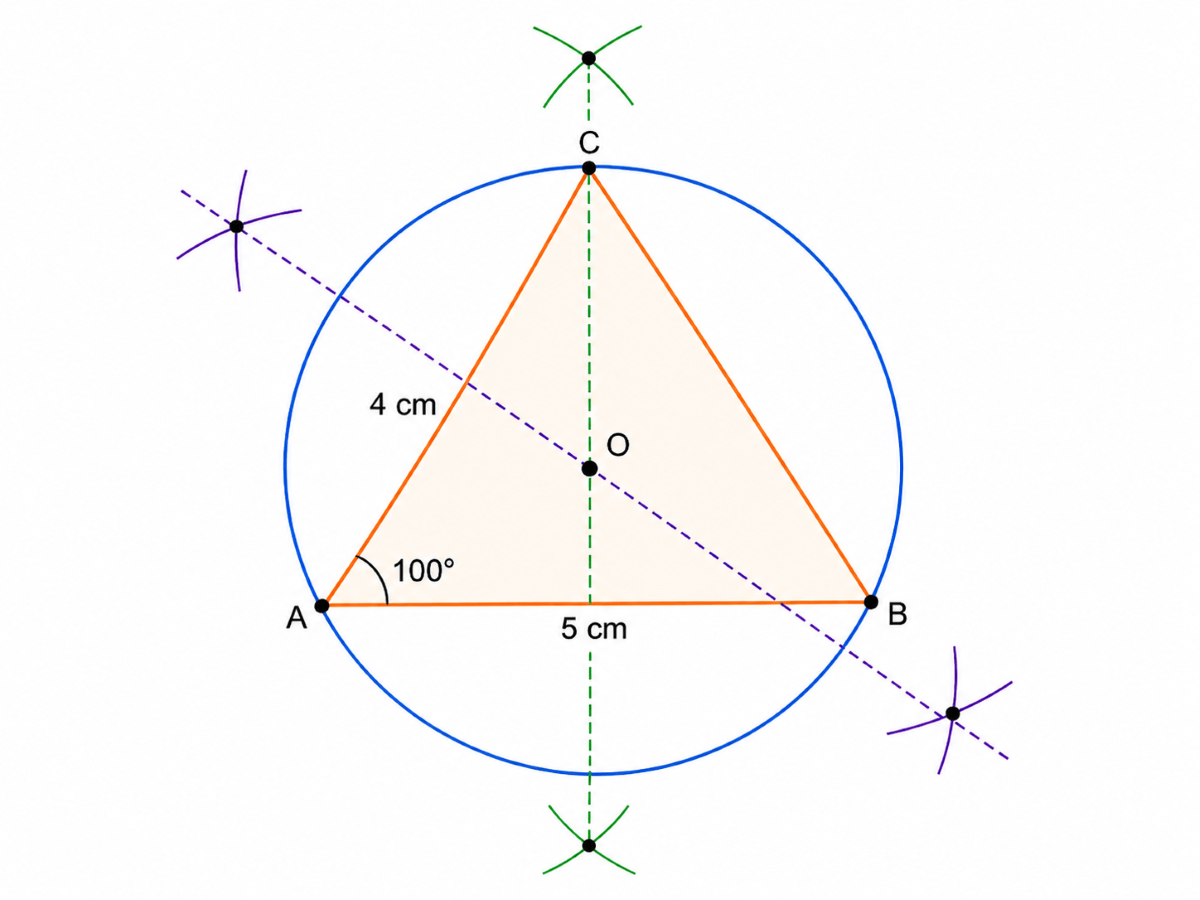
Draw △ABC with AB = 5 cm, ∠A = 100°, AC = 4 cm. Draw the circumcircle of △ABC. Is the centre inside or outside the triangle?
✍️ Solution
Given,
AB = 5 cm
∠A = 100°
AC = 4 cm
To construct,
1. △ABC
2. The circumcircle of △ABC
3. The position of its circumcentre
Construction: First construct △ABC using the given side, angle and side. Then construct the perpendicular bisectors to locate the circumcentre and draw the circumcircle.

📐 Construction Figure

Class 9 Maths Chapter 5 Exercise 5.1 Question 2 triangle ABC with 100 degree angle, circumcircle and circumcentre

Figure: Triangle ABC with its circumcircle, perpendicular bisectors and circumcentre O.

✏️ Construction

Step 1. Draw AB = 5 cm.
Step 2. At A, construct ∠BAC = 100° and draw ray AC.
Step 3. On ray AC, mark C such that AC = 4 cm.
Step 4. Join BC. Thus, △ABC is constructed.
Step 5. Construct the perpendicular bisector of AB.
Step 6. Construct the perpendicular bisector of AC.
Step 7. Let the two perpendicular bisectors meet at O. Then O is the circumcentre of △ABC.
Step 8. With O as centre and OA as radius, draw the circumcircle.

🔍 Observation

Given, ∠A = 100°, which is greater than 90°.
Therefore, △ABC is an obtuse-angled triangle. The circumcentre of an obtuse-angled triangle lies outside the triangle.

✅ Final Answer

The circumcircle of △ABC is constructed successfully. Its centre O lies outside the triangle.

Question 3
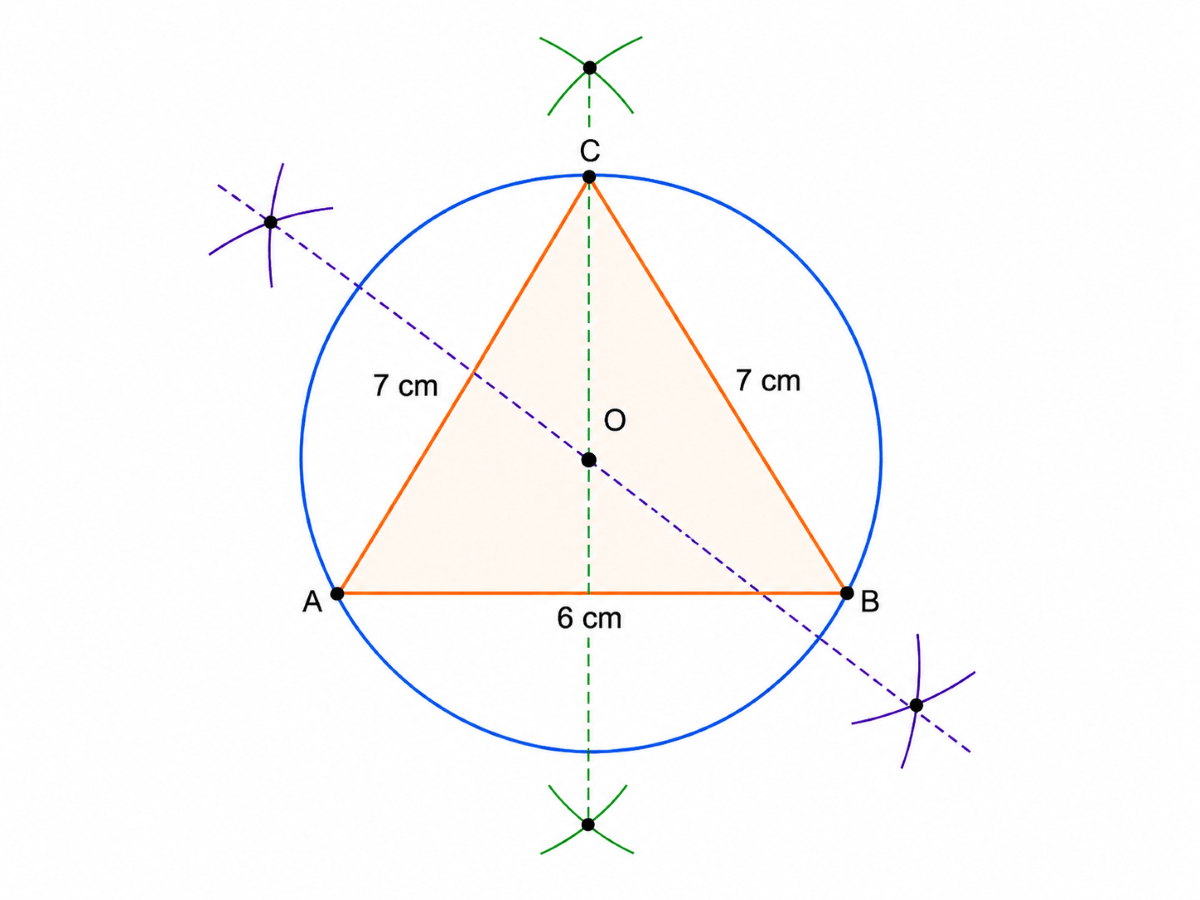
Draw △ABC, with AB = 6 cm, BC = 7 cm and CA = 7 cm. Draw the circumcircle of △ABC. Let the circumcentre be O. Measure OA, OB, OC.
✍️ Solution
Given,
AB = 6 cm
BC = 7 cm
CA = 7 cm
To construct,
1. △ABC
2. The circumcircle of △ABC
3. Measure OA, OB and OC
Construction: First construct △ABC using the three given sides. Then construct two perpendicular bisectors to locate the circumcentre O and draw the circumcircle.

📐 Construction Figure

Class 9 Maths Chapter 5 Exercise 5.1 Question 3 triangle ABC with circumcircle and circumcentre O

Figure: Triangle ABC with its circumcircle and circumcentre O.

✏️ Construction

Step 1. Draw AB = 6 cm.
Step 2. With A as centre and radius 7 cm, draw an arc.
Step 3. With B as centre and radius 7 cm, draw another arc intersecting the first arc at C.
Step 4. Join AC and BC. Thus, △ABC is constructed.
Step 5. Construct the perpendicular bisector of AB.
Step 6. Construct the perpendicular bisector of AC.
Step 7. Let the two perpendicular bisectors meet at O. Then O is the circumcentre of △ABC.
Step 8. With O as centre and OA as radius, draw the circumcircle.

📏 Measurement

On measuring the three radii of the circumcircle,
OA ≈ 3.9 cm
OB ≈ 3.9 cm
OC ≈ 3.9 cm

🔍 Observation

The measured values of OA, OB and OC are equal. Hence, O is equidistant from A, B and C and is therefore the circumcentre of △ABC.

✅ Final Answer

OA ≈ OB ≈ OC ≈ 3.9 cm.

Question 4
What is the least possible radius of a circle through two points A and B?
✍️ Solution
Given,
Two fixed points A and B.

📐 Geometrical Figure

Circles through two fixed points A and B Three circles pass through A and B. Their centres M, O1 and O2 lie on the perpendicular bisector of AB. The corresponding radii are r, r1 and r2. A B M O₁ O₂ r r₁ r₂ AB Perpendicular bisector

Figure: Different circles through A and B have their centres M, O₁ and O₂ on the perpendicular bisector of AB.

🔍 Explanation

Step 1. Let M be the midpoint of AB.
AM = MB = AB/2
Step 2. The centre of every circle passing through A and B lies on the perpendicular bisector of AB.
Step 3. If M is the centre, then
r = MA = MB = AB/2
Thus, AB is the diameter.
Step 4. For another centre O₁, triangle AMO₁ is right-angled at M. Therefore, r₁ = O₁A is the hypotenuse and
r₁ > AM = r
Step 5. Similarly, for centre O₂, triangle AMO₂ is right-angled at M. Its hypotenuse is r₂ = O₂A. Hence,
r₂ > AM = r
Also, since O₂ is farther from AB than O₁, r₂ > r₁.
Step 6. Therefore,
r < r₁ < r₂
So the smallest radius is r = AB/2, obtained when the centre is at the midpoint M of AB.

📌 Conclusion

The smallest possible radius is obtained when the centre is the midpoint of AB. In this case, AB is the diameter.

✅ Final Answer

Least possible radius = AB/2

📚 Continue Learning

Congratulations! You have completed the Class 9 Maths chapter 5 Exercise 5.1 Solutions. You have now worked through the first exercise of Chapter 5 – I’m Up and Down, and Round and Round. Continue your learning journey by moving to the next exercise, exploring the complete chapter, or revisiting Exercise 5.1 whenever you need a quick revision.


📖 Explore More Class 9 Maths Chapters

⚡ Quick Revision Dashboard

Revise the complete Class 9 Maths Chapter 5 — Circles in a few minutes before solving Exercise 5.1. Think of this as your whole lesson in short. 🎯

⭕ Circle — Know the Basics
Centre: fixed point from which the circle is drawn.
Radius: distance from the centre to any point on the circle.
Chord: joins any two points on the circle.
Diameter: chord passing through the centre.
💡 Remember: Diameter = 2 × Radius
📏 Perpendicular Bisector
✔ Divides a line segment into two equal parts at 90°.
✔ Every point on it is equidistant from the endpoints.
✔ For segment AB, a point O on its perpendicular bisector gives: OA = OB.
🎯 Key use: It helps us locate the centre of a circle.
🎯 Circumcentre — Find It
✔ In △ABC, construct the perpendicular bisectors of any two sides.
✔ Their intersection is the circumcentre O.
✔ Then: OA = OB = OC.
💡 Don’t guess the centre — construct it.
⭕ Circumcircle — Draw It
✔ Take O as the centre.
✔ Take OA (or OB or OC) as the radius.
✔ Draw the circle through A, B and C.
🎯 This circle is called the circumcircle.
📍 Position of Circumcentre
Acute triangle → Circumcentre is inside.
Right triangle → Circumcentre is the midpoint of hypotenuse.
Obtuse triangle → Circumcentre is outside.
🛠️ Triangle Construction Skills
SSS: Three sides given → use two arcs.
SAS: Two sides + included angle → construct the angle, then mark the second side.
ASA: Two angles + included side → construct both endpoint angles; their rays meet at the third vertex.
💡 Always follow the measurements carefully.
🧠 If You Forget Everything, Remember This
Construct triangle
Two perpendicular bisectors
Intersection = O
O = Circumcentre
OA as radius
Draw circumcircle
✅ Final Exercise 5.1 Checklist
☑ I know circle, radius, chord and diameter.
☑ I can construct a perpendicular bisector.
☑ I can locate the circumcentre.
☑ I know the position of O in all three triangle types.
☑ I can construct a circumcircle.
☑ I can construct triangles using SSS, SAS and ASA.
☑ I know why OA = OB = OC.
🚀 I’m ready for Exercise 5.1!

❓ Frequently Asked Questions

Find answers to common questions about Class 9 Maths Exercise 5.1 Solutions. These FAQs are designed to help you understand the ideas behind the exercise, avoid common construction mistakes, and prepare confidently for Chapter 5 – I’m Up and Down, and Round and Round.

What is the main focus of Exercise Set 5.1?

Exercise Set 5.1 introduces the construction-based ideas of Chapter 5 – I’m Up and Down, and Round and Round. The four questions involve constructing triangles, drawing their circumcircles, identifying the position of the circumcentre, measuring the radii of a circumcircle, and understanding the least possible radius of a circle through two given points.

What should I know before attempting Exercise 5.1?

You should be familiar with basic triangle construction, perpendicular bisectors, circles, radius, and the idea of a circumcircle and circumcentre. It is also important to understand that the perpendicular bisectors of the sides of a triangle meet at its circumcentre. These ideas are developed in the beginning of Chapter 5 before Exercise Set 5.1.

How do I construct the circumcircle of a triangle?

First construct the given triangle. Then construct the perpendicular bisectors of any two of its sides. Their point of intersection is the circumcentre. Taking this point as the centre and the distance to any vertex as the radius, draw the circle. The circle passes through all three vertices of the triangle and is called its circumcircle.

Where does the circumcentre lie in different types of triangles?

For an acute-angled triangle, the circumcentre lies inside the triangle. For an obtuse-angled triangle, it lies outside the triangle. For a right-angled triangle, the circumcentre lies at the midpoint of the hypotenuse.

Why are OA, OB and OC equal in Question 3?

In Question 3, O is the circumcentre of triangle ABC. Therefore A, B and C all lie on the same circumcircle with centre O. Since the radii of the same circle are equal, the distances from O to A, B and C are equal. Hence, OA = OB = OC.

What is the least possible radius of a circle passing through two points?

For two given points A and B, infinitely many circles can pass through them. The least possible radius is obtained when the centre is at the midpoint of AB. In that case, the radius is the distance from the midpoint of AB to either A or B.

What are the common mistakes in Exercise Set 5.1?

Common mistakes include constructing only one perpendicular bisector, incorrectly locating the circumcentre, drawing the circumcircle with an incorrect radius, and confusing the position of the circumcentre in acute and obtuse triangles. Students should also take care to use accurate construction and measurement.

Are these Class 9 Maths Exercise 5.1 Solutions based on Ganita Manjari 2026?

Yes. The solutions on this page are prepared from Chapter 5 – I’m Up and Down, and Round and Round of the NCERT Ganita Manjari (2026) Grade 9 textbook. Exercise Set 5.1 contains four questions covering triangle construction, circumcircles, circumcentre, measurement of radii, and the least possible radius through two given points.

📚 Useful Learning Resources

Continue your preparation with more Class 9 Maths resources from Maths Gurukulam, or visit the official NCERT and CBSE websites for the latest textbooks, syllabus, and academic updates.

Need Personal Guidance in Maths?

Find Class 9 Maths Chapter 5 Exercise 5.1 Solutions helpful? For students who need personal support beyond self-study, join Newton Study Point for concept-based Maths coaching by an experienced teacher. Small batches, individual attention, regular tests, and complete CBSE exam preparation are available for Classes 8, 9, 10, 11 & 12.

📞 Call Now: 8447002272 💬 WhatsApp 🏫 Explore Newton Study Point

📍 Newton Study Point • Ankur Vihar, Ghaziabad

Rakesh Kumar Singh - Maths Educator
👨‍🏫 Reviewed & Prepared By

Rakesh Kumar Singh

Founder, Maths Gurukulam & Newton Study Point
Teaching CBSE Mathematics Since 2006

These Class 9 Maths Chapter 5 Exercise 5.1 Solutions are carefully prepared according to the latest NCERT Ganita Manjari (2026) and the CBSE curriculum. The solutions follow a clear, step-by-step approach to help students understand the construction and reasoning used in Exercise 5.1 and build confidence in circle geometry.

📘 NCERT Ganita Manjari (2026) 🎯 CBSE Aligned 📝 Step-by-Step Solutions 💡 Concept-Based Learning
Know More About the Author →

Leave A Reply

Your email address will not be published. Required fields are marked *

You May Also Like