NCERT GANITA MANJARI 2026 • CLASS 9 MATHEMATICS
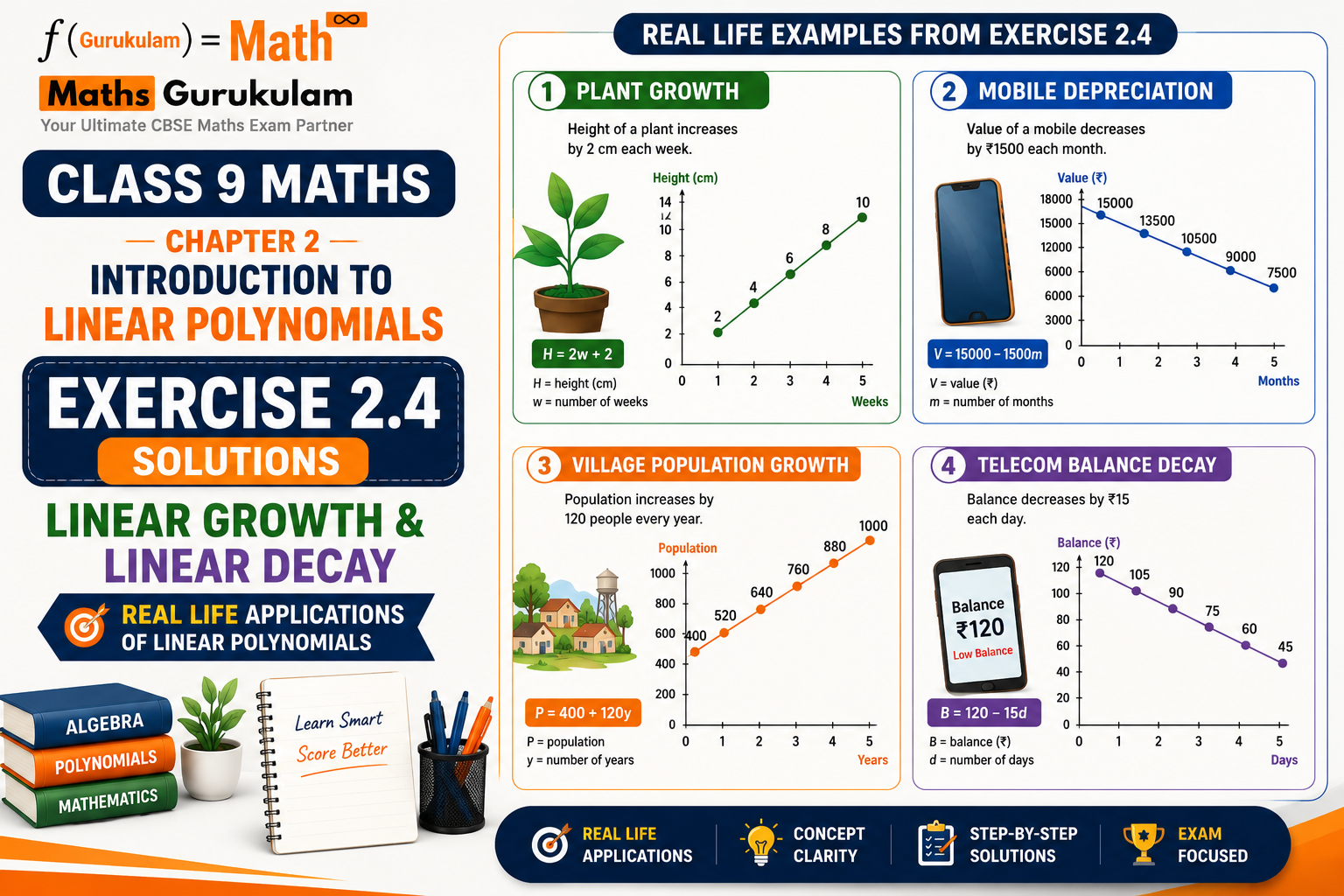
Looking for complete Class 9 Maths Chapter 2 Exercise 2.4 Solutions? Here you will get step-by-step solutions of all questions from the latest NCERT Ganita Manjari (2026) textbook. These solutions explain Linear Growth and Linear Decay patterns through real-life examples such as plant growth, mobile depreciation, village population growth, and telecom prepaid balance reduction.
these strong>Exercise 2.4 Solutions help students understand linear expressions, constant rate of change, table patterns, and the formation of linear models in an easy and exam-oriented manner.
📑 Table of Contents
In Class 9 Maths Chapter 2 Exercise 2.4, we study Linear Growth and Linear Decay through practical examples.
Question 1: 🌱 Plant Growth Pattern (Linear Growth) Question 2: 📱 Mobile Price Depreciation (Linear Decay) Question 3: 👨👩👧👦 Village Population Growth Model Question 4: 📞 Telecom Prepaid Balance ReductionAbout Class 9 Maths Chapter 2 Exercise 2.4
Class 9 Maths Chapter 2 Exercise 2.4 Solutions introduce students to the concepts of Linear Growth and Linear Decay through practical real-life situations. In this exercise, students learn how quantities increase or decrease by a fixed amount over equal intervals and how such situations can be represented using linear expressions.
The questions in Exercise 2.4 of NCERT Ganita Manjari (2026) are based on everyday examples such as plant growth, mobile phone depreciation, village population growth, and telecom prepaid balance reduction. These examples of Class 9 Maths Chapter 2 Exercise 2.4 Solutions help students understand the practical applications of linear polynomials and constant rate of change.
Important Topics Covered
- ✅ Linear Growth Pattern
- ✅ Linear Decay Pattern
- ✅ Constant Rate of Change
- ✅ Linear Expressions
- ✅ Real-Life Applications of Linear Polynomials
- ✅ Plant Growth Models
- ✅ Mobile Depreciation Models
- ✅ Population Growth Patterns
- ✅ Telecom Balance Reduction
Class 9 Maths Chapter 2 Exercise 2.4 Solutions
Question 1
Suppose a plant has height 1.75 feet and it grows by 0.5 feet each month.
(i) Find the height after 7 months.
(ii) Make a table of values for t varying from 0 to 10 months and show how the height, h, increases every month.
(iii) Find an expression that relates h and t, and explain why it represents linear growth.
Given:
- Initial height of the plant = 1.75 feet
- Monthly growth = 0.5 feet
To Find:
- The height after 7 months.
- The table showing the growth pattern.
- The linear expression relating h and t.
Solution:
Initially, the height of the plant is
1.75 feet
The plant grows by
0.5 feet every month.
(i) Height after 7 months
h = 1.75 + (7 × 0.5)
= 1.75 + 3.5
= 5.25 feet
Therefore, the height after 7 months is
5.25 feet
(ii) Table of Values
| Month, t | 0 | 1 | 2 | 3 | 4 | 5 | 6 | 7 | 8 | 9 | 10 |
| Height, h (feet) | 1.75 | 2.25 | 2.75 | 3.25 | 3.75 | 4.25 | 4.75 | 5.25 | 5.75 | 6.25 | 6.75 |
Observe the Linear Growth Pattern:
1.75
1.75 + 1 × 0.5
1.75 + 2 × 0.5
1.75 + 3 × 0.5
Therefore, after t months,
h = 1.75 + 0.5t
(iii) Why does this represent Linear Growth?
The height of the plant increases by a fixed amount of
0.5 feet every month.
Since the increase is constant, the relation
h = 1.75 + 0.5t
represents a Linear Growth Pattern.
- The height after 7 months is 5.25 feet.
Linear Expression:
h = 1.75 + 0.5t
Key Concept Used: A quantity that increases by a fixed amount over equal intervals represents linear growth.
Common Mistake: Students often multiply the initial value by the number of months instead of adding the monthly increase.
Exam Tip: In linear growth problems, first write the initial value and then add the fixed increase for each time interval.
Question 2
A mobile phone is bought for ₹10,000. Its value decreases by ₹800 every year.
(i) Find the value of the phone after 3 years.
(ii) Make a table of values for t varying from 0 to 8 years and show how the value of the phone, v, depreciates with time.
(iii) Find an expression that relates v and t, and explain why it represents linear decay.
Given:
- Initial value of the mobile phone = ₹10,000
- Decrease in value every year = ₹800
To Find:
- The value of the phone after 3 years.
- The table showing the depreciation pattern.
- The linear expression relating v and t.
Solution:
Initially, the value of the mobile phone is
₹10,000
The value decreases by
₹800 every year.
(i) Value after 3 years
v = 10000 − (3 × 800)
= 10000 − 2400
= ₹7600
Therefore, the value of the mobile phone after 3 years is
₹7600
(ii) Table of Values
| Year, t | 0 | 1 | 2 | 3 | 4 | 5 | 6 | 7 | 8 |
| Value, v (₹) | 10000 | 9200 | 8400 | 7600 | 6800 | 6000 | 5200 | 4400 | 3600 |
Observe the Linear Decay Pattern:
10000
10000 − 1 × 800
10000 − 2 × 800
10000 − 3 × 800
Therefore, after t years,
v = 10000 − 800t
(iii) Why does this represent Linear Decay?
The value of the mobile phone decreases by a fixed amount of
₹800 every year.
Since the decrease is constant, the relation
v = 10000 − 800t
represents a Linear Decay Pattern.
- The value of the mobile phone after 3 years is ₹7600.
Linear Expression:
v = 10000 − 800t
Key Concept Used: A quantity that decreases by a fixed amount over equal intervals represents linear decay.
Common Mistake: Students often add ₹800 instead of subtracting it while calculating depreciation.
Exam Tip: In depreciation problems, always start with the original value and subtract the fixed decrease occurring in each time interval.
Question 3
The initial population of a village is 750. Every year, 50 people move from a nearby city to the village.
(i) Find the population of the village after 6 years.
(ii) Make a table of values for t varying from 0 to 10 years and show how the population, P, increases every year.
(iii) Find an expression that relates P and t, and explain why it represents linear growth.
Given:
- Initial population of the village = 750
- Increase in population every year = 50 people
To Find:
- The population after 6 years.
- The table showing the population growth.
- The linear expression relating P and t.
Solution:
Initially, the population of the village is
750
Every year, the population increases by
50 people.
(i) Population after 6 years
P = 750 + (6 × 50)
= 750 + 300
= 1050
Therefore, the population of the village after 6 years is
1050
(ii) Table of Values
| Year, t | 0 | 1 | 2 | 3 | 4 | 5 | 6 | 7 | 8 | 9 | 10 |
| Population, P | 750 | 800 | 850 | 900 | 950 | 1000 | 1050 | 1100 | 1150 | 1200 | 1250 |
Observe the Linear Growth Pattern:
750
750 + 1 × 50
750 + 2 × 50
750 + 3 × 50
Therefore, after t years,
P = 750 + 50t
(iii) Why does this represent Linear Growth?
The population of the village increases by a fixed number of
50 people every year.
Since the increase is constant, the relation
P = 750 + 50t
represents a Linear Growth Pattern.
- The population of the village after 6 years is 1050.
Linear Expression:
P = 750 + 50t
Key Concept Used: A quantity that increases by a fixed amount over equal intervals represents linear growth.
Common Mistake: Students often forget to include the initial population while writing the linear expression.
Exam Tip: In growth problems, always write the initial value first and then add the fixed increase occurring in each time interval.
Question 4
A telecom company charges ₹600 for a certain recharge scheme. This prepaid balance is reduced by ₹15 each day after the recharge.
(i) Write an equation that models the remaining balance b(x) after using the scheme for x days. Explain why it represents linear decay.
(ii) After how many days will the balance run out?
(iii) Make a table of values for x varying from 1 to 10 days and show how the balance b(x) reduces with time.
Given:
- Initial prepaid balance = ₹600
- Balance decreases by ₹15 every day
To Find:
- The equation representing the remaining balance.
- The number of days after which the balance becomes zero.
- A table showing the decrease in balance.
Solution:
Initially, the prepaid balance is
₹600
The balance decreases by
₹15 every day.
(i) Equation of the Remaining Balance
After 1 day,
Balance = 600 − 15
= ₹585
After 2 days,
Balance = 600 − 2 × 15
= ₹570
Similarly, after x days,
b(x) = 600 − 15x
Since the balance decreases by a fixed amount of ₹15 every day, the relation
b(x) = 600 − 15x
represents a Linear Decay Pattern.
(ii) When will the balance run out?
The balance becomes zero when
b(x) = 0
Substituting in the equation,
600 − 15x = 0
15x = 600
x = 40
Therefore, the prepaid balance will run out after
40 days
(iii) Table of Values
| Days, x | 1 | 2 | 3 | 4 | 5 | 6 | 7 | 8 | 9 | 10 |
| Balance, b(x) (₹) | 585 | 570 | 555 | 540 | 525 | 510 | 495 | 480 | 465 | 450 |
Observe the Linear Decay Pattern:
600 − 1 × 15
600 − 2 × 15
600 − 3 × 15
…
600 − x × 15
Linear Equation:
b(x) = 600 − 15x
Balance runs out after
40 days
Key Concept Used: A quantity that decreases by a fixed amount over equal intervals represents linear decay.
Common Mistake: Students often write 600 + 15x instead of 600 − 15x while forming the equation.
Exam Tip: For linear decay problems, always begin with the initial value and subtract the fixed amount that decreases in each time interval.
📚What We Learned in Class 9 Maths Chapter 2 Exercise 2.4 solutions
Plant and population growth patterns
Mobile value and prepaid balance reduction
Finding values using tables
Writing expressions for the nth term
Frequently Asked Questions (FAQs)
What is the answer of Question 1 of Class 9 Maths Chapter 2 Exercise 2.4?
In Question 1, the height of the plant after 7 months is 5.25 feet and the linear growth equation is h = 1.75 + 0.5t.
What is the linear decay equation in Question 2 of Exercise 2.4?
The value of the mobile phone decreases by ₹800 every year. Therefore, the linear decay equation is v = 10000 − 800t.
What is the population equation in Question 3 of Exercise 2.4?
The population increases by 50 people every year. Hence, the linear growth equation is P = 750 + 50t.
After how many days will the prepaid balance become zero in Question 4?
The prepaid balance becomes zero after 40 days using the equation b(x)=600−15x.
What is linear growth in Class 9 Maths?
Linear growth occurs when a quantity increases by a fixed amount after equal intervals of time. Examples include plant growth and population growth.
What is linear decay in Class 9 Maths?
Linear decay occurs when a quantity decreases by a fixed amount after equal intervals of time. Examples include mobile depreciation and prepaid balance reduction.
How can we identify a linear pattern?
A pattern is linear if the increase or decrease between consecutive values remains constant.
Why is Exercise 2.4 important in Class 9 Maths Chapter 2?
Exercise 2.4 helps students understand linear growth, linear decay, linear expressions, and real-life applications of linear polynomials.
What are some real-life examples of linear growth and linear decay?
Examples include plant growth, village population increase, mobile phone depreciation, salary increments, and prepaid balance reduction.
Are questions from Exercise 2.4 important for CBSE exams?
Yes. Questions based on linear growth, linear decay, tables, and forming linear expressions are frequently used in CBSE examinations and higher mathematics.
Official Learning Resources
For additional reference and official curriculum information, students can visit:
These official educational resources provide authentic syllabus information, curriculum updates, and academic guidelines.
Explore More Class 9 Maths Chapter 2 Resources
Continue your preparation with other exercises and study resources from Class 9 Maths Chapter 2 – Introduction to Linear Polynomials.
Complete Chapter Resources
Chapter Revision Questions
Introduction to Polynomials
Linear Equations
Linear Patterns
Linear Growth & Linear Decay
Coming Soon
Coming Soon
Coming Soon
Need More Class 9 Maths Solutions & Personal Guidance?
Explore complete Class 9 Maths Solutions based on the latest NCERT Ganita Manjari (2026) textbook with step-by-step solutions, graphs, exam tips, important concepts, and chapter-wise exercises.
🎓 Need Personal Maths Guidance?
Join Newton Study Point for offline coaching classes in Ankur Vihar, Ghaziabad or learn online through Maths Gurukulam with chapter-wise explanations, exam preparation, doubt support, and board-focused guidance.
✔ Offline Coaching Classes • ✔ Online Maths Classes • ✔ CBSE Exam Preparation • ✔ Personal Guidance
More chapter-wise notes, important questions, worksheets, and PDF resources will be added regularly.

Reviewed & Prepared By
Rakesh Kumar
Founder, Newton Study Point & Maths Gurukulam | Mathematics Educator Since 2006
Rakesh Kumar has been teaching Mathematics since 2006 and has guided hundreds of students from Classes 8 to 12. His teaching approach focuses on conceptual understanding, problem-solving techniques, and exam-oriented preparation.
These Class 9 Maths Chapter 2 Exercise 2.4 Solutions have been carefully prepared according to the latest NCERT Ganita Manjari (2026) textbook to help students understand Linear Growth, Linear Decay, and their real-life applications through step-by-step explanations.
📖 Continue Your Learning Journey
Previous Exercise
← Exercise 2.3 SolutionsNext Exercise
Exercise 2.5 Solutions →