Home › Class 9 Maths › Chapter 3 › Exercise 3.4
Class 9 Maths Chapter 3 Exercise 3.4 Solutions (Ganita Manjari 2026)
Learn how to represent rational numbers on the number line, find rational numbers between two numbers, and solve every question of Exercise 3.4 with easy step-by-step explanations following the latest CBSE and NCERT (Ganita Manjari 2026) pattern.
📚 Learn Before You Solve
Before solving Exercise 3.4, revise this simple method. It will help you solve almost every number line question quickly and correctly.
📍 Card 1: How to Represent a Rational Number on the Number Line
Find the Interval
Locate the two integers between which the rational number lies.
Divide Equally
Divide one unit into as many equal parts as the denominator.
Count the Parts
Move the required number of equal parts according to the numerator.
Mark the Point
Mark the rational number on the number line. Move right for positive numbers and left for negative numbers.
🔍 Card 2: How to Find Rational Numbers Between Two Rational Numbers
Sometimes two rational numbers have no visible number between them. In such cases, first convert them into equivalent fractions with a common denominator. Then choose any fraction lying between them.
Make Denominators Same
Convert both rational numbers into equivalent fractions having the same denominator.
Compare Numerators
Look at the numerators and identify the numbers that lie between them.
Choose Any Fraction
Write any fraction whose numerator lies between the two numerators.
Write the Answer
The selected fraction is a rational number lying between the given rational numbers.
Between 1/4 and 3/4, one rational number is 2/4 = 1/2.
📊 Concept Infographic
Before solving the questions, revise the complete method of representing a rational number on the number line through this visual infographic.
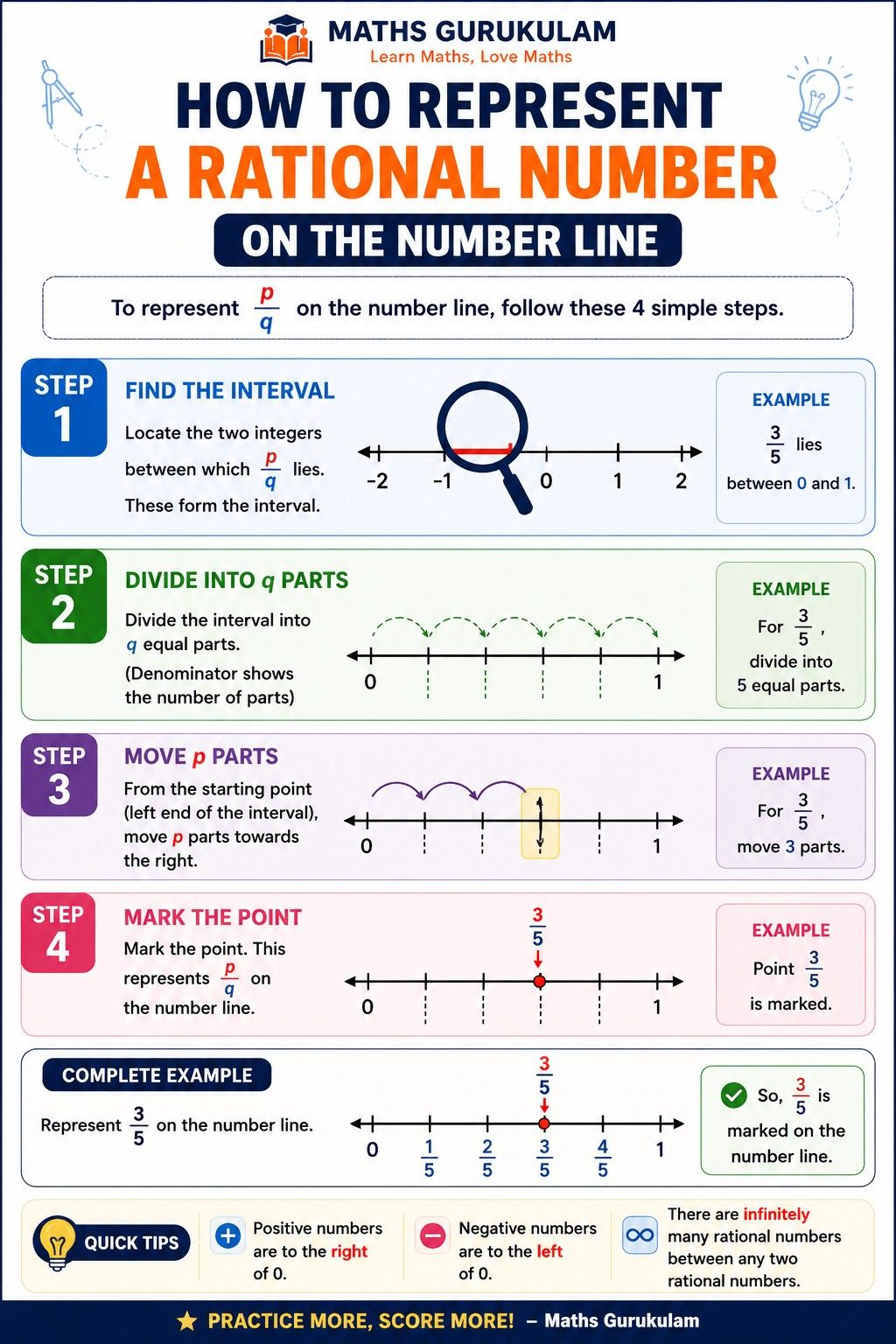
Figure: Follow these four simple steps to represent any rational number on the number line: Find the Interval → Divide into q Equal Parts → Move p Parts → Mark the Point.
💡 Quick Revision: The denominator tells you how many equal parts to make, while the numerator tells you how many parts to count from the starting point.
⚠️ Common Mistakes to Avoid
Many students lose marks in number line questions because of small mistakes. Check these points before solving Exercise 3.4.
❌ Ignoring the Denominator
Always divide one unit into the number of equal parts shown by the denominator.
❌ Counting Incorrectly
After dividing the interval, count the required number of parts carefully according to the numerator.
❌ Wrong Direction
Positive rational numbers are marked to the right of 0, while negative rational numbers are marked to the left.
❌ Assuming Only One Number Exists
There are infinitely many rational numbers between any two rational numbers.
📝 Class 9 Maths Chapter 3 Exercise 3.4 Solutions
Below are the complete step-by-step solutions for every question of Exercise 3.4 (Ganita Manjari 2026). Follow each solution carefully to understand the method and improve your problem-solving skills.
Given
The given rational numbers are:
- 2 3
- 5 4
- −1 2
To Find
Represent the given rational numbers on a single number line.
Solution
General Method (NCERT)
To represent a rational number on the number line:
- Identify the two consecutive integers between which the rational number lies.
- Divide one unit into as many equal parts as the denominator.
- Move the required number of equal parts according to the numerator.
- Move towards the right for positive numbers and towards the left for negative numbers.
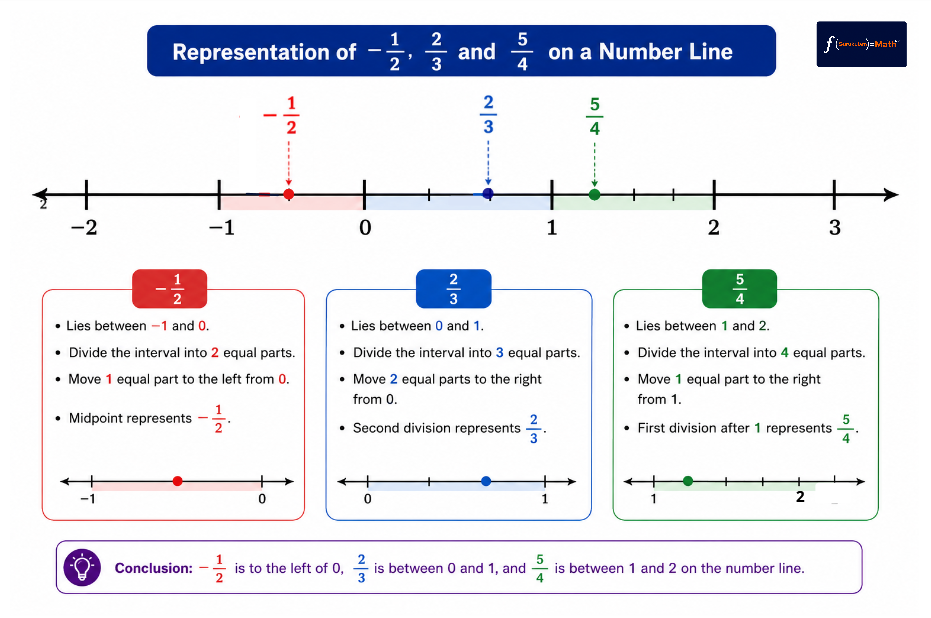
(i) Representation of 2 3
- The rational number lies between 0 and 1.
- Divide the interval from 0 to 1 into 3 equal parts.
- Move 2 equal parts to the right from 0.
- The second division point represents 2 3 .
(ii) Representation of 5 4
Convert the improper fraction into a mixed fraction.
- It lies between 1 and 2.
- Divide the interval from 1 to 2 into 4 equal parts.
- Move 1 equal part to the right from 1.
- The first division after 1 represents 5 4 .
(iii) Representation of −1 2
- It lies between −1 and 0.
- Divide the interval into 2 equal parts.
- Move 1 equal part to the left from 0.
- The midpoint represents −1 2 .
Final Answer
The rational numbers −1 2 , 2 3 and 5 4 are represented on the same number line by following the NCERT method. Divide each unit according to the denominator and move the required number of parts according to the numerator to locate the correct position of each rational number.
💡 Key Concept
Denominator → Divide | Numerator → Move
❌ Common Mistake
Dividing the unit according to the numerator instead of the denominator.
📝 Exam Tip
Always show equal divisions clearly on the number line.
🧠 Memory Trick
D = Divide, N = Move.
Given
Rational numbers are −1 2 and 1 4
To Find
Three distinct rational numbers lying strictly between the given rational numbers.
Solution
First, express both rational numbers with the same denominator.
Therefore, the given rational numbers become
Between −2 4 and 1 4 there are only two rational numbers,
Since three rational numbers are required, multiply the numerator and denominator of each fraction by 2.
Multiply the numerator and denominator of each fraction by 2.
Therefore, the given rational numbers become
The integers lying between −4 and 2 are
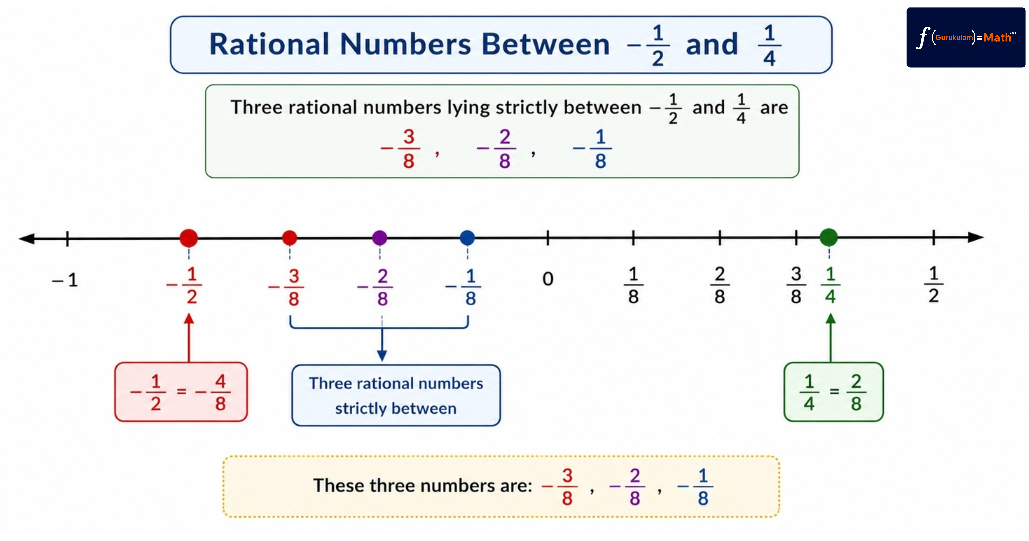
Hence, any three rational numbers lying strictly between −4 8 and 2 8 are
Number Line Representation
The rational numbers lie between −4/8 and 2/8.
Final Answer
Three rational numbers lying strictly between −1 2 and 1 4 are
📘 Key Concept Used
To obtain more rational numbers between two given rational numbers, first convert them into equivalent fractions having a larger common denominator.
❌ Common Mistake
Students often write −1/4 and 0 without checking whether three distinct rational numbers are actually available.
📝 Exam Tip
Always show the multiplication used to convert equivalent fractions. Do not jump directly to the new denominator in the board examination.
💡 Memory Trick
Need more numbers?
Increase the denominator first, then choose the numerators lying between them.
Given
The given expression is
To Find
Simplify the given expression.
Solution
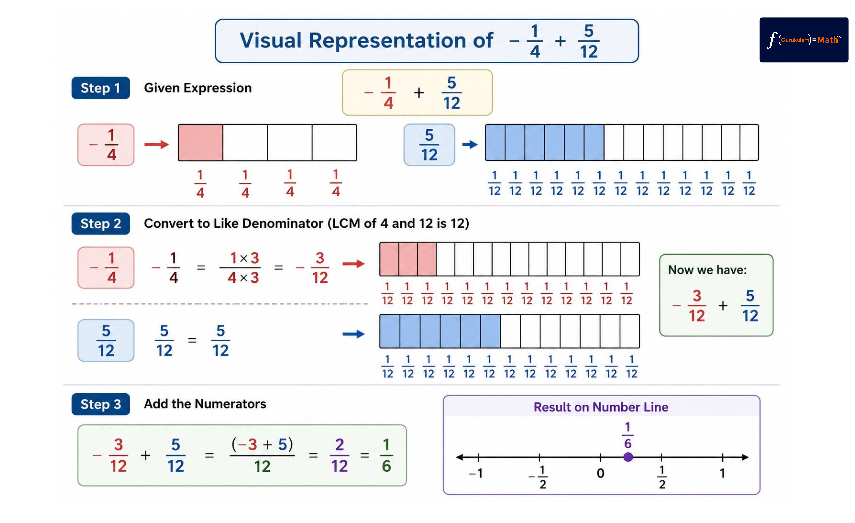
The denominators are 4 and 12.
Their Least Common Multiple (LCM) is 12.
Convert both fractions into equivalent fractions having denominator 12.
Therefore, the given expression becomes
Now add the numerators since the denominators are the same.
Add the numerators and keep the denominator the same.
Therefore, the simplified value of the given expression is
Visual Representation
Both fractions are first converted to the same denominator (12), then their numerators are added and the result is simplified.
Final Answer
Therefore,
Given
- Total silk = 15 3 4 metres
- Silk required for one kurta = 2 1 4 metres
To Find
Find the exact number of kurtas the tailor can make.
Solution
First, convert the mixed fractions into improper fractions.
Therefore,
Divide one fraction by another fraction.
Divide by multiplying with the reciprocal of the divisor.
Final Answer
Therefore, the tailor can make 7 kurtas.
Given
The given decimal numbers are 3.1415 and 3.1416.
To Find
Find any three rational numbers lying between 3.1415 and 3.1416.
Solution
Write both decimal numbers with one more decimal place.
Now the given numbers become
Any decimal numbers lying between these two numbers will also be rational numbers.
We can now choose any three numbers between 3.14150 and 3.14160.
We can choose any three decimal numbers between 3.14150 and 3.14160.
These numbers lie between 3.14150 and 3.14160.
Final Answer
Therefore, three rational numbers between 3.1415 and 3.1416 are
Given
Two rational numbers are given.
To Find
Find another method to obtain a rational number between the given rational numbers.
Solution
Yes. A rational number between any two rational numbers can also be found by taking their average (mean).
If the two rational numbers are a and b, then their average is
This average always lies between a and b.
Example: Find a rational number between
(Simplify this expression to get a rational number between them.)
Let us verify this method using the given example.
Thus, 5 8 lies between 1 2 and 3 4 .
Final Answer
Yes. Another way to find a rational number between any two rational numbers is to take their average (mean).
The average always lies between the two given rational numbers.
🎯 Exercise 3.4 Quick Revision Sheet
Revise the complete Exercise 3.4 in just 2 minutes before your class test or CBSE examination.
📘 Key Concepts
- Represent rational numbers on the number line.
- Find rational numbers between two fractions.
- Simplify expressions involving rational numbers.
- Use rational numbers in real-life situations.
- Decimals are also rational numbers.
- Infinitely many rational numbers exist between two rational numbers.
🧠 Memory Tricks
- Denominator → Equal Parts
- Numerator → Count Parts
- LCM first while adding or subtracting fractions.
- Division means multiply by the reciprocal.
- Make equivalent fractions to find numbers between two rational numbers.
⚠️ Common Mistakes
- Choosing the wrong interval on the number line.
- Unequal divisions on the number line.
- Forgetting to simplify the final answer.
- Taking the wrong reciprocal during division.
- Thinking only one rational number exists between two numbers.
📝 CBSE Exam Tips
- Draw neat and equally spaced number lines.
- Show every calculation step.
- Simplify answers wherever possible.
- Write units correctly in word problems.
- Always box the final answer.
✅ After Completing Exercise 3.4, You Can
❓ Frequently Asked Questions – Class 9 Maths Chapter 3 Exercise 3.4 Solutions
Find quick answers to the most frequently asked questions about Class 9 Maths Chapter 3 Exercise 3.4 Solutions (Ganita Manjari 2026). These FAQs will help you understand important concepts and prepare better for your CBSE examinations.
🔗 Useful Resources
Explore these official educational resources for authentic CBSE and NCERT study materials.
Need Personal Guidance in Maths?
Join Newton Study Point for concept-based Maths coaching by an experienced teacher. Small batches, individual attention, regular tests, and complete CBSE exam preparation for Classes 8, 9, 10, 11 & 12.
📞 Call Now: 8447002272 💬 WhatsApp📍 Newton Study Point • Ankur Vihar, Ghaziabad

Rakesh Kumar Singh
Founder, Maths Gurukulam & Newton Study Point
Teaching CBSE Mathematics Since 2006
These Class 9 Maths Chapter 3 Exercise 3.4 Solutions are carefully prepared according to the latest NCERT Ganita Manjari (2026) and the CBSE curriculum. Every solution is explained in a simple, step-by-step manner to help students understand concepts, avoid common mistakes, and score better in examinations.
📚 Continue Learning
Explore More NCERT Solutions