Answers
Exercise-wise Solutions
Find clear, step-by-step answers for Exercise Sets 6.1, 6.2, 6.3 and the End-of-Chapter Exercises.
View Exercise Solutions →Find Class 9 Maths Chapter 6 Solutions with clear, step-by-step answers based on the latest NCERT Ganita Manjari (2026–27). Understand perimeter, circumference, arc length and area, learn the important formulas and methods, and quickly move to the exercise-wise solutions you need.
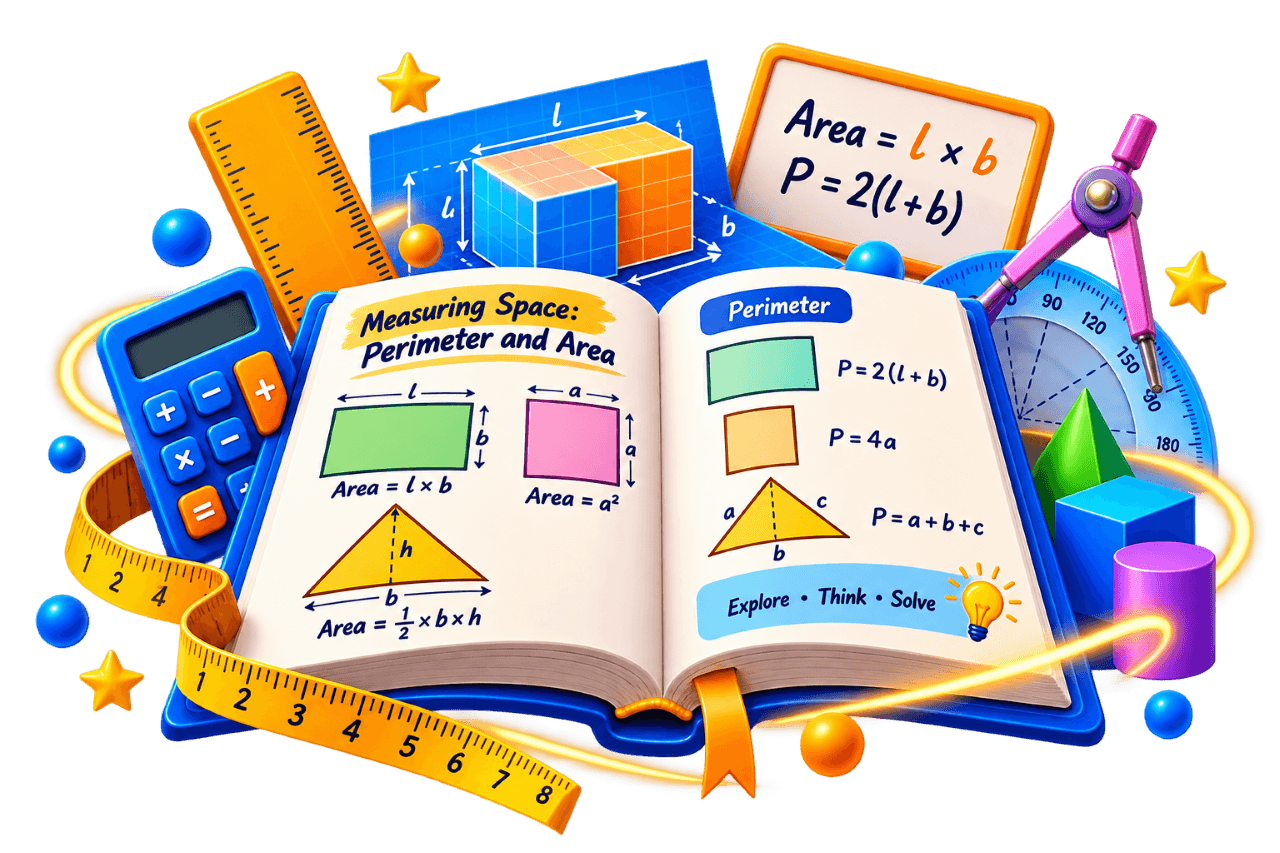
Looking for an exercise answer, an important formula or a concept explanation? Start with the section you need and move through Chapter 6 at your own pace.
Find clear, step-by-step answers for Exercise Sets 6.1, 6.2, 6.3 and the End-of-Chapter Exercises.
View Exercise Solutions →Revise perimeter, circumference, arc length, areas of shapes, Heron’s Formula, circle area and sector-area relationships.
Explore Formulas →Explore the additional thinking questions from Chapter 6 and understand the reasoning behind perimeter, area and circular measurements.
View Think & Reflect →See how the chapter connects perimeter, circular boundaries, area, Heron’s Formula, sectors, segments and related ideas.
Explore Concept Map →Revise the essential formulas and key relationships before solving questions or preparing for a test.
Open Quick Revision →Chapter 6 learning and solutions are organised around the latest NCERT Ganita Manjari textbook: Measuring Space: Perimeter and Area.
Start Chapter 6 →Find your question → open the exercise solution → check the concept or formula if needed → understand the reasoning → continue with the next question.
Class 9 Maths Chapter 6 Solutions become easier when you understand how the chapter connects perimeter, circles, arc length, area and geometric reasoning. Ganita Manjari builds these ideas step by step, from familiar shapes to more challenging circle and area problems.
Build the basic idea of perimeter as the total length around a shape and apply it to squares, rectangles, triangles and other boundaries.
Understand why the ratio of a circle's circumference to its diameter remains constant, and see how this leads to the important idea of π.
Explore the mathematical idea behind the irrationality of π and see how the study of the circle connects geometry with number concepts.
Learn how the length of a semicircular, quarter-circular and general arc is connected to the circumference and its corresponding central angle.
Apply perimeter ideas to interesting shapes and real-life situations, including curved boundaries, tracks and problems where careful interpretation matters.
Revisit area as the amount of two-dimensional space occupied by a region and connect the idea of square units with the area of rectangles and squares.
Understand how area relationships are developed for parallelograms and triangles, including the role of base, height and geometric transformations.
Learn how the area of a triangle can be found when its three sides are known, using the semi-perimeter and Heron’s Formula in suitable problems.
Explore the classical idea of constructing a square equal in area to a given rectangle and connect geometry with the mathematical heritage of Baudhāyana.
Understand the reasoning behind the area of a circle and connect it with the idea of rearranging circular slices into a parallelogram-like shape.
Extend the idea of circle area to sectors and understand how the central angle determines the portion of the circle represented by a sector.
Class 9 Maths Chapter 6 — Measuring Space: Perimeter and Area
Use when: the question asks for the distance around a closed shape.
Use when: finding the distance around a circle from its radius or diameter.
Remember: π is the constant ratio of a circle's circumference to its diameter.
Use when: only a part of the circumference is required.
Important: the height must be perpendicular to the chosen base.
Use when: all three sides of a triangle are known and its area is required.
Use when: the complete circular region is being measured.
Use when: only a portion of the circular area determined by a central angle is required.
Think: a quadrant is a sector with central angle 90°.
Use when: the region is bounded by an arc and its chord.
Use when: a complicated region can be divided into familiar shapes.
Remember: do not include internal lines unless the question specifically asks for them.
First identify what is being measured — boundary, circumference, arc, area, sector or segment. Then identify the known dimensions and choose the formula that matches the geometry of the figure.
Strengthen your understanding of Chapter 6 through thoughtful questions that encourage reasoning, observation and deeper mathematical thinking.
Explore the Think & Reflect questions from Measuring Space: Perimeter and Area and develop a deeper understanding of perimeter, circumference, area, geometric construction and mathematical reasoning.
💡 Explore Think & Reflect Solutions →A clear step-by-step explanation based on Measuring Space: Perimeter and Area.
The stagger is needed because runners in the outer lanes travel a greater distance on the curved portions of the track.
The extra distance depends on the difference in the radii of adjacent lanes, which is determined by the width of the lanes.
Therefore, simply making the track 200 m instead of 400 m does not mean that the stagger must be smaller.
If the school uses the same lane width, the difference in radii of adjacent lanes remains the same. Hence, the required stagger will also remain the same.
A clear step-by-step explanation based on Measuring Space: Perimeter and Area.
The 400 m athletics track and the circle both involve finding the total distance around a shape.
For the 400 m athletics track, the total distance is found by adding the lengths of the two straight sections and the two semicircular sections.
Similarly, the perimeter of a circle is the total distance around the circle, which is called its circumference.
Thus, both questions are connected by the idea of finding the perimeter, or total distance around a shape. The curved parts of the athletics track are related to the circumference of a circle.
A clear step-by-step explanation based on Measuring Space: Perimeter and Area.
From Fig. 6.11, the width of each lane is 1.22 m. Therefore, the difference in radius between the first and second lanes is
The curved portions of the track consist of two semicircles. Together, these two semicircles form one complete circle.
Hence, the extra distance travelled by the runner in the second lane on the curved portions is
Thus, the runner in the second lane needs to start approximately 7.66 m ahead of the runner in the first lane.
The width of every lane is the same, 1.22 m. Therefore, the difference in radius between the second and third lanes is also 1.22 m.
Chapter 6 • Measuring Space: Perimeter and Area
Chapter 6 • Measuring Space: Perimeter and Area
Yes, it is possible.
In parallelogram ABCD, diagonal AC divides the parallelogram into two triangles, △ABD and △ACD.
These two triangles have the same base AD and equal perpendicular heights because the points B and C lie on a line parallel to AD.
To rearrange △ABD, we can make a straight cut through the triangle to form smaller pieces. These pieces can then be moved and fitted together along the sides of △ACD.
The cut pieces do not overlap and no piece is left over. Since cutting and rearranging do not change the total area, the pieces can exactly cover △ACD.
This is an example of an area-preserving dissection: the shape may change after rearrangement, but the total area remains unchanged.
Class 9 Maths Chapter 6 में कौन-सा concept कहाँ मिलेगा? नीचे topic चुनें और सीधे उसके detailed Learn Before You Solve section पर जाएँ।
Perimeter को boundary की total length के रूप में समझें और different shapes की perimeter reasoning से शुरुआत करें।
Learn the Concept →Circle की circumference, diameter और radius के relationship से π की meaning और use को समझें।
Learn the Concept →Full circle से arc तक आते हुए angle के आधार पर arc की length समझें और calculate करना सीखें।
Learn the Concept →Arc की length और पूरे sector की perimeter में difference पहचानें और सही boundary को calculate करें।
Learn the Concept →Triangle का area, base और corresponding height के relationship से area reasoning को मजबूत करें।
Learn the Concept →Parallel sides और height की मदद से trapezium का area समझें और formula को सही situation में apply करें।
Learn the Concept →जब triangle की तीनों sides दी हों, तब semi-perimeter और Heron’s Formula की मदद से area निकालें।
Learn the Concept →Equal-area triangles, parallel-line reasoning और area ratios को geometry problems में use करना सीखें।
Learn the Concept →Circle के area को समझें और πr² को radius के साथ correctly use करना सीखें।
Learn the Concept →Central angle के आधार पर sector का area समझें और fraction-of-circle reasoning को apply करें।
Learn the Concept →Chord, sector और circular segment के बीच relationship को पहचानें और composite area problems समझें।
Learn the Concept →Circle के अंदर बने regular figures में circle, radius और area relationships को समझें।
Learn the Concept →Perimeter, area, circle, sector और important formula-based ideas को जल्दी revise करने के लिए।
Open Quick Revision →Perimeter, Circumference, Arc Length, Areas, Heron’s Formula, Sectors & Segments के important concepts और formulas को जल्दी revise करें। किसी concept को detail में पढ़ना हो तो उसके Learn Before You Solve section पर जाएँ।
किसी closed shape की boundary की total length उसका perimeter कहलाती है। सभी outer sides की lengths को add करें।
Circle की boundary की length को circumference कहते हैं। Circumference और diameter का ratio constant होता है।
Circle के circumference का एक हिस्सा arc कहलाता है। Arc की length उसके central angle के proportion में होती है।
Sector का perimeter केवल arc नहीं होता। इसमें दो radii + arc length शामिल होते हैं।
Triangle का area उसकी base और corresponding height से निकाला जाता है।
Parallelogram का area base × corresponding height के बराबर होता है। Slant side को height न समझें।
जब triangle की तीनों sides दी हों, तो Heron’s Formula से उसका area निकाला जा सकता है।
Same base और same height वाले suitable shapes में area relationships को पहचानना calculation को काफी आसान बनाता है।
Circle का area उसके radius के square के proportional होता है। Radius की value को सही unit में रखें।
Sector का area पूरे circle के area का central angle के अनुसार corresponding fraction होता है।
Circle में chord, arc, sector और segment को अलग-अलग पहचानना जरूरी है। Diagram देखकर सही region identify करें।
Circle के अंदर बने regular figures में radius, side, perimeter और area के बीच relationships को identify करें।
Perimeter, Circumference, Arc Length, Area, Heron’s Formula & Sectors के questions में answer गलत होने से बचने के लिए इन common mistakes को solve करने से पहले एक बार जरूर check करें।
Perimeter boundary की total length है, जबकि area enclosed region का measure है। Question में जो पूछा गया है उसी के अनुसार formula चुनें।
Circle में d = 2r और r = d/2। अगर question में diameter दिया है तो उसे सीधे πr² में radius की जगह न रखें।
Circle की boundary की length के लिए C = 2πr या C = πd use करें। Area का formula πr² circumference के लिए नहीं है।
Arc पूरे circumference का केवल एक हिस्सा होता है। इसलिए central angle θ के लिए पूरे circumference का θ/360° हिस्सा लेना होता है।
Sector के boundary में केवल curved arc नहीं होता। इसमें दो radii भी शामिल होती हैं। इसलिए sector का perimeter निकालते समय दोनों radii को include करें।
Triangle का area निकालते समय height हमेशा चुनी गई base पर perpendicular height होनी चाहिए। कोई भी slant side automatically height नहीं होती।
Parallelogram में area के लिए base × corresponding perpendicular height लें। Slant side को height मानना common mistake है।
Heron’s Formula में s semiperimeter है, पूरा perimeter नहीं। पहले तीनों sides का sum करें और फिर 2 से divide करें।
Heron’s Formula में चारों factors को carefully substitute करें। प्रत्येक side को s से subtract करना है। Bracket या sign की छोटी गलती पूरा answer बदल देती है।
Length का answer cm, m, km जैसी units में हो सकता है, लेकिन area का answer cm², m², km² में होना चाहिए। Final answer में unit जरूर लिखें।
Arc Length length है, जबकि Sector Area region का area है। दोनों में angle factor होता है, लेकिन formulas अलग हैं।
Sector दो radii और एक arc से bounded region है। Segment एक chord और corresponding arc से bounded region है। Diagram में boundary पहचानना जरूरी है।
Follow this simple four-step path to move from understanding Measuring Space: Perimeter and Area to confidently checking your final preparation.
Start with the Chapter 6 concept map and explore the key ideas behind perimeter, circumference, arc length, area, Heron's Formula, sectors and related concepts.
Use the quick revision dashboard to recall the essential formulas, relationships and key ideas before starting your question practice.
Choose the required exercise and work through clear, step-by-step NCERT-aligned solutions for Chapter 6.
Finish with the Chapter 6 End-of-Chapter Exercises to check how confidently you can apply what you have learned.
Quick answers for students preparing with Class 9 Maths Chapter 6 Solutions , NCERT Ganita Manjari 2026–27, exercise-wise practice and chapter revision.
Class 9 Maths Chapter 6, “Measuring Space: Perimeter and Area” , develops the ideas of measuring the boundary and area of different shapes. The chapter covers perimeter, circumference, arc length, areas of rectangles, parallelograms and triangles, Heron's Formula, circles and sectors.
You can use the Class 9 Maths Chapter 6 Solutions on Maths Gurukulam for exercise-wise, NCERT-aligned answers. The solutions are organised according to the formal exercises so that you can directly open the exercise you are studying.
Start with the Chapter 6 Exercise Solutions section to choose the required exercise.
Chapter 6 contains Exercise Sets 6.1, 6.2 and 6.3 , followed by the End-of-Chapter Exercises . The exercise sets provide practice across the different perimeter and area concepts developed throughout the chapter.
The chapter covers perimeter of a shape, perimeter of a circle and the C/D ratio, the irrationality of π, length of an arc, perimeter problems, area of a rectangle, area of a parallelogram, area of a triangle, Heron's Formula, squaring a rectangle, area of a circle and area of a sector of a circle .
Yes. The solutions are designed in a clear, step-by-step CBSE answer-writing style . Important calculations, reasoning, constructions and mathematical relationships are presented in a student-friendly sequence so that you can understand how an answer is obtained rather than simply copying the final result.
The Think & Reflect Solutions are organised separately from the formal exercise-wise solutions. This makes it easier to work through the textbook's reflective questions without mixing them with the formal exercise answers.
You can jump directly to Think & Reflect Solutions .
A useful preparation sequence is: learn the concepts → revise the key ideas → solve the exercises → check your preparation with the End-of-Chapter Exercises . Pay special attention to choosing the correct formula, identifying the required measurement, using the correct units and showing calculations clearly.
Yes. The Chapter 6 solution material on Maths Gurukulam is prepared for the NCERT Ganita Manjari 2026–27 Class 9 Mathematics curriculum. The chapter terminology and exercise structure are aligned with the current textbook used for these solutions.
Yes. The End-of-Chapter Exercises are useful for checking whether you can apply the ideas developed throughout Chapter 6. They are best attempted after completing the exercise sets and revising the chapter concepts.
Before solving questions, revise the difference between perimeter and area , the relationship between radius and diameter, circumference and the C/D ratio, arc length, sector perimeter, areas of basic shapes, Heron's Formula and the area formulas for circles and sectors. Then use the Chapter 6 Quick Revision section for a fast recap.
Use these carefully selected resources to study Class 9 Maths Chapter 6, revise the NCERT material and explore official academic information from trusted sources.

M.Sc. Mathematics
•
18+ Years of Teaching Experience
•
Teaching Mathematics Since
2006
Founder of
Maths Gurukulam
&
Newton Study Point
The Class 9 Maths Chapter 6 Solutions on Maths Gurukulam are prepared with a focus on clear mathematical reasoning, accurate presentation and student-friendly step-by-step learning. For “Measuring Space: Perimeter and Area” , the material follows the NCERT Ganita Manjari 2026–27 chapter structure and is designed to help students understand concepts, practise questions confidently and prepare effectively for school and CBSE examinations.
Not a member yet? Register now
Are you a member? Login now