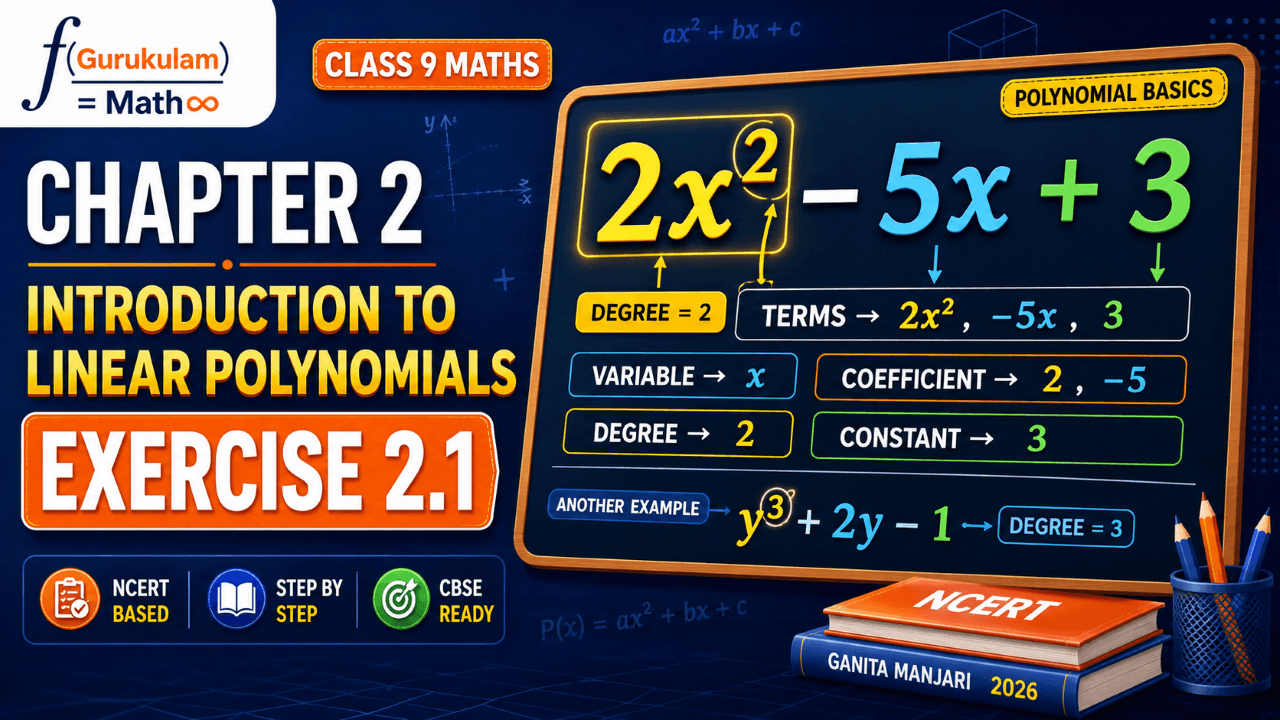
Class 9 Maths Chapter 2 Exercise 2.1 Solutions
Introduction to Linear Polynomials – Complete NCERT Solutions
Prepare with complete Class 9 Maths Chapter 2 Exercise 2.1 Solutions based on the latest NCERT Ganita Manjari (2026). This exercise builds the foundation of Introduction to Linear Polynomials by focusing on degree of a polynomial, writing polynomials of different degrees, coefficients, and constant terms. Every question is explained step by step in a simple CBSE answer-writing style so that students can understand the algebraic idea clearly and solve similar questions with confidence.
📖 About Class 9 Maths Chapter 2 Exercise 2.2
Class 9 Maths Chapter 2 Exercise 2.2 Solutions takes students further into Introduction to Linear Polynomials through a combination of direct questions and familiar real-life situations. The exercise connects classroom algebra with situations involving numbers, ages, money, measurements, and everyday quantities.
The questions gradually encourage students to move beyond simply reading an expression and start thinking about the information hidden in a question. This makes Exercise 2.2 an important part of Class 9 Maths Chapter 2 and a useful step towards solving application-based questions with confidence.
🎯 What You Will Find in Exercise 2.2
👨🏫 Let’s Read a Polynomial
Before we talk about its degree, let’s first learn how to read a polynomial.
Look at this expression:
We don’t need to calculate anything here. We simply need to identify the different parts of this expression.
1️⃣ Terms
The parts separated by + or − signs are called terms.
So the terms are 5x², 2x and −7.
2️⃣ Variable
The letter whose value can change is called the variable.
Here, x is the variable.
3️⃣ Coefficient
The number multiplying a variable is called its coefficient.
Similarly, the coefficient of x in 2x is 2.
4️⃣ Constant Term
A number without a variable is called a constant term.
So, when we look at an expression such as 5x² + 2x − 7, we can identify its terms, variable, coefficients and constant term.
Expressions involving one variable and its powers are called one-variable polynomials.
✏️ Let’s Try One Together
Identify the terms, variable, coefficients and constant term in:
Terms: 3x³, −4x, 8
Variable: x
Coefficients: 3 and −4
Constant term: 8
📓 Notebook Answer
Next, let’s learn how to find its degree.
👨🏫 First, Understand the Idea
To find the degree of a polynomial, look carefully at the powers of the variable.
For example:
The powers of x are 5, 3 and 2. The highest power is 5.
The degree of a polynomial is the highest power of the variable appearing in it.
🔎 How Do We Find It?
Step 2: Look at its powers.
Step 3: Pick the highest power.
Step 4: That is the degree.
✏️ Example 1
The powers of x are 6, 4, 2 and 1.
The highest power is 6.
Therefore, Degree = 6
✏️ Example 2
The powers of y are 7, 5 and 2.
The highest power is 7.
Therefore, Degree = 7
💡 What About a Constant?
Sometimes a polynomial has no variable at all. For example:
A non-zero constant can be written as −9x⁰, because x⁰ = 1. Therefore, its degree is 0.
⚠️ One Important Exception
The zero polynomial is different. Its degree is undefined.
So, do not write degree = 0 for the zero polynomial.
👨🏫 Let’s Try One Together
Find the degree of:
The powers of z are 4, 3 and 1.
The highest power is 4.
So, Degree = 4
📓 Now Write It in Your Notebook
👨🏫 The Degree Gives the Polynomial Its Name
You now know how to find the degree of a polynomial. There is one more important idea: the degree also tells us what type of polynomial it is.
Degree 1 → Linear
Degree 2 → Quadratic
Degree 3 → Cubic
So, instead of memorising three names separately, first find the degree. The degree tells you the name.
① Linear Polynomial
A polynomial of degree 1 is called a linear polynomial.
The highest power of x is 1.
Therefore, it is a Linear Polynomial.
② Quadratic Polynomial
A polynomial of degree 2 is called a quadratic polynomial.
The highest power of x is 2.
Therefore, it is a Quadratic Polynomial.
③ Cubic Polynomial
A polynomial of degree 3 is called a cubic polynomial.
The highest power of x is 3.
Therefore, it is a Cubic Polynomial.
Find the highest power → identify the degree → give the polynomial its name.
👨🏫 Let’s Try One Together
What type of polynomial is
Look only at the highest power of x.
Highest power = 3
Degree = 3 → Cubic Polynomial
✍️ Now Think About Question 2
If a question asks you to write a polynomial of degree 1, 2 or 3, you already know what to do.
The important point is that the highest power must be exactly the required degree.
📓 Now Write It in Your Notebook
✏️ Example Problem
Let’s understand a polynomial step by step.
For the polynomial
Find its terms, number of terms, variable terms, constant term, name, degree and coefficients.
👨🏫 Let’s Solve
1. Terms
The terms are separated by + or − signs.
So, there are 3 terms.
2. Name of the Polynomial
A polynomial with 3 terms is called a trinomial.
3. Variable Terms and Constant Term
3x100 and −7x50 contain the variable x, so they are the variable terms.
11 has no variable, so it is the constant term.
4. Degree of the Polynomial
The highest power of x is 100.
5. Coefficients
Look at the numerical factors of the variable terms:
−7x50 → −7
Therefore, the coefficients are 3 and −7.
11 is the constant term.
Revise the Concept You Need
Stuck on a particular idea? Use the relevant lesson below to quickly revise that concept and then return to Exercise 2.1.
What is a Polynomial?
Need to understand what makes an algebraic expression a polynomial? Revise variables, terms, coefficients, constants and the degree of a polynomial.
👉 Understand PolynomialsAlgebraic Expression vs Polynomial
Confused between an algebraic expression and a polynomial? See the difference clearly with examples, terms, coefficients and degree.
👉 Learn the DifferenceThink & Reflect Questions
Want to understand the ideas behind the chapter instead of memorising them? Check the solved Think and Reflect questions from Chapter 2.
👉 Explore Think & Reflect SolutionsValue of a Polynomial
Need practice substituting a given value of the variable and finding the value of a polynomial? Revise this concept with solved examples and questions.
👉 Learn Value of a PolynomialLinear Equation Word Problems
Questions involving ages, numbers, coins, ratios and other situations can be converted into simple linear equations.
👉 Practise Linear Word ProblemsLinear Patterns & Relationships
Learn how quantities change by a constant amount and how real-life situations can be represented using linear expressions.
👉 Explore Linear RelationshipsGraph of a Linear Polynomial
Want to understand straight-line graphs, slope, y-intercept and how changing a and b changes the graph?
👉 Learn Linear GraphsNeed a Tougher Mixed Problem?
Ready to connect different Chapter 2 concepts? Try the mixed problems in the End-of-Chapter Exercise.
👉 Try End Exercise📝 Class 9 Maths Chapter 2 Exercise 2.1 Solutions
Get easy, step-by-step solutions for Class 9 Maths Chapter 2 Exercise 2.1 from NCERT Ganita Manjari (2026). Understand polynomials, algebraic expressions, terms, coefficients, constants and degree with clear CBSE-style solutions.
Q1. Find the degree of the following polynomials
(i) 2x²−5x+3
Highest power of x = 2
Degree = 2
(ii) y³+2y−1
Highest power of y = 3
Degree = 3
(iii) −9
Constant polynomial
Degree = 0
(iv) 4z−3
Highest power = 1
Degree = 1
- 2
- 3
- 0
- 1
💡 Key Concept: Degree = highest exponent.
⚠️ Common Mistake: Constant polynomial has degree 0.
🎯 Exam Tip: Always identify the highest power.
Q2. Write polynomials of degrees 1, 2 and 3.
Given:
Required degrees are 1, 2 and 3.
To Find:
Examples of polynomials having degrees 1, 2 and 3.
Solution:
A polynomial of degree 1 is called a linear polynomial.
3x + 5
A polynomial of degree 2 is called a quadratic polynomial.
x2 + 2x + 1
A polynomial of degree 3 is called a cubic polynomial.
2x3 − x + 4
- Degree 1 : 3x + 5
- Degree 2 : x² + 2x + 1
- Degree 3 : 2x³ − x + 4
💡 Key Concept: Classification of polynomials according to degree.
⚠️ Common Mistake: Writing a polynomial whose highest power is different from the required degree.
🎯 Exam Tip: Always check the highest exponent before writing the answer.
Q3. What are the coefficients of x² and x³ in the polynomial x⁴ − 3x³ + 6x² − 2x + 7?
Given:
p(x) = x⁴ − 3x³ + 6x² − 2x + 7
To Find:
The coefficients of x² and x³.
Solution:
In the polynomial
x⁴ − 3x³ + 6x² − 2x + 7
The coefficient of x² is 6.
The coefficient of x³ is −3.
- Coefficient of x² = 6
- Coefficient of x³ = −3
💡 Key Concept: Coefficient is the numerical factor of a term.
⚠️ Common Mistake: Ignoring the negative sign of the coefficient.
🎯 Exam Tip: Always include the sign with the coefficient.
Q4. What is the coefficient of z in the polynomial 4z³ + 5z² − 11?
Given:
4z³ + 5z² − 11
To Find:
The coefficient of z.
Solution:
The polynomial contains the terms:
4z³, 5z² and −11
There is no term containing z.
Therefore, the coefficient of z is 0.
Coefficient of z = 0
💡 Key Concept: Missing terms have coefficient zero.
⚠️ Common Mistake: Taking −11 as the coefficient of z.
🎯 Exam Tip: If a term is absent, its coefficient is always zero.
Q5. What is the constant term of the polynomial 9x³ + 5x² − 8x − 10?
Given:
9x³ + 5x² − 8x − 10
To Find:
The constant term.
Solution:
The constant term is the term without any variable.
In the polynomial
9x³ + 5x² − 8x − 10
The term without x is −10.
Therefore,
Constant term = −10
Constant term = −10
💡 Key Concept: Constant term contains no variable.
⚠️ Common Mistake: Confusing coefficient with constant term.
🎯 Exam Tip: The constant term is always the term without any variable.
📚 Continue Learning
You have completed Class 9 Maths Chapter 2 Exercise 2.1. Continue with the next exercise or explore the complete Chapter 2 learning guide.
📖 Explore More Class 9 Maths Chapters
⚡ Quick Revision Dashboard
A quick one-minute revision before solving Class 9 Maths Chapter 2 Exercise 2.1.
✔ Powers are non-negative integers
✔ Example: 3x² − 5x + 2
✔ Number multiplying variable = coefficient
✔ Term without variable = constant term
✔ Highest power = degree
✔ Non-zero constant → degree 0
✔ Zero polynomial → degree undefined
✔ Degree 2 → Quadratic
✔ Degree 3 → Cubic
✔ Degree 0 → Constant
✔ Identify the variable
✔ Find the coefficients
✔ Check the highest power
✘ Miss a constant term
✘ Read a coefficient incorrectly
✘ Confuse highest power with coefficient
❓ Frequently Asked Questions
Common questions about Class 9 Maths Chapter 2 Exercise 2.1 Solutions, covering polynomials, terms, coefficients, constant terms and degree.
What is a polynomial?
A polynomial is an algebraic expression involving one variable in which the powers of the variable are non-negative integers.
How do I find the degree of a polynomial?
Look at the powers of the variable and identify the highest power. That highest power is the degree of the polynomial.
What are linear, quadratic and cubic polynomials?
A polynomial of degree 1 is called a linear polynomial, degree 2 a quadratic polynomial, and degree 3 a cubic polynomial.
What is a coefficient and what is a constant term?
The number multiplying a variable is its coefficient. A term without a variable is called the constant term.
What is the degree of a non-zero constant polynomial?
A non-zero constant polynomial has degree 0, because it can be written using the variable to the power zero.
What is the degree of the zero polynomial?
The degree of the zero polynomial is undefined. It does not have a highest power of the variable.
What should I identify first when reading a polynomial?
First identify its terms, then the variable, coefficients, constant term, and finally the degree. This makes Exercise 2.1 questions much easier to read and answer correctly.
Need Personal Guidance in Maths?
Join Newton Study Point for concept-based Maths coaching by an experienced teacher. Small batches, individual attention, regular tests, and complete CBSE exam preparation for Classes 8, 9, 10, 11 & 12.
📞 Call Now: 8447002272 💬 WhatsApp 🏫 Explore Newton Study Point📍 Newton Study Point • Ankur Vihar, Ghaziabad

Rakesh Kumar Singh
Founder, Maths Gurukulam & Newton Study Point
Teaching CBSE Mathematics Since 2006
These Class 9 Maths Chapter 2 Exercise 2.1 Solutions are carefully prepared according to the latest NCERT Ganita Manjari (2026) and the CBSE curriculum. Every solution follows a clear, step-by-step approach designed to strengthen understanding of polynomials, degree, terms, coefficients, and constant terms and help students prepare confidently for school examinations.