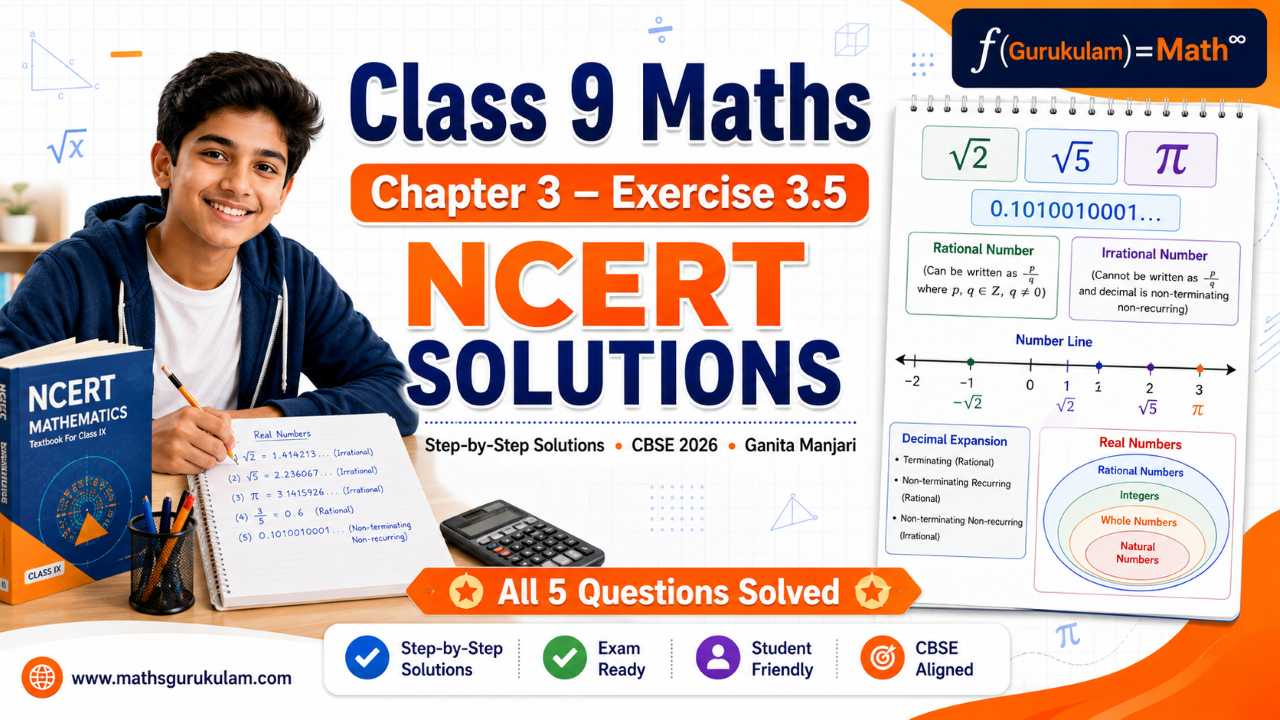
What You’ll Learn in Exercise 3.5
Exercise 3.5 is much more than solving five questions. It acts as a complete revision of the Real Numbers chapter by strengthening six essential concept clusters that every CBSE Class 9 student should master.
① Real Number System
Purpose: Build the foundation of the Real Number System.
- Rational Numbers
- Irrational Numbers
- Real Numbers
- Representation on the Number Line
- Construction of √6
② Understanding Irrational Numbers
Purpose: Learn why some numbers cannot be written as p/q.
- Proof of √2 is Irrational
- Proof by Contradiction
- Lowest Form of Fractions
- Logical Mathematical Reasoning
③ Operations on Rational Numbers
Purpose: Revise basic operations before studying decimal expansions.
- Addition
- Subtraction
- Multiplication
- Division
- Reciprocal & Simplification
④ Decimal Representation
Purpose: Connect fractions with decimal numbers.
- Decimal Expansion
- Terminating Decimals
- Recurring Decimals
- Long Division Concept
⑤ Predict Decimal Expansion
Purpose: Predict decimal behaviour without lengthy calculations.
- Prime Factor Rule
- Lowest Form
- Fraction → Decimal
- Recurring Decimal → Rational Number
⑥ Pattern Recognition (Cycle Numbers)
Purpose: Develop mathematical observation skills.
- Powers of Numbers
- Repeating Cycles
- Cycle Numbers
- Finding the Last Digit
🚀 By the End of This Exercise
You won’t just finish Exercise 3.5—you’ll revise the complete Real Numbers chapter, strengthen your mathematical reasoning, improve your problem-solving speed, and build a solid foundation for upcoming chapters in Class 9 Mathematics.
Jump to Any Question
Need help with a particular question? Click on the question number below to jump directly to its detailed NCERT solution.
Learn Before You Solve
Spend just 2 minutes revising these important concepts before solving Exercise 3.5. A quick revision now will help you solve every question with greater confidence.
① Real Numbers
Rule: Every rational number and every irrational number together form the set of real numbers.
🎯 Exam Tip: Every irrational number is a real number, but not every real number is irrational.
② Irrational Numbers
Rule: An irrational number cannot be written in the form p/q.
🎯 Exam Tip: Their decimal expansion is non-terminating and non-recurring.
③ Rational Numbers
Rule: A rational number can always be written in the form p/q where q ≠ 0.
🎯 Exam Tip: Always simplify the fraction before analysing its decimal expansion.
④ Decimal Expansion
Rule: Every rational number has either a terminating or a recurring decimal expansion.
🎯 Exam Tip: A recurring decimal never ends but follows a repeating pattern.
⑤ Prime Factor Rule
Rule: Reduce the fraction to its lowest form. If the denominator has only 2 and/or 5 as prime factors, the decimal terminates.
🎯 Exam Tip: Any other prime factor gives a recurring decimal.
⑥ Cycle Numbers
Rule: The last digit of powers follows a repeating cycle.
🎯 Exam Tip: Find the cycle first instead of calculating large powers directly.
⭐ Quick Reminder
- Always reduce fractions to the lowest form.
- Check the denominator before predicting the decimal expansion.
- Remember: Rational + Irrational = Real Numbers.
- Look for repeating patterns while solving cycle number questions.
Class 9 Maths Chapter 3 Exercise 3.5 Solutions
These Class 9 Maths Chapter 3 Exercise 3.5 Solutions are prepared according to the latest NCERT Ganita Manjari (2026) textbook and follow the CBSE guidelines. Every solution is explained step by step using a simple and student-friendly approach to help you understand the concepts clearly and score better in examinations.
Then check your answers by explicitly performing the long divisions and expressing these rational numbers as decimals.
Given
The given rational numbers are:
- 7 20
- 4 15
- 13 250
To Find
Determine whether each rational number has a terminating decimal or a non-terminating repeating decimal, and verify the result by performing long division.
Given
- The fraction is 1/13.
- Its decimal expansion is obtained by long division.
- The same process is repeated for 2/13, 3/13, 4/13, ….
To Find
- Find the repeating block of digits in the decimal expansion of 1/13.
- Check whether the repeating blocks of 2/13, 3/13, 4/13, … show cyclic properties.
- State the observation.
Final Answer
The repeating block of 1/13 is
The repeating blocks of 2/13, 3/13, 4/13, … are 153846, 230769, 307692, etc.
These repeating blocks are obtained by rotating the digits of 076923. Hence, they show cyclic properties.
📘 Observation
In every reciprocal of the form n/13 (where n = 1, 2, 3, …, 12), the decimal expansion has the same six digits.
↓ Rotate the digits
153846 → 230769 → 307692 → …
Thus, each repeating block is a cyclic rearrangement of the others. This is the cyclic property shown by the decimal expansions of the reciprocals of 13.
(i) √81
(ii) √12
(iii) 0.33333…
(iv) 0.123451234512345…
(v) 1.01001000100001… (Notice the pattern: Is it repeating a single block?)
(vi) 23.560185612239874790120
Find the explicit fractions in case they are rational.
Given
Six numbers are given. We have to determine whether each number is rational or irrational.
For every rational number, we also need to write its explicit fraction.
To Find
Classify each given number as Rational or Irrational, and write its explicit fractional form wherever possible.
| Part | Given Number | Type | Explicit Fraction |
|---|---|---|---|
| (i) | √81 | Rational | 9/1 |
| (ii) | √12 | Irrational | Not Possible |
| (iii) | 0.3333… | Rational | 1/3 |
| (iv) | 0.1234512345… | Rational | 4115/33333 |
| (v) | 1.01001000100001… | Irrational | Not Possible |
| (vi) | 23.560185612239874790120 | Rational | 23560185612239874790120 / 1000000000000000000000 |
📘 Key Concept
- Every terminating decimal is a Rational Number.
- Every non-terminating repeating decimal is a Rational Number.
- Every non-terminating non-repeating decimal is an Irrational Number.
- Perfect square roots are Rational, while non-perfect square roots are Irrational.
❌ Common Mistake
Students often think that every non-terminating decimal is irrational. Remember that a decimal is Rational if its digits repeat in a fixed pattern.
📝 Exam Tip
First check whether the decimal is terminating, repeating, or non-repeating. This single observation helps you identify whether the number is Rational or Irrational in just a few seconds.
Given
- The decimal number is 0.99999….
- Let x = 0.99999….
To Find
Show that 0.99999… = 1 using the algebraic method.
Why is 0.99999… exactly equal to 1?
From the algebraic steps, we obtained
But we had already assumed
Since both expressions represent the same value of x, they must be equal.
Final Answer
Hence, 0.99999… is exactly equal to 1. Therefore, it is a Rational Number.
Try to find more numbers (n) whose reciprocals (1/n) produce decimals with repeating blocks that are cyclic.
Given
- The repeating block of 1/7 is a cyclic number.
- We have to explore similar reciprocals.
To Find
Find more natural numbers n such that the decimal expansion of 1/n has a repeating block which is a cyclic number.
Final Answer
Some numbers whose reciprocals produce decimals with cyclic repeating blocks are 7, 17 and 19.
- 1/7 = 0.142857142857…
- 1/17 = 0.0588235294117647…
- 1/19 = 0.052631578947368421…
📘 What is a Cyclic Number?
A cyclic number is a repeating block of digits that produces its own cyclic rearrangements when multiplied by 2, 3, 4, … up to one less than the denominator.
142857 × 3 = 428571
142857 × 4 = 571428
Notice that the digits remain the same and only their positions change.
🔍 How to Find a Cyclic Number?
- Choose a number n.
- Write the decimal expansion of 1/n.
- Find its repeating block.
- Multiply the repeating block by 2, 3, 4, ….
- If the products contain the same digits in a different order (cyclic rearrangements), then the repeating block is a cyclic number.
Exercise 3.5 Quick Revision Sheet
Revise these important points in just one minute before solving the exercise or appearing in your CBSE examination.
Can be written in the form p/q, where q ≠ 0.
Cannot be written in the form p/q.
Only 2 and/or 5 in the denominator → Terminating Decimal.
Every rational number has either a terminating or recurring decimal.
Repeats a fixed pattern forever and represents a rational number.
Use repeating last-digit cycles to solve large powers quickly.
📝 Exam Tip
Before deciding whether a decimal is terminating or recurring, always reduce the fraction to its lowest form. Then check the prime factors of the denominator. This is one of the most frequently tested concepts in the Real Numbers chapter.
Avoid These Common Mistakes
Many students lose marks in Exercise 3.5 because of small conceptual mistakes. Read these points carefully before solving the questions.
❌ Mistake 1
Thinking every non-terminating decimal is irrational.
❌ Mistake 2
Checking the denominator without simplifying the fraction.
❌ Mistake 3
Confusing recurring decimals with non-recurring decimals.
❌ Mistake 4
Finding large powers by direct multiplication.
❌ Mistake 5
Assuming every square root is irrational.
❌ Mistake 6
Ignoring the question requirement before choosing a method.
🎯 Final Exam Reminder
Most mistakes in this exercise happen because students apply the correct rule at the wrong time. Read the question carefully, choose the correct concept, and then solve it step by step.
Frequently Asked Questions
Here are answers to some common questions students ask while studying Class 9 Maths Chapter 3 Exercise 3.5.
1. Is Exercise 3.5 important for CBSE exams?
Yes. Exercise 3.5 is a mixed-concept exercise that revises the important ideas from the entire Real Numbers chapter. Questions based on these concepts are frequently asked in school and CBSE examinations.
2. Should I solve the questions in order?
Yes. Solving the questions in sequence helps you revise the chapter systematically and strengthens your understanding of different concepts.
3. Can I use these solutions for school homework?
Yes. These solutions follow the latest NCERT Ganita Manjari (2026) textbook and present the answers in a clear, step-by-step format suitable for homework and revision.
4. Are these solutions based on the latest NCERT book?
Yes. All solutions are prepared according to the latest NCERT Ganita Manjari (2026) edition and are aligned with current CBSE guidelines.
5. What should I do if I still have doubts after solving the exercise?
Revise the “Learn Before You Solve” and “Quick Revision Sheet” sections once again. If you’re still facing difficulty, practise similar NCERT questions and ask your teacher for clarification on the specific concept.
📚 Continue Learning
🔗 Useful Resources
Explore these official educational resources for authentic CBSE and NCERT study materials.
Need Personal Guidance in Maths?
Join Newton Study Point for concept-based Maths coaching by an experienced teacher. Small batches, individual attention, regular tests, and complete CBSE exam preparation for Classes 8, 9, 10, 11 & 12.
📞 Call Now: 8447002272 💬 WhatsApp📍 Newton Study Point • Ankur Vihar, Ghaziabad

Rakesh Kumar Singh
Founder, Maths Gurukulam & Newton Study Point
Teaching CBSE Mathematics Since 2006
These Class 9 Maths Chapter 3 Exercise 3.5 Solutions are carefully prepared according to the latest NCERT Ganita Manjari (2026) and the CBSE curriculum. Every solution follows a clear, step-by-step approach designed to strengthen conceptual understanding, improve problem-solving skills, and help students perform confidently in school and board examinations.