📖 About Class 9 Maths Chapter 5 End-of-Chapter Exercises
Class 9 Maths Chapter 5 End of Chapter Exercises Solutions provide complete, question-wise support for the final exercises of Chapter 5 – I’m Up and Down, and Round and Round from the latest NCERT Ganita Manjari (2026). This page is designed for students who want reliable and easy-to-follow solutions to the End-of-Chapter Exercises in one place.
The complete exercise is presented in the same order as the textbook, with all 26 questions organised clearly for quick access. The page is useful for classroom practice, homework, self-study, revision, doubt-solving, and CBSE examination preparation. Students can use the question navigator to move directly to the question they want to study.
🎯 Exercise Snapshot
- Complete coverage of the Chapter 5 End-of-Chapter Exercises.
- Question-wise solutions for all 26 questions.
- Clear presentation following the textbook order.
- Step-by-step NCERT solutions.
- Easy question-wise navigation.
- Student-friendly CBSE answer-writing approach.
- Students following Ganita Manjari (2026).
- Homework, classroom practice and self-study.
- Chapter-end revision and CBSE preparation.
- One place for the complete end exercise.
- Easy navigation between questions.
- Useful for last-minute chapter revision.
📚 Learn Before You Solve
Before solving the
End-of-Chapter Exercise — Chapter 5: Circles,
revise the essential circle concepts and theorems you need.
This LBWS focuses only on the
new and important ideas required here.
Concepts already explained in earlier exercises are linked
instead of being repeated.
So, using Theorem 1, there is a circle passing through A, B and C.
Let us show that D also lies on this circle.
Join AD.
Now C and E are on the same segment of the arc formed by chord AB. Therefore,
Since ∠AEB is an exterior angle of triangle BED,
Again, C and E are on the same segment of the arc formed by chord AB. Therefore,
Since ∠ADB is an exterior angle of triangle BED,
Therefore, D must be on the circle passing through A, B and C.
Cyclic Quadrilateral
A four-sided figure whose vertices lie on the same circle.
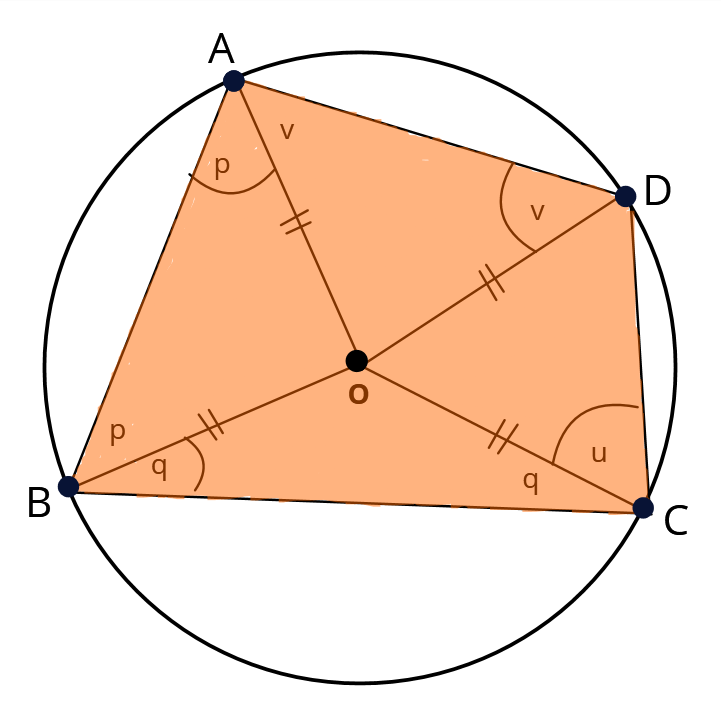
In the figure, the four vertices A, B, C and D all lie on the circumference of the same circle.
Its four vertices must lie on one common circle.
So:
Concyclic vertices → Cyclic quadrilateral
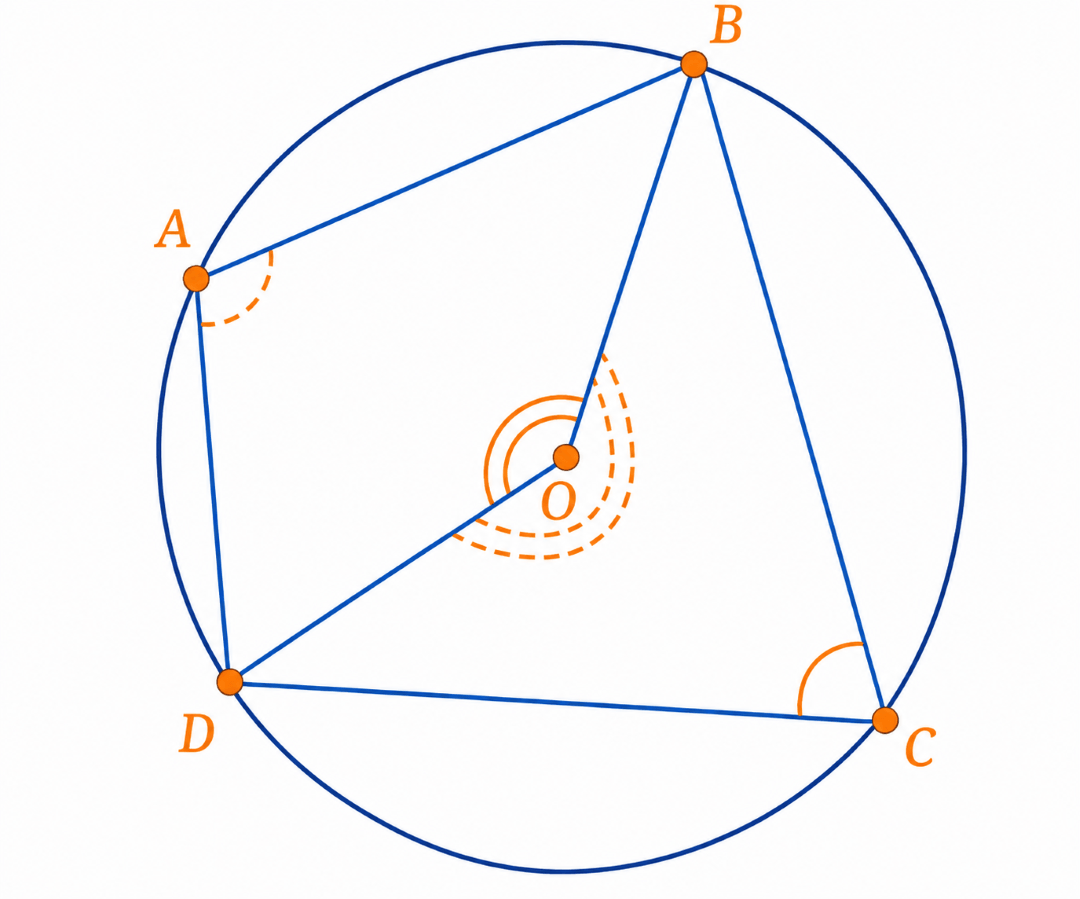
So, ∠BAD subtends at the centre O the reflex angle BOD.
Similarly, ∠BCD is half the angle subtended by the arc BAD at the centre O.
Opposite angles → 180°
∠BAD + ∠BCD = 180°.
∠ABC + ∠CDA = 180°.
We eliminate both possibilities.
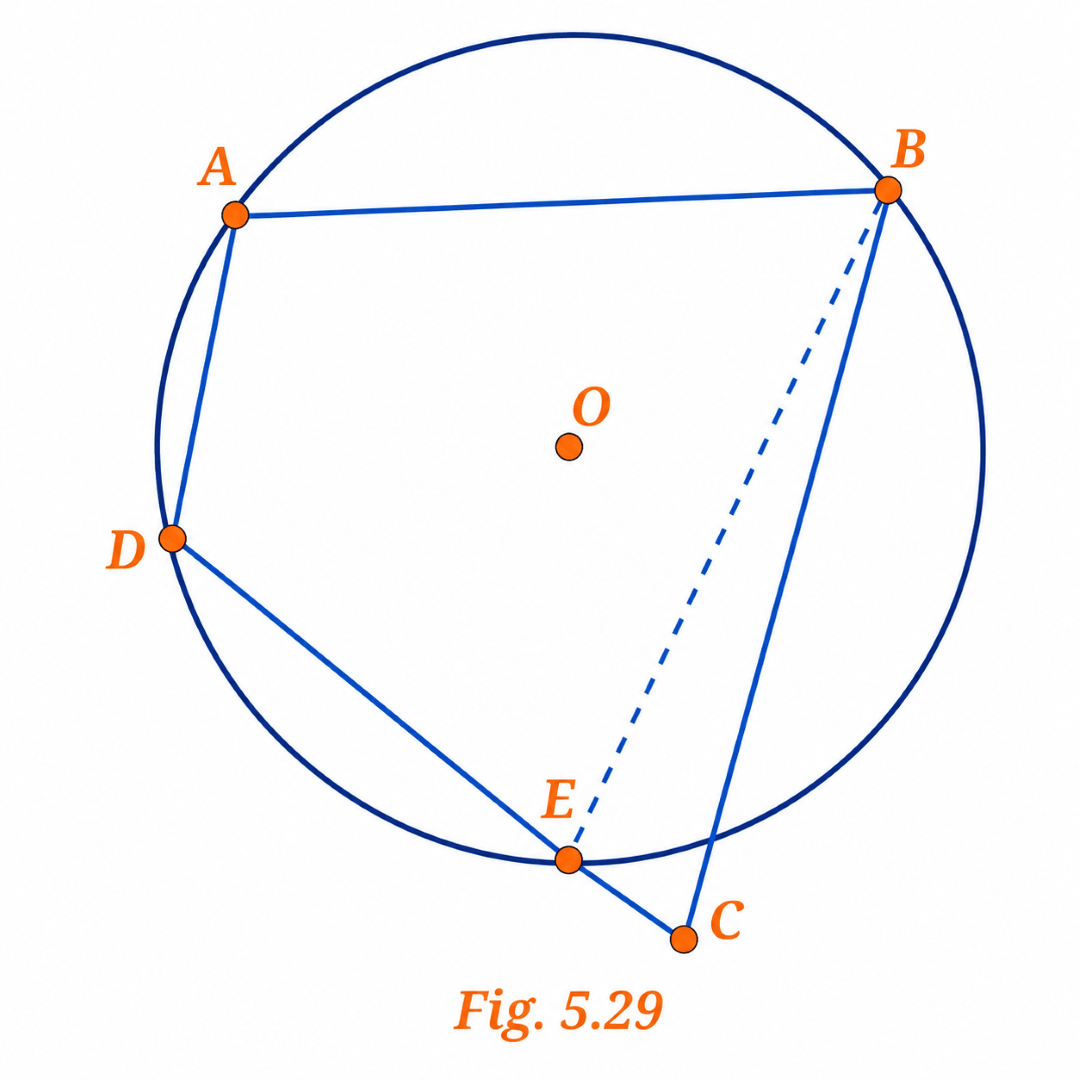
Since A, D and B are non-collinear, there is a circle passing through A, D and B.
If this circle does not pass through C, there are two cases:
C is outside the circle or C is inside the circle.
Then ABED is a cyclic 4-gon.
So, from Theorem 11,
Therefore, by the exterior angle property,
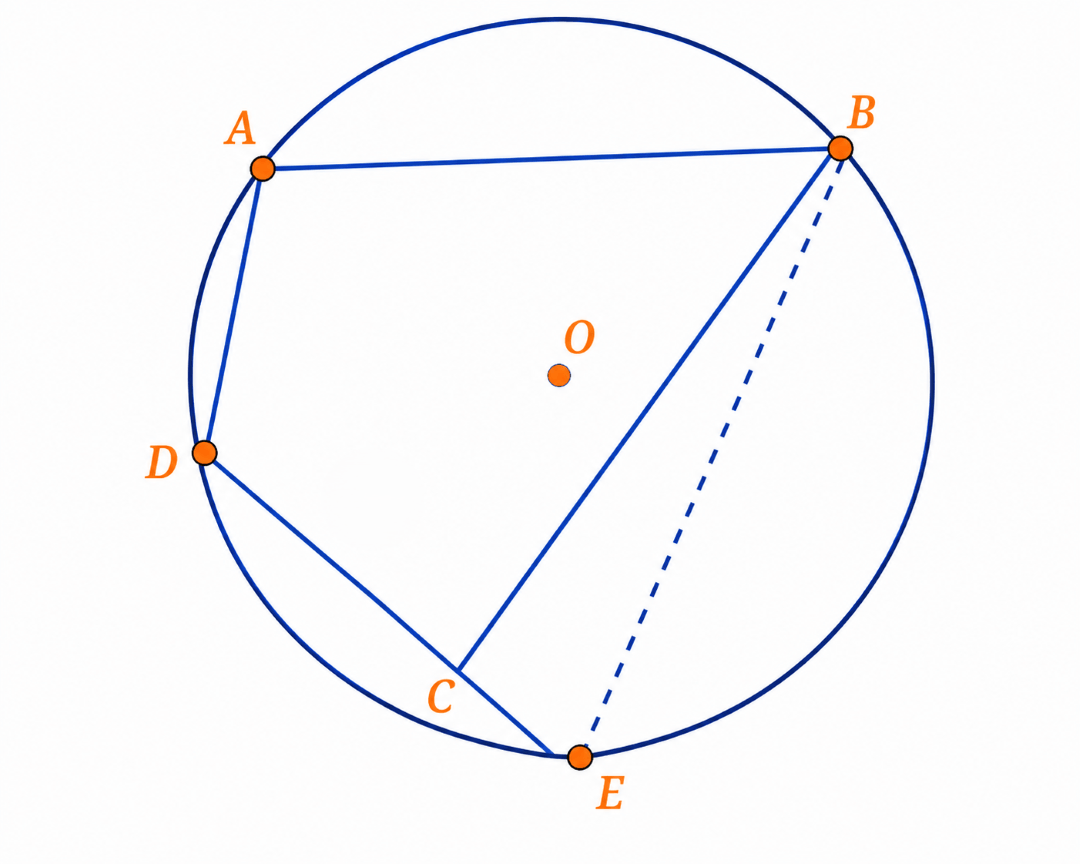
Extend CD to meet the circle again at E.
Then ABED is a cyclic 4-gon.
Therefore, by Theorem 11,
C cannot be inside the circle.
Therefore, our assumption that ABCD is not cyclic is impossible.
Hence, C must lie on the circle passing through A, B and D.
→ the quadrilateral is cyclic.
This is the converse of Theorem 11.
Cyclicity Test
Use the opposite-angle condition to recognise a cyclic quadrilateral.
opposite angles are supplementary.
Theorem 11
∠A + ∠C = 180°
then the four vertices are concyclic.
Theorem 12
⚡ Quick Revision Dashboard
Three non-collinear points determine one unique circle. A fourth point is concyclic with them when it also lies on that circle.
⇒ A, B, C, D are concyclic
Therefore, whenever four points are shown on one circle, the quadrilateral formed by them is cyclic.
∠ABC + ∠ADC = 180°
⇒ Quadrilateral is cyclic
OR
Opposite angles sum to 180°
Theorem 12 → converse direction
- Equal angles must subtend the same line segment AB.
- For Theorem 10, the relevant points lie on the same side of AB.
- For Theorem 11, the quadrilateral is already known to be cyclic.
- For Theorem 12, the opposite angles summing to 180° establish cyclicity.
→ Use cyclic quadrilateral properties.
Do I know equal angles subtending AB?
→ Think Theorem 10.
Do opposite angles add to 180°?
→ Think Theorem 12.
Class 9 Maths Chapter 5 End Exercise Question 1 Solution
Class 9 Maths Chapter 5 End Exercise Question 2 Solution
Class 9 Maths Chapter 5 End Exercise Question 3 Solution
Class 9 Maths Chapter 5 End Exercise Question 4 Solution
Class 9 Maths Chapter 5 End Exercise Question 5 Solution
Class 9 Maths Chapter 5 End Exercise Question 6 Solution
Class 9 Maths Chapter 5 End Exercise Question 7 Solution
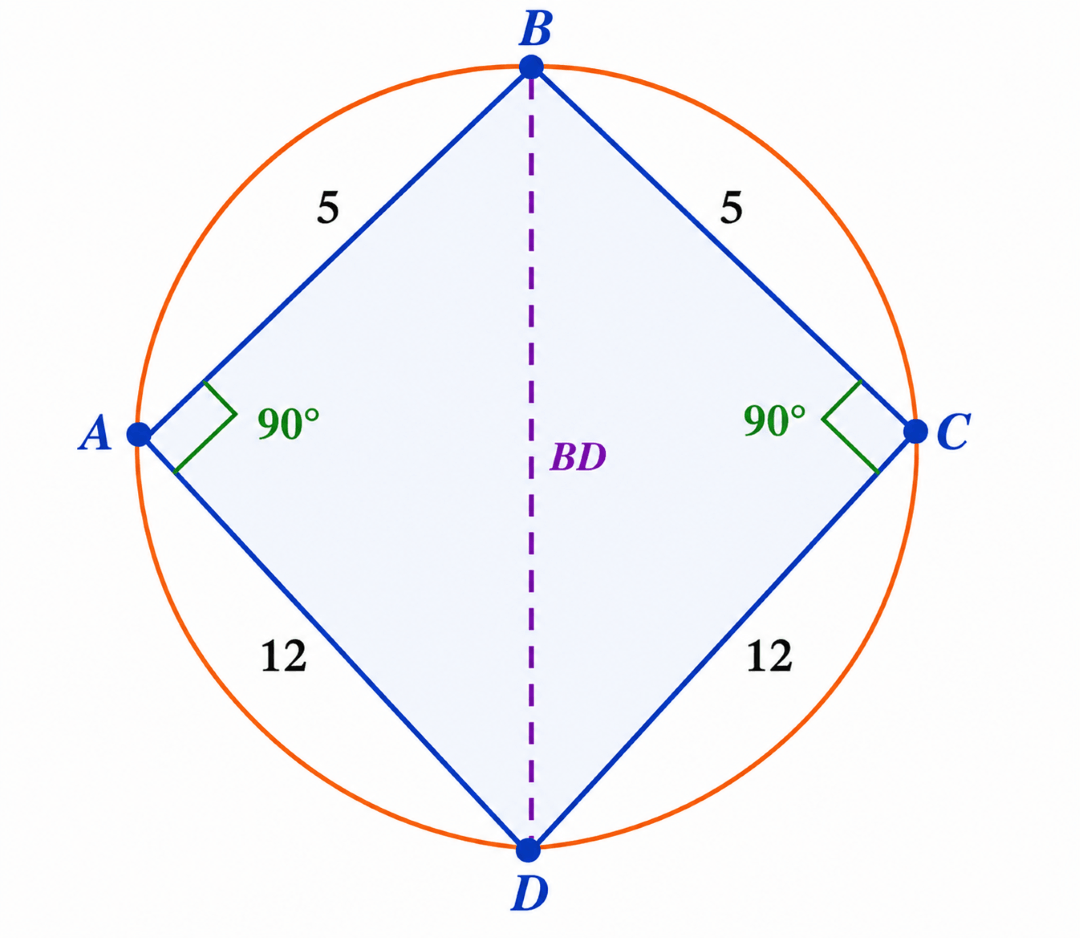
∠ACB = ∠ADB = 90° → O lies on AB
∠ACB = ∠ADB > 90° → O lies outside ABCD
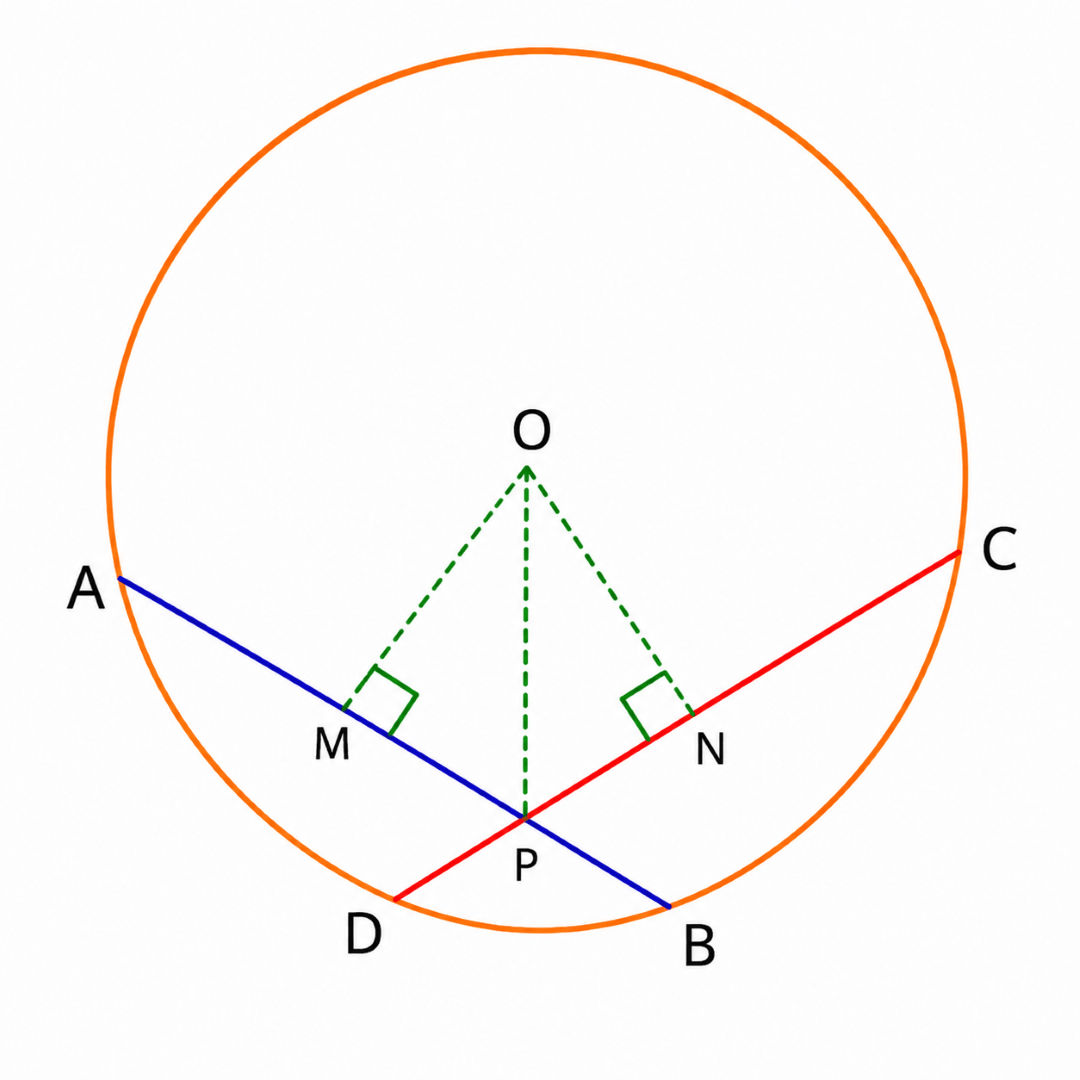
Hint: Is it a circumcircle of a suitable triangle?
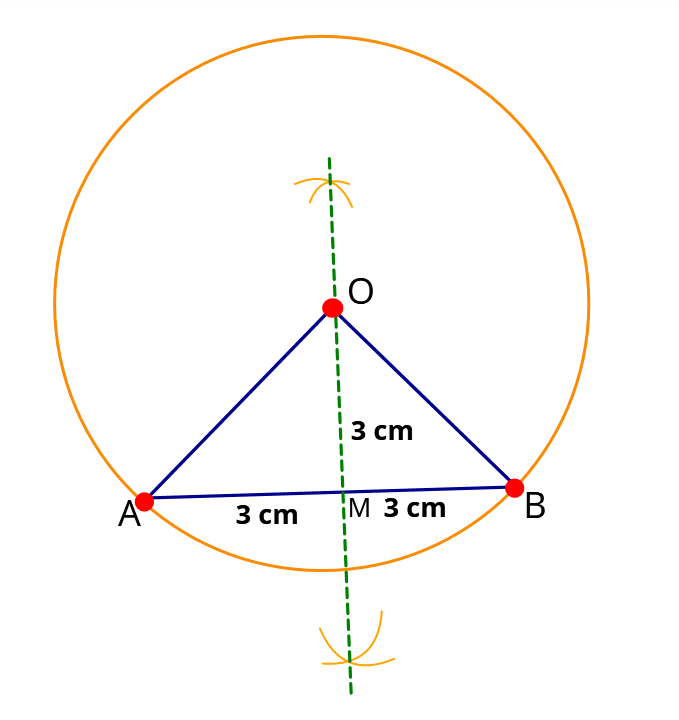
Class 9 Maths Chapter 5 End Exercise Question 17 Solution
Distance between chords = 7 cm
2. Distance of each side from the centre.
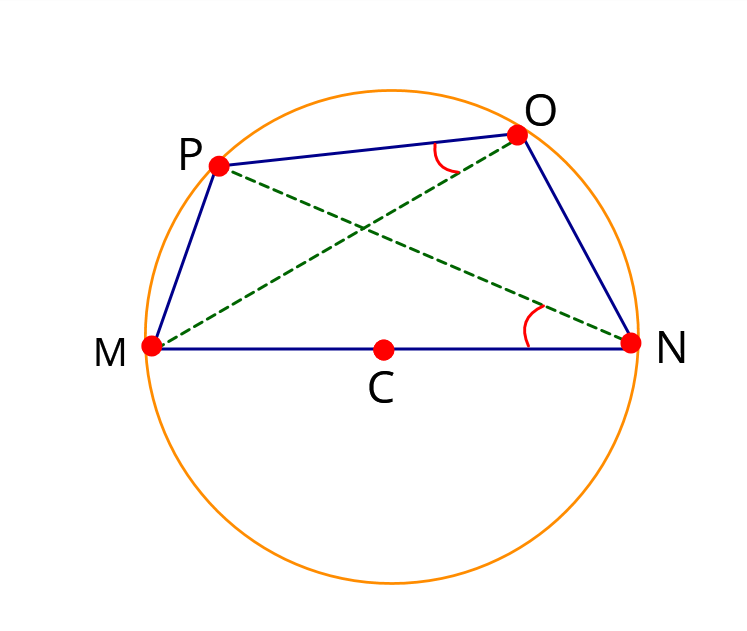
They are equal because they stand on the same chord MP and lie in the same segment of the circle.
Example: ∠ADE = ∠ABC, where E is a point on the extension of side AD.
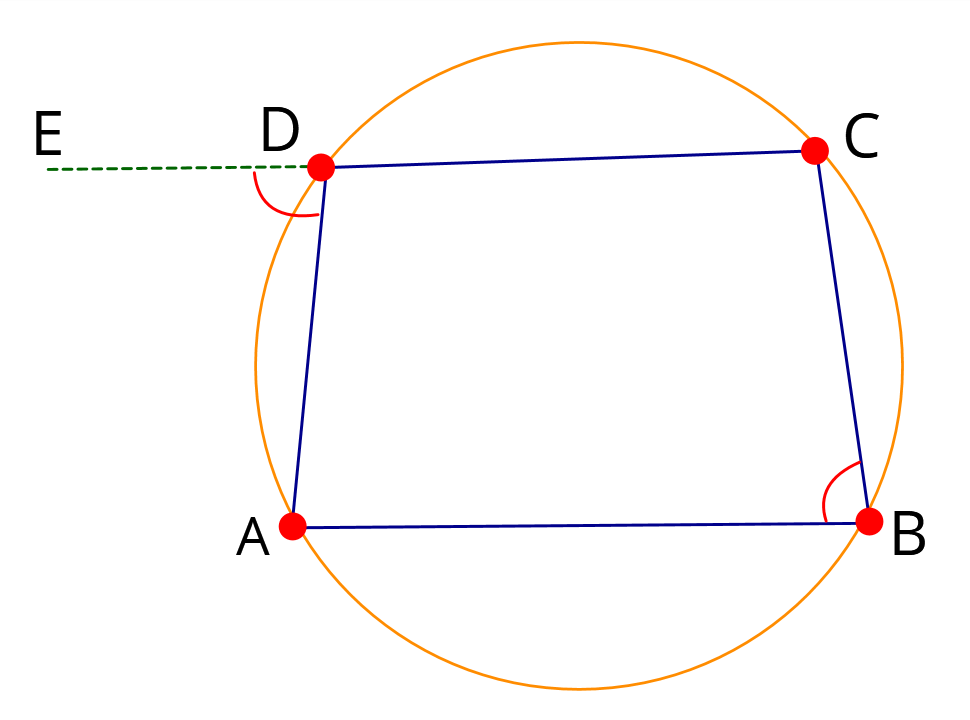
Thus, the exterior angle at a vertex of a cyclic quadrilateral is equal to its interior opposite angle.
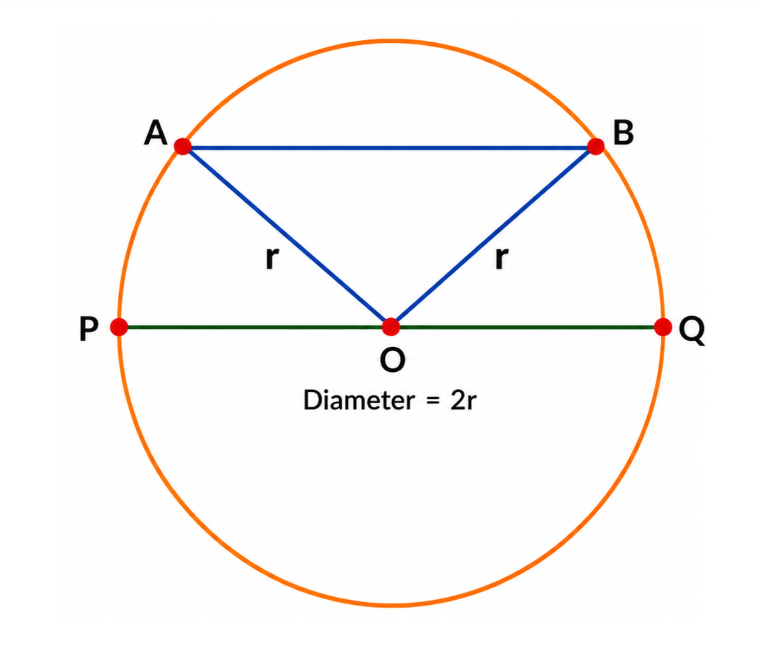
Therefore, no chord can be longer than the diameter.
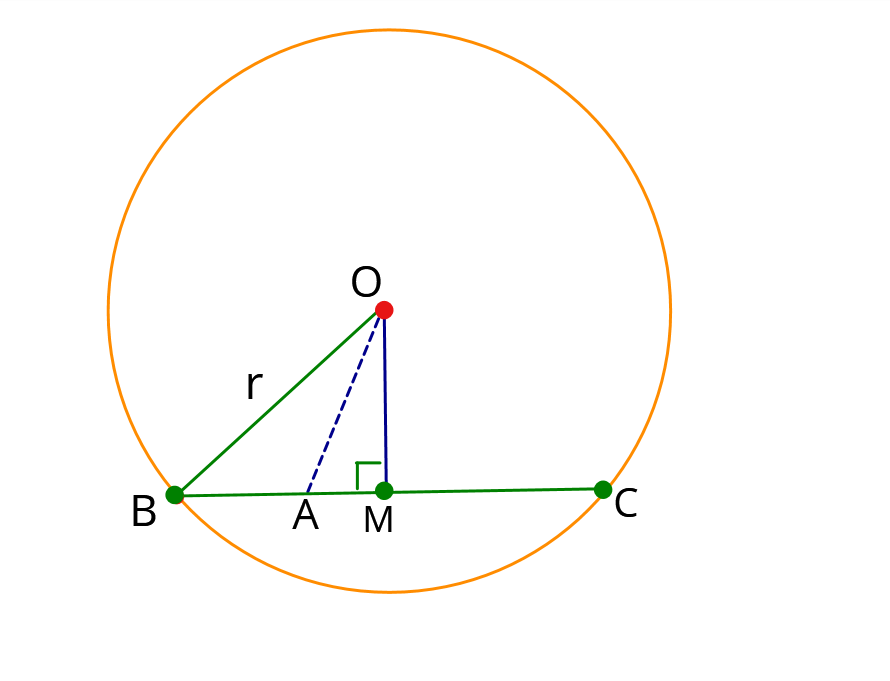
M and M′ are the midpoints of CD and C′D′, respectively.
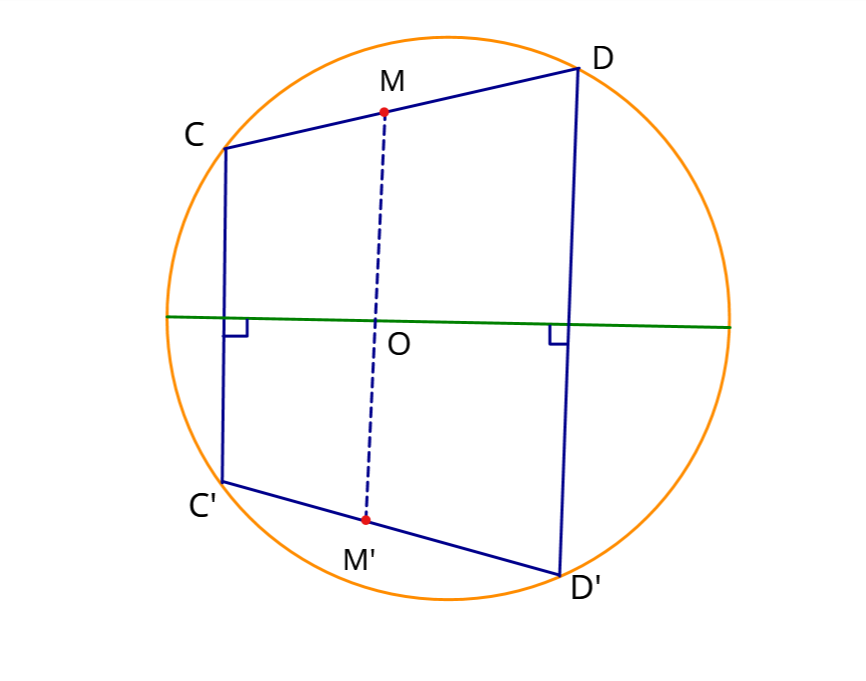
Thus, CD and C′D′ are the two non-parallel sides of the trapezium.
📚 Continue Learning
Congratulations! You have completed the Class 9 Maths Chapter 5 End-of-Chapter Exercises. You have now revised the complete Chapter 5 through its 26 end-of-chapter questions. Continue your preparation by revisiting any exercise for practice or moving to another chapter.
📖 Explore More Class 9 Maths Chapters
❓ Frequently Asked Questions
Find quick answers to common questions about Class 9 Maths Chapter 5 End of Chapter Exercises Solutions. These FAQs help students understand the exercise, its coverage, and how to use the complete solutions effectively for homework, revision, self-study, and CBSE examination preparation.
What are the End-of-Chapter Exercises in Class 9 Maths Chapter 5?
The End-of-Chapter Exercises are the final set of practice questions given at the end of Chapter 5 – I’m Up and Down, and Round and Round in the NCERT Ganita Manjari (2026) textbook. They bring together the major concepts and applications covered throughout the chapter.
How many questions are there in Chapter 5 End-of-Chapter Exercises?
There are 26 questions in the End-of-Chapter Exercises. The questions are presented in the same order as the textbook and include different types of practice, proof, application, construction, and higher-order questions.
What topics are covered in the Chapter 5 End Exercises?
The End-of-Chapter Exercises revise a wide range of Chapter 5 topics, including chords, distance from the centre, angles subtended by arcs, diameter-related results, concyclicity, cyclic quadrilaterals, intersecting chords, constructions, and applications involving circles. The complete set also includes proof-based and higher-order questions.
Are the Chapter 5 End Exercises useful for revision?
Yes. The End-of-Chapter Exercises are especially useful for complete Chapter 5 revision because they bring together different types of questions from the chapter. Students can use the question-wise solutions to identify weak areas and practise before tests and examinations.
Are there higher-order questions in the Chapter 5 End Exercises?
Yes. The exercise includes several questions marked with an asterisk (*) in the textbook. These questions require deeper reasoning, proof, construction, or application of the concepts developed in Chapter 5.
Are these solutions suitable for CBSE Class 9 students?
Yes. The solutions are presented in a clear, student-friendly, step-by-step CBSE answer-writing style. They can be used for classroom practice, homework, self-study, revision, and examination preparation.
Can I jump directly to a particular question?
Yes. A dedicated Jump to Any Question navigator is provided on this page. Students can select any question from Q1 to Q26 and move directly to its solution without scrolling through the complete exercise.
Are these Class 9 Maths Chapter 5 End-of-Chapter Solutions based on Ganita Manjari 2026?
Yes. These Class 9 Maths Chapter 5 End of Chapter Exercises Solutions are prepared according to the latest NCERT Ganita Manjari (2026) textbook. The questions are followed in textbook order and the solutions are presented in a student-friendly format for learning, revision, and CBSE preparation.

Rakesh Kumar Singh
Founder, Maths Gurukulam &
Newton Study Point
Teaching Mathematics Since 2006
These Class 9 Maths Chapter 5 End-of-Chapter Exercises Solutions are carefully prepared according to the latest NCERT Ganita Manjari (2026) and the CBSE curriculum. The complete set of 26 questions is presented in a clear, step-by-step format to help students practise, revise, and prepare confidently for Class 9 Mathematics examinations.