Perimeter and Circumference — Ganita Manjari 2026–27
Prepare with complete
Exercise 6.1 solutions from
Chapter 6 – Measuring Space: Perimeter and Area,
based on the latest NCERT Ganita Manjari (2026).
This exercise covers
perimeter, circumference, arc length, sector perimeter,
and composite curved shapes, along with
tyre revolutions and perimeter-based applications.
All eight questions are explained in a clear,
step-by-step CBSE answer-writing style.
📖
Exercise
6.1
❓
Questions
8 Questions
⭕️
Main Concept
Perimeter &
Circumference
📐
Key Skill
Arc Length &
Perimeter
🧮
Circumference
= 2πr
🎯
Exam Importance
★★★★★
🎯 By the End of Exercise 6.1,
You Will Be Able To…
Class 9 Maths Chapter 6 Exercise 6.1 Solutions cover
Exercise Set 6.1 from
Chapter 6 – Measuring Space: Perimeter and Area in the
latest NCERT Ganita Manjari (2026) textbook.
This page provides complete, reliable and easy-to-follow
NCERT Class 9 Maths solutions for students looking for
Exercise 6.1 Class 9 answers in one place.
The NCERT Class 9 Maths Chapter 6 Exercise 6.1 Solutions
are presented question-wise in a clear,
student-friendly CBSE answer-writing format. The exercise
includes questions based on perimeter and circumference,
arc length, sector perimeter,
composite curved shapes and
tyre revolutions. These solutions are useful for
homework, classroom practice, self-study, revision and
CBSE examination preparation.
🎯 Exercise Snapshot
📘 What You’ll Find
Complete coverage of Exercise Set 6.1.
NCERT-based solutions for all eight questions.
Question 5 includes nine composite-shape figures.
📚 Page Includes
Step-by-step NCERT Class 9 Maths solutions.
Complete Exercise 6.1 question coverage.
Simple CBSE answer-writing approach.
🏆 Best For
Students following Ganita Manjari (2026).
Homework and classroom practice.
Revision and CBSE examination preparation.
🔎 Jump to Any Question
Quickly jump to any question from the
8 questions of Class 9 Maths
Exercise Set 6.1.
✨ Class 9 Maths Chapter 6 Exercise 6.1 Solutions — पहले concept समझें, फिर solve करें
Before solving
Class 9 Maths Chapter 6 Exercise 6.1 Solutions,
let’s first understand the key ideas behind
perimeter, circumference, π, arc length and sector perimeter.
This
Learn Before You Solve
section follows the
NCERT Ganita Manjari Class 9 Mathematics
sequence and builds the concepts step-by-step, so you can solve
Exercise 6.1 by understanding the boundary of a shape rather than
simply memorising formulas.
🎯 The learning journey moves from
perimeter → circumference → arcs → sectors → composite curved shapes → wheels and motion → circle ratios.
Concepts already introduced earlier are not unnecessarily repeated.
👆 Click any concept to jump directly to that learning section.
🔄 Perimeter: The Distance Around a Boundary
Understand what perimeter really measures
Perimeter means the total length around the boundary of a shape.
Imagine walking all the way around the edge of a shape and returning to your starting point.
The distance you walk is its perimeter.
📏 Start with Shapes You Already Know
Square
Perimeter = 4a
Equilateral Triangle
Perimeter = 3a
Rectangle
Perimeter = 2(a + b)
👨🏫 The Main Idea
Notice what we are doing in every case: we are adding the lengths of the
boundary. So, perimeter is always about
how far it is around a shape, not how much space it covers inside.
💡 Quick Example
A square garden has side length 8 m.
To put a fence all around it, we need the distance around its boundary:
Perimeter = 4 × 8 = 32 m
The fence follows the boundary, so we need the perimeter,
not the area of the garden.
⭕ Now Think About a Circle
A circle has no straight sides. Its boundary is curved.
Question:
How can we find the total length around this curved boundary?
This leads us to the circumference of a circle.
💭 Think and Reflect — Class 9 Maths Chapter 6 Exercise 6.1
Perimeter & 400 m Athletics Track
What is the connection between the question about the perimeter
of a circle and the one about the 400 m athletics track?
Perimeter = total length around the boundary.
For a curved boundary, we need a different way to measure that length.
⭕ From Circle to Circumference: Discovering π
Understand where circumference and π come from
We know how to measure the boundary of shapes with straight sides.
But a circle has a curved boundary.
So, what do we call the distance around a circle?
The distance around a circle is called its circumference.
📏 Compare Circumference with Diameter
To look for a pattern, compare the circumference C
with the diameter d of different circles.
Circle A
Diameter = 5 cm
Circumference ≈ 15.7 cm
Circle B
Diameter = 10 cm
Circumference ≈ 31.4 cm
Circle C
Diameter = 15 cm
Circumference ≈ 47.1 cm
🔎 Look for the Same Ratio
Now divide the circumference by the diameter:
15.7 ÷ 5 ≈ 3.14
31.4 ÷ 10 ≈ 3.14
47.1 ÷ 15 ≈ 3.14
The ratio is approximately the same for every circle.
π — The Constant Ratio
This fixed ratio is called π (pi).
π = Circumference ÷ Diameter
So, for any circle:
C = πd
🔗 From Diameter to Radius
We usually know a circle by its radius r.
Since the diameter is twice the radius,
d = 2r
therefore
C = 2πr
💡 One Important Point About π
π is an irrational number, so its decimal expansion continues without repeating.
For practical calculations in Exercise 6.1, the textbook asks us to use:
π ≈ 22/7
Remember: π is not equal to 22/7.
📜 A Short Journey of π
Mathematicians have studied this constant for thousands of years.
Archimedes improved its approximation using polygons,
while Mādhava later discovered an infinite series for π.
The symbol π was introduced by William Jones
and later popularised by Euler.
💭 Think and Reflect — Class 9 Maths Chapter 6 Exercise 6.1
200 m Track & Relay Stagger
In my school, the playground is too small to have a 400 m track,
so the school constructed a 200 m track instead. Does this mean
that we need a smaller stagger for the same 4 × 100 m relay race?
π is the constant ratio of circumference to diameter.
Therefore,
C = πd = 2πr.
📐 From a Full Circle to an Arc
Understand how an arc is a fraction of a circle
A circle has a complete turn of 360°.
When only a part of its curved boundary is taken, that curved part is
called an arc.
The central angle tells us what fraction of the complete
circle the arc represents.
Complete circle
The whole circumference
Semicircle
Half of the circumference
Quarter circle
One-fourth of the circumference
🧠 The Key Idea
If the central angle is θ°, then the arc represents
the same fraction of the complete circle as:
θ°
360°
of the complete circle
Since the circumference of a circle of radius r is
2πr, the length of the arc is:
Arc length =
θ°
360°
× 2πr
✏️ Example 1 — A 60° Arc
A circle has radius 6 cm.
Find the length of its 60° arc.
Step 1:
The arc represents
60°
360°
of the complete circle.
Step 2:
Therefore,
Arc length =
60°
360°
× 2π × 6
Result:
The 60° arc is one-sixth of the circumference.
✏️ Example 2 — A 135° Arc
A circle has radius 8 cm.
A central angle of 135° forms an arc.
The arc represents:
135°
360°
of the complete circumference.
So, the larger the central angle, the larger the arc.
The arc always represents the same fraction of the circumference
as the angle represents of 360°.
✏️ Example 3 — A 270° Arc
A 270° central angle corresponds to most of the circle.
Its arc represents:
270°
360°
= three-fourths of the complete circumference.
This means we do not need separate formulas for semicircles,
quarter circles and other arcs.
The same idea works for any central angle.
💡 Visual Memory
360° → whole circle → whole circumference
180° → half circle → half circumference
90° → quarter circle → quarter circumference
Any θ° → corresponding fraction of the circumference
🎯 Takeaway
Central angle → fraction of 360° → same fraction of circumference → arc length.
Once this connection is clear, finding the length of any arc becomes
a simple application of the circumference.
◒ Arc Length or Sector Perimeter? Know the Difference
Understand exactly which parts of a sector boundary must be counted
A very common mistake is to confuse the
length of an arc with the
perimeter of a sector.
Remember:
An arc is only the curved part.
A sector has the curved arc plus two straight radii.
Orange: curved arc
Blue: two radii
🧠 What does a sector contain?
The sector shown above has exactly three boundary parts:
1. One curved arc
2. First radius
3. Second radius
Therefore, when the question asks for the
perimeter of the sector, all three boundary parts
must be counted.
✏️ Fresh Example — Radius 10 cm, Angle 120°
Consider a sector with:
Radius = 10 cm Central angle = 120°
If we are asked for the arc length, we count only the
curved orange part.
If we are asked for the perimeter of the sector,
we count the curved arc and both radii.
📌 Perimeter of a Sector
The perimeter includes the arc and the two radii.
Perimeter of sector
=
Arc length + 2r
🔍 What exactly should you count?
Arc length
Curved part only
Sector perimeter
Arc + two radii
Circumference
Complete circular boundary
⚠️ Common Mistake
Do not use the complete circumference 2πr
for the perimeter of a sector.
Why?
A sector contains only part of the circular boundary,
not the complete circle.
💡 Quick Think
Before calculating, ask yourself:
“Am I being asked for the curved part only, or for the entire boundary of the sector?”
🎯 Learning Outcome
Arc length → count only the curved part.
Sector perimeter → count the curved arc + both radii.
Circumference → count the complete circular boundary.
First identify the boundary. Then calculate.
🧩 Reading Composite Curved Shapes
Learn to read the boundary before calculating its length
A composite shape may contain several straight lines and curved arcs.
The main challenge is to decide which parts actually belong to
the outside perimeter.
So do not begin with calculation.
Read the boundary first.
🧭 A Universal 5-Step Method
Step 1 — Trace the Actual Outside Boundary
Imagine your finger moving around the outside edge.
Ask:
“Which parts are really part of the perimeter?”
Internal or dotted construction lines are not counted unless they
themselves form the required boundary.
Step 2 — Identify Each Curved Piece
Decide what each arc represents:
• Quarter circle
• Semicircle
• Three-quarter circle
• Another fraction of a circle
Step 3 — Find the Radius
The radius may not be written directly.
Look for clues such as:
• radius markings
• diameter
• side length
• midpoint information
• symmetry
Step 4 — Find Each Arc Length
Start with the complete circumference:
2πr
Then take the required fraction of the complete circumference.
For example, a semicircle uses half of the
circumference, while a quarter circle uses
one-fourth.
Step 5 — Add All Boundary Pieces
Add every curved and straight part that belongs to the
outside perimeter.
Do not count an internal line merely because it is visible in the
diagram.
🔎 Read the Boundary
The dashed vertical lines are the diameters used to understand the
semicircles. They are inside the shape, so they are
not part of the outside perimeter.
The actual boundary contains:
• two straight portions
• two semicircular arcs
This is the boundary we calculate.
🧩 Identify the Arc Fraction
Each rounded corner in this fresh example is a
quarter-circle arc.
So we do not use the complete circumference for either corner.
First identify the quarter-circle, then find its radius, and finally
find the length of that curved part.
🌸 Look for Repeated Pieces
Here the outside boundary is made from
four equal semicircular arcs.
The dashed square is only a construction guide. It helps us see the
diameter and the common radius, but it is not part of the
outside perimeter.
Since the arcs are equal, their lengths are equal too.
💡 A Powerful Composite-Arc Insight
Different-looking groups of semicircular arcs can sometimes have the
same total length.
The reason is simple: the length of a semicircle is proportional to its
radius.
Therefore, if the radii of several semicircles add up appropriately,
their total curved length can equal the curved length of another
semicircle.
In a composite figure, look for relationships between the radii before
doing long calculations.
⚠️ Common Mistake
Do not calculate first and inspect the boundary later.
A line drawn inside a figure may help you find a radius or diameter,
but it does not automatically become part of the perimeter.
Once the boundary is correctly understood, even a complicated-looking
perimeter becomes a collection of simple pieces.
🚗 Circles in Motion: Wheels, Tracks & Repeated Distance
Understand circumference as distance travelled in one complete revolution
Circumference is not just a formula.
Whenever a circular object makes a complete turn, the point on its
boundary travels exactly one circumference.
This simple idea connects circles with wheels, revolutions and
circular tracks.
🔄 Part A — One Wheel Revolution
Suppose a wheel makes exactly one complete turn.
The point touching the ground moves through the entire circular
boundary once.
Therefore:
Distance per revolution = 2πr
So, one revolution = one circumference.
🔁 Part B — When the Wheel Makes Many Revolutions
If one revolution covers one circumference, then several revolutions
simply repeat the same distance.
So first find the distance covered in one revolution.
Then compare the total distance with that repeated distance.
Number of revolutions =
Total distance
Distance per revolution
The important thinking step is:
find what one complete turn covers first.
✏️ Think Through a Fresh Example
Imagine a circular wheel with radius 14 cm.
Before finding how far it travels after several turns, ask:
“How far does it travel in one complete turn?”
That distance is its circumference.
Once the distance for one revolution is known, repeated revolutions
become a repeated-distance problem.
🏃 Part C — The Same Idea on an Athletics Track
A curved part of an athletics track behaves like part of a circle.
The straight portions may have the same length,
but the lengths of the curved portions depend on their
radii.
If the radius becomes larger, the circular path becomes longer.
➖
Straight portions
May have equal lengths
◒
Curved portions
Depend on radius
📏
Larger radius
Longer curved path
Therefore, runners in outer lanes need a
stagger so that each runner covers the required
race distance.
💭 Think and Reflect — Class 9 Maths Chapter 6 Exercise 6.1
Athletics Track & Lane Stagger
What is the difference in radius between the first and second lanes?
Use Fig. 6.11 to find the stagger needed by the runner in the second
lane. Will an equal stagger be needed between the third and second
lanes?
🧠 First understand the boundary and the circle fraction;
then calculate.
📝 Class 9 Maths Chapter 6 Exercise 6.1 Solutions
Solve all eight questions of
Class 9 Maths Chapter 6 Exercise 6.1
with clear, step-by-step
NCERT Ganita Manjari (2026) solutions.
This exercise focuses on
perimeter, circumference, arc length, sector perimeter
and composite curved shapes, along with
tyre revolutions and perimeter-based applications.
Each question is explained in a simple,
student-friendly CBSE answer-writing format.
The perimeter of a circle is 44 cm. What is its radius?
Given & To Find
Given:
Perimeter of the circle = 44 cm
π =
227
To Find:
Radius of the circle.
Solution
We know that,
Perimeter of a circle = 2πr
Given,
2πr = 44
Substituting π =
227,
2 ×
227
× r = 44
44r7
= 44
r =
44 × 744
r = 7 cm
Final Answer:
The radius of the circle is 7 cm.
Question 2
Calculate, correct to 3 significant figures, the circumference of a circle with: (i) radius 7 cm (ii) radius 10 cm (iii) radius 12 cm.
Given & To Find
Given:
Radius = 7 cm, 10 cm and 12 cm
π =
227
To Find:
The circumference of each circle, correct to 3 significant figures.
Solution
We know that,
Circumference of a circle = 2πr
(i) When radius = 7 cm
C = 2 ×
227
× 7
= 44 cm
(ii) When radius = 10 cm
C = 2 ×
227
× 10
=
4407
cm
≈ 62.9 cm
(iii) When radius = 12 cm
C = 2 ×
227
× 12
=
5287
cm
≈ 75.4 cm
Radius
Circumference
7 cm
44 cm
10 cm
62.9 cm
12 cm
75.4 cm
Final Answer:
When radius = 7 cm, circumference = 44 cm
When radius = 10 cm, circumference = 62.9 cm
When radius = 12 cm, circumference = 75.4 cm
Question 3
Calculate the length of the arc of a circle if: (i) the radius is 3.5 cm and the angle at the centre is 60°, and (ii) the radius is 6.3 cm and the angle at the centre is 120°.
Given & To Find
Given:
(i) r = 3.5 cm, θ = 60°
(ii) r = 6.3 cm, θ = 120°
π =
227
To Find:
The length of the arc in each case.
Solution
We know that,
Length of an arc =
θ°360°
× 2πr
(i) When r = 3.5 cm and θ = 60°
Length of arc =
60°360°
× 2 ×
227
× 3.5
=
16
× 44
×
12
=
113
cm
≈ 3.67 cm
(ii) When r = 6.3 cm and θ = 120°
Length of arc =
120°360°
× 2 ×
227
× 6.3
=
13
× 2 ×
227
× 6.3
= 13.2 cm
Final Answer:
For r = 3.5 cm and θ = 60°, the length of the arc is 3.67 cm.
For r = 6.3 cm and θ = 120°, the length of the arc is 13.2 cm.
Question 4
Find the perimeter of a sector (i.e., the curved portion as well as the two straight portions) of a circle of radius 14 cm and sector angle 75°.
Given & To Find
Given:
Radius of the circle = 14 cm
Sector angle = 75°
π =
227
To Find:
Perimeter of the sector.
Solution
We know that,
Perimeter of a sector = Length of arc + 2r
Also,
Length of arc =
θ°360°
× 2πr
Here, r = 14 cm and θ = 75°.
Length of arc =
75°360°
× 2 ×
227
× 14
=
75360
× 88
=
553
cm
≈ 18.33 cm
Therefore,
Perimeter of sector
= Length of arc + 2r
=
553
+ 2 × 14
=
553
+ 28
=
1393
cm
≈ 46.33 cm
Final Answer:
The perimeter of the sector is
46.33 cm (approximately).
Question 5
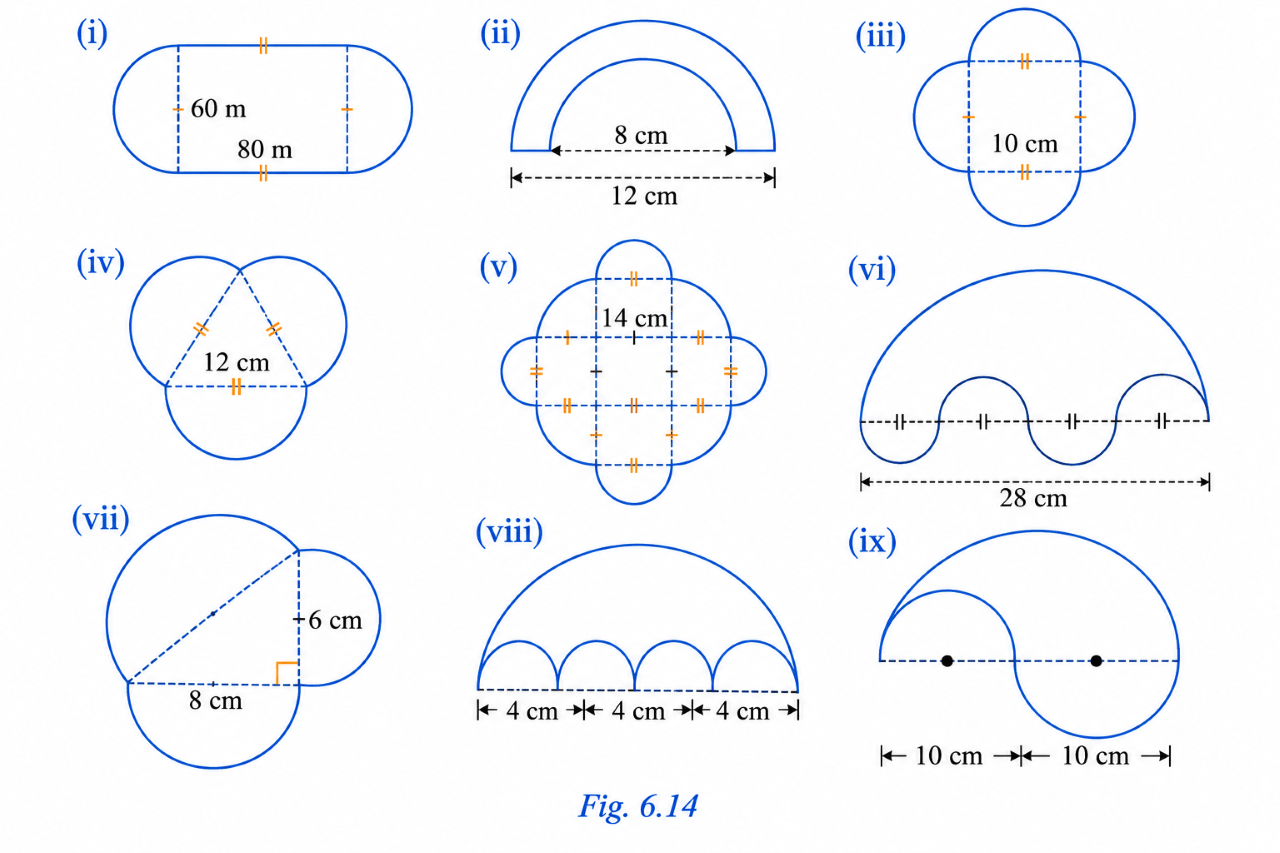
Find the perimeters of the following shapes, taking the arcs to be quarter, half, or three-quarters of a circle as appropriate.
Fig. 6.14 — Shapes for Exercise 6.1 Question 5
Question 5(i)
Find the perimeter of the following shapes, taking the arcs
to be quarter or half or three-quarters of a circle, as appropriate.
✍️ Solution
Given,
Length of the rectangular part = 80 m
Diameter of each semicircle = 60 m
To find,
Perimeter of the shape
📐 Figure
Length = 80 m and diameter of each semicircle = 60 m.
✍️ Solution
The perimeter consists of the two straight portions
of 80 m each and the two semicircular arcs.
Straight portions = 80 + 80 = 160 m
The two semicircles together make one complete circle
of diameter 60 m.
Circumference of the circle = πd
=
227 × 60 m
=
13207 m
Perimeter = 160 +
13207 m
=
1120 + 13207 m
=
24407 m
=
348
47 m
✓ Final Answer
Perimeter of the shape =
348
47 m
Question 5(ii)
Find the perimeter of the following shape, taking the arcs
to be quarter or half or three-quarters of a circle, as appropriate.
✍️ Solution
Given,
Diameter of outer semicircle = 12 cm
Diameter of inner semicircle = 8 cm
To find,
Perimeter of the shape
📐 Figure
Outer diameter = 12 cm and inner diameter = 8 cm.
✍️ Solution
The perimeter consists of the outer semicircular arc,
the inner semicircular arc and the two straight portions.
Length of each straight portion is
=
12 − 82 cm
= 2 cm
Therefore, total length of the two straight portions is
= 2 + 2 = 4 cm
Length of outer semicircular arc
=
12
× π × 12
= 6π cm
Length of inner semicircular arc
=
12
× π × 8
= 4π cm
Hence,
Perimeter = 4 + 6π + 4π
= 4 + 10π
=
4 +
2207 cm
=
28 + 2207 cm
=
2487 cm
=
35
37 cm
✓ Final Answer
Perimeter of the shape =
35
37 cm
Question 5(iii)
Find the perimeter of the following shape, taking the arcs
to be quarter or half or three-quarters of a circle, as appropriate.
✍️ Solution
Given,
Diameter of each semicircle = 10 cm
To find,
Perimeter of the shape
📐 Figure
Four equal semicircular arcs, each with diameter 10 cm.
✍️ Solution
The perimeter consists of the four semicircular arcs.
Length of one semicircular arc is
=
12
× π × 10
= 5π cm
There are four such semicircular arcs.
Perimeter = 4 × 5π
= 20π cm
Using
227
for π,
=
20 ×
227 cm
=
4407 cm
=
62
67 cm
✓ Final Answer
Perimeter of the shape =
62
67 cm
Question 5(iv)
Find the perimeters of the following shapes, taking the arcs to be quarter or half or three-quarters of a circle, as appropriate.
✍️ Solution
Given,
Diameter of each semicircle = 12 cm
To find,
Perimeter of the shape
📐 Figure
Figure 6.14(iv) — Three equal semicircular arcs.
✍️ Solution
The boundary of the shape is made up of three semicircular arcs.
Diameter of each semicircle = 12 cm
Therefore, radius of each semicircle is
=
122cm
= 6 cm
Length of one semicircular arc
= πr
= 6π cm
There are three such semicircular arcs.
Perimeter = 3 × 6π
= 18π cm
Using
227
for π,
=
18 ×
227cm
=
3967cm
=
56
47cm
✓ Final Answer
Perimeter of the shape =
56
47cm
Question 5(v)
Find the perimeters of the following shapes, taking the arcs
to be quarter or half or three-quarters of a circle, as appropriate.
✍️ Solution
Given,
Side segments shown in the figure = 14 cm
Radius of each quarter-circle = 14 cm
Radius of each semicircle = 7 cm
To find,
Perimeter of the shape
📐 Figure
Figure 6.14(v) — Curved shape with horizontal and vertical dotted construction lines.
✍️ Solution
The boundary of the shape is made up of four
quarter-circles and four semicircles.
Radius of each quarter-circle = 14 cm
Length of four quarter-circles
=
4 ×
14
× 2π × 14
= 28π cm
Diameter of each semicircle = 14 cm
Therefore, radius of each semicircle = 7 cm
Length of four semicircles
=
4 ×
12
× 2π × 7
= 28π cm
Therefore,
Perimeter = 28π + 28π
= 56π cm
Using
227
for π,
=
56 ×
227 cm
= 176 cm
✓ Final Answer
Perimeter of the shape = 176 cm
Question 5(vi)
Find the perimeters of the following shapes, taking the arcs
to be quarter or half or three-quarters of a circle, as appropriate.
✍️ Solution
Given,
Diameter of the larger semicircle = 28 cm
The diameter 28 cm is divided into 4 equal parts.
Diameter of each smaller semicircle = 7 cm
To find,
Perimeter of the shape
📐 Figure
Fig. 6.14(vi) — One large semicircle and four equal smaller semicircles.
✍️ Solution
The boundary of the shape is made up of one large
semicircular arc and four smaller semicircular arcs.
Diameter of the larger semicircle = 28 cm
Therefore, radius of the larger semicircle
=
282 cm
= 14 cm
Length of the larger semicircular arc
= πr
= 14π cm
The diameter 28 cm is divided into 4 equal parts.
Therefore, diameter of each smaller semicircle
=
284 cm
= 7 cm
Radius of each smaller semicircle
=
72 cm
= 3.5 cm
Length of one smaller semicircular arc
= πr
= 3.5π cm
Length of four smaller semicircular arcs
= 4 × 3.5π
= 14π cm
Therefore,
Perimeter = 14π + 14π
= 28π cm
Using
227
for π,
=
28 ×
227 cm
= 88 cm
✓ Final Answer
Perimeter of the shape = 88 cm
Question 5(vii)
Find the perimeters of the following shapes, taking the arcs
to be quarter or half or three-quarters of a circle, as appropriate.
✍️ Solution
Given,
One perpendicular side = 8 cm
Other perpendicular side = 6 cm
To find,
Perimeter of the shape
📐 Figure
Fig. 6.14(vii) — Three semicircular arcs constructed externally on the three sides of a right triangle.
✍️ Solution
The boundary of the shape is made up of three
semicircular arcs.
By Pythagoras theorem,
Hypotenuse² = 8² + 6²
= 64 + 36
= 100
Hypotenuse = 10 cm
Therefore, the diameters of the three semicircles are
8 cm, 6 cm and 10 cm.
Perimeter of the shape
=
12
× π × 8 +
12
× π × 6
+ 12
× π × 10
=
12
× π × (8 + 6 + 10)
=
12
× π × 24
= 12π cm
Using
227
for π,
=
12 ×
227 cm
=
2647 cm
≈ 37.71 cm
✓ Final Answer
Perimeter of the shape =
2647
cm
≈ 37.71 cm
Question 5(viii)
Find the perimeters of the following shapes, taking the arcs
to be quarter or half or three-quarters of a circle, as appropriate.
✍️ Solution
Given,
Diameter of the larger semicircle = 12 cm
Diameter of each smaller semicircle = 4 cm
To find,
Perimeter of the shape
📐 Figure
Fig. 6.14(viii) — One large semicircle and three equal smaller semicircles.
✍️ Solution
The boundary of the shape is made up of one large
semicircular arc and three smaller semicircular arcs.
Diameter of the larger semicircle = 12 cm
Therefore, radius of the larger semicircle
=
122 cm
= 6 cm
Length of the larger semicircular arc
= πr
= 6π cm
Diameter of each smaller semicircle = 4 cm
Therefore, radius of each smaller semicircle
=
42 cm
= 2 cm
Length of one smaller semicircular arc
= πr
= 2π cm
Length of three smaller semicircular arcs
= 3 × 2π
= 6π cm
Therefore,
Perimeter = 6π + 6π
= 12π cm
Using
227
for π,
=
12 ×
227 cm
=
2647 cm
≈ 37.71 cm
✓ Final Answer
Perimeter of the shape =
2647
cm
≈ 37.71 cm
Question 5(viii)
Find the perimeters of the following shapes, taking the arcs
to be quarter or half or three-quarters of a circle, as appropriate.
✍️ Solution
Given,
Diameter of the larger semicircle = 12 cm
Diameter of each smaller semicircle = 4 cm
To find,
Perimeter of the shape
📐 Figure
Figure 6.14(viii) — One large semicircle and three equal smaller semicircles.
✍️ Solution
The boundary of the shape is made up of one large
semicircular arc and three smaller semicircular arcs.
Diameter of the larger semicircle = 12 cm
Therefore, radius of the larger semicircle
=
122cm
= 6 cm
Length of the larger semicircular arc
= πr
= 6π cm
Diameter of each smaller semicircle = 4 cm
Therefore, radius of each smaller semicircle
=
42cm
= 2 cm
Length of one smaller semicircular arc
= πr
= 2π cm
Length of three smaller semicircular arcs
= 3 × 2π
= 6π cm
Therefore,
Perimeter = 6π + 6π
= 12π cm
Using
227
for π,
=
12 ×
227cm
=
2647cm
=
37
57cm
✓ Final Answer
Perimeter of the shape =
37
57
cm
Question 5(ix)
Find the perimeters of the following shapes, taking the arcs
to be quarter or half or three-quarters of a circle, as appropriate.
✍️ Solution
Given,
Diameter of the larger semicircle = 10 + 10 = 20 cm
Diameter of each smaller semicircle = 10 cm
To find,
Perimeter of the shape
📐 Figure
Fig. 6.14(ix) — One large semicircle and two smaller semicircles.
✍️ Solution
The boundary of the shape is made up of one large
semicircular arc and two smaller semicircular arcs.
Diameter of the larger semicircle
= 10 + 10
= 20 cm
Therefore, radius of the larger semicircle
=
202 cm
= 10 cm
Length of the larger semicircular arc
= πr
= 10π cm
Diameter of each smaller semicircle = 10 cm
Therefore, radius of each smaller semicircle
=
102 cm
= 5 cm
Length of two smaller semicircular arcs
= 2 × πr
= 2 × 5π
= 10π cm
Therefore,
Perimeter = 10π + 10π
= 20π cm
Using
227
for π,
=
20 ×
227 cm
=
4407 cm
=
62
67 cm
✓ Final Answer
Perimeter of the shape =
62
67 cm
≈ 62.86 cm
Question 6
If the diameter of a car tyre is 56 cm, then:
(i) How far does the car need to travel for the tyre
to complete one revolution?
(ii) How many revolutions does the tyre make if the
car travels 10 km?
Given
Diameter of tyre = 56 cm
Therefore, radius,
56
2
= 28 cm
Take π =
22
7
(i) Distance travelled in one revolution
One complete revolution of the tyre covers its
circumference.
Circumference of a circle = 2πr
Therefore,
Circumference = 2 ×
22
7
× 28
= 176 cm
∴ The car travels 176 cm in one revolution.
(ii) Number of revolutions in 10 km
Distance travelled by the car = 10 km
Converting kilometres into centimetres,
10 km = 10 × 1000 m
= 10,000 m
= 10,00,000 cm
Distance travelled in one revolution = 176 cm
Therefore,
Number of revolutions
=
10,00,000
176
=
62,500
11
= 5681
9
11
∴ The tyre makes
5681
9
11
revolutions
in 10 km.
Final Answer
(i) Distance travelled in one revolution
= 176 cm (ii) Number of revolutions in 10 km
= 5681
9
11
revolutions
(approximately 5682 complete revolutions)
Question 7
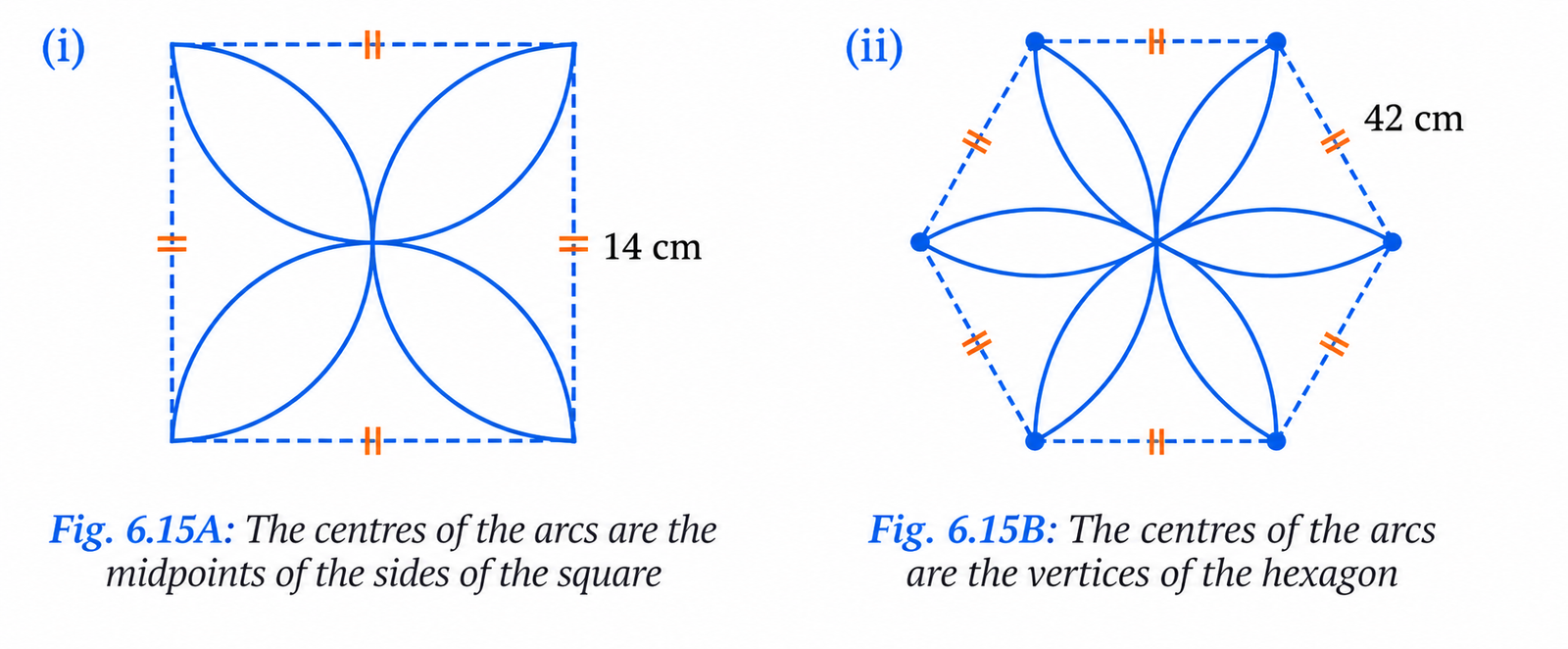
Find the total perimeter of all the petals in each of the following
flowers (Fig. 6.15).
(A) The square has side 14 cm.
(B) The hexagon has side 42 cm.
Fig. 6.15 — Flowers for Exercise 6.1 Question 7
Question 7 (i)
Find the total perimeter of all the petals in the flower.
The square has side 14 cm.
Understanding the Figure
To find the perimeter, consider one petal first.
Its boundary is made up of two quarter-circle arcs.
The two centres of these arcs are the midpoints of the sides
of the square.
Given
Side of square = 14 cm
The centres of the arcs are the midpoints of the sides of the square.
Solution
Step 1: Find the radius of each arc
Each centre is the midpoint of a side of the square.
Therefore,
Radius of each arc
=
14
2
= 7 cm
Step 2: Find the perimeter of one petal
One petal consists of two quarter-circle arcs.
Length of one quarter-circle arc
=
1
4
× 2πr
=
1
4
× 2 ×
22
7
× 7
= 11 cm
Therefore, perimeter of one petal
= 2 × 11
= 22 cm
Step 3: Find the perimeter of all four petals
There are 4 identical petals.
Total perimeter
= 4 × 22
= 88 cm
Final Answer
The total perimeter of all the petals is
88 cm.
Question 7 (ii)
Find the total perimeter of all the petals in the flower.
The hexagon has side 42 cm.
Understanding the Figure
Join the centre O of the regular hexagon to the
vertices A and B. Then
AB = AO = BO = 42 cm, so
△AOB is equilateral. Hence each angle is
60°.
Given
Side of regular hexagon = 42 cm
Solution
Step 1: Find the radius and angle of each arc
In a regular hexagon,
AB = AO = BO = 42 cm.
Hence, △AOB is equilateral.
Therefore,
∠BAO = ∠ABO = ∠AOB = 60°.
Since A and B are the centres of the two arcs forming one petal,
Radius of each arc = 42 cm
Angle of each arc = 60°
Step 2: Find the length of one arc
Length of an arc
=
60°
360°
× 2πr
=
1
6
× 2 ×
22
7
× 42
= 44 cm
Step 3: Find the total perimeter
One petal consists of 2 equal arcs.
Perimeter of one petal
= 2 × 44
= 88 cm
There are 6 identical petals.
Total perimeter
= 6 × 88
= 528 cm
Final Answer
The total perimeter of all the petals is
528 cm.
Question 8
The ratio of the perimeters of two circles is 5 : 4.
Find the ratio of their radii.
Given
Ratio of the perimeters of two circles = 5 : 4
Let the radii of the two circles be
r₁ and r₂.
To find: Ratio of their radii = r₁ : r₂
Solution
We know that,
Perimeter of a circle = 2πr
Therefore, the ratio of the perimeters is
2πr₁ : 2πr₂
= r₁ : r₂
But the ratio of the perimeters is given as
5 : 4
Therefore,
r₁ : r₂ = 5 : 4
∴ The ratio of their radii is
5 : 4.
📚 Continue Learning
Congratulations! You have completed the
Class 9 Maths Chapter 6 Exercise 6.1 Solutions.
You have now worked through Exercise 6.1 of
Chapter 6 – Measuring Space: Perimeter and Area.
Continue your learning journey by moving to the previous or next exercise,
or revisiting Exercise 6.1 whenever you need a quick revision.
Find quick answers to common questions about
Class 9 Maths Chapter 6 Exercise 6.1 Solutions.
These FAQs help students understand what the exercise covers,
which formulas are used, how to approach the questions, and how to
use the solutions effectively for homework, revision,
self-study and CBSE examination preparation.
What is taught in Class 9 Maths Chapter 6 Exercise 6.1?
Exercise 6.1 of Class 9 Maths Chapter 6,
Measuring Space: Perimeter and Area, focuses mainly on
the perimeter of circles and curved shapes. The exercise includes
circumference, arc length, sector perimeter, composite curved
shapes, tyre revolutions and perimeter-based applications.
What value of π should I use in Exercise 6.1?
Unless stated otherwise, the exercise instructs students to use
π = 22/7. Therefore, the calculations in these
Class 9 Maths Exercise 6.1 Solutions follow the
textbook’s instruction and use 22/7 where applicable.
What are the important formulas in Exercise 6.1?
The main formulas used are
circumference = 2πr,
circumference = πd, and
arc length = 2πr × θ/360°.
For a sector, remember that its perimeter includes the
arc length plus the two radii. These formulas are
used repeatedly throughout Exercise 6.1.
How do I calculate the length of an arc in Class 9 Maths?
If an arc subtends an angle
θ° at the centre of a circle of radius
r, use
Arc length = 2πr × θ/360°.
First identify the radius and central angle, substitute the values,
and simplify the result carefully. This formula is used in
Question 3 of Exercise 6.1.
What is the perimeter of a sector?
The perimeter of a sector consists of the
curved arc and the two radii. Therefore,
Perimeter of sector = Arc length + 2r.
In Exercise 6.1, this idea is applied in
Question 4, where the radius and sector angle are given.
How do I solve the composite-shape questions in Exercise 6.1?
For a composite curved shape, first identify all the boundary parts
that form its perimeter. Decide whether each curved part is a
quarter, half or three-quarter circle, or another
required fraction of a circle. Then calculate the curved lengths and
any straight lengths and add them to obtain the complete perimeter.
Question 5 contains nine such figures.
How do I find the number of revolutions of a tyre?
First find the distance travelled by the tyre in one complete
revolution. This is equal to the tyre’s
circumference. Then convert the total distance into
the same unit and use:
Number of revolutions = Total distance ÷ Distance travelled in one revolution.
This method is used in Question 6 of Exercise 6.1.
Are these Class 9 Maths Chapter 6 Exercise 6.1 Solutions based on Ganita Manjari 2026?
Yes. These Class 9 Maths Chapter 6 Exercise 6.1 Solutions
are prepared according to the questions and concepts of the
NCERT Ganita Manjari (2026–27) textbook. The solutions
are presented question-wise in a clear, student-friendly format to help
with classwork, homework, self-study, revision and
CBSE examination preparation.
📚 Useful Learning Resources
Continue your preparation with more
Class 9 Maths resources from Maths Gurukulam,
or visit the official NCERT and CBSE websites for the latest textbooks,
syllabus, and academic updates.
Found Class 9 Maths Chapter 6 Exercise 6.1 Solutions helpful?
For students who need personal support beyond self-study, join
Newton Study Point for concept-based Maths coaching by an
experienced teacher. Small batches, individual attention, regular tests, and
complete CBSE exam preparation are available for Classes 8, 9, 10, 11 & 12.
Mathematics Educator • Founder of
Maths Gurukulam & Newton Study Point
18+ Years of Mathematics Teaching Experience • Teaching Since 2006
These Class 9 Maths Chapter 6 Exercise 6.1 Solutions are
carefully prepared according to the latest NCERT Ganita Manjari
(2026) and the CBSE curriculum. The solutions follow
a clear, step-by-step approach to help students understand questions based
on perimeter, circumference, arc length, sector perimeter, and
composite curved shapes, while building confidence in solving
Exercise 6.1 problems.