Answers
Exercise-wise Solutions
Find clear, step-by-step answers to the Class 9 Maths Chapter 5 exercises.
View Exercise Solutions →Find Class 9 Maths Chapter 5 Solutions with clear, step-by-step answers based on the latest NCERT Ganita Manjari (2026–27). Learn the important circle concepts and theorems, understand their geometric reasoning, and quickly move to the exercise-wise solutions you need.
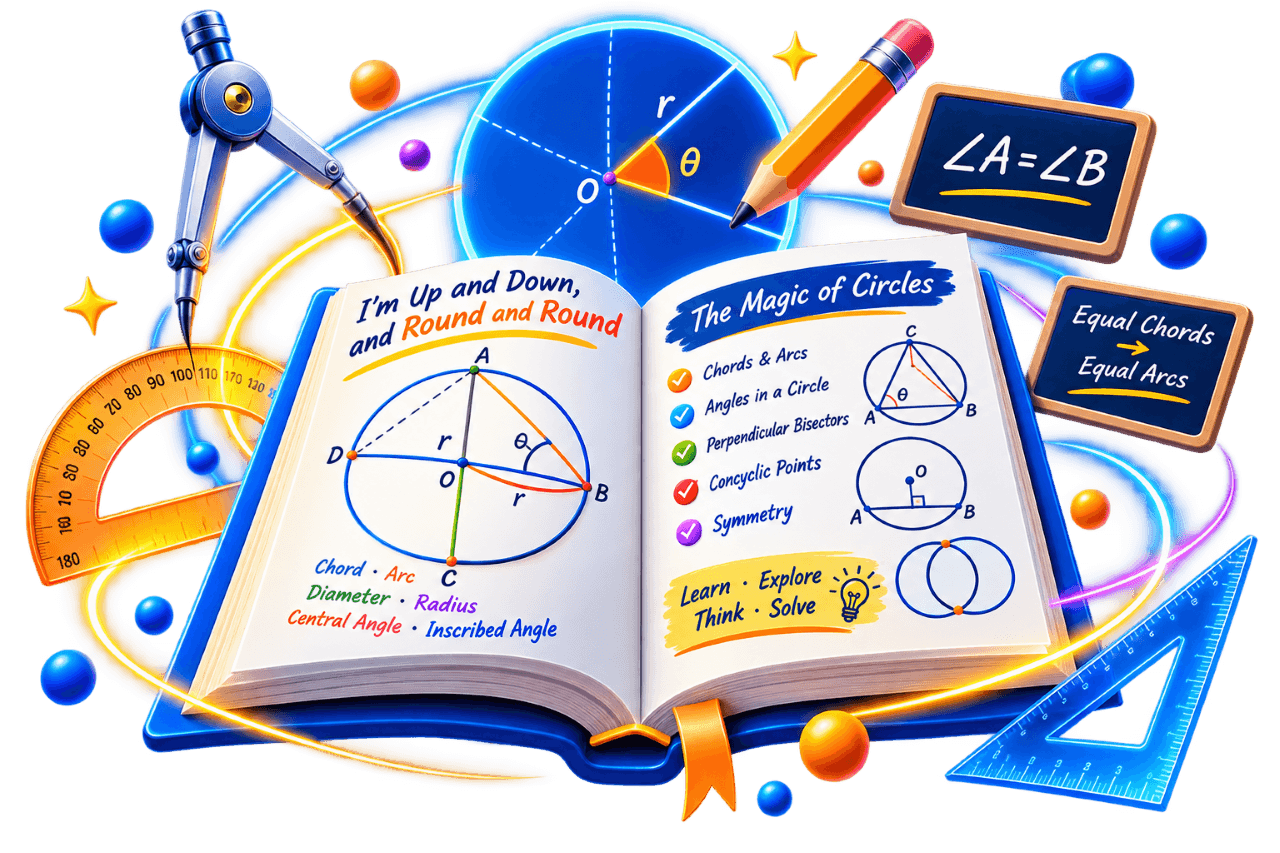
Looking for a particular exercise answer, theorem or proof? Start with the section you need and continue learning at your own pace.
Find clear, step-by-step answers to the Class 9 Maths Chapter 5 exercises.
View Exercise Solutions →Understand the important theorems of the chapter with diagrams, reasoning and proof-based explanations.
Explore Theorems →Explore the additional thinking questions from Chapter 5 and follow their step-by-step solutions.
View Think & Reflect →Revise key circle concepts, important results and theorem-based ideas before solving questions.
Open Quick Revision →Use accurate geometric figures to understand circles, chords, angles and related constructions more clearly.
Learn Through Figures →Chapter 5 learning and solutions are organised around the latest NCERT Ganita Manjari textbook.
Start Chapter 5 →Find your question → open the exercise solution → check the theorem if needed → understand the reasoning → continue with the next question.
From the basic language of circles to chords, arcs, angles and cyclic quadrilaterals, this chapter builds your understanding step by step through important results and theorems.
Learn the basic terms and ideas used throughout the chapter, including the important parts and properties of a circle.
Explore the symmetry of a circle and understand its rotational symmetry about the centre.
Investigate circles passing through given points and understand the uniqueness of the circle through three non-collinear points.
Discover the relationship between equal chords and the angles they subtend at the centre, together with the corresponding converse.
Understand how the centre of a circle is related to the midpoint of a chord and the perpendicular to that chord.
Learn how the length of a chord is connected with its distance from the centre, including the important result about longer and shorter chords.
Study angles subtended by an arc at the centre and at points on the circle, leading to the important result for an angle in a semicircle.
Learn when points lie on the same circle and study cyclic quadrilaterals, including the relationship between their opposite angles.
Chapter 5 is built around these important results. Read each theorem here for a quick understanding, then follow the link to learn its detailed proof step by step.
There is a unique circle passing through three non-collinear points.
Learn the Proof →Equal chords of a circle subtend equal angles at the centre of the circle.
Learn the Proof →Chords of a circle that subtend equal angles at the centre are equal.
Learn the Proof →The line joining the centre of a circle and the midpoint of a chord of the circle is perpendicular to the chord.
Learn the Proof →The perpendicular from the centre of a circle to a chord of the circle bisects the chord.
Learn the Proof →Chords of a circle having the same length are all at the same distance from the centre of the circle.
Learn the Proof →Chords of a circle that are equidistant from the centre have equal length.
Learn the Proof →Let AB and DE be two chords of a circle with centre C. Suppose AB > DE. Then the distance from C to AB is less than the distance from C to DE.
Learn the Proof →The angle subtended by an arc at the centre of the circle is double the angle subtended by the arc at any point on the circle outside the arc.
Learn the Proof →If a line segment AB joining two points A, B subtends equal angles at two other points C, D that lie on the same side of AB, then the four points lie on a circle.
Learn the Proof →The sum of two opposite angles of a cyclic quadrilateral is 180°.
Learn the Proof →If two opposite angles of a quadrilateral add up to 180°, then the vertices of the quadrilateral lie on a circle, i.e., they are concyclic.
Learn the Proof →Strengthen your understanding of Chapter 5 through thoughtful questions that encourage reasoning, observation and deeper mathematical thinking.
Explore the Think & Reflect questions from I’m Up and Down, and Round and Round and develop a deeper understanding of circles, chords, angles and their properties.
💡 Explore Think & Reflect Solutions →Class 9 Maths Chapter 5 में कौन-सा concept कहाँ मिलेगा? नीचे topic चुनें और सीधे उसके detailed Learn Before You Solve section पर जाएँ।
Centre, radius, chord और diameter जैसे basic circle concepts से शुरुआत करें।
Learn the Concept →Three non-collinear points से unique circle और circumcircle की basic idea समझें।
Learn Theorem 1 →Equal chords और उनके द्वारा centre पर subtend किए गए angles का relationship समझें।
Learn the Concept →Chord के midpoint, centre से perpendicular और chord की distance के बीच connection समझें।
Learn the Concept →Equal chords की centre से दूरी और उनके reciprocal relationship को समझें।
Learn the Concept →Longer और shorter chords की centre से दूरी का relationship तथा Theorem 8 समझें।
Learn Theorem 8 →Minor arc, major arc और arc द्वारा centre तथा circle पर subtend किए गए angles को समझें।
Learn the Concept →Points के concyclic होने और cyclic quadrilateral से जुड़े important ideas को revise करें।
Learn the Concept →पूरे chapter के important ideas और theorems को quickly revise करने के लिए।
Open Quick Revision →Circle, chords, arcs, angles और cyclic quadrilaterals से जुड़े important theorems को एक जगह revise करें। Detailed proof पढ़ने के लिए संबंधित exercise solution पर जाएँ।
Equal chords of a circle subtend equal angles at the centre.
Chords that subtend equal angles at the centre are equal.
The line joining the centre to the midpoint of a chord is perpendicular to the chord.
The perpendicular from the centre of a circle to a chord bisects the chord.
Equal chords of a circle are equidistant from the centre.
Chords equidistant from the centre of a circle are equal.
Of two chords of a circle, the longer chord is nearer to the centre.
The angle subtended by an arc at the centre is double the angle subtended by the same arc at any point on the circle outside the arc.
The angle subtended by a diameter at any point on the circle is 90°.
Equal angles subtended by AB at C and D on the same side imply that A, B, C and D are concyclic.
The sum of two opposite angles of a cyclic quadrilateral is 180°.
If two opposite angles of a quadrilateral add to 180°, its vertices are concyclic.
Circles, Chords, Arcs, Angles & Cyclic Quadrilaterals के important concepts को जल्दी revise करें। किसी concept को detail में पढ़ना हो तो उसके Learn Before You Solve section पर जाएँ।
Centre से circle के हर point की दूरी radius होती है। Centre से गुजरने वाली chord diameter होती है।
Revise from Ex 5.1 LBWS →Three non-collinear points से one unique circle गुजरता है। यही circumcircle की foundation है।
Revise Theorem 1 →Equal chords centre पर equal angles subtend करते हैं, और converse भी true है।
Revise Theorems 2 & 3 →Centre को chord के midpoint से join करने वाली line chord पर perpendicular होती है।
Revise Theorems 4 & 5 →Equal chords centre से equal distance पर होते हैं, और converse भी true है।
Revise Theorems 6 & 7 →दो chords में जो chord longer है, वह centre के closer होती है।
Revise Theorem 8 →एक ही arc द्वारा centre पर subtended angle, circle के point पर subtended angle का double होता है।
Revise Theorem 9 →Diameter द्वारा circle पर subtended angle हमेशा 90° होता है।
Revise the Corollary →Equal angles subtended by the same segment concyclicity establish करने में मदद करते हैं।
Revise Theorem 10 →Cyclic quadrilateral में opposite angles का sum 180° होता है।
Revise Theorem 11 →यदि quadrilateral के opposite angles का sum 180° है, तो उसके vertices concyclic होते हैं।
Revise Theorem 12 →Concepts revise हो गए? अब Chapter 5 के End-of-Chapter Exercises solve करके अपनी preparation check करें।
Start Practice →Circles के questions में answer गलत होने से बचने के लिए इन common mistakes को solve करने से पहले एक बार जरूर check करें।
Equal chords की centre से equal distance बताने के लिए Theorem 6 की condition पहचानें। Theorem को बिना condition के apply न करें।
याद रखें: Equal chords → Equal distance, जबकि Equal distance → Equal chords converse direction है।
Theorem 8 में relationship याद रखें: longer chord → nearer to the centre. Direction को उल्टा लिखना common error है।
Theorem 4 में centre और midpoint of chord को join करने वाली line perpendicular होती है। Theorem 5 में centre से chord पर perpendicular chord को bisect करता है।
एक ही arc के लिए centre पर angle, circle के point पर subtended angle का double होता है। दोनों angles को interchange न करें।
Angle in a semicircle = 90° तभी directly use करें जब given segment diameter हो।
Cyclic quadrilateral में opposite angles का sum 180° होता है। Adjacent angles पर यह rule सीधे apply नहीं होता।
Theorem 11 में cyclic quadrilateral से opposite angles का sum मिलता है। Theorem 12 इसका converse है: 180° sum से concyclicity establish होती है।
Follow this simple four-step path to move from understanding the chapter to confidently checking your final preparation.
Start with the Chapter 5 concept guide and understand the ideas needed before solving questions.
Use the quick revision dashboard to recall the key ideas and important relationships before practice.
Choose the required exercise and work through clear, step-by-step NCERT-aligned solutions.
Finish with the chapter-end questions to check how confidently you can apply what you have learned.
Quick answers for students preparing with Class 9 Maths Chapter 5 Solutions, NCERT Ganita Manjari 2026–27, exercise-wise practice and chapter revision.
Class 9 Maths Chapter 5, “I’m Up and Down, and Round and Round”, introduces students to the geometry of circles. The chapter develops ideas related to circles, symmetry, chords, arcs, angles and concyclicity through definitions, activities, constructions and mathematical reasoning.
You can use the Class 9 Maths Chapter 5 Solutions on Maths Gurukulam for exercise-wise NCERT-aligned answers. The solutions are organised according to the chapter exercises so that you can directly open the exercise you are studying.
Start with the Chapter 5 Exercise Solutions section to choose the required exercise.
The chapter contains Exercise Sets 5.1, 5.2, 5.3, 5.4, 5.5 and 5.6, followed by the End-of-Chapter Exercises. Each exercise focuses on a different stage of understanding circles and their properties.
The chapter covers definitions of a circle, symmetries of a circle, circles through given points, chords and the angles they subtend, perpendicular bisectors of chords, distance of chords from the centre, angles subtended by an arc and concyclicity of points.
Yes. The solutions are designed in a clear, step-by-step CBSE answer-writing style. Important reasoning, constructions and calculations are shown in a student-friendly sequence so that you can understand how an answer is obtained rather than simply copying the final result.
The Think & Reflect Solutions are organised separately from the exercise-wise solutions. This makes it easier to practise the textbook’s reflective questions without mixing them with the formal exercise answers.
You can jump directly to Think & Reflect Solutions .
A good preparation sequence is: learn the concepts → revise the key ideas → solve the exercises → attempt the chapter-end questions. Pay special attention to diagrams, construction-based questions, numerical applications and questions that require mathematical reasoning.
Yes. The Chapter 5 solution material on Maths Gurukulam is prepared for the NCERT Ganita Manjari 2026–27 Class 9 Mathematics curriculum. The exercise structure and chapter terminology are aligned with the new textbook.
Yes. The End-of-Chapter Exercises are useful for checking whether you can apply the ideas learned throughout Chapter 5. They are best attempted after completing the exercise sets and revising the chapter concepts.
Before solving questions, revise the basic circle vocabulary, the relationship between a chord and its midpoint, the role of the centre, arcs and angles, and the conditions used in concyclicity problems. Then use the Chapter 5 Quick Revision section for a fast recap.
Use these carefully selected resources to study Class 9 Maths Chapter 5, revise the NCERT material and explore official academic information from trusted sources.

M.Sc. Mathematics
•
18+ Years of Teaching Experience
•
Teaching Mathematics Since 2006
Founder of
Maths Gurukulam
&
Newton Study Point
The Class 9 Maths Chapter 5 Solutions on Maths Gurukulam are prepared with a focus on clear mathematical reasoning, accurate presentation and student-friendly step-by-step learning. For “I’m Up and Down, and Round and Round”, the material follows the NCERT Ganita Manjari 2026–27 chapter structure and is designed to help students understand concepts, practise questions confidently and prepare effectively for school and CBSE examinations.
Not a member yet? Register now
Are you a member? Login now