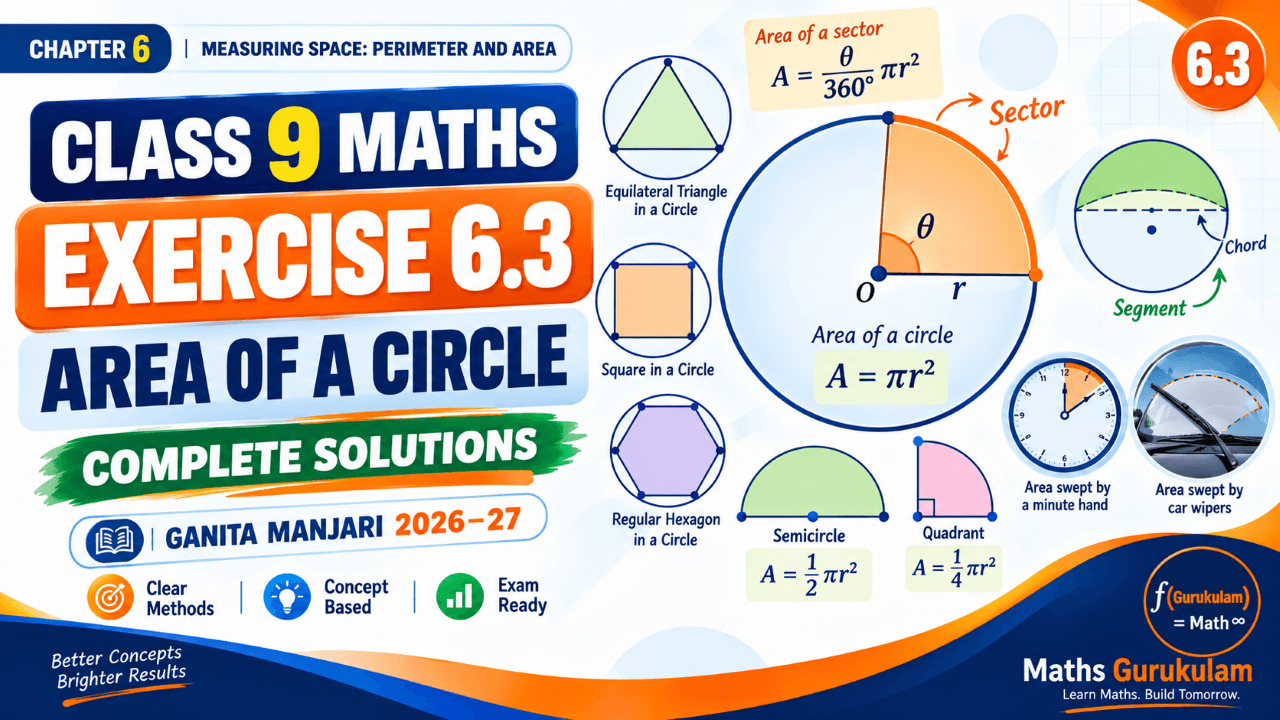
📖 About Class 9 Maths Chapter 6 Exercise 6.3
Class 9 Maths Chapter 6 Exercise 6.3 Solutions cover Exercise Set 6.3 from Chapter 6 – Measuring Space: Perimeter and Area in the latest NCERT Ganita Manjari (2026–27) textbook. This page provides complete, reliable and easy-to-follow NCERT Class 9 Maths solutions for students searching for Class 9 Maths Exercise 6.3 Solutions, Exercise 6.3 Class 9 Maths answers and Class 9 Maths Chapter 6 Solutions in one place.
The NCERT Class 9 Maths Chapter 6 Exercise 6.3 Solutions are arranged question-wise in a clear, student-friendly CBSE answer-writing format. This exercise focuses on important questions related to area of a circle, area of sectors, area of quadrants, area of semicircles, minor and major sectors, minor and major segments, area swept by a minute hand, area swept by car wipers and area ratios of inscribed figures. The exercise also includes questions involving an inscribed equilateral triangle, inscribed square and inscribed regular hexagon. These solutions are useful for homework, classroom practice, self-study, revision and CBSE examination preparation.
📚 Learn Before You Solve
Before solving
Class 9 Maths Chapter 6 Exercise 6.3 Solutions,
first understand the important concepts behind
the area of a circle, the formula πr², sectors,
quadrants, circular segments, inscribed figures and area ratios.
This
Learn Before You Solve section follows the
NCERT Ganita Manjari Class 9 Mathematics
approach and builds the concepts needed for
Exercise Set 6.3.
The learning journey moves from understanding the area of a circle
and discovering the formula
A = πr² to sector areas, real-life applications,
chords and segments, inscribed regular figures and quick revision.
The aim is simple:
understand the mathematics first, then solve independently.
⭕ Understanding the Area of a Circle
Learn what the enclosed area of a circle means and why circular shapes are mathematically special
Before solving Class 9 Maths Chapter 6 Exercise 6.3 Solutions, let us first understand what the area enclosed by a circle means and why the area of a circle is connected with the square of its size.
What does the area enclosed by a circle actually represent?
1. What Is the Area Enclosed by a Circle?
The area of a circle is the amount of flat space enclosed by its circular boundary.
If a circle is drawn on a sheet of paper, its area represents the complete region inside the circle—not only the curved boundary.
Area is measured in square units.
For example, the area may be measured in cm², m² or km². The unit is squared because area measures two-dimensional space.
2. Why Does Circle Area Depend on the Square of Its Size?
When a circle becomes larger, its area does not increase only by the same amount as its radius or circumference. Area grows in two dimensions—length and breadth—so it is connected with the square of the scale factor.
If the size doubles
Every length becomes twice as large. Therefore, the area becomes:
So, doubling the radius makes the area four times as large.
If the size triples
Every length becomes three times as large. Therefore, the area becomes:
So, tripling the radius makes the area nine times as large.
Main idea: Area changes with the square of the scale factor because area is measured in two dimensions.
3. Scale Reasoning: Square and Equilateral Triangle
The same scale idea can be understood using familiar shapes. Suppose every length of a figure is multiplied by the same number.
For a square, both its length and breadth are multiplied. Therefore, its area is multiplied twice by the scale factor.
An equilateral triangle also grows in two dimensions. Its area changes according to the square of the scale factor.
Shape may change the constant, but the square-scale behaviour remains.
4. Why Does the Ratio Depend on the Shape, Not Its Size?
Consider two squares of different sizes. Their areas and perimeters are different, but the relationship between the square of the perimeter and the area remains fixed for every square.
This happens because enlarging a shape multiplies its perimeter by the scale factor, while its area is multiplied by the square of that factor.
Perimeter
Perimeter is a one-dimensional measurement. If every length is multiplied by a factor k, the perimeter is multiplied by k.
Area
Area is a two-dimensional measurement. If every length is multiplied by k, the area is multiplied by k².
Same shape + different size = same ratio
The ratio is determined by the shape itself, not by whether the shape is small or large.
5. Introducing the Constant Ratio Involving C² and A
For a circle, let:
- C represent the circumference.
- A represent the area enclosed by the circle.
Since circumference is a length and area is a square measurement, the square of the circumference is naturally compared with the area.
The ratio of C² to A remains constant for circles of different sizes.
What Does “Constant” Mean Here?
A constant is a value that does not change when the size changes, provided the shape remains the same.
Thus, if we compare the square of the circumference with the area of several circles, the ratio will be the same for all of them.
Remember:
The circle may become larger or smaller, but the ratio remains unchanged because every circle has the same shape.
6. Historical Attempts to Understand the Circle
The relationship between a circle’s circumference and its area fascinated mathematicians for thousands of years.
Babylonians
Ancient Babylonian mathematicians used numerical approximations for circle measurements. Their work shows that people were trying to understand the relationship between circular length and enclosed space long before modern notation.
Egyptians
Ancient Egyptian mathematicians also developed methods for estimating the area of a circle. Their calculations used practical approximations that were useful in construction, measurement and land-related problems.
These historical attempts remind us that finding the area of a circle is not merely a modern formula-based activity. It is a mathematical question that humans have explored for a very long time.
Circular Shapes in Human Life
Why were human beings so fond of using circular shapes? Was this only for practical reasons, or could there have been other reasons too? What kinds of uses have human beings found for the circular shape?
🧮 Discovering the Formula A = πr²
Understand how polygons and circle slices lead naturally to the area formula
The area of a circle is not an isolated formula to memorise. Mathematicians developed it by comparing a circle with shapes whose areas were already understood.
The formula A = πr² can be discovered in more than one meaningful way.
1. Archimedes’ Important Observation
The ancient mathematician Archimedes studied the relationship between a circle and polygons drawn inside it.
He observed that the area of a circle can be understood by using regular polygons with more and more sides.
Central idea:
As a regular polygon gets more sides, its boundary and shape become closer to those of a circle.
2. Area of a Regular Polygon
A regular polygon has all its sides equal and all its interior angles equal. Join its centre to all its vertices. The polygon is divided into congruent triangles.
In each triangle, the base is one side of the polygon and the perpendicular height from the centre is called the apothem.
Area of a regular polygon
The apothem is the perpendicular distance from the centre to a side.
Why the Formula Works
Each small triangle has area equal to:
Adding all the triangles gives:
- The sum of all triangle bases is the polygon’s perimeter.
- The apothem is common to all the triangles.
- Therefore, the total area is half the product of perimeter and apothem.
3. Let the Regular Polygon Approach a Circle
Imagine drawing regular polygons inside the same circle: first a hexagon, then a polygon with many more sides, and finally a polygon with an extremely large number of sides.
As the number of sides increases:
Perimeter
The polygon’s perimeter approaches the circumference of the circle.
Apothem
The apothem approaches the radius of the circle.
Area
The polygon’s area approaches the area enclosed by the circle.
4. Deriving the Area Formula of a Circle
Start with the area formula for a regular polygon:
When the polygon approaches a circle:
Perimeter
becomes C
Apothem
becomes r
Area
becomes A
Area of a circle
Therefore, A = πr²
5. Nilakantha Somayaji’s Slice-and-Rearrange Idea
Another intuitive explanation is associated with the Indian mathematician Nilakantha Somayaji.
Imagine dividing a circle into many equal sectors. Arrange these sectors alternately upward and downward.
When the sectors are narrow enough, the rearranged figure begins to look like a parallelogram.
The important observation:
Rearranging the pieces changes their position, but not the total area.
6. Area of the Rearranged Shape
The rearranged sectors form a parallelogram-like figure. Its dimensions are:
Base
Each half of the circle contributes approximately half of the circumference.
Base = C/2
Height
The distance from the centre to the boundary remains the radius.
Height = r
Area of the circle
A = πr²
The Big Mathematical Picture
Whether we use regular polygons or rearranged circle sectors, both methods lead to the same conclusion: the area of a circle is half the circumference multiplied by the radius.
Since the circumference is 2πr, the area becomes πr².
📐 Area of a Sector
Understand how a part of a circle represents the same fraction of its total area
A circle can be divided into several parts by drawing radii from its centre. Each part is called a sector.
The area of a sector depends on the fraction of the complete circle represented by its central angle.
1. What Is a Sector?
A sector of a circle is the region enclosed by:
- two radii drawn from the centre, and
- the arc joining their endpoints.
The angle between the two radii is called the central angle.
In the diagram:
O is the centre, OA and OB are radii, AB is the curved arc, and ∠AOB = θ is the central angle.
2. A Full Circle, a Semicircle and a Quadrant
A complete revolution around the centre measures 360°. Therefore, the central angle tells us what fraction of the full circle is included in a sector.
Full area
Half of the circle
One-fourth of the circle
3. Sector Area as a Fraction of the Circle
The complete circle has an angle of 360°. A sector with central angle θ represents the fraction:
Thus, the sector’s area is the same fraction of the complete circle’s area as its central angle is of 360°.
A Simple Example
Suppose a sector has a central angle of 90°. Since 90° is one-fourth of 360°, the sector occupies one-fourth of the complete circle.
Therefore:
Area of a 90° sector = one-fourth of the area of the circle.
4. Different Types of Sectors
Different central angles give sectors of different sizes. The same formula works for every sector.
Acute Sector (60°)
Less than one-fourth of the circle
Quadrant (90°)
One-fourth of the circle
Obtuse Sector (120°)
More than one-fourth, less than half
Semicircle (180°)
Half of the circle
5. General Formula for the Area of a Sector
The area of the complete circle is πr². A sector with central angle θ represents the fraction θ/360° of the complete circle.
Area of a sector
Area of sector = πr² × θ/360°
6. How Rotational Symmetry Explains the Formula
A circle looks exactly the same after any rotation about its centre. This rotational symmetry means that equal central angles cut out equal sectors.
For example, dividing a circle into four equal sectors gives four sectors of 90°. Each sector has the same area, so each one contains one-fourth of the complete circle’s area.
Equal angles
Equal central angles create equal sectors.
Equal sectors
Equal sectors have equal areas.
Fractional area
The angle fraction gives the area fraction.
🕒 Using Sector Area in Real Situations
Class 9 Maths Chapter 6 Exercise 6.2 — पहले situation समझें, फिर sector area लगाएँ
🕒 Area Swept by a Clock Hand
Imagine that a clock hand starts from one position and rotates to another position. As it moves, it covers a region of the clock face.
If the hand has length r and turns through an angle θ, the region covered is a sector.
🚘 Area Swept by a Windshield Wiper
A windshield wiper rotates about a fixed point. The fixed point behaves like the centre of a circle, and the wiper blade traces an arc.
The region between the starting and ending positions of the wiper is a sector. Therefore, its area can be found using the sector-area formula.
📐 From Complete Circle to Swept Sector
A complete circle has a central angle of 360° and area πr².
If an object sweeps through only θ degrees, it covers the same fraction of the circle as the fraction of the angle.
Here, r is the radius and θ is the central angle of the sector.
🟠 Quadrant — A 90° Sector
A quadrant is one-fourth of a complete circle. Its central angle is 90°.
◔ Minor Sector
The sector formed by the smaller angle between two radii is called the minor sector.
Its central angle is generally less than 180°.
◕ Major Sector
The sector formed by the larger angle between two radii is called the major sector.
Its central angle is greater than 180° and less than 360°.
360° − 150° = 210°
◓ Semicircle — A 180° Sector
A semicircle is formed when the central angle is exactly 180°.
🔍 Read the Situation Carefully
In real-life problems, the angle may not always be written directly as the angle of the required sector. First decide which region is actually being swept or asked for.
Situation A — Clock Hand
A clock hand rotates from one marked position to another. The angle between the starting and ending positions at the centre is the angle to use.
Situation B — Windshield Wiper
A wiper moves from its starting position to its ending position. The smaller angle between these two positions usually gives the minor swept sector.
Situation C — Quadrant Region
If the diagram shows one-fourth of a circle, the angle is automatically 90°.
Situation D — Major Region
If the larger part of the circle is required, first find the major angle.
⚡ Before Substituting Values
- Find the fixed centre of rotation.
- Identify the radius from the centre to the moving boundary.
- Locate the starting and ending positions.
- Measure the central angle between those positions.
- Decide whether the required region is minor, major, a semicircle, or a quadrant.
- Use the sector-area formula with the correct angle.
Practice Situation 1
A decorative lamp rotates through 30° about a fixed point. Its rotating arm reaches a circular boundary at a distance of r.
The region covered by the arm is a sector with central angle 30°.
Practice Situation 2
A garden sprinkler covers a quarter of a circular region. The covered part is a quadrant.
Therefore, the central angle of the covered region is 90°.
Practice Situation 3
A rotating sensor covers a smaller sector of a circular floor through an angle of 150°.
Since the angle is less than 180°, the covered region is a minor sector.
Practice Situation 4
A machine covers the larger region between two radii. The smaller angle between them is 150°.
The required major angle is:
🔵 Chords, Sectors and Segments
Class 9 Maths Chapter 6 Exercise 6.2 — Understand the curved regions inside a circle
📏 Chord
A chord is a straight line segment whose two endpoints lie on the circle.
〰️ Arc
An arc is a curved part of the circumference of a circle between two points.
🟠 Sector
A sector is the region enclosed by:
- Two radii
- The arc between their endpoints
🔵 Segment
A segment is the region enclosed by:
- One chord
- The corresponding arc
◒ Minor Segment
The smaller region between a chord and its corresponding minor arc is called the minor segment.
When the central angle is less than 180°, the smaller curved region is usually the minor segment.
◓ Major Segment
The larger region between the same chord and the corresponding major arc is called the major segment.
It is the remaining part of the circle after removing the minor segment.
📐 Minor Sector Contains an Extra Triangle
Consider a minor sector formed by two radii and a chord. The sector contains two parts:
- The triangle formed by the two radii and the chord
- The curved region between the chord and the arc
That curved region is the minor segment. Therefore, we remove the triangle from the minor sector.
= Area of minor sector − Area of triangle
🟠 Area of Minor Segment
For a minor sector with central angle less than 180°:
= Area of minor sector − Area of triangle
The triangle is formed by the two radii and the chord joining their endpoints.
🟢 Area of Major Segment
The major segment is the part of the circle left after removing the minor segment.
= Area of circle − Area of minor segment
60°
The triangle is equilateral because all three of its sides are radii or equal to the radius.
= √3 4 r²
Therefore: Minor segment = 60° sector − equilateral triangle.
90°
The triangle is a right isosceles triangle with perpendicular sides equal to the radius.
= 1 2 r²
Therefore: Minor segment = 90° sector − right triangle.
120°
The triangle has two equal sides of length r, with included angle 120°.
= √3 4 r²
Therefore: Minor segment = 120° sector − triangle.
180°
At 180°, the chord becomes a diameter and the sector becomes a semicircle.
= 1 2 × r × 0 = 0
The two radii lie on the same straight line, so the triangle has zero area.
📈 Comparing the Four Cases
- At 60°, the minor sector and minor segment are small.
- At 90°, the sector becomes a quadrant.
- At 120°, the minor sector and minor segment become larger.
- At 180°, the sector becomes a semicircle.
📏 Chord
A straight line segment joining two points on the circle.
〰️ Arc
A curved part of the circumference between two points.
🟠 Sector
A region bounded by two radii and one arc.
🔵 Segment
A region bounded by one chord and its corresponding arc.
🔺 Area of Inscribed Regular Figures
Class 9 Maths Chapter 6 Exercise 6.3 — Understand how a circle is divided into equal triangles
The most useful idea is to join the centre of the circle to every vertex. This divides the regular figure into equal triangles. These triangles help us understand both the area of the figure and its relationship with the area of the complete circle.
⭕ Inscribed Figure
A polygon is inscribed in a circle when each of its vertices lies exactly on the circumference of the circle.
- The circle passes through every vertex.
- The polygon lies completely inside the circle.
- The centre of the circle is also the centre of the regular polygon.
📐 Join the Centre to the Vertices
Suppose a regular polygon has centre O. Joining O to all its vertices divides the polygon into equal central triangles.
- A regular triangle forms 3 equal triangles.
- A square forms 4 equal triangles.
- A regular hexagon forms 6 equal triangles.
🔺 Three Equal Central Triangles
An equilateral triangle inscribed in a circle has three vertices on the circle. Joining the centre O to these vertices divides the circle into three equal central angles.
Since a complete circle measures 360°, each central angle is:
Each central triangle has two equal sides, both equal to the radius of the circle. The three central triangles together form the inscribed equilateral triangle.
= 3√3 4 r²
Area of triangle Area of circle = 3√3 4π ≈ 0.413
🟦 Four Equal Central Triangles
A square inscribed in a circle has four vertices on the circumference. Joining the centre O to all four vertices divides the square into four equal isosceles triangles.
The central angle of each triangle is:
The diagonal of the square passes through the centre and is equal to the diameter of the circle.
Side of square = √2r
Area of square = 2r²
Area of square Area of circle = 2 π ≈ 0.637
⬡ Six Equal Central Triangles
A regular hexagon inscribed in a circle has six vertices on the circumference. Joining the centre O to all six vertices divides the hexagon into six equal equilateral triangles.
Each central angle is:
In a regular hexagon inscribed in a circle, each side is equal to the radius. Thus, the hexagon can be viewed as six equilateral triangles, each having side length r.
Area of regular hexagon = 6 × √3 4 r² = 3√3 2 r²
Area of hexagon Area of circle = 3√3 2π ≈ 0.827
🔺 Equilateral Triangle
Number of central triangles: 3
Area ratio:
Approximate value: 0.413
🟦 Square
Number of central triangles: 4
Area ratio:
Approximate value: 0.637
⬡ Regular Hexagon
Number of central triangles: 6
Area ratio:
Approximate value: 0.827
🔍 Both Areas Contain r²
The area of every inscribed regular figure is proportional to r². The area of the circle is also proportional to r².
When the ratio is formed, the common factor r² cancels.
Therefore, the ratio depends on the shape and number of sides, not on the size of the circle.
🧩 Equal Central Triangles
- Draw the circle and mark its centre O.
- Place the regular polygon inside the circle.
- Join O to every vertex.
- Observe that the central triangles are equal.
- Add the areas of these triangles to obtain the polygon’s area.
📈 More Sides, Closer to the Circle
A triangle leaves more space between its sides and the circle. A square follows the circle more closely, while a regular hexagon follows it even more closely.
⚡ Quick Revision Dashboard
Class 9 Maths Chapter 6 Exercise 6.3 — Essential Area, Sector and Segment Formulas
⭕ Complete Circular Region
The area of a circle is the space enclosed by its circumference. If the radius of the circle is r, then:
Here, r is the radius and π is the constant ratio of the circumference to the diameter.
🟠 Part of a Circle Formed by Two Radii
A sector is the region enclosed by two radii and the arc between them. If the central angle is θ, then the sector occupies the same fraction of the circle as the angle occupies out of 360°.
= πr² × θ 360°
◓ Half of a Complete Circle
A semicircle is formed when a circle is divided into two equal parts by a diameter. Its central angle is 180°.
= 1 2 πr²
◔ One-Fourth of a Circle
A quadrant is a sector whose central angle is 90°
= 1 4 πr²
🔵 Sector Minus Triangle
A minor segment is the smaller curved region enclosed by a chord and its corresponding minor arc.
For a central angle less than 180°, the minor sector contains both the triangle formed by the two radii and the chord, and the minor segment.
= Area of minor sector − Area of triangle
🟢 Remaining Part of the Circle
The major segment is the larger region between the chord and the corresponding major arc.
= Area of circle − Area of minor segment
Therefore, it is generally easier to find the minor segment first and subtract it from the complete circle.
🔵 Full Circle
One complete revolution around the centre forms a full circle.
◓ Semicircle
A semicircle is half of a complete circle.
◔ Quadrant
A quadrant is one-fourth of a complete circle.
🕒 General Sector
Any central angle between 0° and 360° can form a sector.
🧠 Identify the Boundary Before Choosing the Formula
📏 Radius
A line segment joining the centre of the circle to any point on its circumference.
📐 Central Angle
The angle formed at the centre by two radii.
🟠 Sector Area
The area enclosed by two radii and the corresponding arc.
🟢 Swept Area
The region covered when a rotating object, such as a clock hand or wiper, moves through an angle.
✅ Four-Step Formula Check
- Identify the radius of the circle.
- Identify the central angle.
- Decide whether the required region is a circle, sector, semicircle, quadrant, or segment.
- Choose the correct formula and substitute the values carefully.
Class 9 Maths Chapter 6 Exercise Set 6.3 Question 1 – Solution
r = 7 cm
Angle of the sector,
θ = 60°
To Find: Area of the sector
Area of sector = θ 360 × πr²
Here,
θ = 60°, r = 7 cm
Therefore,
Area of sector AOB = 60 360 × 22 7 × 7²
= 1 6 × 22 7 × 49
= 154 6
= 25⅔ cm²
Class 9 Maths Chapter 6 Exercise Set 6.3 Question 2 – Solution
C = 44 cm
Using,
π = 22/7
To Find: Area of the quadrant
C = 2πr
Here,
C = 44 cm
Therefore,
44 = 2 × 22 7 × r
Hence,
r = 44 × 7 44 = 7 cm
A quadrant is one-fourth of a circle.
Therefore,
Area of quadrant = 1 4 × πr²
= 1 4 × 22 7 × 7²
= 22 × 49 28
= 38.5 cm²
Class 9 Maths Chapter 6 Exercise Set 6.3 Question 3 – Solution
r = 7 cm
Time for which the minute hand sweeps,
10 minutes
To Find: Area swept by the minute hand
Therefore, in 10 minutes, the angle swept by the minute hand is:
Angle swept = 10 60 × 360°
= 60°
Thus, the minute hand sweeps a sector of angle 60°.
From the formula for the area of a sector,
Area of sector = θ 360 × πr²
Here,
θ = 60°, r = 7 cm
Therefore,
Area swept by the minute hand = 60 360 × 22 7 × 7²
= 1 6 × 22 7 × 49
= 154 6
= 25⅔ cm²
Class 9 Maths Chapter 6 Exercise Set 6.3 Question 4 – Solution
r = 10 cm
Angle subtended by the chord at the centre,
θ = 90°
Therefore, the angle of the major sector is:
360° − 90° = 270°
Value of π,
π ≈ 3.14
To Find: Area of the minor sector and major sector
The angle of the major sector is:
360° − 90° = 270°
The area of a sector is:
Area of sector = θ 360 × πr²
(i) Area of the minor sector
Here,
θ = 90°, r = 10 cm, π = 3.14
Therefore,
Area of minor sector = 90 360 × 3.14 × 10²
= 1 4 × 3.14 × 100
= 3.14 × 25
= 78.5 cm²
(ii) Area of the major sector
The angle of the major sector is 270°.
Therefore,
Area of major sector = 270 360 × 3.14 × 10²
= 3 4 × 3.14 × 100
= 3.14 × 75
= 235.5 cm²
Class 9 Maths Chapter 6 Exercise Set 6.3 Question 5 – Solution
r = 15 cm
Central angle,
θ = 60°
π ≈ 3.14 and √3 ≈ 1.73
To Find: Areas of the corresponding minor and major segments
Therefore,
Area of minor segment = Area of sector AOB − Area of triangle AOB
First, find the area of sector AOB.
Area of sector AOB = 60 360 × πr²
= 1 6 × 3.14 × 15²
= 3.14 × 225 6
= 117.75 cm²
Now, in △AOB,
OA = OB = 15 cm
Since ∠AOB = 60°, △AOB is an equilateral triangle.
Therefore,
Area of △AOB = √3 4 × 15²
= 1.73 4 × 225
= 97.3125 cm²
Hence,
Area of minor segment = 117.75 − 97.3125
= 20.4375 cm²
Now, the area of the complete circle is:
Area of circle = πr²
= 3.14 × 15²
= 3.14 × 225
= 706.5 cm²
The major segment and minor segment together make the complete circle.
Therefore,
Area of major segment = Area of circle − Area of minor segment
= 706.5 − 20.4375
= 686.0625 cm²
∴ Area of the major segment = 686.0625 cm².
Class 9 Maths Chapter 6 Exercise Set 6.3 Question 6 – Solution
Length of each wiper blade,
r = 28 cm
Angle swept by each wiper,
θ = 120°
The two wipers do not overlap.
To Find: Total area cleaned at each sweep
From the formula for the area of a sector,
Area of sector = θ 360 × πr²
Here,
θ = 120°, r = 28 cm
Since the exercise instructs us to use 22 7 for π,
Area cleaned by one wiper = 120 360 × 22 7 × 28²
= 1 3 × 22 7 × 784
= 22 × 112 3
= 2464 3
= 821⅓ cm²
Since there are two wipers and their swept areas do not overlap,
Total area cleaned = 2 × Area cleaned by one wiper
= 2 × 821⅓
= 4928 3
= 1642⅔ cm²
Class 9 Maths Chapter 6 Exercise Set 6.3 Question 7 – Solution
r
Angle subtended by the chord at the centre,
θ = 60°
To Find: Area of the corresponding minor segment
Therefore,
Area of minor segment = Area of minor sector − Area of △AOB
First, find the area of the minor sector.
Area of minor sector = 60 360 × πr²
= 1 6 πr²
Now consider △AOB.
We have
OA = OB = r
and
∠AOB = 60°.
Since OA = OB, △AOB is isosceles. Its two base angles are equal.
Therefore,
∠OAB = ∠OBA = 180° − 60° 2 = 60°
Hence, all three angles of △AOB are 60°.
Thus, △AOB is an equilateral triangle.
Therefore,
AB = OA = OB = r
Area of △AOB = √3 4 × r²
= √3 4 r²
Therefore,
Area of minor segment = Area of minor sector − Area of △AOB
= 1 6 πr² − √3 4 r²
Taking r² common,
Area of minor segment = r² ( π 6 − √3 4 )
Class 9 Maths Chapter 6 Exercise Set 6.3 Question 8 – Solution
Radius of the circle,
OA = OB = OC = r
Let the side of the equilateral triangle be
AB = BC = CA = a
To Find: Ratio of the area of the triangle to the area of the circle
Draw AD to the midpoint D of the side BC.
Since
AB = AC,
point A lies on the perpendicular bisector of BC.
Also,
OB = OC,
so point O also lies on the perpendicular bisector of BC.
Therefore, A, O and D are collinear and
AD ⟂ BC.
Since D is the midpoint of BC,
BD = DC = a 2 .
By Pythagoras’ theorem,
AD² = AB² − BD²
= a² − a² 4
= 3a² 4
Therefore,
AD = √3 2 a
OA = r,
we have
OD = AD − OA
= √3 2 a − r
Now consider right-angled triangle OBD.
Here,
OB = r
and
BD = a 2
By Pythagoras’ theorem,
OB² = OD² + BD²
Therefore,
r² = ((√3/2)a − r)² + (a/2)²
Expanding the square,
r² = 3a² 4 − √3ar + r² + a² 4
Combining the first and last terms,
r² = a² − √3ar + r²
Subtract r² from both sides:
0 = a² − √3ar
Taking a common,
0 = a(a − √3r)
Since a ≠ 0,
a = √3r
= 1 2 × base × height
= 1 2 × a × √3 2 a
= √3 4 a²
Since a = √3r,
Area of triangle
= √3 4 (√3r)²
= √3 4 × 3r²
= 3√3 4 r²
Area of the circle
= πr²
Ratio of area of triangle to area of circle
= (3√3/4)r² πr²
Cancelling r²,
= 3√3 4π
Hence,
Ratio = 3√3 : 4π
Class 9 Maths Chapter 6 Exercise Set 6.3 Question 9 – Solution
Radius of the circle,
r
Let the side of the square be
AB = BC = CD = DA = a
To Find: Ratio of the area of the square to the area of the circle
Since, its all angle is 90°.
Therefore,
∠BCD = 90°, and BD passes through O and will be a diameter of the circle.
Hence,
BD = diameter = 2r
Similarly, AC also passes through O and is a diameter of the circle.
Thus,
AC = BD = 2r
BC = CD = a
Also, the angle of a square is 90°.
Therefore,
∠BCD = 90°
In right-angled triangle BCD, by Pythagoras’ theorem,
BD² = BC² + CD²
Since
BD = 2r,
BC = CD = a,
we get
(2r)² = a² + a²
Therefore,
4r² = 2a²
Dividing both sides by 2,
a² = 2r²
= side × side
= a²
Therefore,
Area of square = 2r²
= πr²
Ratio of area of square to area of circle
= 2r² πr²
Cancelling r²,
= 2 π
Using π ≈ 3.14,
2 3.14 ≈ 0.637
Class 9 Maths Chapter 6 Exercise Set 6.3 Question 10 – Solution
Can you see why the answer is exactly twice the answer to Question 8?
Radius of the circle,
OA = OB = OC = OD = OE = OF = r
To Find: Ratio of the area of the hexagon to the area of the circle
Thus, the hexagon is divided into six triangles:
△AOB, △BOC, △COD, △DOE, △EOF and △FOA.
Since the hexagon is regular, the six central angles are equal.
Therefore,
Each central angle = 360° 6 = 60°
We know that
OA = OB = r
and
∠AOB = 60°
Therefore, △AOB is an equilateral triangle.
Hence,
AB = OA = OB = r
Similarly, each of the six triangles is an equilateral triangle with side r.
= √3 4 × (side)²
= √3 4 × r²
Therefore,
Area of one triangle = √3 4 r²
Therefore,
Area of hexagon
= 6 × Area of one triangle
= 6 × √3 4 r²
= 6√3 4 r²
Simplifying,
Area of hexagon = 3√3 2 r²
= πr²
Ratio of area of hexagon to area of circle
= (3√3/2)r² πr²
Cancelling r²,
= 3√3 2π
Therefore,
Ratio = 3√3 2π
Also,
3√3 2π ≈ 0.827
In Question 10, the regular hexagon is divided into 6 equal triangles from the centre.
Each small triangle has the same area because each has side r.
Therefore, the hexagon contains exactly twice as many such triangles as the equilateral triangle.
Hence, the ratio for the hexagon is exactly
2 × the ratio obtained in Question 8.
📚 Continue Learning
Congratulations! You have completed the Class 9 Maths Chapter 6 Exercise 6.3 Solutions. You have now worked through Exercise 6.3 of Chapter 6 – Measuring Space: Perimeter and Area. Continue your learning journey by revisiting Exercise 6.3 for revision, exploring the Chapter 6 End-of-Exercise questions, or reviewing other Class 9 Maths Chapter 6 Solutions.
📖 Explore More Class 9 Maths Chapters
❓ Frequently Asked Questions
Find quick answers to common questions about Class 9 Maths Chapter 6 Exercise 6.3 Solutions. These FAQs explain the main concepts of the exercise, including area of a circle, sectors, quadrants, segments, area swept by moving hands and wipers, and inscribed figures. Use them for homework, revision, self-study and CBSE examination preparation.
What is taught in Class 9 Maths Chapter 6 Exercise 6.3?
Exercise 6.3 of Class 9 Maths Chapter 6, Measuring Space: Perimeter and Area, focuses on the area of a circle and its applications. The exercise includes questions based on sectors, quadrants, semicircles, minor segments, major segments, and areas swept by a minute hand and car wipers. It also includes questions involving equilateral triangles, squares and regular hexagons inscribed in a circle.
How many questions are included in Exercise Set 6.3?
Exercise Set 6.3 contains 10 questions. These questions cover the area of a circle, sector and quadrant calculations, minor and major sectors, minor and major segments, area swept by moving objects, and the comparison of areas of inscribed figures with the area of a circle.
What is the formula for the area of a sector?
The area of a sector is calculated using the formula: Area of sector = (θ upon 360°) × πr² Here, θ is the central angle of the sector and r is the radius of the circle. The angle must be measured in degrees. For a semicircle, the angle is 180°, and for a quadrant, the angle is 90°.
How do we find the area of a quadrant?
A quadrant is one-fourth of a complete circle because its central angle is 90°. Therefore, its area is: Area of quadrant = ¼ × πr² If the circumference or another measurement is given, first find the radius and then substitute it into the formula.
What is the difference between a sector and a segment?
A sector is the region bounded by two radii and the corresponding arc of a circle. A segment is the region bounded by a chord and its corresponding arc. The area of a segment is usually found by subtracting the area of the triangle from the area of the related sector.
How is the area of a minor segment calculated?
The area of a minor segment is found by subtracting the area of the triangle formed by the two radii and the chord from the area of the corresponding minor sector. Area of minor segment = Area of minor sector − Area of triangle The exact triangle-area formula depends on the information given in the question, such as the radius, chord or central angle.
How do we find the area swept by a minute hand?
The minute hand sweeps a sector of a circle. First determine the angle swept by the minute hand. Since the minute hand completes 360° in 60 minutes, the angle swept in a given time is: Angle swept = (Time upon 60) × 360° Then use the sector-area formula: Area swept = (θ upon 360°) × πr² Here, the length of the minute hand is the radius.
How are the areas of inscribed figures compared with the area of a circle?
For an inscribed figure, the vertices lie on the circle. To compare its area with the area of the circle, first express the area of the figure in terms of the circle’s radius. Then divide the area of the figure by πr², the area of the circle. Exercise 6.3 includes comparisons involving an equilateral triangle, square and regular hexagon inscribed in a circle.
Which value of π should be used in Exercise 6.3?
Unless otherwise stated, use π = 22 upon 7 in Exercise Set 6.3. Some questions specifically instruct students to use π = 3.14 or provide an approximation for √3. Always follow the value mentioned in the individual question.
Are these Class 9 Maths Chapter 6 Exercise 6.3 Solutions based on Ganita Manjari 2026–27?
Yes. These Class 9 Maths Chapter 6 Exercise 6.3 Solutions are prepared according to the questions and concepts of the NCERT Ganita Manjari (2026–27) textbook. The solutions are arranged question-wise in a simple, student-friendly format to support classwork, homework, self-study, revision and CBSE examination preparation.

Rakesh Kumar Singh
Mathematics Educator • Founder of
Maths Gurukulam & Newton Study Point
18+ Years of Mathematics Teaching Experience • Teaching Since 2006
These Class 9 Maths Chapter 6 Exercise 6.3 Solutions are carefully prepared according to the latest NCERT Ganita Manjari (2026) and the CBSE curriculum. The solutions follow a clear, step-by-step approach to help students understand questions based on area of a circle, sectors, quadrants, semicircles, minor and major segments, area swept by a minute hand, car wipers, and inscribed figures, while building confidence in solving Exercise 6.3 problems.