📖 About Class 9 Maths Chapter 6 Exercise 6.2
Class 9 Maths Chapter 6 Exercise 6.2 Solutions cover Exercise Set 6.2 from Chapter 6 – Measuring Space: Perimeter and Area in the latest NCERT Ganita Manjari (2026–27) textbook. This page provides complete, reliable and easy-to-follow NCERT Class 9 Maths solutions for students searching for Class 9 Maths Exercise 6.2 Solutions, Exercise 6.2 Class 9 Maths answers and Class 9 Maths Chapter 6 Solutions in one place.
The NCERT Class 9 Maths Chapter 6 Exercise 6.2 Solutions are arranged question-wise in a clear, student-friendly CBSE answer-writing format. This exercise focuses on important questions related to area of triangles, area of trapeziums, Heron’s Formula, area of rhombuses, area of parallelograms, equal-area triangles, area ratios and geometry proofs. These solutions are useful for homework, classroom practice, self-study, revision and CBSE examination preparation.
🎯 Exercise Snapshot
- Complete coverage of Exercise Set 6.2.
- NCERT-based solutions for all eleven questions.
- Important questions on area, ratios and geometry proofs.
- Step-by-step NCERT Class 9 Maths Exercise 6.2 solutions.
- Complete question-wise coverage of Class 9 Maths Chapter 6.
- Simple and exam-oriented CBSE answer-writing approach.
- Students following Ganita Manjari 2026–27.
- Homework, classroom practice and assignments.
- Revision and CBSE examination preparation.
📚 Learn Before You Solve
Before solving
Class 9 Maths Chapter 6 Exercise 6.2 Solutions,
first understand the important concepts behind
area of triangles, area of trapeziums, Heron’s formula,
semi-perimeter, area of a rhombus, equal-area triangles and
area ratios.
This
Learn Before You Solve section follows the
NCERT Ganita Manjari Class 9 Mathematics
approach and builds the concepts needed for
Exercise Set 6.2.
The learning journey moves from basic area ideas to
Heron’s formula, geometric area reasoning,
circle connections, Brahmagupta’s formula and important
special cases.
The aim is simple:
understand the mathematics first, then solve independently.
Take a parallelogram with base b and perpendicular height h. Its area is:
The diagonal joins two opposite vertices of the parallelogram. It divides the parallelogram into two triangles. These two triangles have the same base and the same corresponding perpendicular height, so their areas are equal.
Therefore, the area of one triangle is exactly half the area of the parallelogram.
The height is the perpendicular distance from the opposite vertex to the chosen base, or to the extension of that base.
In an obtuse triangle, the perpendicular may meet the extension of the chosen base rather than the side itself. That perpendicular distance is still the correct height.
The formula remains unchanged because the important quantity is the perpendicular distance.
A triangular garden has a base of 12 m and a perpendicular height of 7 m. What is its area?
Perpendicular height = 7 m
What happens if the parallelogram is “thin” and the foot of perpendicular from C to AD does not lie on side AD? The construction then does not seem to work. How do we fix this “gap”?
View Solution →Suppose the parallel sides of a trapezium have lengths a and b. The perpendicular distance between them is its height h.
The two parallel sides of a trapezium are generally different in length. So there is no single base that can be used directly as in a parallelogram.
The area depends on the combined effect of both parallel sides. Their average gives the effective base length for the trapezium.
You have just learned that the area of a triangle is based on base × perpendicular height. A trapezium follows the same basic idea: first determine its effective base from the two parallel sides, then multiply by the perpendicular height.
Not necessarily. To determine the area of a trapezium using the standard formula, we need the lengths of its two parallel sides and the perpendicular height.
The height is especially important because it measures the perpendicular distance between the parallel sides.
A trapezium has parallel sides of lengths 14 cm and 8 cm. Its perpendicular height is 5 cm. Find its area.
Height = 5 cm
You already know that the area of a triangle can be found from its base and perpendicular height. But suppose the three sides are known and the height is not. Drawing the height and finding it separately may require additional work.
Heron’s Formula gives another route: the area can be calculated directly from the three side lengths.
Heron’s Formula begins with the semi-perimeter, usually represented by s.
Consider a triangle whose three sides are 5 cm, 6 cm and 7 cm.
Heron’s Formula is another way of finding the same area of a triangle. If the base and perpendicular height are easy to obtain, the usual triangle-area formula may be convenient. If all three sides are given, Heron’s Formula is especially useful.
Suppose the three sides of a triangle are in the ratio 2 : 3 : 4. This does not mean that the sides are 2 cm, 3 cm and 4 cm. It means that the sides are proportional to these numbers.
If the perimeter is known, add the ratio parts first. Their total tells us how many equal parts make up the whole perimeter.
The sides of a triangular plot are in the ratio 2 : 3 : 4, and its perimeter is 45 m. Find the three side lengths.
One part: 45 upon 9 = 5 m
Side lengths:
2 × 5 = 10 m
3 × 5 = 15 m
4 × 5 = 20 m
A ratio gives relative lengths, not actual lengths. Use the given perimeter to find the scale factor first. Only after finding the actual side lengths should you move on to the appropriate area calculation.
A rhombus is a parallelogram in which all four sides are equal. Like every parallelogram, it has two diagonals joining opposite vertices.
The important fact for area is that the diagonals of a rhombus bisect each other at right angles. This divides the rhombus into four right triangles.
Let the diagonals of the rhombus be d₁ and d₂. Since they bisect each other, each half of a diagonal has length d₁ 2 or d₂ 2 .
Each of the four small triangles has a right angle at the intersection of the diagonals. Adding their areas gives the area of the whole rhombus.
If both diagonals are known, the area can be found directly using the diagonal formula.
If only the side length is known, that alone does not generally determine the area of a rhombus. Another measurement, such as a perpendicular height or suitable diagonal information, may be needed.
A rhombus has diagonals of lengths 16 cm and 10 cm. Find its area.
Recall the area formula: Area = half × base × perpendicular height. Therefore, if two triangles have the same base and their opposite vertices lie on a line parallel to that base, their perpendicular heights are equal.
Both triangles have the same base. Their third vertices lie on the same line parallel to that base, so the perpendicular distance from that line to the base is the same.
The same reasoning works when the bases are different but have equal lengths and the corresponding perpendicular heights are equal.
What matters is not where the triangle is drawn, but the two quantities in its area formula: the base and the perpendicular height.
Two triangles can have the same area even when they do not have the same shape or the same side lengths.
Equal area tells us that they cover the same amount of plane region. It does not by itself prove that the triangles are congruent.
In geometry questions, you may not need to calculate numerical areas at all. Look for relationships first.
Since two triangles can have equal areas, you may wonder: Can we divide one triangle using straight cuts into two or more pieces and then rearrange those pieces to exactly cover the other triangle? What do you think? Is it possible?
View Solution →Two triangles each have a base of 10 cm. Their third vertices lie on the same line parallel to the base, 6 cm away from it.
Base = 10 cm
Perpendicular height = 6 cm
Therefore, their areas are equal.
Before comparing areas, look at the diagram carefully. Ask these three questions:
Suppose two triangles have the same perpendicular height. Their areas are determined by their bases because the factor half × height is common to both.
= Base 1 : Base 2
So, if one base is twice the other while the heights are equal, the corresponding area is also twice as large.
The same reasoning works in the other direction. If two triangles have the same base, then their areas depend directly on their perpendicular heights.
→ Compare the heights to compare the areas.
When two bases lie on one line and the opposite vertices lie on another line parallel to it, the perpendicular distance between the two parallel lines is fixed. Therefore, all such triangles have the same height with respect to that base line.
Two triangles have the same perpendicular height. Their bases are 8 cm and 12 cm.
When an Exercise 6.2 question asks you to prove an area equality or ratio, do not begin by measuring the diagram. Instead, identify the geometric relationship first:
Equal perpendicular heights → compare bases
Equal bases → compare heights
Equal base + equal height → equal areas
In an area-ratio or parallel-line problem, first mark the base and the corresponding perpendicular height. Once the common quantity is recognised, the required relationship often becomes much simpler.
This advanced section is for students who want to understand why the formulas agree, how special cases arise, and how different geometric ideas lead to the same area.
Imagine a parallelogram whose two adjacent side lengths remain fixed. Now increase or decrease the angle between those sides. The side lengths have not changed, but the perpendicular height changes.
Since the area of a parallelogram depends on its base and corresponding perpendicular height, changing the angle can change the area.
For a right-angled triangle, enclosing the triangle inside a rectangle makes the half-area relationship easy to see. But what happens when the triangle is obtuse?
The perpendicular from the opposite vertex may fall on the extension of the base rather than on the base segment itself. The argument still works because the perpendicular distance to the line containing the base is the required height.
Height means perpendicular distance from the vertex to the line containing the chosen base. It does not have to lie completely inside the triangle.
NCERT gives another beautiful route to the triangle-area formula: take two congruent copies of a triangle and fit them together to form a parallelogram.
The parallelogram consists of two congruent triangles. Therefore, the area of one triangle is half the area of the parallelogram.
Suppose all three sides of an equilateral triangle are a. Heron’s formula gives its area using only the side lengths.
NCERT then checks the result using the familiar half-base-times-height formula. Dropping the perpendicular from the vertex divides the equilateral triangle into two right triangles. Baudhāyana–Pythagoras gives the height, and the same area is obtained.
Consider an isosceles triangle with equal sides a and base 2b. Heron’s formula gives
Now drop the perpendicular from the vertex to the base. In an isosceles triangle, this divides the base into two equal parts of length b.
= b√(a² − b²)
For a triangle with side lengths 3, 4 and 5:
But the converse of the Baudhāyana–Pythagoras theorem tells us that a triangle with sides 3, 4 and 5 is right-angled. Therefore its area can also be checked directly using base 3 and height 4.
NCERT points out that there are several proofs of Heron’s formula. One important route uses the Baudhāyana–Pythagoras theorem together with the repeated use of the difference-of-two-squares identity.
NCERT now introduces two important circles associated with a triangle.
The unique circle passing through all three vertices of a triangle.
Its radius is denoted by R.
The unique circle that touches all three sides of a triangle.
Its radius is denoted by r.
If the sides of the triangle are a, b, c, NCERT gives two additional area formulas:
Area = r a + b + c 2
↓ Two congruent triangles → parallelogram
↓ Heron’s formula from three sides
↓ Special-case checks using Pythagoras
↓ Circumcircle and incircle → alternative area formulas
This advanced learning section supports students preparing Class 9 Maths Chapter 6 Exercise 6.2 Solutions. It is especially useful for students who want to understand not only the formulas, but also their connections, verification and proof.
A cyclic 4-gon is a quadrilateral whose four vertices lie on the same circle. Let its four sides be represented by a, b, c, d. Its semi-perimeter is represented by s:
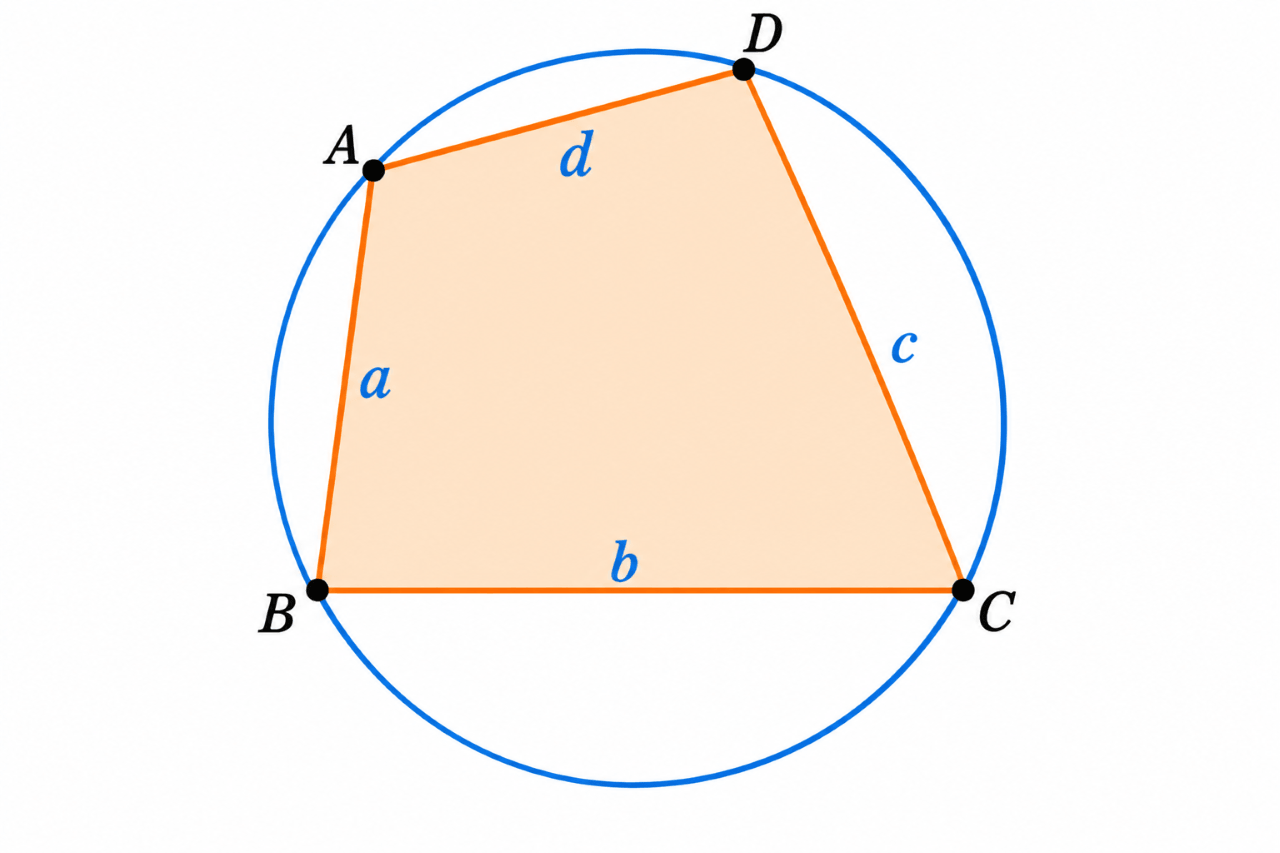
For a cyclic 4-gon with side lengths a, b, c, d, first calculate its semi-perimeter:
Brahmagupta’s formula gives the area of the cyclic 4-gon:
The important condition is that the quadrilateral must be cyclic. This formula is not a general formula for every quadrilateral having the same four side lengths.
Every rectangle is cyclic. Let its side lengths be a and b. Its four sides are therefore a, b, a, b.
= √(b · a · b · a)
= ab
Consider an isosceles trapezium whose parallel sides are 2a and 2b, while each non-parallel side has length c. Since every isosceles trapezium is cyclic, Brahmagupta’s formula applies.
The semi-perimeter is
Substituting in Brahmagupta’s formula:
Using the difference-of-two-squares identity:
Hypotenuse = c
Horizontal part = a − b
By the Baudhāyana–Pythagoras theorem:
A special case is obtained when a general result is applied under an additional condition. The resulting formula is simpler because the figure has extra properties. A general result that includes many special cases is called a generalisation.
c = a√2
The mathematical flow is:
Special case → helps us understand the general result
A triangle with side lengths a, b, c can be viewed as a special case of a 4-gon by taking the fourth side to have zero length. Thus, d = 0.
Now substitute d = 0 in Brahmagupta’s formula:
= √[s(s−a)(s−b)(s−c)]
Therefore, Heron’s formula can be viewed as a special case of Brahmagupta’s formula.
In ancient mathematics, to square a shape means to construct a square having the same area as that shape. NCERT introduces a construction attributed to the ancient Indian mathematician Baudhāyana for a rectangle.
The construction in NCERT can be understood through the following sequence:
Start with rectangle ABCD where AD = a and AB = b.
Locate E on AD so that AE = AB = b.
Locate the midpoint F of ED.
Construct square AFGH with AF as its side and H lying on the extension of AB.
With centre H and radius HG, draw an arc cutting BC at K.
Draw through K a line parallel to AH and let it meet the produced diagonal AG at P.
Construct square HPQS with HP as its side. This square has the same area as rectangle ABCD.
Since AE = b and AD = a,
Since F is the midpoint of ED,
Also, AF is half of AE + AD:
Since AFGH is a square, HG = AF. Also, HK is the radius of the circle with centre H. Therefore,
The vertical distance from H to the original base line is
In right-angled triangle HKP, by the Baudhāyana–Pythagoras theorem:
= (a + b)² 4 − (a − b)² 4
Expand the two squares:
(a−b)² = a² − 2ab + b²
Therefore,
= 4ab 4 = ab
Therefore, the area of square HPQS is ab square units.
The area of rectangle ABCD is also ab square units.
Hence, both figures have equal areas.
These NCERT pages are not a collection of unrelated formulas. They show how mathematics develops by connecting general results, special cases, geometry and algebra.
↓ Special case: fourth side becomes zero
↓ Heron’s formula
Rectangle area = ab
↓ Geometric construction of an equal-area square
↓ Baudhāyana–Pythagoras theorem + algebraic identity
The deeper lesson is that a mathematical formula becomes meaningful when we understand where it comes from, how it connects to other results, and why it works in special cases.
Do not choose a formula by memory alone. First identify what information the figure gives you: base, height, parallel sides, three sides, diagonals, equal lengths, ratios or a special geometric property.
⇒ Equal area
Area = b√(a² − b²)
Area = (a+b)√[c² − (a−b)²]
Side of equal-area square = √ab
Three sides → semi-perimeter → Heron’s formula
Special triangle → Heron’s formula can be checked using Pythagoras and half-base-times-height
Triangle + circumcircle → area using R
Triangle + incircle → area using r and perimeter
Four sides + cyclic condition → Brahmagupta’s formula
Cyclic 4-gon + special shape → familiar formulas for rectangle and isosceles trapezium
Brahmagupta + d = 0 → Heron’s formula
Rectangle → equal-area square → Baudhāyana construction → Pythagoras + algebra
2. Are two parallel sides and height given? → Trapezium
3. Are three triangle sides given? → Heron’s formula
4. Are diagonals of a rhombus given? → Diagonal formula
5. Are equal bases/heights or parallel lines involved? → Equal-area / area-ratio reasoning
6. Are four sides given with a cyclic condition? → Brahmagupta
7. Is the problem about constructing a square with the same area as a rectangle? → Baudhāyana construction
Class 9 Maths Chapter 6 Exercise Set 6.2 Question 1 – Solution
AD = BC = 8 cm
AB = DC = 10 cm
Taking AD as the base, the perpendicular distance from E to AD is equal to DC.
Therefore, perpendicular height = 10 cm
To Find: Area of triangle ADE
Area of a triangle = 1 2 × Base × Height
Therefore,
Area of △ADE = 1 2 × 8 × 10
= 4 × 10
= 40 cm²
Class 9 Maths Chapter 6 Exercise Set 6.2 Question 2 – Solution
40 cm and 20 cm
The two non-parallel sides are equal, each measuring:
26 cm
To Find: Area of the trapezium
Draw perpendiculars from the endpoints of the shorter parallel side to the longer parallel side.
The difference between the parallel sides is:
40 − 20 = 20 cm
In an isosceles trapezium, this difference is divided equally on both sides.
Therefore, the horizontal part of each right-angled triangle is:
20 2 = 10 cm
Let the perpendicular height of the trapezium be h.
Using Pythagoras’ theorem in the right-angled triangle:
h² + 10² = 26²
h² + 100 = 676
h² = 676 − 100
h² = 576
h = √576 = 24 cm
Now, the area of a trapezium is:
Area = 1 2 × Sum of parallel sides × Height
Therefore,
Area of trapezium = 1 2 × (40 + 20) × 24
= ½ × 60 × 24
= 30 × 24
= 720 cm²
Class 9 Maths Chapter 6 Exercise Set 6.2 Question 3 – Solution
8 cm and 11 cm
Perimeter of the triangle = 32 cm
To Find: Area of the triangle
Since the perimeter of a triangle is the sum of its three sides,
x + 8 + 11 = 32
x + 19 = 32
x = 32 − 19
x = 13 cm
Thus, the three sides of the triangle are:
8 cm, 11 cm and 13 cm
We use Heron’s formula to find the area of the triangle.
Heron’s formula is:
Area = √[ s(s − a) (s − b) (s − c) ]
where s is the semi-perimeter.
Semi-perimeter,
s = 8 + 11 + 13 2
= 32 2 = 16 cm
Now, using Heron’s formula,
Area = √[16(16 − 8)(16 − 11)(16 − 13)]
= √[16 × 8 × 5 × 3]
= √1920
= √(64 × 30)
= 8√30 cm²
Therefore, the area of the triangle is approximately:
8√30 ≈ 43.82 cm²
Class 9 Maths Chapter 6 Exercise Set 6.2 Question 4 – Solution
3 : 5 : 7
Perimeter of the triangular plot = 300 m
To Find: Area of the triangular plot
3x, 5x and 7x
Since the perimeter is 300 m,
3x + 5x + 7x = 300
15x = 300
x = 300 15 = 20
Therefore, the three sides are:
3x = 3 × 20 = 60 m
5x = 5 × 20 = 100 m
7x = 7 × 20 = 140 m
The semi-perimeter is:
s = 60 + 100 + 140 2
= 300 2 = 150 m
Using Heron’s formula,
Area = √[ s(s − a) (s − b) (s − c) ]
Area = √[150(150 − 60)(150 − 100)(150 − 140)]
= √(150 × 90 × 50 × 10)
= √6,750,000
= √(2,250,000 × 3)
= 1500√3 m²
Therefore,
Area ≈ 1500 × 1.732
≈ 2598.08 m²
Class 9 Maths Chapter 6 Exercise Set 6.2 Question 5 – Solution
One diagonal is twice the other diagonal.
To Find: Length of the shorter diagonal
Therefore, the longer diagonal is 2d cm.
We know that the area of a rhombus is:
Area = 1 2 × Diagonal 1 × Diagonal 2
Therefore,
128 = 1 2 × d × 2d
128 = d²
Therefore,
d² = 128
d = √128
d = √(64 × 2)
d = 8√2 cm
Class 9 Maths Chapter 6 Exercise Set 6.2 Question 6 – Solution
P and Q are any two points on side AB.
Triangles PCD and QCD have the same base CD.
To Find:
Area (△PCD) : Area (△QCD)
Also, P and Q lie on the line AB.
Since ABCD is a parallelogram,
AB ∥ CD
Therefore, the perpendicular distances of P and Q from the line CD are equal to the height of the parallelogram.
Let the common base be CD = b and the common height be h.
Area of △PCD = 1 2 × b × h
Area of △QCD = 1 2 × b × h
Hence,
Area (△PCD) : Area (△QCD)
= ½ × b × h ½ × b × h
= 1 : 1
Thus, the two triangles have equal areas.
Class 9 Maths Chapter 6 Exercise Set 6.2 Question 7 – Solution
O is any point on diagonal PR.
Diagonals PR and SQ intersect at M.
To Prove:
Area (△PSO) = Area (△PQO)
Therefore,
SM = QM
In △PSQ, M is the midpoint of SQ.
Hence, PM is a median of △PSQ.
We know that a median of a triangle divides it into two triangles of equal area.
Therefore,
Area (△PSM) = Area (△PQM) ……… (1)
Now, in △OSQ, M is also the midpoint of SQ.
Hence, OM is a median of △OSQ.
Therefore,
Area (△OSM) = Area (△OQM) ……… (2)
Since O lies on PM,
Area (△PSM) = Area (△PSO) + Area (△OSM)
Similarly,
Area (△PQM) = Area (△PQO) + Area (△OQM)
Using equations (1) and (2), we get:
Area (△PSO) + Area (△OSM) = Area (△PQO) + Area (△OQM)
But,
Area (△OSM) = Area (△OQM)
Subtracting these equal areas from both sides, we obtain:
Area (△PSO) = Area (△PQO)
Area (△PSO) = Area (△PQO)
Hence proved.
Class 9 Maths Chapter 6 Exercise Set 6.2 Question 8 – Solution
P, Q, R and S are the midpoints of AB, BC, CD and DA, respectively.
Construction:
Join BD and BS.
To Prove:
Area (PQRS) = ½ × Area (ABCD)
In △BAD, S is the midpoint of AD.
Therefore, BS is a median of △BAD.
Hence,
Area (△BAS) = ½ × Area (△BAD)
……… (1)
In △BAS, P is the midpoint of AB.
Therefore, SP is a median of △BAS.
Hence,
Area (△APS) = ½ × Area (△BAS)
……… (2)
From (1) and (2),
Area (△APS)
= ½ × ½ × Area (△BAD)
= ¼ × Area (△BAD)
……… (3)
Similarly, in △BCD, Q and R are the midpoints of BC and CD.
Therefore,
Area (△CQR) = ¼ × Area (△BCD)
……… (4)
Adding (3) and (4),
Area (△APS) + Area (△CQR)
= ¼ × Area (△BAD) + ¼ × Area (△BCD)
= ¼ × Area (ABCD)
……… (5)
Similarly,
Area (△DRS) + Area (△BQP)
= ¼ × Area (ABCD)
……… (6)
Adding (5) and (6),
Area (△APS) + Area (△CQR) + Area (△DRS) + Area (△BQP)
= ¼ × Area (ABCD) + ¼ × Area (ABCD)
= ½ × Area (ABCD)
……… (7)
From the figure,
Area (△APS) + Area (△CQR) + Area (△DRS) + Area (△BQP) + Area (PQRS)
= Area (ABCD)
Using (7),
½ × Area (ABCD) + Area (PQRS)
= Area (ABCD)
Therefore,
Area (PQRS)
= Area (ABCD) − ½ × Area (ABCD)
= ½ × Area (ABCD)
Area (PQRS) = ½ × Area (ABCD)
Hence proved.
Class 9 Maths Chapter 6 Exercise Set 6.2 Question 9 – Solution
Therefore, BD = DC.
AD is a median of △ABC.
P is any point on AD.
To Show: Area (△ABP) = Area (△ACP)
Therefore,
Area (△ABD) = Area (△ACD)
Also, D is the midpoint of BC. Hence,
BD = DC
Now, triangles PBD and PCD have equal bases BD and DC. They also have the same perpendicular height from P to BC.
Therefore,
Area (△PBD) = Area (△PCD)
Since,
Area (△ABD) = Area (△ACD)
We can write,
Area (△ABP) + Area (△PBD) = Area (△ACP) + Area (△PCD)
Since,
Area (△PBD) = Area (△PCD)
Cancelling the equal areas of △PBD and △PCD from both sides, we get,
Area (△ABP) = Area (△ACP)
Hence proved.
Class 9 Maths Chapter 6 Exercise Set 6.2 Question 10 – Solution
P is a point within the square.
PA, PB, PC and PD are joined.
Let the side of the square be a.
To Find: Ratio of the areas of the red region and the green region
Draw perpendiculars from P to the four sides of the square.
Let the perpendicular distances from P to AB, CD, AD and BC be h₁, h₂, h₃ and h₄, respectively.
Therefore,
h₁ + h₂ = a
Similarly, AD and BC are opposite sides of the square. Hence,
h₃ + h₄ = a
The red region consists of triangles PAB and PCD.
Therefore,
Area of red region = Area (△PAB) + Area (△PCD)
= 1 2 × AB × h₁ + 1 2 × CD × h₂
Since AB = CD = a,
= 1 2 × a × h₁ + 1 2 × a × h₂
= 1 2 × a × (h₁ + h₂)
= 1 2 × a × a
= a²/2
The green region consists of triangles PBC and PDA.
Therefore,
Area of green region = Area (△PBC) + Area (△PDA)
= 1 2 × BC × h₄ + 1 2 × AD × h₃
Since BC = AD = a,
= 1 2 × a × h₄ + 1 2 × a × h₃
= 1 2 × a × (h₃ + h₄)
= 1 2 × a × a
= a²/2
Hence,
Area of red region = Area of green region
Therefore,
Ratio of the areas of the red region and the green region
= a²/2 : a²/2
= 1 : 1
Class 9 Maths Chapter 6 Exercise Set 6.2 Question 11 – Solution
Therefore,
AD = DB
P is any point on BC.
Q is a point on AB such that:
CQ ∥ PD
PQ is joined.
To Prove:
Area (△BPQ) = ½ Area (△ABC)
AD = DB
Triangles △ACD and △BCD have equal bases AD and DB on the same straight line AB.
Their perpendicular heights from C to AB are equal.
Therefore,
Area (△ACD) = Area (△BCD)
Also,
Area (△ACD) + Area (△BCD) = Area (△ABC)
Hence,
Area (△BCD) = ½ Area (△ABC)
Now, triangle BCD is divided into two triangles BPD and PDC.
Therefore,
Area (△BCD) = Area (△BPD) + Area (△PDC)
Since CQ ∥ PD, triangles △PDC and △PDQ lie between the same parallel lines.
They have the same base PD and equal perpendicular heights.
Therefore,
Area (△PDC) = Area (△PDQ)
Now, triangle BPQ is divided into triangles BPD and PDQ.
Thus,
Area (△BPQ) = Area (△BPD) + Area (△PDQ)
Using,
Area (△PDQ) = Area (△PDC)
We get,
Area (△BPQ) = Area (△BPD) + Area (△PDC)
Therefore,
Area (△BPQ) = Area (△BCD)
But,
Area (△BCD) = ½ Area (△ABC)
Hence,
Area (△BPQ) = ½ Area (△ABC)
Hence proved.
📚 Continue Learning
Congratulations! You have completed the Class 9 Maths Chapter 6 Exercise 6.2 Solutions. You have now worked through Exercise 6.2 of Chapter 6 – Measuring Space: Perimeter and Area. Continue your learning journey by revisiting Exercise 6.2 for revision, moving to the next exercise, or exploring other Class 9 Maths Chapter 6 Solutions.
📖 Explore More Class 9 Maths Chapters
❓ Frequently Asked Questions
Find quick answers to common questions about Class 9 Maths Chapter 6 Exercise 6.2 Solutions. These FAQs explain what the exercise covers, which topics are included, how to approach different question types, and how to use the solutions effectively for homework, revision, self-study and CBSE examination preparation.
What is taught in Class 9 Maths Chapter 6 Exercise 6.2?
Exercise 6.2 of Class 9 Maths Chapter 6, Measuring Space: Perimeter and Area, focuses on different applications of area. The exercise includes questions based on area of triangles, trapeziums, rhombuses and parallelograms, Heron’s Formula, area ratios, equal-area triangles, medians, midpoints and geometry proofs.
How many questions are included in Exercise Set 6.2?
Exercise Set 6.2 contains 11 questions. These questions cover direct area calculations, Heron’s Formula, area ratios, equal-area figures and proof-based geometry questions. The Class 9 Maths Exercise 6.2 Solutions on this page follow the same question-wise order as the textbook.
Which important topics are covered in Exercise 6.2?
The important topics include area of a triangle, area of a trapezium, Heron’s Formula, area of a rhombus, area of a parallelogram, equal-area triangles, median and midpoint properties, area ratios and geometry proofs. These topics are useful for classroom practice, revision and CBSE examination preparation.
When should I use Heron’s Formula in Class 9 Maths Exercise 6.2?
Heron’s Formula is used when the three sides of a triangle are known and its area is required. In Exercise 6.2, students also use the formula in questions where the perimeter and a ratio of the sides are given. The sides must first be identified correctly before applying the formula.
How do I solve area questions involving a trapezium or rhombus?
First identify the required measurements from the question or figure. For a trapezium, focus on its parallel sides and height. For a rhombus, identify its diagonals or the other information provided. Convert all measurements into consistent units and write the required formula before substitution. The solutions explain each question in a clear, step-by-step format.
How are area-ratio questions solved in Exercise 6.2?
In area-ratio questions, first identify the figures being compared. Then use their common base, common height, corresponding sides or given geometric relationships. Areas are compared only after the relevant measurements and relationships have been established. Questions involving triangles, parallelograms, medians and parallel lines are included in this exercise.
How should I write geometry proofs in Class 9 Maths Exercise 6.2?
For a geometry proof, begin by identifying the given information and the result to be proved. Use suitable properties of triangles, parallelograms, medians, midpoints and parallel lines. Write each step in a logical order and mention the reason wherever necessary. The proof-based questions in Class 9 Maths Chapter 6 Exercise 6.2 Solutions are presented in a clear, exam-oriented format.
Are these Class 9 Maths Chapter 6 Exercise 6.2 Solutions based on Ganita Manjari 2026?
Yes. These Class 9 Maths Chapter 6 Exercise 6.2 Solutions are prepared according to the questions and concepts of the NCERT Ganita Manjari (2026–27) textbook. The solutions are arranged question-wise in a simple, student-friendly format to help with classwork, homework, self-study, revision and CBSE examination preparation.

Rakesh Kumar Singh
Mathematics Educator • Founder of
Maths Gurukulam & Newton Study Point
18+ Years of Mathematics Teaching Experience • Teaching Since 2006
These Class 9 Maths Chapter 6 Exercise 6.2 Solutions are carefully prepared according to the latest NCERT Ganita Manjari (2026) and the CBSE curriculum. The solutions follow a clear, step-by-step approach to help students understand questions based on area of triangles, area of trapeziums, Heron’s formula, area of rhombuses, equal-area triangles, and practical applications of area, while building confidence in solving Exercise 6.2 problems.