Class 9 Maths Chapter 6 End of Chapter Exercises Solutions
Measuring Space: Perimeter and Area — Ganita Manjari 2026–27
Prepare with complete
Class 9 Maths Chapter 6 End of Chapter Exercises Solutions
based on the latest NCERT Ganita Manjari (2026).
This complete revision set covers
perimeter, area, triangles, circles, trapeziums, kites,
rectangles, congruent shapes and area relationships,
along with challenging geometry and shaded-area problems.
All 27 questions are explained in a clear,
step-by-step CBSE answer-writing style.
📖 About Class 9 Maths Chapter 6 End of Chapter Exercises
Class 9 Maths Chapter 6 End of Chapter Exercises Solutions
cover the complete
End of Chapter Exercises from
Chapter 6 – Measuring Space: Perimeter and Area
in the latest
NCERT Ganita Manjari (2026–27) textbook.
This page provides complete, reliable and easy-to-follow
NCERT Class 9 Maths solutions
for students searching for
Class 9 Maths Chapter 6 Solutions,
Class 9 Maths End of Chapter Exercises Solutions
and
Class 9 Maths Chapter 6 answers
in one place.
The
Class 9 Maths Chapter 6 End of Chapter Exercises Solutions
are arranged question-wise in a clear,
student-friendly CBSE answer-writing format.
The complete set contains
27 questions
covering important concepts from the chapter, including
algebraic identities through area models,
areas and perimeters of triangles,
Heron’s formula,
circumference and area of circles,
quadrants and semicircles,
trapeziums,
kites,
rectangles,
congruent figures,
area ratios,
shaded regions
and challenging
circle and geometry area problems.
These solutions are useful for
homework, classroom practice, self-study, revision
and
CBSE examination preparation.
🎯 End of Chapter Exercise Snapshot
📘 What You’ll Find
Complete coverage of all 27 End of Chapter questions.
NCERT-based solutions for the complete Chapter 6 exercise set.
Questions covering triangles, circles, trapeziums, kites and area relationships.
📚 Page Includes
Step-by-step NCERT Class 9 Maths Chapter 6 solutions.
Complete question-wise coverage from Q1 to Q27.
Simple and exam-oriented CBSE answer-writing approach.
🏆 Best For
Students following Ganita Manjari 2026–27.
Homework, classroom practice and assignments.
Complete chapter revision and CBSE examination preparation.
🔎 Jump to Any Question
Quickly jump to any question from the
27 questions of the
End of Chapter Exercises
of Class 9 Maths Chapter 6.
✨ Class 9 Maths Chapter 6 End of Chapter Exercises Solutions — पहले concept समझें, फिर solve करें
Before solving
Class 9 Maths Chapter 6 End of Chapter Exercises Solutions,
first revise the key ideas needed across
perimeter, area, triangles, quadrilaterals, circles,
sectors, segments and composite figures.
This
Learn Before You Solve section connects the
End of Chapter Exercises with the concepts already developed in
Exercise Sets 6.1, 6.2 and 6.3.
You do not need to relearn every formula here —
simply open the relevant concept when you need a deeper explanation.
👆 किसी concept पर click करके सीधे उसके detailed learning section पर जाएँ।
“`
🔷 Block 1 — Area Models & Algebraic Identities
Use areas of simple figures to understand and apply algebraic identities
In some End-of-Chapter questions, an algebraic expression can be
understood more easily through the
area of a square or rectangle.
Instead of treating an identity as a rule to memorise,
think of it as a relationship between different parts of an area.
📐 The Area Connection
If a square has side a + b, its total area is
represented by the product of its side lengths.
Dividing the square into smaller rectangles and squares
gives the same area in another form.
This geometric idea leads naturally to the identity:
Important Identity
(a + b)² = a² + 2ab + b²
Another Useful Area Identity
(a + b)(a − b) = a² − b²
🧠 When Will This Help?
Use the area interpretation when a question connects
lengths, areas, squares, rectangles or algebraic
expressions.
It can help you recognise the correct identity before
doing the calculation.
📚 Need the Full Concept Explanation?
See the detailed area-model explanation, diagrams and
step-by-step identity development before returning to
the End-of-Chapter question.
Do not expand blindly.
First identify the pattern of the expression and then
choose the appropriate identity.
🔺 Block 2 — Triangle Area & Heron’s Formula
Choose the correct triangle-area method from the information given
Triangle-area questions in the
End-of-Chapter Exercises may give a
base and perpendicular height, or they may give
all three sides.
The important skill is to recognise which formula matches the
information provided.
📐 When Base and Height Are Known
If the base and its corresponding perpendicular height are known,
use half of the product of base and height.
Area of a Triangle
Area = 1/2 × base × perpendicular height
The height must be perpendicular to the chosen base
🧮 When All Three Sides Are Known — Heron’s Formula
When the three sides of a triangle are known but the perpendicular
height is not given, Heron’s Formula gives the area directly.
First find the semi-perimeter.
Semi-perimeter = (a + b + c) / 2
Area = √[s(s − a)(s − b)(s − c)]
🧠 Which Formula Should You Use?
Base + perpendicular height given:
use Area = 1/2 × base × height.
Three sides given:
find the semi-perimeter first, then use Heron’s Formula.
Side ratio + perimeter given:
first convert the ratio into the actual side lengths,
then choose the appropriate area method.
Before substituting values, identify exactly what information
the question gives. Do not use Heron’s Formula when the
perpendicular height is already available.
Connect circular boundary, circumference and wheel revolutions
For a circle, the boundary is its circumference.
The same idea connects directly to wheels:
one complete revolution covers exactly one circumference.
This concept is used in Q7 and Q9, and also supports
the circle-ratio reasoning in Q8.
⭕ Circumference — The Boundary of a Circle
If the radius is r and the diameter is
d, the length of the complete circular boundary
is called the circumference.
C = 2πr
C = πd
Radius and diameter determine the circumference
🛞 One Revolution = One Circumference
Imagine a wheel rolling without slipping.
In one complete revolution, every point on the outer edge
travels through exactly one circumference.
Therefore, if a wheel makes n complete revolutions,
the total distance travelled is n × circumference.
Distance = n × C
Number of revolutions = Distance ÷ Circumference
🧠 Connect the Three Ideas
Circle:
Its complete boundary is the circumference.
Wheel:
One complete revolution covers one circumference.
Repeated revolutions:
Multiply the circumference by the number of revolutions.
Known distance:
Divide the distance by the circumference to find the number
of revolutions.
Before solving a wheel question, first find the circumference.
Then decide whether the question asks for
distance or number of revolutions.
Also check whether the given measurement is the radius or diameter.
🟠 Block 4 — Circle Area, Sectors, Segments & Circular Regions
Identify the circular region first, then choose the correct area formula
In Class 9 Maths Chapter 6, questions involving
area of a circle, sectors, segments and other circular regions
require you to identify the exact part of the circle shown in the figure.
Once the region is recognised, the appropriate formula can be applied
directly and the calculation becomes much easier.
📐 First Identify the Circular Region
Before calculating area, look carefully at the figure. A complete
circle, quadrant, sector and segment are different regions, so the
formula used depends on the region asked for.
Circle
Complete circular region
Quadrant
One-fourth of a circle
Sector
Region between two radii and an arc
Segment
Region between a chord and its arc
📌 Important Area Formulas
Area of a Circle
A = πr²
Area of a Sector
A =
θ
360°
× πr²
Area of a Quadrant
A =
1
4
× πr²
🟣 Sector and Segment — Know the Difference
A sector is the region enclosed by two radii and
the corresponding arc. A segment is the region
enclosed by a chord and its corresponding arc.
Area of Segment = Area of Sector − Area of Triangle
🧠 Which Formula Should You Use?
Complete circle:
use A = πr².
Quadrant:
use one-fourth of the area of the circle.
Sector:
use the angle at the centre to find the required fraction of the
circle.
Segment:
subtract the area of the triangle from the area of the sector.
Do not start calculating immediately. First identify the region
shown in the figure and write the corresponding formula. This
prevents confusion between the area of a circle, sector,
quadrant and segment.
🔶 Block 5 — Trapezium, Kite & Area Relationships
Understand how shapes can be divided, rearranged and compared to find area
In Class 9 Maths Chapter 6 End-of-Chapter Exercises,
several area questions can be solved by recognising the relationship
between familiar shapes. A trapezium can be understood through its
parallel sides and perpendicular height, while a kite can be divided
into triangles using its diagonals.
🔶 Area of a Trapezium
For a trapezium, identify the two parallel sides and the
perpendicular distance between them. Let the parallel sides be
a and b, and the perpendicular
height be h.
Formula for Area of a Trapezium
Area =
12
× (a + b) × h
Two parallel sides and the perpendicular height
🪁 Area of a Kite
A kite can be divided into triangles using its diagonals.
If the lengths of the two diagonals are d₁
and d₂, its area is half the product of
the diagonals.
Formula for Area of a Kite
Area =
12
× d₁ × d₂
The diagonals divide the kite into triangular regions
🧠 Area Relationships Can Save Calculation
Same base + same perpendicular height:
the two triangles have equal areas.
Same base + different heights:
their areas are in the same ratio as their perpendicular heights.
Same perpendicular height + different bases:
their areas are in the same ratio as their bases.
Rearrangement:
dividing a figure into simpler parts can make its area easier
to determine.
🔎 How to Approach Area Questions
First identify the shape and the measurements given.
If the figure is complicated, look for triangles, parallel sides,
diagonals or smaller familiar shapes. Then choose the formula
that matches the information available.
Do not rush to substitute numbers. First identify the shape,
the required dimensions and any useful area relationship.
A complicated figure can often be reduced to two or more
familiar shapes.
🔷 Block 6 — Composite Shapes & Advanced Area Reasoning
Learn how to break complex figures into familiar shapes and find the required area or boundary
In Class 9 Maths Chapter 6 End-of-Chapter Exercises,
some questions combine two or more familiar shapes. To solve these
composite area problems, trace the required region
carefully, divide the figure into simpler parts, and use addition,
subtraction, symmetry or equal-area relationships wherever useful.
🧠 The Main Idea: Break the Figure into Familiar Parts
A complicated figure does not always require a new formula.
Look for rectangles, triangles, circles, semicircles, quadrants
and other familiar regions. Find the area of each useful part
and combine the results according to the question.
Required Area
Required Area = Total Area − Unwanted Area
A complex region can be understood by separating its parts
📏 When the Question Asks for Perimeter
Trace the required boundary first.
Do not automatically add every side or curve visible inside
the figure.
For a composite boundary:
add only the lengths of the boundary parts that actually enclose
the required region.
For circular parts:
identify whether the boundary contains a full circle,
semicircle, quadrant or another arc before calculating its length.
Composite Perimeter
Composite Perimeter
= Sum of the required boundary parts
⚖️ Use Symmetry and Equal Areas
Some figures contain repeated or symmetrical regions.
Instead of calculating every small region separately, identify
equal parts and calculate one part first. Then multiply by the
number of equal regions.
This idea is especially useful in questions involving
equal-area triangles, repeated circular regions and
symmetrical arrangements.
🌸 Petals, Semicircles and Overlapping Circular Regions
In figures made from circles or parts of circles, first identify
the radius or diameter and the type of circular region involved.
A petal may be formed by overlapping arcs, while a shaded region
may require the area of one circular part to be subtracted from
another.
Think in Parts
Required Area
= Area Added − Area Removed
🔍 Where This Strategy Is Useful
This approach supports the more involved questions of the
End-of-Chapter Exercises, including arrangements of rectangles,
equal-area triangles, quadrants with semicircles, four-petalled
figures, concentric circles, semicircles on triangle sides,
overlapping circles and combinations of rectangles, triangles
and circular regions.
Before calculating, mark the exact region asked for.
Then decide whether you should add areas, subtract an
unwanted area, use equal areas, or use a circle relationship.
A clear breakdown of the figure usually makes the calculation
much easier.
⚡ Quick Revision Dashboard
Class 9 Maths Chapter 6 — Important Concepts, Formulas & Problem-Solving Ideas
Before going to the Class 9 Maths Chapter 6 End of Chapter Exercises Solutions, quickly revise
the important formulas and concepts of
Class 9 Maths Chapter 6.
Identify the shape, choose the correct formula, and then
substitute the given values carefully.
🔵 Circle Basics & π
π — Circumference to Diameter Ratio
π is the constant ratio of the circumference of a
circle to its diameter.
π = Circumference ÷ Diameter
π — Common Approximate Values
In calculations, commonly used values are:
π ≈
227
or 3.14
π Is an Irrational Number
π cannot be expressed exactly as a terminating or
recurring decimal.
Archimedes’ Estimate of π
3
1071
< π <
3
17
Chongzhi’s Estimate
π ≈
355113
Aryabhata’s Estimate
π ≈ 3.1416
Madhava’s Exact Formula
π = 4
(
1 −
13
+
15
−
17
+ ⋯
)
📐 Circle, Circumference & Arc Length
Circumference of a Circle
C = 2πr = πd
r = radius | d = diameter
Arc Length
l = 2πr ×
θ°360°
θ is the central angle.
Wheel & Repeated Distance
Distance = Number of revolutions × Circumference
Number of Revolutions
Number of revolutions =
DistanceCircumference
📊 Area Formulas
Area of a Triangle
Area =
12
× base × perpendicular height
Heron’s Formula
Area = √[s(s − a)(s − b)(s − c)]
where
s =
a + b + c2
Area of a Circle
A = πr²
Area of a Sector
Area = πr² ×
θ°360°
θ is the central angle.
Area of a Quadrant
Area =
14
πr²
Area of a Trapezium
Area =
12
× (a + b) × h
Area of a Kite
Area =
12
× d₁ × d₂
Brahmagupta’s Formula
Area = √[(s − a)(s − b)(s − c)(s − d)]
for a cyclic quadrilateral, where
s =
a + b + c + d2
🟣 Circular Regions & Segments
Area of a Segment
Segment Area =
Sector Area − Triangle Area
Region Between Two Concentric Circles
Required Area = π(R² − r²)
Quadrant
A quadrant is one-fourth of a circle.
Its central angle is 90°.
Sector
A sector is the region bounded by two radii
and the corresponding arc.
🧩 Composite Areas, Ratios & Scaling
Composite Area
Required Area =
Total Area − Unwanted Area
Composite Perimeter
Perimeter =
Sum of required boundary parts
Area Ratio
Compare corresponding areas using the given
lengths, sides, bases, heights or radii.
Scaling of Area
If every length is multiplied by k,
the area is multiplied by k².
🎯 Remember Before You Solve
Identify the shape → choose the formula →
substitute carefully → write the correct square units
🧠 Composite-Figure Strategy
For a complicated figure, trace the required region first.
Divide it into familiar shapes such as triangles,
rectangles, trapeziums, sectors and semicircles.
Then add the required areas or subtract the unwanted
regions. For circular figures, identify the radius,
diameter, central angle and arc before applying a formula.
📝 Class 9 Maths Chapter 6 End of Chapter Exercises Solutions
Solve all 27 questions of
Class 9 Maths Chapter 6 End of Chapter Exercises
with clear, step-by-step
NCERT Ganita Manjari (2026–27) solutions.
This complete exercise covers
perimeter and area of triangles,
Heron’s formula,
circles and their areas,
trapeziums,
kites,
rectangles,
congruent figures,
area ratios,
shaded regions
and challenging
circle and geometry area problems.
Each question is presented in a simple,
student-friendly CBSE answer-writing format.
Class 9 Maths Chapter 6 End of Chapter Exercises Question 1 – Solution
Ganita Manjari 2026–27 | Measuring Space: Perimeter and Area
Identities in algebra can sometimes be shown as area
relationships. For example, the figure shown corresponds to
the identity
(a + b)² = a² + 2ab + b².
Draw figures corresponding to the identities
(a + b)(a − b) = a² − b²
and
(a + b + c)² = a² + b² + c² + 2ab + 2bc + 2ca.
Solution
(i) Identity:
(a + b)(a − b) = a² − b²
Draw a square of side a.
Therefore, its area is a².
From this square, remove a smaller square of side
b.
Area model showing how a² − b² can be rearranged into a rectangle
Area of the original square = a².
Area of the removed square = b².
Therefore, area of the remaining region is
a² − b²
The two remaining parts can be rearranged to form a rectangle
whose dimensions are (a + b) and
(a − b).
Hence, the area of the rearranged rectangle is
(a + b)(a − b)
Since both figures represent the same area,
(a + b)(a − b) = a² − b²
(ii) Identity:
(a + b + c)² = a² + b² + c² + 2ab + 2bc + 2ca
Draw a large square whose side is
(a + b + c).
Divide each side into three parts of lengths
a, b and c.
Area model for (a + b + c)²
The large square is divided into nine smaller regions:
one square of area a²
one square of area b²
one square of area c²
two rectangles of area ab
two rectangles of area bc
two rectangles of area ca
Therefore, the total area of the large square is
(a + b + c)²
= a² + b² + c² + ab + ab + bc + bc + ca + ca
Combining the equal pairs,
(a + b + c)²
= a² + b² + c² + 2ab + 2bc + 2ca
∴ The required area figures represent the identities:
Ganita Manjari 2026–27 | Measuring Space: Perimeter and Area
The wheel of a car has an outer radius of 28 cm.
Calculate how far the car travels after one complete turn
of the wheel, and how many times the wheel turns during
a journey of 1 km.
Car wheel of radius 28 cm
Given
Outer radius of the wheel,
r = 28 cm
For π, use
227
Distance of journey = 1 km
To Find:
(i) Distance travelled after one complete turn
(ii) Number of turns in 1 km
Solution
Step 1 — Distance travelled in one complete turn
The distance travelled by the car in one complete turn
of the wheel is equal to the circumference of the wheel.
We know that,
Circumference = 2πr
Therefore,
Circumference
= 2 ×
227
× 28
= 2 × 22 × 4
= 176 cm
∴ Distance travelled in one complete turn
= 176 cm
Step 2 — Convert 1 km into centimetres
We have,
1 km = 1000 m
and
1 m = 100 cm
Therefore,
1 km = 1000 × 100 cm
1 km = 1,00,000 cm
Step 3 — Find the number of turns
Number of turns
=
Total distance
Distance travelled in one turn
=
1,00,000176
=
625011
= 568
211
turns
∴ Distance travelled in one complete turn
= 176 cm
Ganita Manjari 2026–27 | Measuring Space: Perimeter and Area
You know that the area of a parallelogram is base × height.
Using this and the figure, show that the area of a trapezium is
half the sum of the parallel sides × height, i.e.
12
(a + b)h
Trapezium divided into a parallelogram and a triangle
Given
The trapezium has parallel sides
a and b.
Its height is h.
The trapezium is divided into a
parallelogram and a
triangle.
To Show:
Area of trapezium
12
(a + b)h
Figure
Trapezium ABCD divided into parallelogram ABED and triangle BCE
Solution
Step 1 — Name the two parts
Let the trapezium be ABCD, where
AB = a
and
DC = b.
Let E be the point on DC
where the dividing line meets the base.
Thus, trapezium ABCD is divided into:
1. Parallelogram ABED 2. Triangle BCE
Step 2 — Find the area of parallelogram ABED
In parallelogram ABED,
Base = AB = a
Height = h
We know,
Area of a parallelogram = base × height
Therefore,
Area of parallelogram ABED = ah
Step 3 — Find the base of triangle BCE
Since ABED is a parallelogram,
DE = AB = a
But,
DC = b
Therefore,
EC = DC − DE
EC = b − a
Hence, the base of triangle BCE is
(b − a) and its height is h.
Step 4 — Find the area of triangle BCE
We know,
Area of a triangle =
12
× base × height
Therefore,
Area of triangle BCE =
12
× (b − a) × h
Step 5 — Find the area of the trapezium
The trapezium ABCD is made up of
parallelogram ABED and triangle BCE.
Therefore,
Area of trapezium ABCD
= Area of parallelogram ABED
+ Area of triangle BCE
Ganita Manjari 2026–27 | Measuring Space: Perimeter and Area
By dividing a trapezium into two triangles show that its area is,
half the sum of the parallel sides multiplied by the height
(the same formula as the one given above).
Given
Let ABCD be a trapezium such that
AB ∥ CD
Let the lengths of the parallel sides be
AB = a and CD = b.
Let the perpendicular height of the trapezium be
h.
To Show:
Area of trapezium ABCD
=
1
2
(a + b)h
Figure
Trapezium ABCD divided into triangles ABC and ACD
Solution
Step 1 — Divide the trapezium into two triangles
Draw the diagonal AC of trapezium ABCD.
The diagonal AC divides the trapezium into
two triangles:
△ABC and △ACD.
Therefore,
Area of trapezium ABCD
= Area of △ABC + Area of △ACD
Step 2 — Find the areas of the two triangles
Since AB ∥ CD, the perpendicular distance
between these parallel sides is the height h.
For △ABC,
Base = AB = a
Height = h
Therefore,
Area of △ABC
=
1
2
× a × h
Similarly, for △ACD,
Base = CD = b
Height = h
Therefore,
Area of △ACD
=
1
2
× b × h
Step 3 — Add the areas of the two triangles
We know that
Area of trapezium ABCD
= Area of △ABC + Area of △ACD
=
1
2
ah
+
1
2
bh
Taking
1
2
h common,
=
1
2
h(a + b)
Step 4 — Write the required formula
Hence,
Area of trapezium ABCD
=
1
2
(a + b)h
Thus, the area of a trapezium is half the sum of its
parallel sides multiplied by its height.
Ganita Manjari 2026–27 | Measuring Space: Perimeter and Area
Three problems about fitting congruent shapes together:
(i)
Rectangle ABCD has sides a, b, and rectangle PQRS
has sides 2a, 2b. Show that PQRS has 4 times the
area of ABCD. Does this mean that 4 copies of rectangle ABCD will
fit into rectangle PQRS? Check and see!
(ii)
△ABC has sides a, b, c, and △PQR has sides
2a, 2b, 2c. Show that △PQR has 4 times the area
of △ABC. Does this mean that 4 copies of △ABC will fit into
△PQR? Check and see!
(iii)
△ABC has sides a, b, c, and △PQR has sides
3a, 3b, 3c. Show that △PQR has 9 times the area
of △ABC. Does this mean that 9 copies of △ABC will fit into
△PQR? Check and see!
Given
(i)
Rectangle ABCD has sides a and b.
Rectangle PQRS has sides 2a and 2b.
(ii)
△ABC has sides a, b, c.
△PQR has sides 2a, 2b, 2c.
(iii)
△ABC has sides a, b, c.
△PQR has sides 3a, 3b, 3c.
To Find:
Compare the areas and check whether the required number of
congruent copies can fit exactly into the larger shape.
(i) Four Congruent Rectangles Fit Exactly
Rectangle PQRS divided into four congruent copies of ABCD
(ii) Four Congruent Triangles Fit Exactly
Joining the midpoints divides △PQR into four congruent triangles
(iii) Nine Congruent Triangles Fit Exactly
Trisecting each side and drawing parallel lines gives nine congruent triangles
Solution
(i) Rectangles
Area of rectangle ABCD
= length × breadth
= a × b
Therefore,
Area of ABCD = ab
Area of rectangle PQRS
= 2a × 2b
= 4ab
Therefore,
Area of PQRS = 4ab
Since
Area of ABCD = ab,
we get
Area of PQRS = 4 × Area of ABCD.
Now check whether four copies of ABCD fit into PQRS.
Along the length of PQRS,
2a ÷ a = 2
copies fit.
Along the breadth of PQRS,
2b ÷ b = 2
copies fit.
Hence, the total number of copies is
2 × 2 = 4.
Thus, four congruent copies of ABCD fit exactly into PQRS.
(ii) Triangles with sides doubled
Let the semiperimeter of △ABC be
a + b + c
2
= s
By Heron’s formula,
Area of △ABC
=
√[s(s − a)(s − b)(s − c)]
For △PQR, the sides are
2a, 2b, 2c.
Therefore, its semiperimeter is
2a + 2b + 2c
2
= a + b + c = 2s
Applying Heron’s formula,
Area of △PQR
=
√[(2s)(2s − 2a)(2s − 2b)(2s − 2c)]
Taking 2 from each of the four factors,
=
√[16s(s − a)(s − b)(s − c)]
= 4√[s(s − a)(s − b)(s − c)]
Therefore,
Area of △PQR = 4 × Area of △ABC.
Now check whether four copies fit.
Since every side of △PQR is twice the corresponding side of
△ABC, joining the midpoints of the three sides of △PQR divides
it into four triangles.
Each of these four triangles has sides
a, b, c.
Hence, each small triangle is congruent to △ABC.
Therefore, four copies of △ABC fit exactly into △PQR.
(iii) Triangles with sides tripled
Again, let the semiperimeter of △ABC be
a + b + c
2
= s
For △PQR, the sides are
3a, 3b, 3c.
Its semiperimeter is
3a + 3b + 3c
2
= 3s
By Heron’s formula,
Area of △PQR
=
√[(3s)(3s − 3a)(3s − 3b)(3s − 3c)]
Taking 3 from each of the four factors,
=
√[81s(s − a)(s − b)(s − c)]
= 9√[s(s − a)(s − b)(s − c)]
Therefore,
Area of △PQR = 9 × Area of △ABC.
Now check whether nine copies fit.
Divide each side of △PQR into three equal parts and draw lines
parallel to the three sides.
This divides the large triangle into
9 congruent small triangles.
Each small triangle has sides
a, b, c.
Therefore, each small triangle is congruent to △ABC.
Hence, nine copies of △ABC fit exactly into △PQR.
Key Idea
When every linear dimension of a plane figure is multiplied by
a factor k, its area is multiplied by
k².
Thus,
scale factor 2 → area factor 4
and
scale factor 3 → area factor 9.
In this question, the larger rectangles and triangles can
actually be divided into the required number of congruent
copies of the smaller shape.
Final Answer
(i)
Area of PQRS = 4 × Area of ABCD, and
4 copies of ABCD fit exactly into PQRS.
(ii)
Area of △PQR = 4 × Area of △ABC, and
4 copies of △ABC fit exactly into △PQR.
(iii)
Area of △PQR = 9 × Area of △ABC, and
9 copies of △ABC fit exactly into △PQR.
Ganita Manjari 2026–27 | Measuring Space: Perimeter and Area
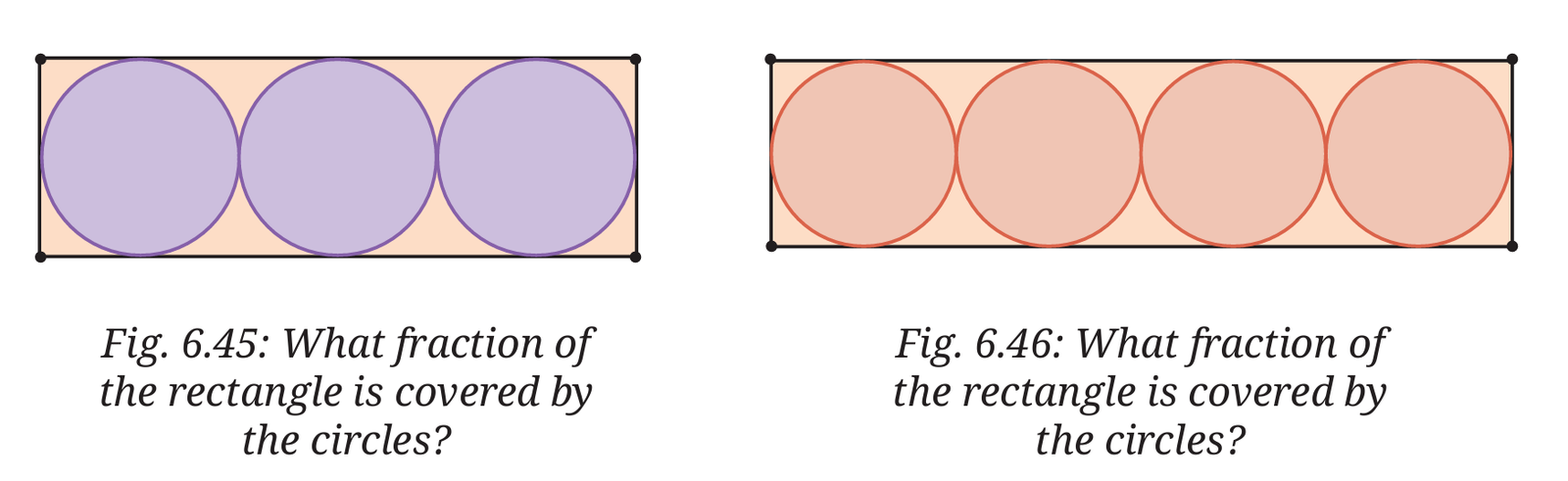
Use the above to make a conjecture about the area occupied by
circles fitted into a rectangle in the manner shown. Test your
conjecture for particular cases: 10 circles; 20 circles; 50
circles. Then prove your conjecture!
Given
Equal circles are fitted inside a rectangle in the same manner
as in Question 17.
Let the diameter of each circle be d.
Let the number of circles be n.
Therefore, the height of the rectangle is d
and its length is nd.
To Find:
The fraction of the rectangle occupied by the circles.
General Arrangement
n equal circles, each of diameter d, fitted inside a rectangle
Solution
Step 1 — Make the conjecture
Suppose there are n equal circles.
Let the diameter of each circle be d.
Then the height of the rectangle is d and
its length is nd.
We therefore expect the fraction occupied by the circles
to remain the same, whatever the value of n.
Conjecture:
The fraction of the rectangle occupied by the circles is
π
4
Step 2 — Test for 10 circles
For 10 circles, the rectangle has length
10d
Area of the rectangle
= 10d × d
= 10d2
Radius of each circle
d
2
Area of 10 circles
= 10 × π ×
d2
4
=
10πd2
4
Therefore, fraction occupied
10πd2
4 × 10d2
=
π
4
Step 3 — Test for 20 circles
Area of 20 circles
= 20 × π ×
d2
4
Area of rectangle
= 20d2
Hence,
20πd2
4 × 20d2
=
π
4
Step 4 — Test for 50 circles
Area of 50 circles
= 50 × π ×
d2
4
Area of rectangle
= 50d2
Therefore,
50πd2
4 × 50d2
=
π
4
Step 5 — Prove the conjecture
Let there be n circles.
Diameter of each circle = d
Therefore,
Radius of each circle
d
2
Area of one circle
= πr2
= π ×
d2
4
Area of n circles
= n × π ×
d2
4
=
nπd2
4
Since the rectangle has height d and length
nd,
Area of rectangle
= nd × d
= nd2
Hence, fraction of rectangle occupied by circles
nπd2
4nd2
Cancelling n and d2,
=
π
4
Thus, the fraction is independent of the number of circles.
Using the NCERT approximation
22
7
for π,
the fraction becomes
22
7 × 4
=
11
14
Therefore, about 11 out of every 14 equal parts
of the rectangle are occupied by the circles.
∴ Conjecture proved:
If n equal circles of diameter d
are fitted side by side in a rectangle of height d,
then the fraction of the rectangle occupied by the circles is
π
4
=
11
14
.
using π =
22
7
.
Ganita Manjari 2026–27 | Measuring Space: Perimeter and Area
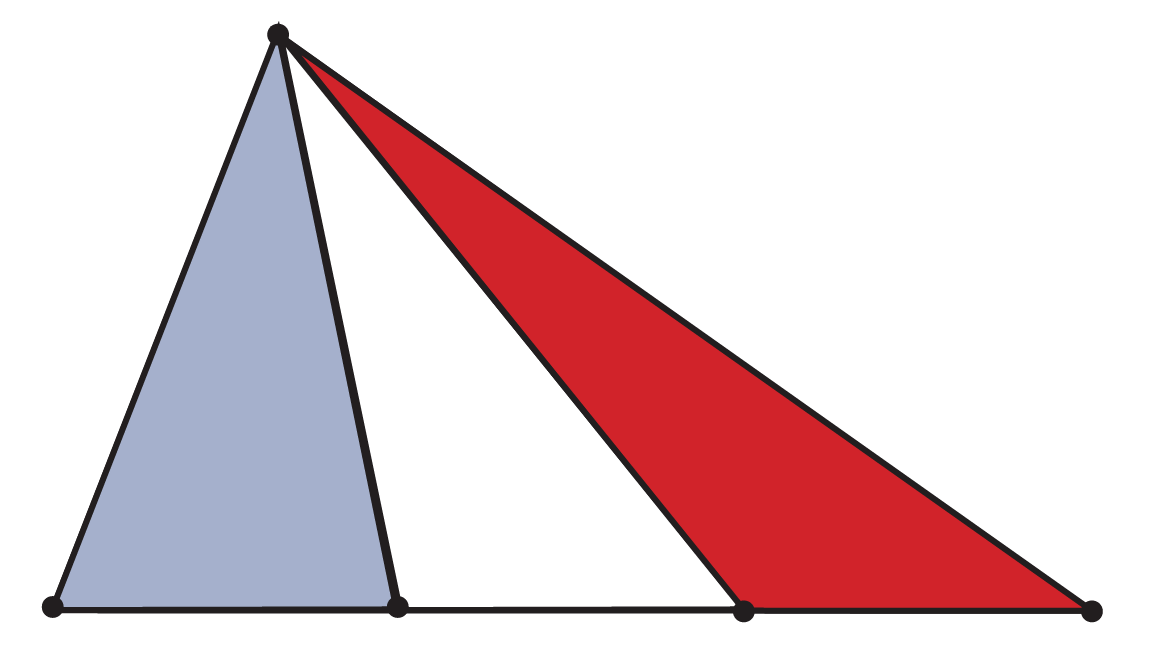
Show that the areas of the shaded blue triangle and the
shaded red triangle are equal.
Find a way of cutting up the blue triangle into some number
of pieces and rearranging the pieces to cover the red triangle.
Fig. 6.48 — Lines from a vertex to the points of trisection of the opposite side
Given
Let the large triangle be △ABC.
Let D and E be the
points of trisection of BC.
Therefore,
BD = DE = EC = b
Let the perpendicular height of the large triangle be
h.
The blue triangle is △ABD and the red
triangle is △AEC.
To Prove:
Area of △ABD
= Area of △AEC
To Show:
The blue triangle can be cut into pieces and rearranged
to cover the red triangle.
Figure 1 — Equal Bases and Same Height
The blue and red triangles have equal bases and the same perpendicular height.
Figure 2 — Cut the Blue Triangle into Three Pieces
The blue triangle is divided into three pieces: P₁, P₂ and P₃.
Figure 3 — Rearrange the Three Pieces
Rearrangement of the Three Pieces
Three pieces P₁, P₂ and P₃ arranged together
By rotating the two upper pieces, the three pieces form a parallelogram.
Figure 4 — One More Cut and Slide
The extra triangular piece is cut and moved to change the slant while preserving its area.
Figure 5 — Final Arrangement Covers the Red Triangle
The finite cut-and-rearrange process converts the blue triangle into the red triangle.
Solution
Step 1 — Identify the equal bases
Since D and E are the
points of trisection of BC,
BD = DE = EC = b
Therefore, the base of the blue triangle △ABD
and the base of the red triangle △AEC are equal.
Hence,
BD = EC = b
Step 2 — Both triangles have the same height
Both triangles have the same vertex A.
Their bases BD and EC
lie on the same straight line BC.
Therefore, the perpendicular distance from A
to the line BC is the same for both triangles.
Let this common height be h.
Step 3 — Compare their areas
We know,
Area of a triangle
=
1
2
× base × height
For the blue triangle △ABD,
Area of △ABD
=
1
2
× BD × h
Since BD = b,
Area of △ABD
=
1
2
× b × h
For the red triangle △AEC,
Area of △AEC
=
1
2
× EC × h
Since EC = b,
Area of △AEC
=
1
2
× b × h
Therefore,
Area of △ABD = Area of △AEC
The shaded blue triangle and the shaded red triangle
have equal areas because they have
equal bases + the same perpendicular height.
Step 4 — Cut the blue triangle into pieces
Draw a line through the midpoints of the two sides of
the blue triangle, parallel to its base.
This cuts off a smaller triangle from the top and leaves
a trapezium below.
Now draw the altitude of the smaller top triangle.
Thus, the blue triangle is divided into three pieces:
P₁, P₂ and P₃.
Step 5 — Rearrange the three pieces
Rotate the two small upper pieces through
180°
about the appropriate endpoints of the middle cut.
They fit against the lower trapezium and form a
parallelogram.
Its base is the same as the base of the original blue
triangle, namely b, and its height is
h upon 2.
No piece is stretched or shrunk.
Only rotation and rearrangement are used.
Step 6 — Change the slant
The red triangle has the same base length and the same
height as the blue triangle.
The parallelogram obtained from the blue triangle can
therefore be changed into the corresponding parallelogram
for the red triangle.
Make one more straight cut through the parallelogram.
Move the small triangular piece to the opposite side.
This changes only the position of the piece; its shape
and area remain unchanged.
The resulting arrangement has exactly the slant required
for the red triangle.
Step 7 — Cover the red triangle
The pieces obtained from the original blue triangle can
now be arranged to occupy the complete red triangle.
There is
no gap
and
no overlap.
Since every operation was only a cut, rotation or translation,
the total area remains unchanged.
Key Idea
Equal area does not mean that the two triangles must have
the same shape.
Here the blue and red triangles have
equal bases
and
the same perpendicular height,
so their areas are equal.
The cutting-and-rearranging construction shows how one
region can be transformed into the other without changing
its total area.
∴
Area of the shaded blue triangle = Area of the shaded red triangle.
The blue triangle can be cut into a finite number of pieces
and rearranged to cover the red triangle completely.
Ganita Manjari 2026–27 | Measuring Space: Perimeter and Area
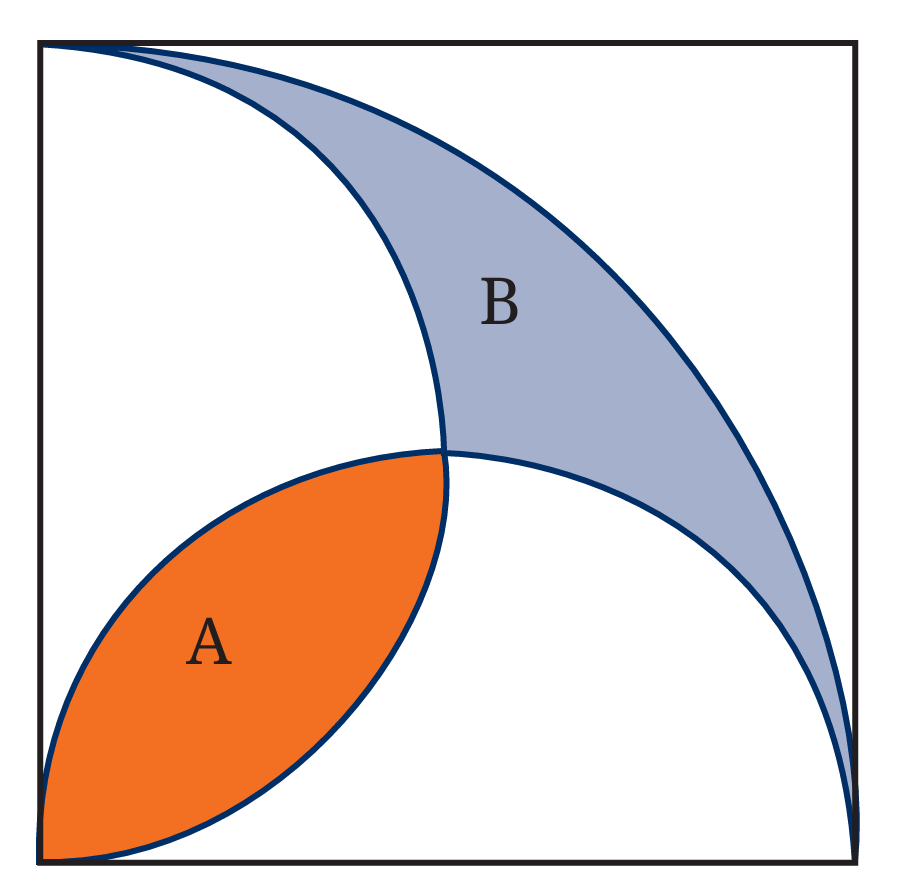
The figure shows a quarter circle in a square. Its centre is at
one vertex, and it passes through two adjacent vertices. There are
two semicircles on two adjacent sides as diameters. They create
the shaded regions A and B. Show that A and B have equal areas.
Figure 6.49 — A quarter circle and two semicircles
Given
Let the side of the square be
a.
The quarter circle has radius
a.
Each semicircle has diameter
a.
Therefore, the radius of each semicircle is
a2.
To Prove:
Area of region A
= Area of region B.
Figure 6.49 — Quarter Circle and Two Semicircles
A quarter circle and two semicircles
Solution
Step 1 — Find the area of the quarter circle
The side of the square is a.
Therefore, the radius of the quarter circle is
a.
Area of the quarter circle
=
πa²
4
Step 2 — Find the total area of the two semicircles
Each semicircle has diameter a.
Therefore, its radius is
a
2
Area of one semicircle
=
1
2
× π ×
a
2
2
=
πa²
8
Therefore, area of two semicircles
=
πa²
8
+
πa²
8
=
πa²
4
Hence,
Total area of the two semicircles
= Area of the quarter circle
Step 3 — Compare regions A and B
The two semicircles overlap in region A.
Therefore, the area covered by the two semicircles is
= Total area of two semicircles − Area of A
= Area of quarter circle − Area of A
On the other hand, region B is the part of the
quarter circle which is not covered by the two semicircles.
Therefore, the same covered area can also be written as
Area of quarter circle − Area of B
Step 4 — Show that A and B have equal areas
Since both expressions represent the same covered area,
Area of quarter circle − Area of A
=
Area of quarter circle − Area of B
Subtracting the area of the quarter circle from both sides,
− Area of A = − Area of B
Therefore,
Area of A
=
Area of B
∴ Area of region A = Area of region B.
Hence, the two shaded regions have equal areas.
Ganita Manjari 2026–27 | Measuring Space: Perimeter and Area
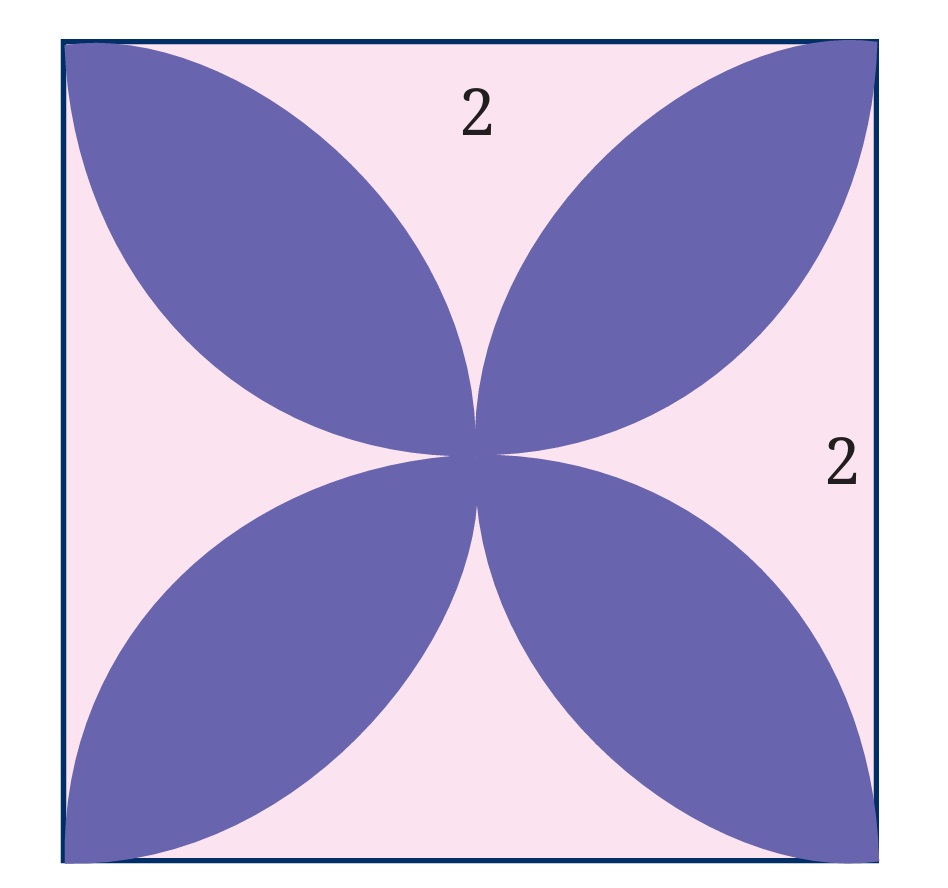
In Fig. 6.50, four semicircles have been drawn within the
given square whose side is 2 units. The centres of these
semicircles are the midpoints of the sides. They create a
4-petalled flower (shown in blue). Find the perimeter and
the area of this flower.
Figure 6.49 — A quarter circle and two semicircles
Given
Side of the square = 2 units.
The diameter of each semicircle is equal to the side of
the square.
Therefore,
Diameter = 2 units
Hence, radius of each semicircle is
2
2
= 1 unit
To Find:
1. Perimeter of the flower
2. Area of the flower
Figure 6.50 — Four-Semicircle Flower
Four semicircles form a 4-petalled flower
Solution
Step 1 — Find the radius of each semicircle
The diameter of each semicircle is equal to the side
of the square.
Therefore,
Radius
=
2
2
= 1 unit
Step 2 — Find the perimeter of the flower
Look carefully at the flower.
Its boundary consists of 8 quarter-circle arcs.
Each quarter-circle has radius 1 unit.
Length of one quarter-circle arc
=
1
4
× 2π × 1
Therefore,
=
π
2
units
There are 8 such arcs.
Hence,
Perimeter
=
8 ×
π
2
= 4π units
Using π = 22/7,
Perimeter
=
4 ×
22
7
Perimeter =
88
7
units
Step 3 — Find the area of the four semicircles
Area of one semicircle
=
1
2
× π × 1²
=
π
2
square units
Therefore, area of four semicircles
= 4 ×
π
2
= 2π square units
Step 4 — Find the area of the flower
The four semicircles together cover the whole square.
But the four petals are the regions where two adjacent
semicircles overlap. These overlapping regions are counted
twice when we add the areas of all four
semicircles.
Therefore,
Area of flower
= Area of four semicircles − Area of square
Area of the square
= 2 × 2
= 4 square units
Hence,
Area of flower
= 2π − 4
Using π = 22/7,
= 2 ×
22
7
− 4
=
44
7
−
4
=
44
7
−
28
7
=
16
7
square units
Therefore,
Perimeter =
88
7
units
Area of flower =
16
7
square units
∴
Perimeter of the flower =
88
7
units
and Area of the flower =
16
7
square units.
Ganita Manjari 2026–27 | Measuring Space: Perimeter and Area
In Fig. 6.51 we see two concentric circles with a common
centre O. A chord BC of the larger circle is drawn,
touching the smaller circle at A. The length of BC is
l. Show that the area of the green region enclosed
between the two circles is
1
4
πl2.
Question Figure — Fig. 6.51
Fig. 6.51 — Chord BC touches the smaller circle at A
Given
Two concentric circles have common centre
O.
BC is a chord of the larger circle and
touches the smaller circle at A.
Length of chord BC = l.
Let the radius of the larger circle be
R and the radius of the smaller circle
be r.
To Show:
Area of the green region
=
1
4
πl2
Solution Figure
OA ⟂ BC and the perpendicular from the centre bisects the chord
Solution
Step 1 — Use the tangent property
Since BC touches the smaller circle at
A, BC is a tangent to the smaller circle.
The radius drawn to the point of contact of a circle
is perpendicular to the tangent.
OA ⟂ BC
Therefore, triangle OAB is a
right-angled triangle at A.
Step 2 — Find the half of the chord
In a circle, the perpendicular from the centre to a chord
bisects the chord.
Hence,
AB = AC
=
BC
2
Since BC = l,
AB =
l
2
Step 3 — Apply Pythagoras theorem
In right-angled triangle OAB,
OB is the radius of the larger circle,
so OB = R.
OA is the radius of the smaller circle,
so OA = r.
Also,
AB
=
l
2
.
By Pythagoras theorem,
OB2 = OA2 + AB2
Substituting the values,
R2
=
r2
+
l2
4
Therefore,
R2 − r2
=
l2
4
Step 4 — Find the area of the green region
The green region is the area between the two concentric
circles.
Ganita Manjari 2026–27 | Measuring Space: Perimeter and Area
Fig. 6.53 shows two circles passing through each other’s
centres. Find the area of the region enclosed by the two
circles in terms of the common radius r.
Question Figure — Fig. 6.53
Fig. 6.53 — Two congruent circles, radius r
Given
The two circles are congruent and have common radius
r.
Each circle passes through the centre of the other circle.
A and B are the centres,
while C and D are the
points where the circles intersect.
To Find:
Area of the common region
Solution Figure
Join AC, BC, AD and BD. Each of the four marked sides is a radius.
Solution
Step 1 — Identify the equilateral triangles
Since each circle passes through the centre of the other
circle,
AB = AC = BC = r
Therefore, triangle ABC is equilateral.
Similarly,
AB = AD = BD = r
Therefore, triangle ABD is also equilateral.
Hence,
∠CAB = ∠DAB = 60°
Step 2 — Find the area of the upper half
The upper half of the common region is made from
two equal 60° sectors and the equilateral triangle
ABC.
Therefore,
Area of upper half
=
Area of two 60° sectors
−
Area of △ABC
Area of one 60° sector is
60
360
× πr2
=
π
6
r2
So, area of two such sectors is
2 ×
π
6
r2
=
π
3
r2
Area of an equilateral triangle of side
r is
√3
4
r2
Therefore,
Area of upper half
=
π
3
r2
−
√3
4
r2
Step 3 — Find the complete common region
The lower half is equal to the upper half.
Therefore, the complete common region has twice the area
found above.
Area of common region
=
2 ×
[
π
3
r2
−
√3
4
r2
]
Therefore,
=
2π
3
r2
−
√3
2
r2
Taking r2 common,
Area of common region
=
2π
3
−
√3
2
times r2
∴
Area of the region enclosed by the two circles
=
2π
3
−
√3
2
r2
square units.
End-of-Chapter Exercises • Question 25
Method 2 — Common Chord Method
Finding the common region using the common chord CD
✦ Idea of Method 2
Here CD is the common chord of the two circles.
We use the perpendicular from the centre to a chord,
the Pythagoras theorem, and the area of a sector and triangle.
Construction
CD is the common chord and M is its midpoint.
✍️ Solution
Given
Two congruent circles have common radius
r and pass through each other’s centres.
Their common chord is CD.
Step 1: Find the angle of the sector
Since each circle passes through the centre of the other circle,
AB = AC = BC = r
Therefore, ΔABC is an equilateral triangle.
∠CAB = 60°
Similarly, ΔABD is also equilateral.
∠DAB = 60°
Hence,
∠CAD = 60° + 60° = 120°
So, each circular segment of the common region is formed
by a 120° sector and the triangle ACD.
Step 2: Find the length of the common chord CD
In equilateral ΔABC, the perpendicular from C to AB
divides AB into two equal parts.
Therefore, the perpendicular height is obtained using
Pythagoras theorem:
height² = r² −
r²4
=
3r²4
Hence,
height =
√3 r2
The same height is obtained for ΔABD on the other side of AB.
Therefore,
CD = √3 r
Step 3: Find the area of ΔACD
Let M be the midpoint of the common chord CD.
Since the perpendicular from the centre of a circle
to a chord bisects the chord,
CM = DM =
√3 r2
Also, AM ⟂ CD.
In right ΔAMC,
AC² = AM² + CM²
Therefore,
r² = AM² +
3r²4
Hence,
AM² =
r²4
So,
AM = r/2
Therefore,
Area of ΔACD
=
12
× √3r ×
r2
Area of ΔACD =
√34
r²
Step 4: Area of one circular segment
Area of the 120° sector:
=
120360
× πr²
=
πr²3
Therefore,
Area of one segment
=
πr²3
−
√3r²4
=
(
π3
−
√34
)r²
Step 5: Area of the common region
The common region consists of two equal circular segments.
Therefore,
Area of common region
=
2
×
(
π3
−
√34
)r²
Hence,
Area =
(
2π3
−
√32
)r²
✅ Final Answer
Area of the region enclosed by the two circles
=
2π3
r²
−
√32
r²
=
(
2π3
−
√32
)r²
square units
End-of-Chapter Exercises • Question 26
Areas of Three Triangles Inside a Rectangle
Proving the area relation using simple area formulas
Question 26
In Fig. 6.54, we see three triangles within a rectangle.
The areas of the triangles are A, B, C, as marked.
Show that the area of the rectangle is
2(A+C)(B+C)
C.
Fig. 6.54
Three triangles of areas A, B and C inside the rectangle.
Geometry Used in the Solution
Width = x + y and height = h + k.
✍️ Solution
Let
Let the horizontal lengths be x and
y, and the vertical lengths be
h and k.
Width of rectangle = x + y
Height of rectangle = h + k
Step 1: Write the areas of A, B and C
For triangle A,
A =
12
× x × h
Therefore,
A =
xh2
For triangle C,
C =
12
× y × h
Therefore,
C =
yh2
For triangle B,
B =
12
× y × k
Therefore,
B =
yk2
Step 2: Find A + C
A + C =
xh + yh
2
Hence,
A + C =
(x + y)h
2
Step 3: Find B + C
B + C =
yk + yh
2
Hence,
B + C =
y(h + k)
2
Step 4: Substitute in the given expression
Consider
2(A + C)(B + C)
C
Substituting the values,
=
2 ×
(x + y)h
2
×
y(h + k)
2
÷
yh
2
Cancelling common factors,
= (x + y)(h + k)
Step 5: Find the area of the rectangle
Width of the rectangle = x + y
Height of the rectangle = h + k
Therefore,
Area of rectangle
=
(x + y)(h + k)
But from Step 4,
(x + y)(h + k)
=
2(A + C)(B + C)
C
✅ Final Answer
Area of rectangle
=
2(A + C)(B + C)
C
💡 Key Idea
Use
Area = ½ × base × height
for the three triangles. After adding the appropriate pairs of
triangle areas, the required expression simplifies directly to
width × height, which is the area of the rectangle.
Ganita Manjari 2026–27 | Measuring Space: Perimeter and Area
In Fig. 6.54, we see three triangles within a rectangle.
The areas of the triangles are A, B, C,
as marked. Show that the area of the rectangle is
2(A+C)(B+C)
C
.
Question Figure — Fig. 6.54
Fig. 6.54 — Three triangles of areas A, B and C.
Given
The areas of the three triangles are
A, B and C.
We need to show that the area of the rectangle is
2(A+C)(B+C)
C
Solution Figure
Let the horizontal parts be x, y
and the vertical parts be h, k.
Solution
Step 1 — Express the three triangle areas
Let the horizontal parts be x and
y, and the vertical parts be
h and k.
For triangle A,
A
=
1
2
× x × h
Therefore,
A =
xh
2
For triangle C,
C
=
1
2
× y × h
Therefore,
C =
yh
2
For triangle B,
B
=
1
2
× y × k
Therefore,
B =
yk
2
Step 2 — Find A + C
A + C
=
xh + yh
2
Taking h common,
A + C
=
(x+y)h
2
Step 3 — Find B + C
B + C
=
yk + yh
2
Taking y common,
B + C
=
y(h+k)
2
Step 4 — Substitute in the required expression
2(A+C)(B+C)
C
Substituting the values,
=
2 ×
(x+y)h
2
×
y(h+k)
2
÷
yh
2
On cancelling common factors,
= (x+y)(h+k)
Step 5 — Identify the area of the rectangle
The width of the rectangle is
x + y
and its height is
h + k.
Therefore,
Area of rectangle
=
(x+y)(h+k)
But from Step 4,
(x+y)(h+k)
=
2(A+C)(B+C)
C
Hence proved.
∴
Area of the rectangle
=
2(A+C)(B+C)
C
square units.
Thus, the required result is proved.
💡 Key Idea
Use
Area = ½ × base × height
for the three triangles. After adding the appropriate
areas and substituting them in the required expression,
the common factors cancel and the remaining product is
exactly the area of the rectangle.
Ganita Manjari 2026–27 | Measuring Space: Perimeter and Area
In the figure we see two shaded regions formed by a quarter
circle, a semicircle, and a triangle.
Show that the areas of the two shaded regions are equal.
Question Figure — Fig. 6.55
Fig. 6.55
Given
OA = OB = OC = r, where
O is the centre of the semicircle
AC.
AB is the diameter of the smaller
semicircle, whose centre is D.
F is the common unshaded region.
To Prove:
Area of the two shaded regions are equal
Solution Figure
OA = OB = r and AB is the diameter of the smaller semicircle.
Solution
Step 1 — Find AB
In right triangle AOB,
∠AOB = 90°
By Pythagoras theorem,
AB2
=
OA2 + OB2
Therefore,
AB2
=
r2 + r2
=
2r2
Hence,
AB = r√2
Step 2 — Area of the semicircle on AB
Since AB is the diameter of the smaller
semicircle,
Radius
=
AB
2
=
r√2
2
Therefore,
Area of semicircle
=
1
2
× π
×
(
r√2
2
)2
Hence,
Area of semicircle on AB
=
πr2
4
Step 3 — Area of the quarter circle AOB
The quarter circle AOB has radius
r.
Therefore,
Area of quarter circle AOB
=
1
4
πr2
Thus,
Area of semicircle on AB
=
Area of quarter circle AOB
Step 4 — Compare the shaded regions
Let the common unshaded region be F.
For the semicircle on AB,
Area of semicircle
=
Area of left shaded region
+
Area of F
For the quarter circle AOB,
Area of quarter circle
=
Area of △AOB
+
Area of F
But the areas of the semicircle and quarter circle are equal.
Therefore, subtracting the same area F from
both sides,
Area of left shaded region
=
Area of △AOB
Step 5 — Conclusion
Hence, the areas of the two shaded regions are equal.
Hence proved.
∴
The areas of the two shaded regions are equal.
The semicircle on AB and the quarter circle AOB have equal
areas, and the same unshaded region F is removed from both.
📚 Continue Learning
Congratulations! You have completed the
Class 9 Maths Chapter 6 End of Chapter Exercises Solutions.
You have now worked through all
27 questions from the End of Chapter Exercises of
Chapter 6 – Measuring Space: Perimeter and Area.
Continue your learning journey by revisiting the chapter exercises,
reviewing the important formulas, or exploring other
Class 9 Maths Chapter 6 Solutions.
Find quick answers to common questions about
Class 9 Maths Chapter 6 End of Chapter Exercises Solutions.
These FAQs cover the important concepts and question types included in the
27 End of Chapter questions, including
perimeter and area, triangles, Heron’s formula, circles,
trapeziums, kites, rectangles, area ratios and
shaded regions.
Use them for
homework, revision, self-study and
CBSE examination preparation.
What is included in the Class 9 Maths Chapter 6 End of Chapter Exercises?
The
Class 9 Maths Chapter 6 End of Chapter Exercises
contain 27 questions covering the important concepts of
Chapter 6 – Measuring Space: Perimeter and Area.
The questions include problems based on
areas and perimeters of geometric figures, triangles, circles,
trapeziums, kites, rectangles, shaded regions
and relationships between areas.
How many questions are included in the End of Chapter Exercises?
The End of Chapter exercise set contains
27 questions.
The questions provide a complete revision of the major concepts studied in
Class 9 Maths Chapter 6 – Measuring Space: Perimeter and Area.
The question navigator on this page allows students to jump directly to
any question from Q1 to Q27.
What concepts are covered in Chapter 6 End of Chapter Exercises?
The questions revise important concepts from the chapter, including
perimeter and area of triangles,
Heron’s formula,
area and circumference of circles,
areas of trapeziums and kites,
rectangles and other plane figures,
area ratios
and
shaded regions.
Several questions also require students to combine more than one
geometrical concept to find the required area.
When is Heron’s formula used in Chapter 6?
Heron’s formula is useful when the three sides of a triangle
are known and its area needs to be calculated.
If the sides are
a, b and c, first find the semi-perimeter
s = (a + b + c) / 2,
and then use
Area = √[s(s − a)(s − b)(s − c)].
Students should check that the given lengths form a valid triangle before
applying the formula.
How do we find the area of a circle in Chapter 6?
The area of a circle is calculated using
Area = πr²,
where r is the radius of the circle.
If the diameter is given, first use
r = d/2
and then substitute the radius in the area formula.
The value of π should be taken according to the instruction given in the
individual question.
How do we calculate the area of a trapezium?
For a trapezium, the area is calculated using
Area = ½ × (sum of parallel sides) × height.
If the parallel sides are a and b and the
perpendicular height is h, then
Area = ½(a + b)h.
The height must be the perpendicular distance between the two parallel
sides.
How is the area of a kite calculated?
The area of a kite can be calculated using its diagonals:
Area = ½ × d₁ × d₂,
where d₁ and d₂ are the lengths of its two
diagonals.
When solving a question, make sure the diagonal lengths are identified
correctly from the given figure.
How are shaded region questions solved?
For a shaded region, first identify the complete figure and the unshaded
part.
Depending on the diagram, the required area can often be found by
Area of shaded region = Area of larger figure − Area of unshaded region.
For composite figures, calculate each required part separately and combine
the areas carefully. The diagram should always be examined before choosing
the formula.
How are area ratios used in Chapter 6 questions?
Area ratios are useful when two or more figures are related through their
dimensions.
First express the required areas using common dimensions or known
relationships. Then simplify the ratio carefully.
Students should distinguish between a
ratio of lengths
and a
ratio of areas, because areas depend on the square of
corresponding linear dimensions.
Are these Class 9 Maths Chapter 6 End of Chapter Exercises Solutions based on Ganita Manjari 2026–27?
Yes. These
Class 9 Maths Chapter 6 End of Chapter Exercises Solutions
are prepared according to the
NCERT Ganita Manjari (2026–27)
Chapter 6 exercise material provided for this page.
The solutions are arranged question-wise from
Q1 to Q27
in a clear, student-friendly format to support
classwork, homework, self-study, revision
and
CBSE examination preparation.
📚 Useful Learning Resources
Continue your preparation with more
Class 9 Maths resources from Maths Gurukulam,
or visit the official NCERT and CBSE websites for the latest textbooks,
syllabus, and academic updates.
Found
Class 9 Maths Chapter 6 End of Chapter Exercises Solutions
helpful?
For students who need personal support beyond self-study, join
Newton Study Point for concept-based Maths coaching by an
experienced teacher. Small batches, individual attention, regular tests, and
complete CBSE exam preparation are available for Classes 8, 9, 10, 11 & 12.
Mathematics Educator • Founder of
Maths Gurukulam & Newton Study Point
18+ Years of Mathematics Teaching Experience • Teaching Since 2006
These Class 9 Maths Chapter 6 End of Chapter Exercises Solutions
are carefully prepared according to the latest
NCERT Ganita Manjari (2026–27) and the
CBSE curriculum. The solutions cover all
27 questions from the End of Chapter Exercises and follow a
clear, step-by-step approach to help students understand and solve problems
based on perimeter and area, triangles, Heron’s formula, circles,
trapeziums, kites, rectangles, area ratios, shaded regions and
related geometry concepts.