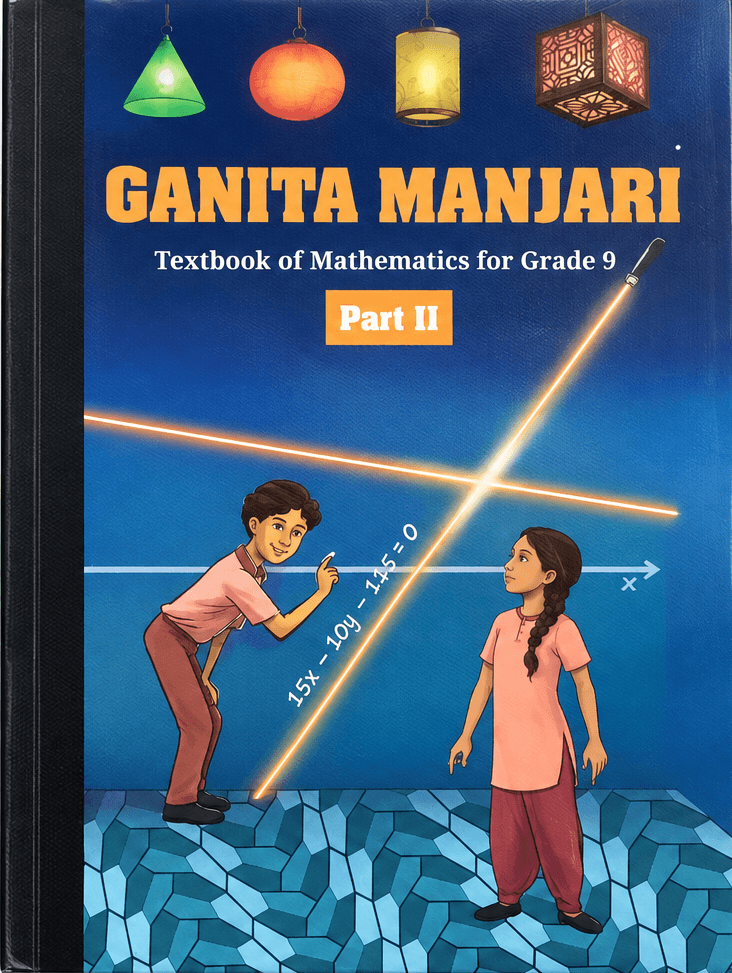
Class 9 Maths Chapter 7 Exercise 7.1 Solutions
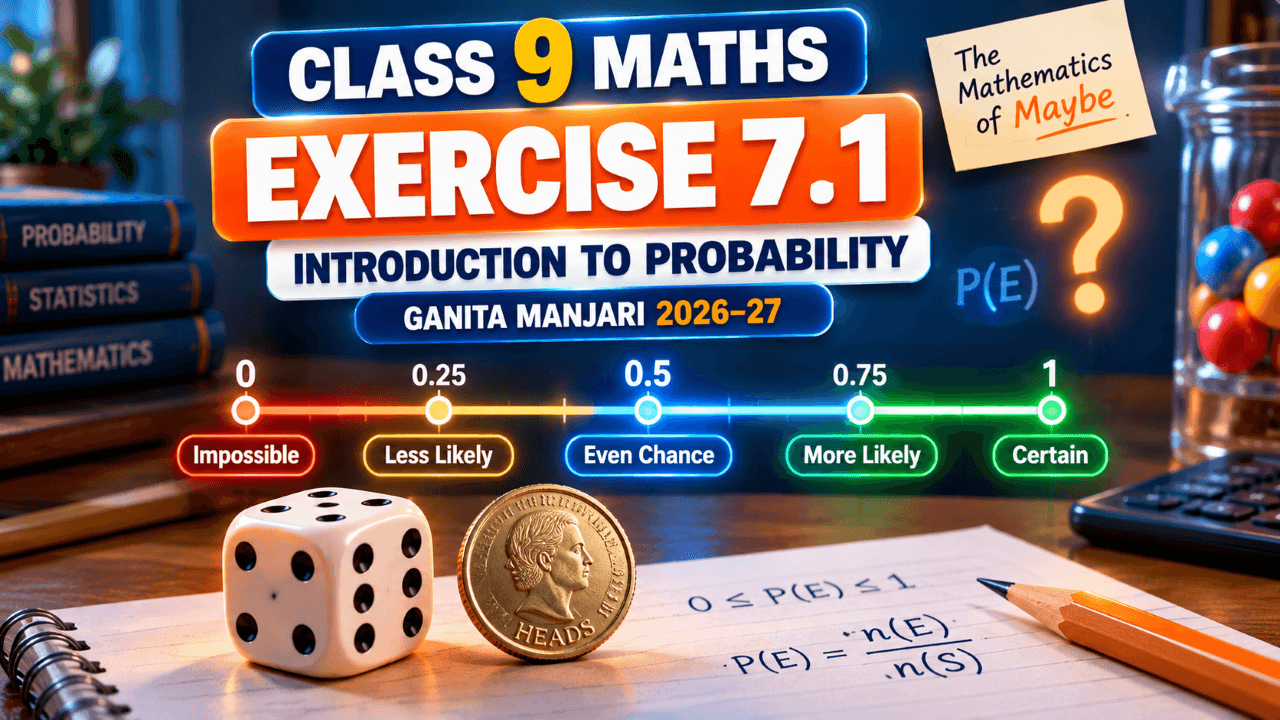
The Mathematics of Maybe: Introduction to Probability — Ganita Manjari 2026–27
Prepare with complete Class 9 Maths Chapter 7 Exercise 7.1 Solutions based on the latest Ganita Manjari 2026–27. This exercise introduces the probability scale from 0 to 1 and asks you to rank events as impossible, less likely, equally likely, more likely or certain. The question is explained with clear reasoning and step-by-step CBSE answer-writing style.
4 Events
Scale
Give Reasons
Impossible → Certain
Reasoning
You Will Be Able To…
📚 Table of Contents
📖 About Class 9 Maths Chapter 7 Exercise 7.1
Class 9 Maths Chapter 7 Exercise 7.1 Solutions cover Exercise Set 7.1 from Chapter 7 – The Mathematics of Maybe: Introduction to Probability in the latest Ganita Manjari 2026–27 textbook. This page provides a clear, student-friendly solution to the exercise, with a focus on the probability scale from 0 to 1 and the language used to describe the likelihood of events. It is designed for students searching for Class 9 Maths Exercise 7.1 Solutions, Class 9 Maths Chapter 7 Solutions and Ganita Manjari Chapter 7 Exercise 7.1 Solutions.
The Class 9 Maths Chapter 7 Exercise 7.1 Solutions are arranged in a clear, student-friendly CBSE answer-writing format. The exercise asks students to rank real-life events on a scale from 0 (Impossible) to 1 (Certain) and label them as impossible, less likely, equally likely (even chance), more likely or certain, giving reasons for each ranking. The page is useful for understanding likelihood, probability scale, randomness and the correct use of probability language.
🎯 Exercise Snapshot
- Complete solution coverage of Exercise Set 7.1.
- The probability scale from 0 to 1, from impossible to certain.
- Clear ranking of the four events given in Question 1.
- Step-by-step Class 9 Maths Exercise 7.1 solutions with clear reasoning.
- Question-wise explanation of the four real-life events in Question 1.
- Simple and exam-oriented CBSE answer-writing approach.
- Students following Ganita Manjari 2026–27.
- Homework, classroom practice and self-study.
- Understanding and revising the probability scale and likelihood language.
📚 Learn Before You Solve
Before solving Class 9 Maths Chapter 7 Exercise 7.1, understand the basic ideas of probability, randomness, random experiments, and the probability scale from 0 to 1. This short Learn Before You Solve section follows Ganita Manjari Chapter 7 – The Mathematics of Maybe: Introduction to Probability and prepares you to rank events as impossible, less likely, equally likely, more likely, or certain.
🎯 What Is Probability?
Understanding how likely an event is to happen
Probability is a way of measuring how likely an event is to happen. We use it when the result of an event is not known with certainty, but we want to describe its likelihood. For example, we may wonder whether it will rain today, whether a team will win a match, or whether a person will be selected in a lucky draw.
An event is something whose occurrence we are interested in.
We think about whether the event is unlikely, equally likely, or very likely to happen.
Probability gives us a way to represent that likelihood and compare different events.
Will it rain today? We may not know the exact outcome beforehand, but available information can help us judge how likely rain is.
Similarly, before a hockey match we may ask: How likely is our team to win? Probability helps us express this likelihood.
🎲 Randomness, Experiment & Outcome
Knowing the possible results does not mean knowing which one will occur
In many situations, we know the possible outcomes, but we cannot predict exactly which outcome will occur. This uncertainty is called randomness. A process involving this kind of uncertainty is called a random experiment.
In a random experiment, the result cannot be known with certainty before the experiment is performed. However, the possible outcomes are known. The experiment can also be repeated, and the outcome may be different each time.
An experiment whose exact outcome cannot be predicted in advance.
One performance or repetition of the random experiment.
The result obtained when the experiment is performed.
🔍 Two simple examples
The possible outcomes are Heads and Tails. Before tossing the coin, we know these possibilities, but we cannot know with certainty which one will appear.
The possible outcomes are 1, 2, 3, 4, 5 and 6. We know all the possibilities, but the actual number obtained is not known before the roll.
💭 Think & Reflect
Page 156Such unpredictability can be useful sometimes! For example, in a cricket match, the fact that a coin is tossed to decide which team will bat first is considered to be a fair method. Can you explain why?
🔎 Find Solution💭 Think & Reflect
Page 157Ask your friend to predict the outcome of a coin you toss. Do you see that your friend could guess heads or tails but could not know for certain? That’s randomness! All possible results are known, but each individual try is unpredictable.
🔎 Find Solution📏 The Probability Scale: 0 to 1
Every event lies somewhere between impossible and certain
Probability is measured on a scale from 0 to 1. The number tells us how likely an event is to happen. A probability closer to 0 means the event is less likely, while a probability closer to 1 means it is more likely. The two ends of the scale have special meanings: 0 means impossible and 1 means certain.
The event is impossible. It cannot occur.
The two outcomes have an even chance of occurring.
The event is certain. It will definitely occur.
🔍 How Do We Judge Likelihood?
Using evidence, observations and patterns to estimate what may happen
A random event may be unpredictable, but that does not mean that nothing can be said about its likelihood. We can use available evidence, observations and patterns to make a reasonable estimate of how likely an event is.
The important idea is: we may not know exactly what will happen, but evidence can help us judge how likely it is to happen. This is especially useful when the event depends on many factors.
Look at information, past observations or available evidence.
Notice what the evidence suggests about the event.
Use that evidence to judge how likely the event is.
The exact time and place of rainfall cannot always be predicted because many factors are involved, such as temperature, humidity, wind and air pressure.
However, information about these factors and previous patterns can help us estimate the likelihood of rain.
Sometimes probability is judged using the evidence available and how that evidence is interpreted. Different evidence or interpretations can lead to different estimates of likelihood.
🧭 How to Rank an Event on the Probability Scale
A simple method to solve Exercise Set 7.1 with a reason
In Exercise Set 7.1, you are asked to place everyday events on the probability scale from 0 to 1. Do not guess the label first. First decide how likely the event is, then place it on the scale and give a short reason.
Q1 asks you to do three things: rank the event on the 0–1 scale, give the correct likelihood label, and explain your choice with a suitable reason.
Understand exactly what the question says may happen.
Ask: Is it impossible, less likely, an even chance, more likely, or certain?
Connect your judgement with the 0 to 1 probability scale.
State the fact or observation that supports your ranking.
Keep the reason connected directly to the event. A clear answer follows this pattern: Event → Likelihood → Label → Reason.
⚡ Quick Revision — Probability Basics
Everything you need to remember before solving Exercise Set 7.1
Probability tells us how likely an event is to happen.
Possible outcomes are known, but the exact outcome is not known in advance.
It can be repeated, and the outcome may differ from trial to trial.
Observations, information and patterns can help estimate how likely an event is.
0 = impossible, 0.5 = even chance, 1 = certain.
Judge the event, place it on the scale, label it and give a suitable reason.
📝 Class 9 Maths Chapter 7 Exercise 7.1 Solutions
Solve the questions from Class 9 Maths Chapter 7 Exercise 7.1 with clear, step-by-step Ganita Manjari (2026–27) solutions. This exercise focuses on the probability scale from 0 to 1 and helps you rank events as impossible, less likely, equally likely (even chance), more likely or certain. The solution explains the reasoning behind each ranking in a simple, student-friendly CBSE answer-writing format.
Class 9 Maths Chapter 7 Exercise 7.1 Question 1
The Mathematics of Maybe: Introduction to Probability | Ganita Manjari 2026–27
Rank the following events on a scale from 0 (Impossible) to 1 (Certain). Label each event: Impossible, less likely, equally likely (even chance), more likely, certain. Give reasons why you gave each event its ranking.
Class 9 Maths Chapter 7 Exercise 7.1 Question 1 (i) – Solution
The Mathematics of Maybe: Introduction to Probability | Ganita Manjari 2026–27
Therefore, this event must happen.
P = 1
Class 9 Maths Chapter 7 Exercise 7.1 Question 1 (ii) – Solution
The Mathematics of Maybe: Introduction to Probability | Ganita Manjari 2026–27
Therefore, the event has a very low chance of occurring.
Class 9 Maths Chapter 7 Exercise 7.1 Question 1 (iii) – Solution
The Mathematics of Maybe: Introduction to Probability | Ganita Manjari 2026–27
Therefore, there is a very low chance of this event happening.
It is therefore classified as less likely.
Class 9 Maths Chapter 7 Exercise 7.1 Question 1 (iv) – Solution
The Mathematics of Maybe: Introduction to Probability | Ganita Manjari 2026–27
However, it is not certain because it is possible that you may not greet any friend.
Therefore, it is placed towards the higher end of the probability scale, but not at 1.
📚 Continue Learning
Congratulations! You have completed the Class 9 Maths Chapter 7 Exercise 7.1 Solutions. You have now worked through Exercise Set 7.1 of Chapter 7 – The Mathematics of Maybe: Introduction to Probability. Continue your learning journey by revising the probability scale, exploring the complete Chapter 7 Solutions, and returning to this page whenever you need to review Exercise 7.1.
📖 Explore More Class 9 Maths Chapters
❓ Frequently Asked Questions
Find quick answers to common questions about Class 9 Maths Chapter 7 Exercise 7.1 Solutions. These FAQs explain the main ideas from Exercise Set 7.1, including the probability scale from 0 to 1, impossible, less likely, equally likely (even chance), more likely and certain events. Use them for homework, revision, self-study and CBSE examination preparation.
What is taught in Class 9 Maths Chapter 7 Exercise 7.1?
Exercise Set 7.1 of Class 9 Maths Chapter 7, The Mathematics of Maybe: Introduction to Probability, introduces students to the probability scale from 0 to 1. Students learn to rank events using the terms impossible, less likely, equally likely (even chance), more likely and certain, and give reasons for their rankings.
How many questions are included in Exercise Set 7.1?
The verified Exercise Set 7.1 contains 1 question with 4 events. The question asks students to rank each event on a scale from 0 (Impossible) to 1 (Certain), label the event using the appropriate likelihood term, and give a reason for the ranking.
What is the probability scale from 0 to 1?
The probability scale is a scale from 0 to 1 used to describe how likely an event is. A probability of 0 represents an impossible event, while a probability of 1 represents a certain event. Values between 0 and 1 represent different degrees of likelihood.
What does probability 0 mean?
A probability of 0 represents an impossible event. It means that the event cannot happen. For example, in a standard die roll, getting a number greater than 6 is impossible, so it lies at the 0 end of the probability scale.
What does probability 1 mean?
A probability of 1 represents a certain event. It means that the event is sure to happen. On the probability scale, 1 is the Certain end of the scale.
What does equally likely or even chance mean?
Equally likely means that the outcomes have the same chance of occurring. It is also described as an even chance. On the probability scale, an even chance is represented by 0.5, or a 50% chance. For example, when a fair coin is flipped, getting Heads is an even-chance event.
How do we rank events on the probability scale?
To rank an event, first think about how likely it is to happen.
Then place it appropriately on the scale from
0 to 1.
0 → Impossible
Between 0 and 0.5 → Less likely
0.5 → Equally likely (Even chance)
Between 0.5 and 1 → More likely
1 → Certain
The ranking should be supported by a
clear reason based on the event.
What is the difference between less likely and more likely?
A less likely event has a smaller chance of happening, while a more likely event has a greater chance of happening. Both lie between the two extreme ends of the probability scale, 0 (Impossible) and 1 (Certain). The probability scale helps us compare the likelihood of different events.
Why do we need to give reasons while ranking events?
Exercise Set 7.1 asks students to give reasons for their rankings. Therefore, it is not enough to simply write impossible, less likely, equally likely, more likely or certain. A good answer briefly explains why the event has that level of likelihood. This develops understanding of probability rather than simple memorisation of labels.
Are these Class 9 Maths Chapter 7 Exercise 7.1 Solutions based on Ganita Manjari 2026–27?
Yes. These Class 9 Maths Chapter 7 Exercise 7.1 Solutions are prepared according to the Ganita Manjari (2026–27) textbook content for Chapter 7 – The Mathematics of Maybe: Introduction to Probability. The solutions follow the Exercise Set 7.1 question format and explain the probability scale and likelihood labels in a simple, student-friendly answer-writing format.