Class 9 Maths Chapter 13 Exercise 13.1 Solutions
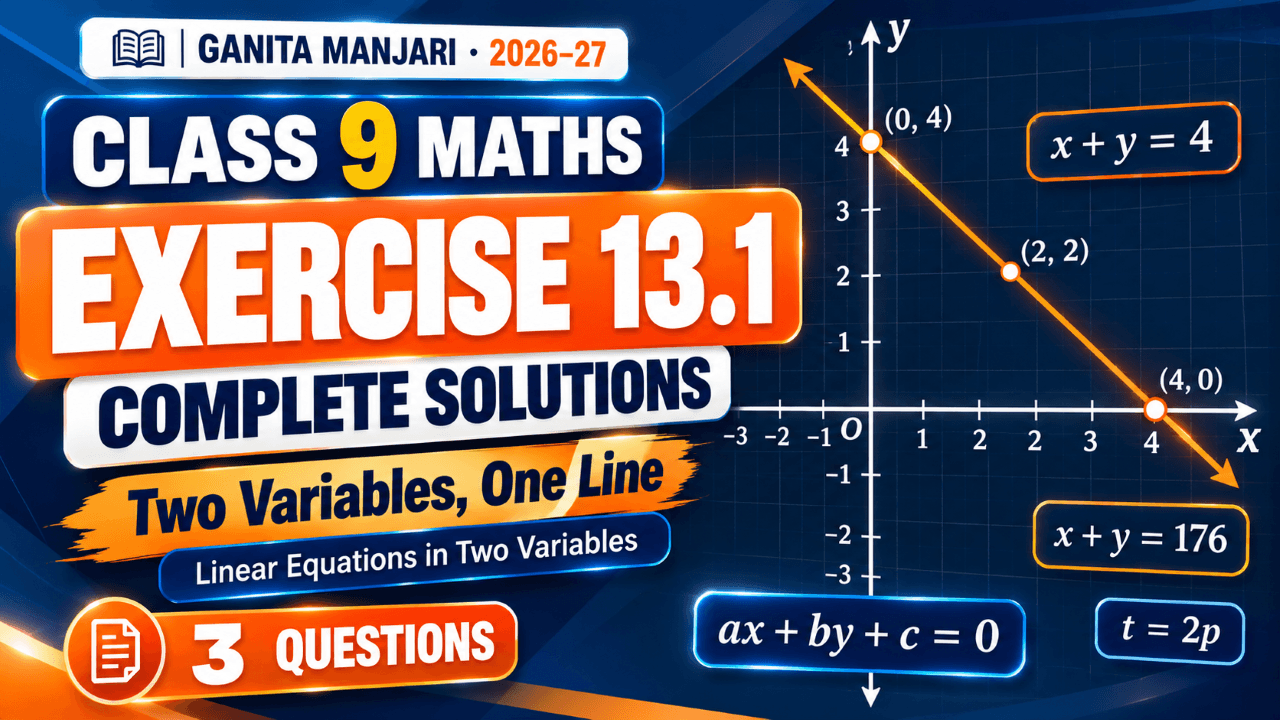
Two Variables, One Line — Ganita Manjari 2026–27
Prepare with complete Class 9 Maths Chapter 13 Exercise 13.1 Solutions based on the latest Ganita Manjari 2026–27. This exercise introduces linear equations in two variables, the standard form ax + by + c = 0, coefficients of x and y, constant terms, and the representation of real-life situations using linear equations. Every question is explained with clear reasoning and step-by-step answer-writing style.
5 Table Rows
in Two Variables
& Coefficients
Identify a, b, c
Linear Equations
You Will Be Able To…
📚 Table of Contents
📖 About Class 9 Maths Chapter 13 Exercise 13.1
Class 9 Maths Chapter 13 Exercise 13.1 Solutions cover Exercise Set 13.1 from Chapter 13 – Two Variables, One Line in the latest Ganita Manjari Grade 9 Part II 2026–27 textbook. This page provides clear, student-friendly solutions to Class 9 Maths Exercise 13.1, with a focus on linear equations in two variables, their standard form ax + by + c = 0, and the identification of the coefficient of x, coefficient of y and constant term. It is designed for students searching for Class 9 Maths Exercise 13.1 Solutions, Class 9 Maths Chapter 13 Solutions and Ganita Manjari Chapter 13 Exercise 13.1 Solutions.
The Class 9 Maths Chapter 13 Exercise 13.1 Solutions are arranged in a clear, student-friendly CBSE answer-writing format. The exercise begins with the structure of a linear equation in two variables and then asks students to work with the standard form ax + by + c = 0. The questions involve writing an equation from given values of a, b and c, converting equations into standard form, identifying coefficients and the constant term, and deciding whether simple real-life statements have been represented correctly by linear equations.
🎯 Exercise 13.1 Snapshot
- Complete solution coverage of Exercise Set 13.1.
- Clear explanation of linear equations in two variables and their standard form.
- Step-by-step treatment of the three main questions given in the exercise.
- Step-by-step Class 9 Maths Exercise 13.1 solutions with clear reasoning.
- Standard-form conversion and identification of a, b, c, including cases where one variable has coefficient zero.
- Simple, exam-oriented CBSE answer-writing approach for the real-life representation questions.
- Students following Ganita Manjari Grade 9 Part II 2026–27.
- Homework, classroom practice and self-study.
- Understanding standard form, coefficients and constants before moving to later concepts in Chapter 13.
📚 Learn Before You Solve
Before solving Class 9 Maths Chapter 13 Exercise 13.1, understand how a real-life situation can be represented using a linear equation in two variables. This short section introduces the standard form ax + by + c = 0, the meaning of its coefficients and constant term, and how to convert or form equations for Exercise 13.1.
What Is a Linear Equation in Two Variables?
From a real-life situation to a mathematical equation
A linear equation in two variables can arise when a real-life situation involves two unknown quantities and a relationship between them. First identify what is unknown and then represent those quantities using variables.
An equation involving two variables such as x and y, where the variables occur only to the first power, is called a linear equation in two variables.
Decide which quantities are not known in the situation.
Represent the unknown quantities using variables such as x and y.
Use the relationship given in the situation to write an equation.
Mangoes cost ₹60 per kg and bananas cost ₹50 per kg. Let x be the number of kilograms of mangoes and y be the number of kilograms of bananas.
Cost of mangoes =
₹60x
Cost of bananas =
₹50y
If the total cost is ₹280, then:
Both sides represent the same quantity—the total cost. Therefore, 60x + 50y = 280 is a linear equation in two variables.
Standard Form of a Linear Equation in Two Variables
Understand ax + by + c = 0 and identify a, b and c
A linear equation in two variables can be written in a common form called its standard form. This form makes it easy to identify the coefficients of x and y, and the constant term.
The number multiplying x.
The number multiplying y.
The term without a variable.
For a linear equation in two variables, a and b cannot both be zero. However, one of them may be zero.
See how the form works
Consider:
Therefore, a = 5, b = 2, c = −2.7.
Consider:
Write it as:
So, a = 0, b = 3, c = −5.
How to Convert an Equation into Standard Form
Bring all terms to one side and write ax + by + c = 0
An equation may not always be given directly in standard form. To convert it, bring all the terms to one side so that the other side becomes zero, and then arrange the terms in the form ax + by + c = 0.
Move all variable and constant terms to one side.
Keep zero on the other side of the equation.
Write the terms in the order x-term, y-term, constant.
Identify the coefficient of x, coefficient of y and constant.
Let’s convert a few equations
Consider:
Standard form:
Consider:
Standard form:
Be careful with signs. When a term moves from one side to the other, its sign changes. After conversion, always check that the equation has the form ax + by + c = 0.
How to Form a Linear Equation from a Situation
Read the relationship first, then translate it into mathematics
In word problems, the most important step is to understand what the statement is saying before writing an equation. First define the variables, then translate the relationship between the quantities.
Find the quantities whose values are being represented.
Clearly state what each variable represents.
Translate words such as twice, together, total or difference.
Combine the variables according to the given relationship.
Example 1 — Notebook and Pen
The cost of a notebook is twice the cost of a pen.
“Notebook is twice the pen” means:
So the correct equation must show that the notebook cost is twice the pen cost.
Example 2 — Two Batsmen’s Runs
Two Indian batsmen together scored 176 runs.
The word together tells us to add their runs.
Therefore, this equation correctly represents the given situation.
“Twice” tells us about multiplication.
“Together” tells us to add the quantities.
“Total” tells us what the combined quantity equals.
Before accepting your equation, ask: Do the variables represent the quantities correctly? Does the equation express exactly the relationship given in the question?
Quick Revision: Class 9 Maths Chapter 13 Exercise 13.1 Solutions
Key ideas to remember before solving Exercise 13.1 | Ganita Manjari 2026–27
An equation involving two variables such as x and y, with the variables occurring only to the first power, is a linear equation in two variables.
A linear equation in two variables can be written as:
a is the coefficient of x, b is the coefficient of y, and c is the constant term.
If a variable is missing, its coefficient is 0. For example, x = 8 becomes x + 0y − 8 = 0.
Form a linear equation when a, b, c are given.
Convert equations to standard form and identify a, b, c.
Translate real-life relationships into a linear equation.
📝 Class 9 Maths Chapter 13 Exercise 13.1 Solutions
Solve the questions from Class 9 Maths Chapter 13 Exercise 13.1 with clear, step-by-step Ganita Manjari (2026–27) solutions. This exercise introduces linear equations in two variables and focuses on writing equations in the standard form ax + by + c = 0. You will also practise identifying the coefficient of x, coefficient of y, and constant term, converting equations into standard form, and forming simple linear equations from real-life statements. The solutions follow a clear, student-friendly CBSE answer-writing format.
Class 9 Maths Chapter 13 Exercise 13.1 Question 1 – Solution
Two Variables, One Line | Ganita Manjari 2026–27
Class 9 Maths Chapter 13 Exercise 13.1 Question 2 – Solution
Express the given linear equations in standard form and identify a, b and c
|
Linear equation in two variables |
Standard Form |
Coefficient of x |
Coefficient of y |
Constant term |
|---|---|---|---|---|
| y − 15 = √2x | ||||
| 3y − 2x = 0 | ||||
| 5x = 3y | ||||
| x = 8 | ||||
| 3y = 1 |
Solution
Write each equation in the standard form ax + by + c = 0. Then identify the coefficient of x, coefficient of y, and the constant term.
Completed Solution Table
|
Linear equation in two variables |
Standard Form |
Coefficient of x |
Coefficient of y |
Constant term |
|---|---|---|---|---|
| y − 15 = √2x | −√2x + y − 15 = 0 | −√2 | 1 | −15 |
| 3y − 2x = 0 | −2x + 3y + 0 = 0 | −2 | 3 | 0 |
| 5x = 3y | 5x − 3y + 0 = 0 | 5 | −3 | 0 |
| x = 8 | x + 0y − 8 = 0 | 1 | 0 | −8 |
| 3y = 1 | 0x + 3y − 1 = 0 | 0 | 3 | −1 |
Class 9 Maths Chapter 13 Exercise 13.1 Question 3
Two Variables, One Line | Ganita Manjari 2026–27
The cost of a notebook is twice the cost of a pen. Consider the cost of a notebook to be ₹t and that of a pen to be ₹p. Charlie wrote t = 2p whereas Meera wrote p = 2t . Which of these two representations is correct?
In a one-day International Cricket match between India and Sri Lanka played in Nagpur, two Indian batsmen together scored 176 runs. Manisha expressed this situation as x + y = 176 where the number of runs scored by one batsman is x, and the number of runs scored by the other is y. Is this a correct representation?
Class 9 Maths Chapter 13 Exercise 13.1 Question 3(i) – Solution
Representing a relationship between the cost of a notebook and a pen
Cost of a notebook = ₹t
Cost of a pen = ₹p
The notebook costs twice as much as
the pen.
The statement says that the cost of the notebook is twice the cost of the pen.
Since the cost of the notebook is represented by t and the cost of the pen by p, we write:
Therefore, Charlie’s representation matches the relationship given in the question.
Charlie’s representation is correct: t = 2p.
Class 9 Maths Chapter 13 Exercise 13.1 Question 3(ii) – Solution
Representing the total runs scored by two batsmen
Runs scored by one batsman = x
Runs scored by the other batsman = y
Total runs scored by both batsmen = 176
The two batsmen together scored 176 runs. Therefore, the sum of the runs scored by the first batsman and the second batsman must be 176.
Since their runs are represented by x and y, respectively, we write:
This is exactly the representation given by Manisha.
Yes, Manisha’s representation is correct: x + y = 176.
📚 Continue Learning
Congratulations! You have completed the Class 9 Maths Chapter 13 Exercise 13.1 Solutions. You have now worked through Exercise Set 13.1 of Chapter 13 – Two Variables, One Line. Continue your learning journey by exploring the complete Chapter 13 Solutions and moving through the remaining exercises of this chapter.
📖 Explore More Class 9 Maths Chapters
❓ Frequently Asked Questions
Find quick answers to common questions about Class 9 Maths Chapter 13 Exercise 13.1 Solutions. These FAQs explain the key ideas from Exercise Set 13.1, including linear equations in two variables, the standard form ax + by + c = 0, coefficients, constants, and writing simple equations from real-life statements. Use them for homework, revision, self-study and CBSE examination preparation.
What is taught in Class 9 Maths Chapter 13 Exercise 13.1?
Exercise Set 13.1 of Class 9 Maths Chapter 13, Two Variables, One Line, introduces linear equations in two variables. Students practise writing equations, expressing them in standard form ax + by + c = 0, identifying coefficients and the constant term, and representing simple real-life relationships using linear equations.
How many questions are included in Exercise Set 13.1?
The verified Exercise Set 13.1 contains 3 main questions. Question 1 asks students to form a linear equation from given values of a, b and c. Question 2 requires a table to be completed after expressing five given equations in standard form. Question 3 contains two parts based on simple real-life statements.
What is the standard form of a linear equation in two variables?
The standard form of a linear equation in two variables is
ax + by + c = 0
where a, b and c are real numbers, and
a and b are not both zero.
Here, a is the coefficient of x,
b is the coefficient of y, and
c is the constant term.
How do you identify the coefficients and constant term?
First express the equation in the standard form ax + by + c = 0. Then compare the equation with this form. The number multiplying x is the coefficient of x, the number multiplying y is the coefficient of y, and the number without a variable is the constant term. If a variable is missing, its coefficient is 0. For example, x = 8 can be written as x + 0y – 8 = 0.
Can a linear equation in two variables have a missing variable?
Yes. A variable may be missing, in which case its coefficient is
0.
For example,
x = 8
can be expressed as
x + 0y – 8 = 0.
Similarly,
3y = 5
can be written as
0x + 3y – 5 = 0.
Thus, the equation can still be expressed in the standard form
ax + by + c = 0.
How do you convert an equation into standard form?
To convert an equation into standard form, rearrange all terms so that the expression is written as ax + by + c = 0. Move all terms to one side of the equation and simplify. If fractional coefficients are present, they may be cleared by multiplying through by a suitable number. For example, 5x + 2y = 2.7 becomes 5x + 2y – 2.7 = 0.
How do we form a linear equation from a real-life statement?
First identify the quantities represented by the variables.
Then translate the relationship given in the statement into an equation.
For example, if the cost of a notebook is twice the cost of a pen,
and t represents the notebook cost while
p represents the pen cost, the relationship can be written as
t = 2p.
The important step is to define the variables correctly before writing
the equation.
Why is the equation x + y = 176 correct when two batsmen together score 176 runs?
Suppose x and y represent the runs scored
by the two batsmen.
The statement says that their runs
together total 176.
Therefore, the relationship between the two variables is
x + y = 176.
This is a linear equation in two variables because it represents a
relationship between x and y.
What is the most important skill to learn from Exercise 13.1?
The key skill is learning to recognise and write a linear equation in two variables and then express it correctly in the standard form ax + by + c = 0. Students should also be comfortable identifying the coefficient of x, coefficient of y and constant term, including cases where one variable has a coefficient of zero.
Are these Class 9 Maths Chapter 13 Exercise 13.1 Solutions based on Ganita Manjari PART-2 2026–27?
Yes. These Class 9 Maths Chapter 13 Exercise 13.1 Solutions are prepared according to the Ganita Manjari (2026–27) textbook content for Chapter 13 – Two Variables, One Line. The solutions follow the Exercise Set 13.1 question structure and explain linear equations, standard form, coefficients, constants and simple real-life equation formation in a clear, student-friendly answer-writing format.