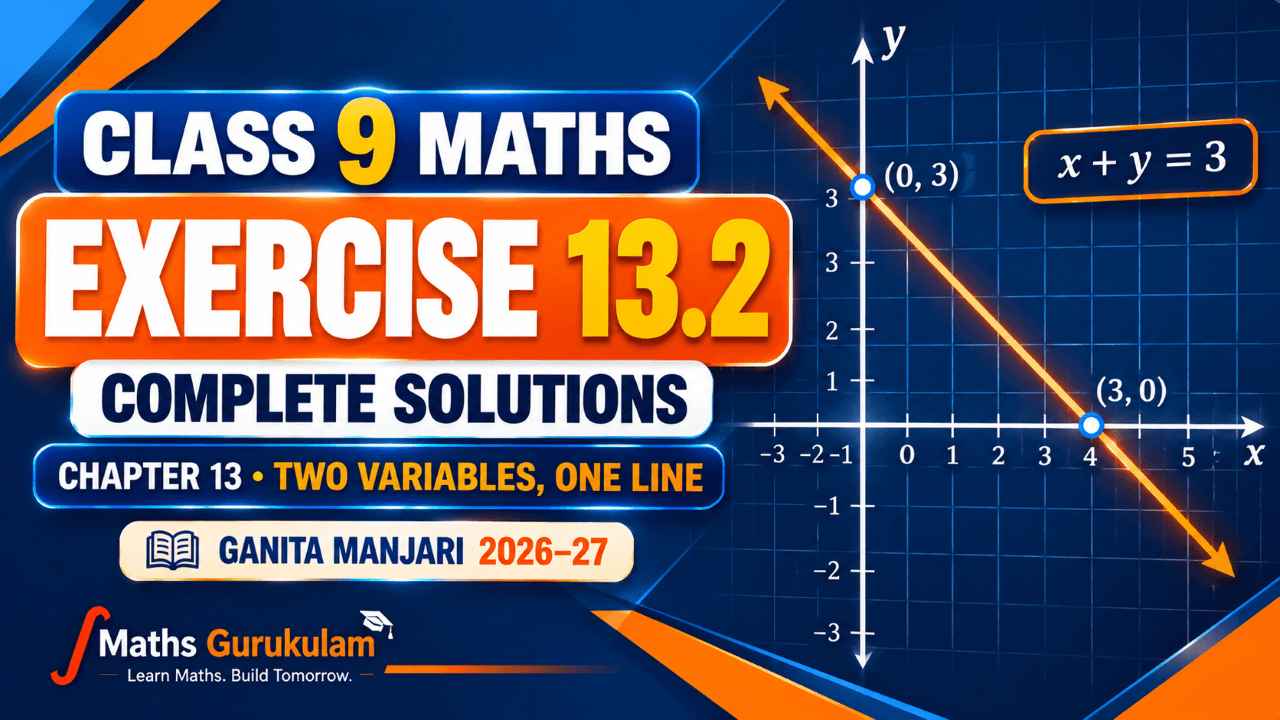
Class 9 Maths Chapter 13 Exercise 13.2 Solutions
Two Variables, One Line — Ganita Manjari 2026–27
Prepare with complete Class 9 Maths Chapter 13 Exercise 13.2 Solutions based on Ganita Manjari Grade 9 Part II (2026–27). This exercise develops the meaning of a solution of a linear equation in two variables, verification of ordered pairs, finding solutions, determining unknown constants, representing solutions on graphs, identifying quadrants, and understanding equations that have the same set of solutions. Every question is explained with clear reasoning and step-by-step answer-writing.
With Sub-parts
in Two Variables
& Find Solutions
& Identify Quadrants
& Equivalent Equations
You Will Be Able To…
📚 Exercise 13.2 — Table of Contents
📖 About Class 9 Maths Chapter 13 Exercise 13.2
Class 9 Maths Chapter 13 Exercise 13.2 Solutions cover Exercise Set 13.2 from Chapter 13 – Two Variables, One Line in the Ganita Manjari Grade 9 Part II textbook for the 2026–27 academic session. This page is designed to help students understand and solve questions related to linear equations in two variables, including checking ordered pairs, finding solutions of equations, and understanding how solutions can be represented on a coordinate plane. These step-by-step explanations support students looking for Class 9 Maths Exercise 13.2 Solutions and Class 9 Maths Chapter 13 Solutions.
In this exercise, students develop their understanding of what it means for an ordered pair to satisfy a linear equation in two variables. The key approach is to substitute the given values of the variables into the equation and check whether both sides are equal. Students can also practise finding suitable values for the variables, interpreting solutions as points on a graph, and connecting algebraic equations with their graphical representation. The solutions on this page are organised to make the mathematical reasoning easier to follow during NCERT-based practice, homework and revision.
🎯 Exercise 13.2 Snapshot
- Step-by-step explanations for questions in Exercise Set 13.2.
- Verification of ordered pairs in linear equations in two variables.
- Clear mathematical working to help students understand how each answer is obtained.
- Substituting values and checking whether an ordered pair satisfies an equation.
- Finding solutions by choosing suitable values for the variables.
- Understanding the connection between solutions and points on a coordinate graph.
- Students studying Ganita Manjari Grade 9 Part II (2026–27).
- Homework, classroom practice and independent mathematics revision.
- Building a stronger foundation in linear equations in two variables.
📚 Learn Before You Solve
Before solving Class 9 Maths Chapter 13 Exercise 13.2, understand what makes an ordered pair a solution, how to find solutions of a linear equation in two variables, and how these solutions form a straight-line graph. This guide also covers the properties needed for the questions in Exercise 13.2 of Ganita Manjari Part II, Grade 9, 2026–27.
What Is a Solution of a Linear Equation in Two Variables?
A linear equation in two variables contains two variables, usually x and y. To understand its solutions, we need to find values of both variables that make the equation true.
1. A Solution Is an Ordered Pair
Consider the equation from the textbook:
If we take x = 2 and y = 3, then 3 × 2 + 2 × 3 = 6 + 6 = 12. The equation is satisfied.
Therefore, (2, 3) is a solution of 3x + 2y = 12. The order matters because the first number is assigned to x and the second to y.
2. How Do We Check a Solution?
Substitute the given values into the equation and compare the left-hand side (LHS) with the right-hand side (RHS).
Replace x and y with the given values.
Calculate the value of each side.
If LHS = RHS, the pair is a solution.
Example: Check These Ordered Pairs
For 3x + 2y = 12, examine the following ordered pairs.
LHS = 3 × 2 + 2 × 3 = 12
RHS = 12
Both sides are equal.
LHS = 3 × 4 + 2 × 0 = 12
RHS = 12
Both sides are equal.
LHS = 3 × 1 + 2 × 3 = 9
RHS = 12
Both sides are not equal.
Next: learn how to choose a value for one variable and calculate the other to find more solutions.
How to Find Solutions of a Linear Equation
We can find solutions of a linear equation in two variables by choosing a value for one variable and calculating the corresponding value of the other. Every valid pair is written in the order (x, y).
1. Choose One Variable
Consider the equation:
Choose a value of x, then substitute it into the equation to find y.
2y = 12
y = 6
Solution: (0, 6)
6 + 2y = 12
2y = 6
y = 3
Solution: (2, 3)
2. Make a Table of Solutions
Different choices of x give different ordered pairs for 3x + 2y = 12.
| x | Calculation | y | Ordered Pair |
|---|---|---|---|
| 0 | 2y = 12 | 6 | (0, 6) |
| 2 | 6 + 2y = 12 | 3 | (2, 3) |
| 4 | 12 + 2y = 12 | 0 | (4, 0) |
| 6 | 18 + 2y = 12 | −3 | (6, −3) |
The value of y can be positive, zero or negative. A pair is a solution whenever it satisfies the equation.
3. Think & Reflect
Check the Ordered Pairs
Consider the equation 3x + 2y = 12. Check whether each of the following ordered pairs is a solution:
- (1, 92 )
- (0, 6)
- (4, 1)
- ( 12 , 214 )
Can you find other solutions? How many solutions do you think this equation has?
Check Solutions ↗Next: Learn how ordered pairs are represented as points on a straight-line graph.
From Solutions to a Straight-Line Graph
Every solution of a linear equation in two variables can be represented by a point on the coordinate plane. When we plot these solution points, they lie on a straight line.
Step 1: Calculate the Solutions
We will use the equation below to calculate ordered pairs before plotting them on the graph.
Substitute x = 0 into the equation.
So, when x = 0, the value of y is 7.
Substitute x = 1 into the equation.
The x-intercept is where the graph crosses the x-axis. Every point on the x-axis has y-coordinate 0.
As a decimal, 72 = 3.5.
Each calculated ordered pair gives us a point to plot. Once we have correct points, we can mark them and draw the straight line through them.
Step 2: Plot the Points on the Graph
Equation: 2x + y = 7. The orange line contains the solutions calculated in the panel on the left.
For (1, 5), move 1 unit right along the x-direction, then 5 units upward to mark the point.
For (2, 3), move 2 units right and 3 units upward. The same method works for every ordered pair.
After plotting the points, use a ruler to draw one straight line through the solution points.
Understand the Intercepts
An intercept is the point where a graph meets one of the coordinate axes. We can calculate these points by setting one coordinate equal to zero.
1. Finding the y-intercept
Every point on the y-axis has x = 0. Put x = 0 in 2x + y = 7.
Therefore, the y-intercept is (0, 7). It is where the orange line crosses the y-axis.
2. Finding the x-intercept
Every point on the x-axis has y = 0. Put y = 0 in 2x + y = 7.
Since 72 = 3.5, the x-intercept is (3.5, 0).
From an Equation to Its Graph
Algebra and geometry tell the same story. If an ordered pair satisfies the equation, its point lies on the graph. If a point lies on the graph, its coordinates satisfy the equation.
Exam connection: In Exercise 13.2, use this relationship when plotting the solutions of an equation and deciding whether a given point lies on its graph.
Unknown Constants, Quadrants and the Origin
A known solution helps us find unknown constants. The signs of the coordinates tell us the quadrant of a point, while the constant term helps us determine whether a line passes through the origin.
1. Find Unknown Constants Using a Known Solution
If an ordered pair is a solution of an equation, substituting its coordinates must make the equation true. We use this fact to find unknown constants.
Example: Find m and n
The ordered pair (2, −1) is a solution of both equations:
Substitute x = 2 and y = −1 into the first equation.
We added 3 to both sides to isolate 4m, then divided both sides by 4.
Substitute x = 2 and y = −1 into the second equation.
Subtract 8 from both sides. Then multiply both sides by −1 to obtain n = 18.
2. Identify Quadrants Using Signs
The sign of x tells us whether a point lies to the left or right of the y-axis. The sign of y tells us whether it lies above or below the x-axis.
Coordinate Sign Guide
| Location | Sign of x | Sign of y |
|---|---|---|
| Quadrant I | Positive (+) | Positive (+) |
| Quadrant II | Negative (−) | Positive (+) |
| Quadrant III | Negative (−) | Negative (−) |
| Quadrant IV | Positive (+) | Negative (−) |
A point on either axis is not in any quadrant. The origin (0, 0) is also not in a quadrant.
How to Check a Point
Consider the equation:
The point satisfies the equation. Since x is positive and y is negative, it lies in Quadrant IV.
The point satisfies the equation. Since x is negative and y is positive, it lies in Quadrant II.
Connect Quadrants with Exercise 13.2, Question 4
The four equations have different sign patterns. The following examples show how to calculate a point and identify its quadrant.
| Equation | Calculated point | Quadrant |
|---|---|---|
| 5x + 3y = 7 | (2, −1) | IV |
| 5x − 3y = 7 | (2, 1) | I |
| −5x + 3y = 7 | (−2, −1) | III |
| −5x − 3y = 7 | (−2, 1) | II |
Each point can be verified by substituting its coordinates. The signs of x and y identify its quadrant; the equation alone does not determine the quadrant of every possible solution.
3. Can x = 3 Be a Linear Equation in Two Variables?
Write It in Standard Form
Subtract 3 from both sides:
This is in the form ax + by + c = 0, with a = 1, b = 0 and c = −3.
What Does It Mean?
Every point on the line x = 3 has an x-coordinate equal to 3. The y-coordinate can take different values.
Each of these points satisfies x = 3. They lie on a vertical straight line parallel to the y-axis.
Why Does the Line Pass Through the Origin?
Four friends discuss the standard form of a linear equation in two variables:
They investigate what happens when c = 0. Read their reasoning and evaluate the conclusion.
Ranju's reasoning
If c = 0, the equation becomes ax + by = 0. Substituting x = 0 and y = 0 makes the equation true. Therefore, the origin lies on the line.
Farhan's example
Consider 2x + 3y = 0. If x = 0, then 3y = 0, so y = 0. Hence, (0, 0) satisfies the equation.
Toshi's example
If b = c = 0, an example is 5x = 0, or x = 0. This is the y-axis, which passes through the origin.
Meena's example
If a = c = 0, an example is 7y = 0, or y = 0. This is the x-axis, which also passes through the origin.
Think before reading the conclusion
The friends conclude that whenever c = 0, the line ax + by + c = 0 passes through the origin. Do you agree?
Test the origin directly in the equation. Does your reasoning depend on the particular values of a and b?
Evaluate their reasoning step by step
When c = 0, the equation becomes:
At the origin, x = 0 and y = 0. Substitute these values:
The equation is satisfied. Therefore, the origin is a solution and the graph passes through (0, 0).
The converse is also useful
If the graph passes through the origin, then (0, 0) satisfies ax + by + c = 0.
Hence, for a genuine linear equation in two variables, the graph passes through the origin exactly when c = 0.
4. Rational Solutions and Number of Solutions
Can Solutions Be Rational?
Consider the equation:
Choose x = 1 and substitute:
Therefore, the ordered pair (1, 53) is a rational solution.
How Many Solutions?
A genuine linear equation in two variables has infinitely many real solutions.
Different choices of x give different values of y.
These are two examples from the infinitely many solutions.
Quick Check: Exercise 13.2, Question 6
Review each statement and its reason.
| Statement | Answer | Reason |
|---|---|---|
| A linear equation in two variables has only one solution. | False | A genuine linear equation has infinitely many real solutions. |
| The graph always passes through the origin. | False | It passes through the origin when its constant term c is zero. |
| A linear equation can never have rational solutions. | False | For example, (1, 53) solves 2x + 3y = 7. |
| x = 3 is a linear equation in two variables. | True | It can be written as x + 0y − 3 = 0. |
| 2x + 3y = 7 has infinitely many solutions. | True | Different values of x give corresponding values of y. |
| (1, 2) is a solution of 2x + 3y = 7. | False | 2(1) + 3(2) = 8, not 7. |
Exam connection: Question 3 uses substitution to find unknown constants; Question 4 uses coordinate signs and graphing; Question 6 checks solutions, rational coordinates, the origin and equations such as x = 3.
Equations with the Same Set of Solutions
Two equations may look different but have exactly the same solutions. Multiplying both sides of an equation by the same non-zero constant does not change which ordered pairs satisfy it.
1. Compare the Two Equations
Equation A
An ordered pair is a solution when substituting its x- and y-coordinates makes the equation true.
So (1, 1) is a solution.
So this ordered pair is also a solution.
Equation B
Every term in Equation A has been multiplied by 2.
So (1, 1) is a solution.
So this ordered pair is also a solution.
What has changed?
The coefficients and the right-hand side have doubled, but both tested ordered pairs still satisfy both equations. Now let us prove why the entire solution set remains the same.
2. Why Does Multiplying Both Sides Work?
Start with the first equation:
Multiply both sides by 2:
Multiply each term:
This gives Equation B. Now reverse the operation to see why no solutions have been added or lost.
The factor 2 cancels in each term: 6 ÷ 2 = 3, 8 ÷ 2 = 4 and 14 ÷ 2 = 7.
3. Generalise the Rule
Step 1: Start with a general equation
Multiply both sides by a constant k:
The new equation is:
Step 2: Cancel the common factor
Since k is non-zero, divide every term by k.
The common factor k cancels from every term, recovering the original equation.
Why is k = 0 not allowed?
If k = 0, then multiplying gives:
That is simply:
This statement is true for every ordered pair, even for pairs that did not satisfy the original equation. Therefore, multiplying by zero does not preserve the original solution set in general.
4. Same Solution Set, Same Graph
Find points using Equation A
The point is (1, 1).
The point is (−1, 52).
| x | y | Ordered pair |
|---|---|---|
| 1 | 1 | (1, 1) |
| −1 | 52 | (−1, 52) |
Both equations have the same graph
The graph must pass through both calculated points: (1, 1) and (−1, 52).
Both equations represent the same straight line because every solution of one equation is a solution of the other.
Remember the General Rule
These equations have the same set of solutions because one equation is obtained from the other by multiplying both sides by a non-zero constant. Dividing by that same constant recovers the original equation.
Concept connection: Equivalent equations preserve the same ordered pairs and therefore describe the same straight line.
Quick Revision: Class 9 Maths Chapter 13 Exercise 13.2 Solutions
Ganita Manjari Part II · Grade 9 · 2026–27
Revise these five key ideas before solving questions from Exercise 13.2: Two Variables, One Line.
Ordered Pair
Substitute the values of x and y into the equation and verify whether both sides are equal.
2(1) + 5 = 2 + 5 = 7 ✓
Find Solutions
Choose a value for one variable, substitute it into the equation, and calculate the other variable.
If x = 2:
2(2) + y = 7
4 + y = 7
y = 3
Solution: (2, 3)
Graph
Plot the solutions as ordered pairs. The solution points of a linear equation in two variables lie on a straight line.
Two distinct points determine a straight line. Every point on the line represents a solution of the equation.
Origin and Quadrants
The origin is (0, 0). The signs of the coordinates identify the quadrant of a point.
Quadrant II: (−, +)
Quadrant III: (−, −)
Quadrant IV: (+, −)
For an equation ax + by + c = 0, the origin satisfies the equation when c = 0.
Same Solution Set
Multiplying or dividing every term of an equation by the same non-zero number does not change its solutions.
Multiply every term by 2:
6x + 8y = 14
Both equations have the same solution set and the same graph.
📝 Class 9 Maths Chapter 13 Exercise 13.2 Solutions
Explore the complete Class 9 Maths Chapter 13 Exercise 13.2 Solutions from Ganita Manjari part-2 (2026–27) with clear, step-by-step explanations in a student-friendly CBSE answer-writing format. This exercise focuses on linear equations in two variables, finding and verifying their solutions, plotting their graphs, and understanding how equations relate to points on a straight line. You will also practise identifying quadrants, interpreting graphical representations, and understanding why equivalent linear equations have the same solution set.
Class 9 Maths Chapter 13 Exercise 13.2 Question 1 – Solution
Two Variables, One Line | Ganita Manjari Part II, 2026–27
The ordered pair is (4, 3).
Therefore, x = 4 and y = 3.
Class 9 Maths Chapter 13 Exercise 13.2 Question 2
Two Variables, One Line | Ganita Manjari Part II, 2026–27
Class 9 Maths Chapter 13 Exercise 13.2 Question 2 (i) – Solution
Two Variables, One Line | Ganita Manjari Part II, 2026–27
First solution: Choose x = 0.
Second solution: Choose x = 3.
Class 9 Maths Chapter 13 Exercise 13.2 Question 2 (ii) – Solution
Two Variables, One Line | Ganita Manjari Part II, 2026–27
First solution: Choose x = 1.
Second solution: Choose x = −1.
Class 9 Maths Chapter 13 Exercise 13.2 Question 3 – Solution
Two Variables, One Line | Ganita Manjari Part II, 2026–27
Second equation: 4x + ny = −10
Common solution: (2, −1)
Hence, x = 2 and y = −1.
Class 9 Maths Chapter 13 Exercise 13.2 Question 4
Two Variables, One Line | Ganita Manjari Part II, 2026–27
Class 9 Maths Chapter 13 Exercise 13.2 Question 4 (i) – Solution
Two Variables, One Line | Ganita Manjari Part II, 2026–27
First solution: Choose x = −1.
Substituting x = −1 into the equation:Second solution: Choose x = 2.
Substituting x = 2 into the equation:Graphical Verification
Graph of 5x + 3y = 7, showing (−1, 4) in Quadrant II and (2, −1) in Quadrant IV.
(2, −1) — Quadrant IV
Both ordered pairs satisfy 5x + 3y = 7.
Class 9 Maths Chapter 13 Exercise 13.2 Question 4 (ii) – Solution
Two Variables, One Line | Ganita Manjari Part II, 2026–27
First solution: Choose x = 2.
Substituting x = 2 into the equation:Second solution: Choose x = 0.
Substituting x = 0 into the equation:Second solution: Choose x = −1.
Substituting x = −1 into the equation:Graphical Verification
Graph of 5x − 3y = 7, showing (2, 1) in Quadrant I and (−1, −4) in Quadrant III.
(−1, −4) — Quadrant III
Both ordered pairs satisfy 5x − 3y = 7.
Class 9 Maths Chapter 13 Exercise 13.2 Question 4 (iii) – Solution
Two Variables, One Line | Ganita Manjari Part II, 2026–27
First solution: Choose x = −2.
Substituting x = −2 into the equation:Second solution: Choose x = 1.
Substituting x = 1 into the equation:Graphical Verification
Graph of −5x + 3y = 7, showing (−2, −1) in Quadrant III and (1, 4) in Quadrant I.
(1, 4) — Quadrant I
Both ordered pairs satisfy −5x + 3y = 7.
Class 9 Maths Chapter 13 Exercise 13.2 Question 4 (iv) – Solution
Two Variables, One Line | Ganita Manjari Part II, 2026–27
First solution: Choose x = −2.
Substituting x = −2 into the equation:Second solution: Choose x = 1.
Substituting x = 1 into the equation:Graphical Verification
Graph of −5x − 3y = 7, showing (−2, 1) in Quadrant II and (1, −4) in Quadrant IV.
(1, −4) — Quadrant IV
Both ordered pairs satisfy −5x − 3y = 7.
Class 9 Maths Chapter 13 Exercise 13.2 Question 5 – Solution
Two Variables, One Line | Ganita Manjari Part II, 2026–27
Point to check: C(2, 3)
The graph also shows A(7, 0) and B(0, −3).
Step 1: Check whether C(2, 3) satisfies the equation
Substitute x = 2 and y = 3 in the equation:Step 2: Verify using the graph
The graph shows that the line passes through A(7, 0) and B(0, −3). The point C(2, 3) lies above the line and does not lie on it.Therefore, the graphical representation confirms the algebraic result: C(2, 3) is not a solution of 3x − 7y = 21.
Step 3: Can a point outside the line satisfy the equation?
No. The graph of a linear equation in two variables consists of all the points whose coordinates satisfy that equation.Every point on the line satisfies the equation, and every solution of the equation lies on the line. Hence, a point that does not lie on the line cannot satisfy the equation.
(ii) It does not satisfy 3x − 7y = 21, since −15 ≠ 21.
(iii) No point outside the line can satisfy the equation.
Graph of 3x − 7y = 21
Compare the position of C with the straight line.
Class 9 Maths Chapter 13 Exercise 13.2 Question 6 – Solution
Two Variables, One Line | Ganita Manjari Part II, 2026–27
(i) A linear equation in two variables has only one solution.
(ii) The graph of a linear equation in two variables always passes through the origin.
(iii) A linear equation in two variables can never have rational solutions.
(iv) x = 3 is a valid linear equation in two variables.
(v) The equation 2x + 3y = 7 has infinitely many solutions.
(vi) The point (1, 2) is a solution of the equation 2x + 3y = 7.
Equation to check: 2x + 3y = 7
Point to check: (1, 2)
(i) A linear equation in two variables has only one solution.
FALSE A linear equation in two variables generally has infinitely many solutions. For example, consider:(ii) The graph of a linear equation in two variables always passes through the origin.
FALSE Consider the equation:(iii) A linear equation in two variables can never have rational solutions.
FALSE Consider:(iv) x = 3 is a valid linear equation in two variables.
TRUE An equation in two variables can be written in the form ax + by = c, where a and b are not both zero.Its graph is a vertical straight line parallel to the y-axis, passing through x = 3.
(v) The equation 2x + 3y = 7 has infinitely many solutions.
TRUE We can find different ordered pairs that satisfy the equation:(vi) The point (1, 2) is a solution of the equation 2x + 3y = 7.
FALSE Substitute x = 1 and y = 2 in the equation:- (i) False — a linear equation in two variables has infinitely many solutions.
- (ii) False — its graph does not always pass through the origin.
- (iii) False — for example, (2, 1) is a rational solution of 2x + 3y = 7.
- (iv) True — x = 3 can be written as x + 0y = 3.
- (v) True — 2x + 3y = 7 has infinitely many solutions.
- (vi) False — (1, 2) gives 8 ≠ 7, so it is not a solution.
Class 9 Maths Chapter 13 Exercise 13.2 Question 7
Two Variables, One Line | Ganita Manjari Part II, 2026–27
Class 9 Maths Chapter 13 Exercise 13.2 Question 7(i) – Solution
Two Variables, One Line | Ganita Manjari Part II, 2026–27
Second equation: 6x + 8y = 14
Step 1: Compare the two equations
The given equations are:Step 2: Show that every solution of equation (1) satisfies equation (2)
Suppose an ordered pair (x, y) satisfies equation (1). Then:Step 3: Show that every solution of equation (2) satisfies equation (1)
Suppose an ordered pair (x, y) satisfies equation (2):Step 4: Compare the sets of solutions
We have proved both statements:Class 9 Maths Chapter 13 Exercise 13.2 Question 7(ii) – Solution
Two Variables, One Line | Ganita Manjari Part II, 2026–27
Second equation: kax + kby = kc
Condition: k ≠ 0
Step 1: Start with the first equation
The first equation is:Step 2: Every solution of equation (1) satisfies equation (2)
Suppose an ordered pair (x, y) is a solution of equation (1). Then:Step 3: Every solution of equation (2) satisfies equation (1)
Suppose an ordered pair (x, y) is a solution of equation (2):Step 4: Conclude that the solution sets are equal
We have proved that:📚 Continue Learning
You have completed the Class 9 Maths Chapter 13 Exercise 13.2 Solutions. Continue to the next exercise or revisit Exercise 13.1 for more practice from Chapter 13 – Two Variables, One Line.
📖 Explore More Class 9 Maths Chapters
❓ Frequently Asked Questions
Find quick answers to common questions about Class 9 Maths Chapter 13 Exercise 13.2 Solutions. These FAQs explain how to verify solutions of linear equations, find ordered pairs, interpret graphs, identify quadrants, and understand why equivalent linear equations have the same solution set. Use them for homework, revision, self-study and CBSE examination preparation.
What is taught in Class 9 Maths Chapter 13 Exercise 13.2?
Exercise Set 13.2 of Chapter 13, Two Variables, One Line, focuses on solutions of linear equations in two variables. Students practise checking whether an ordered pair satisfies an equation, finding solutions, plotting linear equations on graphs, identifying quadrants, and understanding the relationship between equivalent equations.
How do you check whether an ordered pair is a solution of a linear equation?
Substitute the first coordinate for x and the second
coordinate for y in the given equation. Simplify both
sides and check whether the equality holds.
For example, to check whether (4, 3) satisfies
5x − 6y = 2, substitute \(x=4\) and \(y=3\):
5(4) − 6(3) = 20 − 18 = 2
The equality is true, so (4, 3) is a solution.
How can we find two solutions of a linear equation in two variables?
Choose a convenient value for one variable and substitute it into
the equation to calculate the other variable. Repeat with a different
value to obtain another solution.
For example, for 7x − 3y = 21:
If \(x=3\), then \(21-3y=21\), giving \(y=0\).
One solution is (3, 0).
If \(x=0\), then \(-3y=21\), giving \(y=-7\).
Another solution is (0, -7).
Both ordered pairs satisfy the original equation.
How do you find the values of unknown constants in a linear equation?
When an ordered pair is given as a solution of an equation containing
unknown constants, substitute the coordinates into the equation.
This produces an equation involving the unknown constant.
For example, if (2, −1) satisfies
2mx + 3y = 7, then
2m(2) + 3(−1) = 7
4m − 3 = 7, so m = 5/2.
Repeat the same method for the other equation to find its unknown
constant.
What does the graph of a linear equation in two variables represent?
The graph of a linear equation in two variables is a straight line. Every point on the line represents an ordered pair that satisfies the equation. Conversely, a point satisfying the equation lies on its graph. To draw the graph, find two or more solutions, plot their corresponding points on the coordinate plane, and join them with a straight line.
How can we identify the quadrants of solutions on a coordinate plane?
The signs of the coordinates determine the quadrant of an ordered pair:
Quadrant I: \(x>0,\ y>0\)
Quadrant II: \(x<0,\ y>0\)
Quadrant III: \(x<0,\ y<0\)
Quadrant IV: \(x>0,\ y<0\)
If either coordinate is zero, the point lies on an axis and is not
in any quadrant. In Exercise 13.2, this helps students choose solutions
in different quadrants and verify their positions using a graph.
Can a point satisfy a linear equation without lying on its graph?
No. The graph of a linear equation contains precisely the points whose
coordinates satisfy that equation. If a point does not lie on the graph,
its coordinates do not satisfy the equation.
For example, for 3x − 7y = 21, the point
C(2, 3) gives
3(2) − 7(3) = 6 − 21 = −15
Since \(-15\ne21\), the point does not satisfy the equation and therefore
does not lie on its graph.
Does every linear equation in two variables have infinitely many solutions?
Yes, a linear equation in two variables has infinitely many ordered-pair solutions when its coefficients of the variables are not both zero. Each point on its straight-line graph represents a solution, and a straight line contains infinitely many points. For example, 2x + 3y = 7 has infinitely many real solutions. The ordered pair (1, 2), however, is not one of them because \(2(1)+3(2)=8\ne7\).
Why do the equations 3x + 4y = 7 and 6x + 8y = 14 have the same solutions?
The second equation is obtained by multiplying every term of the first
equation by 2:
2(3x + 4y = 7) ⟹ 6x + 8y = 14
Multiplying both sides of an equation by the same non-zero number does
not change its solutions. Therefore, both equations have the same
solution set and represent the same straight line.
Are these Class 9 Maths Chapter 13 Exercise 13.2 Solutions based on Ganita Manjari Part II 2026–27?
These Class 9 Maths Chapter 13 Exercise 13.2 Solutions follow the Exercise Set 13.2 question content from Ganita Manjari (2026–27), Chapter 13, Two Variables, One Line. The explanations cover ordered-pair verification, finding solutions, graphical representation, quadrants, and equivalent linear equations in a clear, student-friendly answer-writing format.