Class 9 Maths Chapter 13 Exercise 13.3 Solutions
Two Variables, One Line — Slope and Steepness
Find complete Class 9 Maths Chapter 13 Exercise 13.3 Solutions based on Ganita Manjari Grade 9 Part II (2026–27). This exercise focuses on the slope of a straight line and how slope describes steepness. Follow clear, step-by-step solutions to compare ski hills, calculate the slope of a ramp, find slopes from the given diagrams, and solve practical ramp problems. Use these NCERT-style textbook explanations for homework, concept revision and independent study.
You Will Be Able To…
📚 Exercise 13.3 — Table of Contents
📖 About Class 9 Maths Chapter 13 Exercise 13.3
Class 9 Maths Chapter 13 Exercise 13.3 Solutions cover Exercise Set 13.3 from Chapter 13 – Two Variables, One Line in the Ganita Manjari Grade 9 Part II textbook for the 2026–27 academic session. This exercise focuses on the slope of a straight line and how slope describes the steepness of a line or ramp. These step-by-step solutions help students compare ski hills, calculate the slope of a ramp, find slopes from diagrams, and understand practical applications of slope. The page supports students looking for Class 9 Maths Exercise 13.3 Solutions and Class 9 Maths Chapter 13 Solutions.
In Exercise 13.3, students explore how the vertical change and horizontal change of a line are used to calculate its slope. The key relationship is slope = vertical change ÷ horizontal change. Students use this relationship to compare steepness, calculate the slope of a ramp, and interpret information shown in diagrams. The worked solutions explain the mathematical steps clearly and connect straight-line slope with real-life situations such as ski hills and ramps.
🎯 Exercise 13.3 Snapshot
- Step-by-step solutions for the four main questions in Exercise Set 13.3.
- Calculations involving the slope of a straight line.
- Worked examples involving ski hills, diagrams and ramps.
- Using vertical change and horizontal change to calculate slope.
- Comparing the steepness of different lines and ski hills.
- Finding the slope of a ramp and interpreting slope diagrams.
- Students studying Ganita Manjari Grade 9 Part II (2026–27).
- Homework, classroom practice and independent revision.
- Building confidence in slope calculations and understanding steepness.
Ready to understand slope step by step?
Go to Exercise 13.3 SolutionsStep-by-step solutions • Slope • Steepness • Ramp Problems
📚 Learn Before You Solve
Before studying Class 9 Maths Chapter 13.3, understand the meaning of slope, how rise and run determine the steepness of a straight line, how to calculate slope using two points, and how to identify the slope and y-intercept from the equation y = mx + d. This guide follows Section 13.3 of Ganita Manjari Part II, Grade 9, 2026–27, including positive, negative, zero and undefined slopes.
Understanding Slope: Steepness, Rise and Run
Before learning the slope-intercept form of a linear equation, we first need to understand the steepness of a straight line. In mathematics, this steepness is called the slope or gradient. It tells us how much a line goes upward or downward as we move from left to right.
By the end of this concept, you will be able to identify positive and negative slopes, understand rise and run, and calculate the slope of a line using two points.
1 What Does Slope Mean?
Imagine cycling on a road. On a nearly flat road, you can move without climbing much. On a steep uphill road, you have to work harder. The difference in steepness helps us understand the idea of slope.
A line’s slope describes how its vertical position changes as we move horizontally from one point to another. The direction in which the line goes tells us whether its slope is positive or negative.
⛰️ A steeper line
A larger vertical change compared with the same horizontal change means a greater magnitude of slope.
🛤️ A flatter line
A smaller vertical change compared with the same horizontal change means a smaller magnitude of slope.
2 Positive Slope and Negative Slope
To identify the slope, imagine moving along a line from left to right. Observe whether the line rises or falls.
Positive Slope
The line goes upward as we move from left to right.
Negative Slope
The line goes downward as we move from left to right.
3 Understand Rise and Run
Consider two points on a straight line: A(x₁, y₁) and B(x₂, y₂). To measure the slope, compare the vertical change with the horizontal change between these points.
Reading the Coordinates
The vertical and horizontal changes are measured between the same two points.
Conceptual diagram: the run is horizontal, while the rise is vertical. Both changes connect the same pair of points.
🔵 Run — Horizontal Change
Run measures how far we move horizontally from the first point to the second point.
Moving right gives a positive run; moving left gives a negative run.
🟢 Rise — Vertical Change
Rise measures how much the vertical coordinate changes between the two points.
Moving up gives a positive rise; moving down gives a negative rise.
4 Build the Slope Formula
The slope compares the vertical change with the horizontal change. Therefore, for two points A(x₁, y₁) and B(x₂, y₂), the slope is the rise divided by the run.
The General Formula for Slope
Slope = Rise ÷ Run m = y₂ − y₁ x₂ − x₁The denominator must not be zero. If the two points have the same x-coordinate, the line is vertical and its slope is undefined.
5 Worked Example: Calculate the Slope
In Figure 13.7, the line passes through A(2, 0) and B(4, 3). Find the slope of the line.
Step-by-Step Calculation
Step 1: Identify the coordinates.
Step 2: Calculate the rise.
Step 3: Calculate the run.
Step 4: Divide rise by run.
Visual Check
From A(2, 0), move 2 units to the right to reach the vertical projection of B. Then move 3 units upward to reach B(4, 3).
The line rises 3 units for every 2 units of horizontal movement to the right.
✓ What You Should Remember
1. Slope describes the steepness and direction of a straight line.
2. A line rising from left to right has positive slope; a line falling from left to right has negative slope.
3. Run is the horizontal change and rise is the vertical change.
4. Slope is the ratio of rise to run: m = y₂ − y₁ x₂ − x₁ , provided the run is not zero.
5. For A(2, 0) and B(4, 3), the slope is 3 2 .
Textbook connection: Ganita Manjari Part II, Grade 9, Chapter 13, Section 13.3.1, pages 94–96, Figures 13.5–13.7.
Not want to continue Concepts, Ready to understand Exercise solutions step by step?
Go to Exercise 13.3 SolutionsStep-by-step solutions • Slope • Steepness • Ramp Problems
Calculating Slope Between Two Points
We know that slope is rise divided by run. Let us now discover two important facts: a straight line has a constant slope, and reversing the order of two points does not change that slope.
Understand constant slope, solve Examples 5 and 6, and learn why the order of the points does not matter.
1 One Straight Line, One Constant Slope
In Figure 13.8, the line through A(2, 0) and B(4, 3) continues beyond B. Compare the slope measured from A to B with the slope measured from B to D(8, 9).
Figure 13.8 — Same line, different intervals
The plotted points lie on the same straight line. The coordinate spacing is schematic; the point labels give the textbook coordinates.
Using A and B
Using B and D
💭 Think and Reflect · Page 97
1. On line AB, find the point whose x-coordinate is 8.
2. Find the point whose y-coordinate is 6.
2 Example 5 — Find the Slope
The straight line passes through A(−1, 0), B(1, 2) and C(4, 5). Find its slope.
Figure 13.9 — Three points on a line
Solution — Use B and C
Notice that the vertical and horizontal changes are equal.
3 Example 6 — A Negative Slope
The line passes through A(−4, 5) and B(−1, 2). Find its slope.
Figure 13.10 — The line falls from left to right
Solution — From A to B
4 Does the Order of the Points Matter?
Now reverse the order: take B first and A second. Both differences change sign.
A to B
B to A
✓ Quick Revision
Constant slope: the slope is the same along a straight line.
Example 5: slope = 1.
Example 6: slope = −1.
Reversing points: both differences change signs, so the slope does not change.
Textbook connection: Ganita Manjari Part II, Grade 9, Chapter 13, Section 13.3.1, pages 96–98, Figures 13.8–13.10, Examples 5 and 6.
Understanding the Slope-Intercept Form
A straight line can be written in a special form that tells us its slope and where it crosses the y-axis.
Understand y = mx + d, identify m and d, derive the slope relationship, and convert the general form into slope-intercept form.
1 What Does y = mx + d Mean?
Slope-Intercept Form
y = mx + dm = Slope
It tells us how steep the line is. Slope is the change in y divided by the change in x.
d = Y-intercept
It is the y-coordinate where the line crosses the y-axis.
2 Identify the Slope and Y-intercept
Consider the equation:
3 How Is m Related to the Slope?
Suppose A(x₁, y₁) and B(x₂, y₂) lie on the line y = mx + d.
Subtract the first equation from the second. The constant d cancels out.
Divide both sides by (x₂ − x₁), where x₂ ≠ x₁.
4 Convert ax + by + c = 0
If b ≠ 0, we can rearrange the general form of a linear equation to make y the subject.
Compare this with y = mx + d.
Slope
Y-intercept
The condition b ≠ 0 is necessary because we divide by b.
✓ Quick Revision
Slope-intercept form: y = mx + d
m: slope of the line.
d: y-coordinate where the line crosses the y-axis.
Slope relationship: m = y₂ − y₁ x₂ − x₁
General form: when b ≠ 0, ax + by + c = 0 can be written as y = mx + d.
Textbook connection: Ganita Manjari Part II, Grade 9, Chapter 13, Understanding the Slope-Intercept Form, pages 98–99.
Finding Slope and Intercept from an Equation
We can find the slope and y-intercept directly from an equation by rewriting it in the form y = mx + d.
Rewrite 5x + y = 3, identify its slope and intercept, make a table of values, and understand its graph.
1 Rewrite in Slope-Intercept Form
Given equation:
Compare this with y = mx + d.
Slope (m)
Y-intercept (d)
2 Construct a Table of Values
Use y = −5x + 3. Choose values for x and calculate y.
| x | Calculation | y | Point |
|---|---|---|---|
| −1 | 5 + 3 | 8 | (−1, 8) |
| 0 | 0 + 3 | 3 | (0, 3) |
| 1 | −5 + 3 | −2 | (1, −2) |
Each ordered pair satisfies the equation y = −5x + 3.
3 Understand Figure 13.11
Plot the points (−1, 8), (0, 3) and (1, −2). Join them with a straight line and extend the line in both directions.
Figure 13.11 — Graph of 5x + y = 3
Y-intercept: The line crosses the y-axis at (0, 3).
Negative slope: The line falls from left to right.
Straight line: All points satisfying the equation lie on the same line.
💭 Think and Reflect · Page 99
Use the equation y = −5x + 3 and the graph to think about the following.
1. What is the y-intercept?
2. Does the line rise or fall as x increases?
4 Interpret the Slope and Intercept
Negative slope
Here m = −5. As x increases by 1, y decreases by 5.
Y-intercept
Here d = 3. When x = 0, y = 3.
✓ Quick Revision
Original equation: 5x + y = 3
Slope-intercept form: y = −5x + 3
Slope: m = −5
Y-intercept: d = 3, at (0, 3)
Graph: a straight line falling from left to right.
Textbook connection: Ganita Manjari Part II, Grade 9, Chapter 13, pages 99–100, Figure 13.11.
Four Types of Slope
The slope tells us how a straight line behaves as we move from left to right. A line may rise, fall, remain horizontal, or be vertical.
Recognise positive, negative, zero and undefined slopes from equations and graphs.
1 Positive Slope
Consider the equation:
Comparing with y = mx + d, we get m = 2. Since the slope is positive, the line rises as x increases.
2 Negative Slope
Consider the equation:
Comparing with y = mx + d, we get m = −3. Since the slope is negative, the line falls as x increases.
3 Zero Slope
Consider the equation:
The value of y remains 5 for every value of x. Therefore, the graph is a horizontal line and its slope is 0.
4 Undefined Slope
Consider the equation:
The value of x remains 2 for every point on the line. The line is vertical, so its slope is undefined.
💭 Think and Reflect
1. Which type of slope gives a line that rises from left to right?
2. What is the slope of the line y = 5?
3. Why is the slope of x = 2 undefined?
✓ Quick Revision
| Type of slope | Example | Graph behaviour |
|---|---|---|
| Positive | y = 2x + 1 | Rises left to right |
| Negative | y = −3x + 4 | Falls left to right |
| Zero | y = 5 | Horizontal line |
| Undefined | x = 2 | Vertical line |
Textbook connection: Ganita Manjari Part II, Grade 9, Chapter 13, pages 100–101, Figures 13.11–13.13.
Quick Revision: Slope of a Straight Line
Revise the formula, rise and run, slope-intercept form, slope and intercepts, and the four slope cases.
1. Slope Formula
The slope measures how much the y-coordinate changes compared with the x-coordinate between two points.
For A(x₁, y₁) and B(x₂, y₂):
m = y₂ − y₁x₂ − x₁
Example: A(1, 1), B(3, 5)
m = 5 − 13 − 1 = 42 = 2
2. Rise and Run
Rise = change in y (vertical change).
Run = change in x (horizontal change).
Slope = RiseRun
From A(1, 1) to B(3, 5), rise = 5 − 1 = 4 and run = 3 − 1 = 2.
m = 42 = 2
3. Slope-Intercept Form
y = mx + c
m is the slope; c is the y-intercept, where the line crosses the y-axis.
Example: y = 2x + 1
Here, m = 2 and c = 1. The line crosses the y-axis at (0, 1).
4. Identify the Slope and Intercept
Compare each equation with y = mx + c.
| Equation | Slope (m) | y-intercept (c) | Meaning |
|---|---|---|---|
| y = 2x + 1 | 2 | 1 | Rises; crosses y-axis at (0, 1) |
| y = −3x + 4 | −3 | 4 | Falls; crosses y-axis at (0, 4) |
| y = 5 | 0 | 5 | Horizontal line |
| x = 2 | Undefined | Not applicable | Vertical line; not in y = mx + c form |
5. The Four Slope Cases
Use each graph to recognise the line’s behaviour. The plotted points sit exactly on the line and on the coordinate grid.
y = 2x + 1
The line rises from left to right. Here m = 2.
y = −3x + 4
The line falls from left to right. Here m = −3.
y = 5
The line is horizontal. The y-coordinate stays 5, so m = 0.
x = 2
The line is vertical. The x-coordinate stays 2, so the slope is undefined.
30-Second Memory Check
Formula: slope = change in y ÷ change in x.
y = mx + c: m is slope; c is the y-intercept.
Positive: rises. Negative: falls. Zero: horizontal. Undefined: vertical.
📝 Class 9 Maths Chapter 13 Exercise 13.3 Solutions
Explore the complete Class 9 Maths Chapter 13 Exercise 13.3 Solutions from Ganita Manjari Part II (2026–27), with clear, step-by-step explanations in a student-friendly CBSE answer-writing format. This exercise focuses on slope and steepness, interpreting lines on graphs, comparing slopes, and applying slope to real-life situations such as wheelchair ramps.
Question 1 — Slope and Steepness
Class 9 Mathematics | NCERT Ganita Manjari Part II | 2026–27
A
B
C
Run = 70 m
Run = 110 m
Run = 100 m
Given
The vertical rise and horizontal run of each ski hill are given in the diagrams.To Find
Rank the three hills in order of steepness, from least to greatest.Solution
Step 1: Find the slope of Hill A.
Step 2: Find the slope of Hill B.
Step 3: Find the slope of Hill C.
Step 4: Compare the slopes.
B, C, A
Question 2 — Slope of a Ramp
Class 9 Mathematics | NCERT Ganita Manjari Part II | 2026–27
Loading dock ramp showing the vertical rise and horizontal run.
Given
Vertical rise = 2.5 metresHorizontal run = 4 metres
To Find
The slope of the ramp.Solution
Step 1: Substitute the given values.
Step 2: Simplify the fraction.
Since 2.5 = 25/10, we can write:5 8 = 0.625
Question 3 — Find the Slope
Class 9 Mathematics | NCERT Ganita Manjari Part II | 2026–27
Study each graph and identify whether the line is horizontal, downward-sloping, upward-sloping or vertical.
(i) Horizontal line
Diagram (i): Line l is horizontal.
Solution
A horizontal line has no vertical rise. Its y-coordinate remains constant as we move from left to right.(ii) Downward-sloping line
Diagram (ii): Line l slopes downward from left to right.
Solution
From the graph, take two points on the line, for example (−3, 3) and (3, −3).(iii) Upward-sloping line
Diagram (iii): Line l slopes upward from left to right.
Solution
A positive slope means that the line rises as we move from left to right. Using the rise and run shown by the graph:(iv) Vertical line
Diagram (iv): Line l is vertical and parallel to the y-axis.
Solution
For a vertical line, the x-coordinate remains constant. Therefore, the horizontal run is zero.Question 4 — Accessibility Ramp
Class 9 Mathematics | NCERT Ganita Manjari Part II | 2026–27
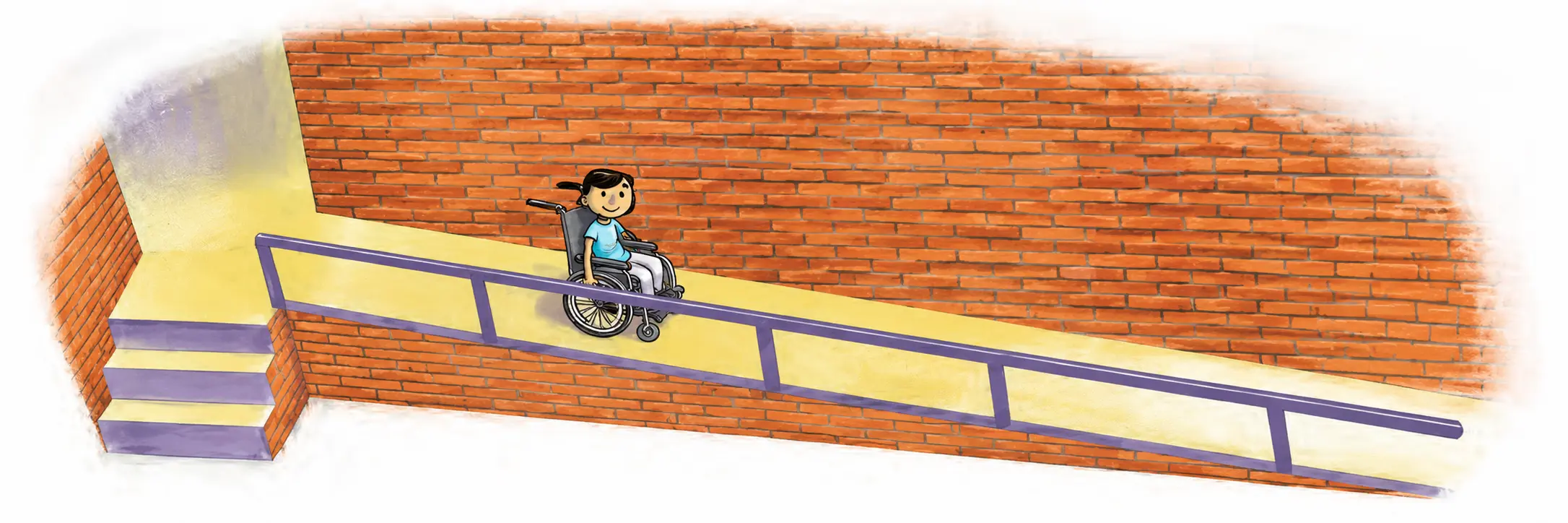
An accessibility ramp alongside a staircase.
Given
Vertical rise = 18 cmGuideline: 1 cm vertical rise for every 12 cm horizontal length.
To Find
The horizontal length of the ramp.Solution
Step 1: Write the given ratio.
Step 2: Let the horizontal length be x cm.
For a vertical rise of 18 cm, the slope is:Step 3: Cross-multiply and solve.
216 cm (or 2.16 m).
📚 Continue Learning
You have completed the Class 9 Maths Chapter 13 Exercise 13.3 Solutions. Revisit an earlier exercise or explore more chapters from Two Variables, One Line and the Ganita Manjari course.
CHAPTER 13 · TWO VARIABLES, ONE LINE
📖 Explore More Class 9 Maths Chapters
❓ Frequently Asked Questions
Find quick answers about Class 9 Maths Chapter 13 Exercise 13.3 Solutions from Ganita Manjari Part II (2026–27). These FAQs explain slope, steepness, graph interpretation, and real-life ramp problems for homework, revision, self-study, and CBSE examination preparation.
What is taught in Class 9 Maths Chapter 13 Exercise 13.3?
Exercise Set 13.3 of Chapter 13, Two Variables, One Line, focuses on slope and steepness. Students compare ski hills, calculate the slope of a ramp, find slopes from line diagrams, and apply slope to a practical wheelchair-ramp problem using the given rise and horizontal length.
What is the formula for slope in Class 9 Maths?
The slope is calculated by dividing the vertical change by the
horizontal change.
Slope = Vertical change ÷ Horizontal change
For example, if a ramp rises 2.5 metres over a horizontal run of
4 metres, then
Slope = 2.5 ÷ 4 = 0.625
The slope is 0.625. Always use the vertical rise and horizontal run,
not the length of the sloping surface.
How do you compare the steepness of two ski hills?
Calculate the slope of each hill using its vertical rise and
horizontal run. Compare the resulting values.
A hill with a larger positive slope is steeper than a hill with
a smaller positive slope. For example, if two hills rise the same
height, the one with the shorter horizontal run has the greater slope.
How do you find the slope of a line from a graph?
Choose two clearly marked points on the line. Find the vertical
change and the horizontal change between them, then divide the
vertical change by the horizontal change.
Slope = Change in y ÷ Change in x
For a line that rises from left to right, the slope is positive.
For a line that falls from left to right, the slope is negative.
A horizontal line has slope zero, while a vertical line has
no defined slope.
What is the slope of a horizontal line?
A horizontal line has no vertical change between any two distinct
points on it. Therefore,
Slope = 0 ÷ Horizontal change = 0
The slope of every horizontal line is zero.
Can a vertical line have a slope?
A vertical line has zero horizontal change. Since slope requires
division by the horizontal change, its slope is undefined.
Vertical line: Slope is undefined.
How do you solve a wheelchair-ramp slope problem?
Use the given vertical rise and horizontal length. In Exercise 13.3,
the accessibility-ramp guideline is a vertical rise of 1 cm for
every 12 cm of horizontal length.
If the total height is 18 cm, then
Horizontal length = 18 × 12 = 216 cm
Therefore, the required horizontal length is
216 cm, or 2.16 metres.
What does a negative slope mean on a graph?
A negative slope means the line falls from left to right. As the x-coordinate increases, the y-coordinate decreases. The slope is negative because the vertical change and horizontal change have opposite signs.
Why is slope important in real-life situations?
Slope describes how steep a surface or line is. It is useful for understanding roads, ski hills, loading ramps, wheelchair ramps, and other situations involving vertical rise and horizontal distance. A larger positive slope represents a steeper upward incline.
Are these Class 9 Maths Chapter 13 Exercise 13.3 Solutions based on Ganita Manjari Part II 2026–27?
These Class 9 Maths Chapter 13 Exercise 13.3 Solutions are prepared for Exercise Set 13.3 of Ganita Manjari Part II (2026–27), Chapter 13, Two Variables, One Line. The explanations cover slope calculations, steepness comparisons, graph-based questions, and practical ramp applications in a student-friendly format.